The following is the text of a speech given by Keith Bennett to a recent public meeting on the theme of ‘The Importance of Solidarity with the DPRK and its People in Today’s Global Situation’.
Keith concentrates his remarks on two aspects of this question. First, the recent developments in the comradely relations between the Democratic People’s Republic of Korea and the People’s Republic of China, which Kim Jong Un stresses have socialism as their core, as illustrated by Chinese leader Xi Jinping’s state visit to the DPRK in June 2026 and subsequently by Kim Jong Un’s greetings on the 105th anniversary of the founding of the Communist Party of China.
Second, Keith analyses a 1968 article written by DPRK founding leader Kim Il Sung marking the first anniversary of the death of Che Guevara, noting in particular its continuing relevance to understanding the vital need to defend the Cuban revolution and its relationship to the situation in Latin America as a whole.
The meeting was held on July 4, in hybrid format at London’s John Buckle Centre and online. Organised by the Co-ordinating Committee of Friends of Korea in Britain, as one of an occasional series, it was chaired by Andy Brooks of the New Communist Party (NCP) of Britain, and other speakers were Kim Song Gi, then Chargé d’Affaires and Minister of the DPRK Embassy in London, Michael Chant of the Revolutionary Communist Party of Britain (Marxist-Leninist) (RCPBML), and Dermot Hudson of the Korean Friendship Association (UK KFA), followed by discussion and Q&A.
Given the events in the world at present, with changes unseen in a century unfolding at an accelerating pace, it is surely both necessary and appropriate to address the importance of solidarity with the DPRK and its people in this situation.
This in turn cannot be separated from the role played by the DPRK in the world. Not simply how the world situation impacts upon the DPRK but at least as importantly how the DPRK, its stands and its internal and external activities, impact upon the world situation.
The DPRK is not a bystander, observer or victim of events in today’s world. From its quantitative and qualitative development of its independent, self-defensive nuclear deterrent to its principled support for the special military operation of the Russian Federation, the DPRK is a conscious maker of history, playing a role far greater than its small geographical size or population would reasonably suggest.
For my own remarks, I want to touch on two aspects of the importance of the DPRK’s stand, role and history as a socialist country in today’s international situation and the relationship of this to the anti-imperialist struggle that unites the overwhelming majority of humanity, irrespective of ideology, system, political view or religious belief, but in which the insights provided by scientific socialism are indispensable for the achievement of final victory.
The last time we organised an event such as this by Friends of Korea, in November 2025 – and how quickly the time passes – I had recently returned from the magnificent celebrations of the 80th anniversary of the founding of the Workers’ Party of Korea in Pyongyang and we were able to discuss the high-level participation there from China, Vietnam, Laos and Russia, as well as from progressive Latin America.
Earlier this week, Kim Jong Un, the General Secretary of the Workers’ Party of Korea and President of the State Affairs of the DPRK, wrote to his Chinese counterpart Xi Jinping, congratulating him on the 105th anniversary of the founding of the Communist Party of China.
Kim Jong Un wrote: “It is the steadfast stand of our Party and government to steadily develop the DPRK-China friendly relations with long and historical roots and with socialism as their core.
“The recent Pyongyang summit was a historic occasion of deepening the comradely friendship and trust between us and reconfirming the unshakable will to more dynamically promote socialist construction in the two countries and their traditional friendly relations.”
The concept of these relations having socialism as their core is one that Kim Jong Un has repeatedly stressed over recent years and he goes on to refer to socialism as “the common cause of the two parties” and the DPRK-China friendly and cooperative relations, as “the common wealth of the peoples of the two countries”.
The reference to the “recent Pyongyang summit” refers to the visit last month by Xi Jinping, his first in seven years and his first foreign trip in 2026.
For his part, writing in Rodong Sinmun, the central organ of the Workers’ Party of Korea, on the day he arrived in Pyongyang, Xi Jinping observed:
“The shared socialist ideal is the defining character of China-DPRK relations. The Communist Party of China and the Workers’ Party of Korea are both Marxist ruling parties, and China and the DPRK are fellow travellers on the socialist road.”
Putting this into its historical context, he notes:
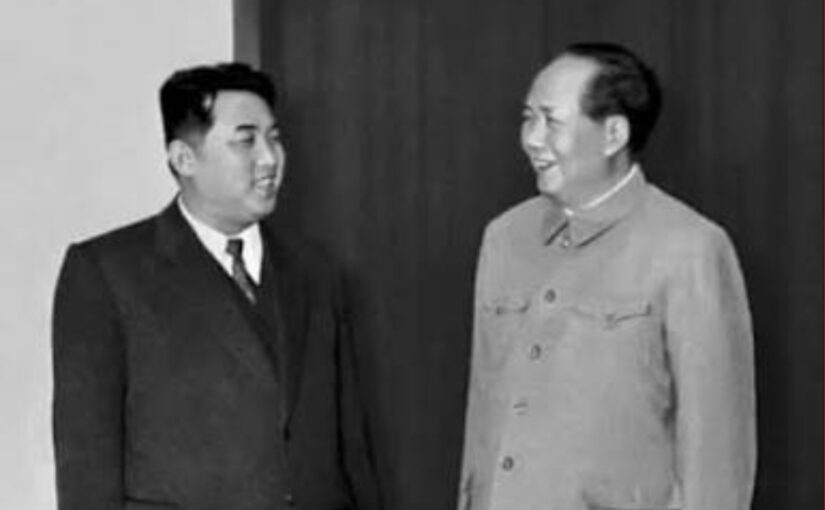
“The older generation of leaders of China and the DPRK knew one another intimately and were as close as can be… The traditional friendship of shared destiny is the deep foundation of China-DPRK relations. In the turbulent years of fighting for national independence and national liberation, the people of China and the DPRK shared weal and woe, depended on each other in life and death, and forged a great fighting friendship with their blood. In the development of each country’s socialist cause, the two peoples have stood shoulder to shoulder, sharing comforts and hardships, vividly embodying the comradely friendship of mutual trust, solidarity, and mutual aid.”
Looking to the future, he adds: “We must hold firm to the path and be unchanged in our resolve, support each other in walking the socialist road that suits our own national conditions, and firmly safeguard the political security of both countries. We must uphold and strengthen the Party’s overall leadership, expand exchanges and cooperation between the two parties, deepen the exchange and mutual learning of experience in governing the party and the country, and lead the socialist cause of the two countries to keep moving from one victory to the next.”
In its own editorial that day, June 8, 2026, Rodong Sinmun wrote:
“The DPRK-China relations are the invincible friendly relations closely united with comradely friendship and bloody ties in the protracted struggle to oppose foreign aggressors and build socialism.
“True to the intention of the great leader Comrade Kim Il Sung, the Korean revolutionaries helped the Chinese revolution with blood in the arduous anti-Japanese struggle. The Chinese people, too, regarded the Korean revolutionaries fighting for the national liberation as their own flesh and blood and rendered material and moral assistance to the Korean people in their struggle.
“The brilliant victories won by the Chinese people in the arduous revolutionary civil war and by the Korean people in the fierce Fatherland Liberation War would have been unthinkable without the fraternal friendship and class ties which have been steadily carried forward and consolidated between the revolutionaries, service personnel and peoples of the two countries.”
And it concludes: “We will, in the future, too, join hands with the Chinese comrades on the road of advancing the socialist cause and defending peace and security in the region and the rest of the world.”
The Korean Central News Agency, reporting on the talks between the two leaders that day, quotes Comrade Kim Jong Un as affirming that, “the WPK and the DPRK government will as ever maintain the DPRK-China friendship as the most important top-priority strategic work and do their utmost to strengthen the bilateral relations into a model of the relationship between socialist states and into an invariably special, genuine and solid strategic relationship and that this is our immutable choice and will.”
As can be seen above, the comradely relationship with socialism as the core has a long tradition created by the previous generations of leaders. And it is in that spirit, as well as for many other reasons, that today we also especially remember Comrade Kim Il Sung, as we approach the anniversary of his passing on July 8, 1994. It scarcely seems possible that already 32 years have gone by.
Not only did he fight all his days to safeguard and consolidate the unity and solidarity of the socialist countries on the basis of revolutionary principles, he analysed the relationship between the internal and external tasks of the revolution, the role of the socialist countries in the struggle against imperialism, the difficulties arising, and how to deal with them and overcome them, with remarkable insight and extraordinary prescience.
Today, for all those who stand against imperialism and in favour of socialism, there can be few things of greater importance than the defence of the Cuban revolution, with the Trump administration, like its tool the Zionist Entity in Gaza, the West Bank and elsewhere, perpetrating genocidal acts of aggression, in the case of Cuba in the form of a siege that plumbs the depths of medievalism and recalls the nazi siege of Leningrad during the Great Patriotic War.
This year has also seen the 95th birth anniversary of Army General Raul Castro, the 98th birthday of Ernesto Che Guevara and next month will see the 100th anniversary of the birth of Comrade Fidel Castro.
In 1968, Kim Il Sung wrote a profound and far-seeing article on the first anniversary of the death in combat of Che Guevara. It is an article that has lost none of its relevance and importance with the passage of years.
Assessing the world historic importance of the Cuban revolution, he writes: “The triumph of the Cuban Revolution is the first victory of the socialist revolution in Latin America and a continuation of the Great October Revolution in Latin America. With the Cuban Revolution emerging victorious, the red banner of socialism now flies high over Latin America which was regarded as a hereditary estate of US imperialism only until recently, and the socialist camp has extended to the Western Hemisphere and grown in strength a great deal.”
The significance of this is therefore that the “consolidation of the triumph of the Cuban Revolution is not only an important problem which decides the life and death, the rise and fall of the Cuban people but also a key problem which sways the destinies of the general development of the Latin American revolution.”
He goes on to state that: “The countries whose proletariat has grasped power in the encirclement of international capitalism are not free from the danger of imperialist aggression and restoration of capitalism during the entire historical period of revolutionary transition from capitalism to socialism. The overthrown exploiting classes always attempt to recover their lost positions and foreign imperialists incessantly engage in armed invasion and intrigues and manoeuvres for political and ideological subversion.
“The US imperialists and the reactionaries of Latin America deeply hate and fear the very existence of the Republic of Cuba and are manoeuvring stubbornly and maliciously to stifle it. They are working hard to get rid of the Cuban Revolution so as to drive out the ‘spectre’ of Communism haunting the Western Hemisphere and check the liberation struggle of the peoples which envelops Latin America like a prairie fire. While scheming to strangle Cuba by directly mobilising their armed forces, the US imperialists are instigating the reactionary Latin American regimes of dictatorship under their domination and subjugation to bring political and economic pressure to bear upon Cuba in order to suffocate her with the policy of blockade.”
Far from losing any of its relevance, does this not describe the situation in 2026 with even greater poignancy and accuracy than it does that of 1968.
Kim Il Sung goes on to explain that, “revolutions should take place consecutively in the majority of countries of the world, in several adjacent countries at the least, to replace imperialist encirclement with socialist encirclement, the barriers of imperialism that surround a socialist country should be torn down to open the path of turning the dictatorship of the proletariat into a world-wide system and an end should be put to the isolation of the socialist fortress of one country… Only then will it be possible to prevent completely armed intervention by the imperialists and their attempt to restore capitalism and say that the ultimate victory of socialism has been secured.”
The reference to “several adjacent countries at the least” highlights an important difference between the situation facing Cuba and that of the socialist countries in East Asia, whose main historical experience, sometimes difficult countervailing periods notwithstanding, has been characterised by strong and sometimes decisive mutual support and solidarity.
In Kim Il Sung’s view: “The Cuban Revolution is an organic part of the world revolution and, particularly, constitutes the decisive link in the chain of the revolution in Latin America. To defend the Cuban Revolution and to consolidate and follow up its victories is not only the duty of the Cuban people but also the internationalist obligation of the oppressed peoples of Latin America and all the revolutionary peoples of the world. Just as the defence of the gains of the October Revolution in Russia which made the first breach in the world capitalist system was an important question decisive of the fate of the development of the world revolution, so the defence of the gains of the Cuban Revolution which made the first breach in the colonial system of US imperialism in Latin America is an important question decisive of the fate of the Latin American revolution.”
How true this is. For more than six decades, socialist Cuba has been the beacon of hope of the Latin American people. If it were to fall, not only would the Cuban people be plunged into an abyss of suffering, misery and humiliation; the people’s struggle throughout Latin America would suffer its greatest ever setback.
That is why Kim Il Sung explained: “It is of great importance for the defence of the Cuban Revolution to advance the revolutionary movement in those Latin American countries neighbouring on Cuba… if the revolution emerges victorious in some other Latin American countries, Cuba will get out of the encircling ring of imperialism with which she is confronted on all sides, there will be opened up a favourable phase in the revolutions of Cuba and Latin America, and the world revolution will be stepped up still more.”
This is in fact a huge part of the importance of the Bolivarian revolution in Venezuela, as well as the Sandinista revolution in Nicaragua, led by Hugo Chavez and, after his untimely death, by Nicolas Maduro. The success of the revolution in Venezuela, the first new, conscious attempt to build and consolidate socialism in a systematic and all-round way since the counter-revolutions in the former Soviet Union and the European socialist countries, not only transformed the lives of the Venezuelan people, it began that crucial process identified by Kim Il Sung of replacing imperialist encirclement with socialist encirclement, of putting an end to the isolation of the socialist fortress of one country, of consolidating and following up the victories of the Cuban revolution as the important question decisive of the fate of the Latin American revolution.
That is why every step taken by US imperialism in the Latin American region, particularly since the coming to power of the Trump-Rubio regime – from the overt support and encouragement of the most reactionary forces of Milei in Argentina and Bolsonaro in Brazil, the destabilisation and overthrow of the socialist-oriented government in Bolivia, the lawfare coup in Peru, the threats against Mexico, and so on, and above all the outrageous kidnapping of President Nicolas Maduro and First Combatant Cilia Flores, and the attempt to turn their proud revolutionary country into a US protectorate, have at their heart US imperialism’s overriding goal of toppling the Cuban revolution – of finally extirpating that spectre which has haunted them since 1959. The stakes could scarcely be higher.
Kim Il Sung wrote, in words that were unmistakably echoed by Kim Jong Un in his speeches to the ninth party congress and the session of the Supreme People’s Assembly earlier this year, that:
“If there ever is imperialism which is not aggressive, it is no longer imperialism. Imperialism will not change its aggressive nature before it dies. That is why one should dispel all illusions about imperialism and fight it out. Only when a principled stand is maintained against imperialism and a staunch anti-imperialist struggle intensified, can the oppressed nations win freedom and independence and the liberated peoples check imperialist aggression, consolidate national independence and achieve prosperity for their countries and nations.”
This is the legacy and lesson that Kim Il Sung left us. This is the stand taken by the DPRK that enables it to stand firm in the face of all pressures, aggression and threats. This is why it is important to stand by the DPRK, to introduce, explain and defend its stand and to learn from its experience and that of all the socialist countries in whatever we are able to do in the cause of anti-imperialism, independence and socialism.