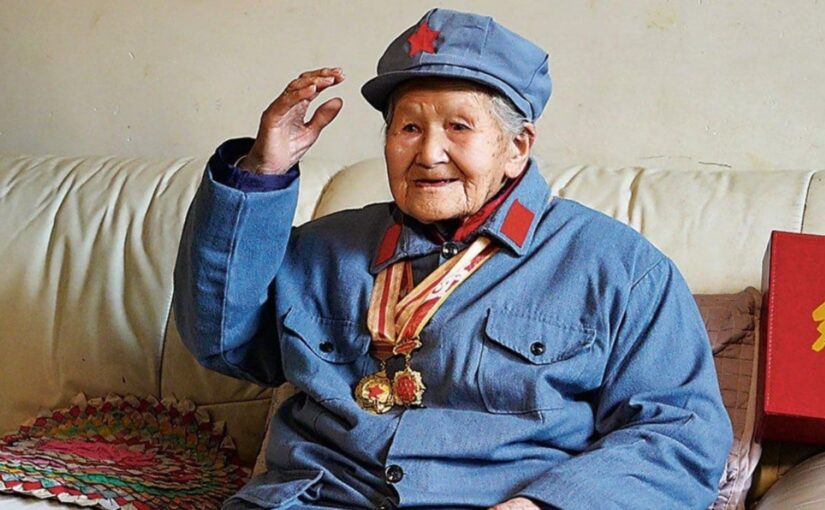
Wang Quanying, who has died at the age of 105, was the last surviving woman to have taken part in the Long March – the epic fighting retreat of 1934–36 that saved the Chinese Red Army and laid the deepest foundations of modern China.
Born Wang Guixiang in 1921 – the very same year the Communist Party of China was founded – into a poor Tibetan family in Jinchuan county, Sichuan, she was orphaned as an infant and sent to labour for a local landlord. In 1935, aged just fourteen, she joined the Fourth Front Army’s Women’s Independent Regiment, serving as a battlefield medical orderly: guiding troops, carrying grain, cooking, and nursing the wounded with the herbal remedies she knew.
Separated from her unit in fierce fighting near Danba in 1936, she crossed the snow-capped mountains on foot, surviving on wild plants and losing a toe to frostbite, before settling anonymously in Wenchuan county, where she lived quietly for decades. Her service was only officially recognised in the 1980s.
After the founding of the People’s Republic she changed her name to Quanying, to express her conviction that “all Red Army soldiers across the nation are heroes”. She died just months before the 90th anniversary of the victory of the Long March, which falls later this year.
This article first appeared in China Daily.
Wang Quanying, the country’s last surviving female Red Army soldier who took part in the legendary Long March, died peacefully in her sleep at 12:30 am on Wednesday at her home in Dujiangyan, Sichuan province. She was 105.
Multiple Chinese media outlets confirmed her death.
According to her family, Wang died without suffering, surrounded by her daughters and grandchildren. She had remained in generally good health after turning 105 earlier this month. However, she developed lung inflammation, progressive muscle atrophy, shortness of breath and difficulty expectorating in early July and was hospitalized on July 18. Her physical functions gradually declined until her passing.
Born in 1921 into a poor Tibetan family in Jinchuan county, Aba Tibetan and Qiang autonomous prefecture, Sichuan province, Wang endured a difficult childhood. She lost her parents at the age of 1 and was raised by her uncle until she was 5. She then worked as a child laborer for a local landlord, doing heavy farm and household work.
At the age of 14, she was deeply inspired by the disciplined and people-oriented conduct of Red Army soldiers after they arrived in Jinchuan in 1935. She volunteered to join the troops, undertaking logistical and medical duties, including guiding marches, cooking, transporting grain and caring for wounded soldiers during the Long March.
In March 1936, Wang became separated from the main force during fierce battles against Kuomintang troops in Danba county. Stranded with injured comrades, she tried to rejoin the troops by crossing snowcapped mountains barefoot and surviving on wild plants in freezing temperatures.
The ordeal left one toe on her left foot severely frostbitten, leading to its eventual amputation, causing her pain on rainy days for the rest of her life.
After wandering for more than a month, she settled anonymously in Wenchuan county in May 1936. For decades, she never spoke publicly about her experiences during the Long March. She married local resident Liu Fuguang and gave birth to five children, though only two daughters survived the harsh living conditions of the time.
Following the founding of the People’s Republic of China, she changed her given name from Guixiang to Quanying, expressing her belief that “all Red Army soldiers across the nation are heroes”. She was officially recognized as a Red Army veteran during a provincial verification campaign in the 1980s.
Even in her later years, Wang remained committed to preserving and promoting the spirit of the Long March. Until May this year, she continued weaving handcrafted futon cushions and donating them to local schools and red education bases.
Not long ago, officers and soldiers from a company of the PLA Ground Force visited Wang at her home, according to China Central Television. The centenarian changed into a Red Army uniform to greet them.
She admired one soldier’s military cap and asked with a smile, “May I put it on? Does it suit me?”
“You look wonderful!” the soldiers replied.
When they unfolded the company flag, Wang’s eyes filled with tears. She gently stroked the fabric as though reliving the turbulent years of war. She then slowly raised her hand and offered a solemn military salute to the flag.
Liu Guihua, Wang’s eldest daughter, paid tribute to her mother on WeChat Moments, writing: “A heroic female soldier who crossed snowcapped mountains during the Long March; she concealed her achievements and remained true to her original aspiration throughout her life.”
According to her family, Wang’s only regret would have been that she did not live to see the 90th anniversary of the victory of the Long March, which falls later this year. In accordance with her final wish, her remains will be buried in Wenchuan county, where she settled decades ago.