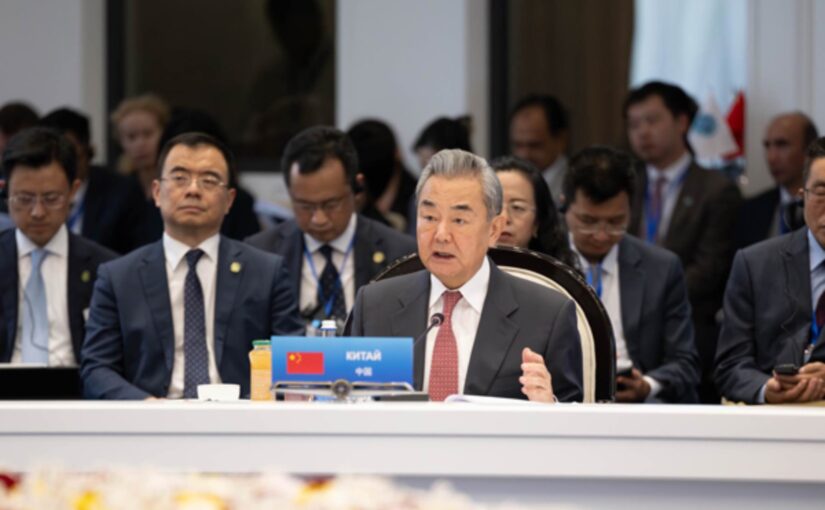
Chinese Foreign Minister Wang Yi attended the Meeting of the Council of the Ministers of Foreign Affairs of the Shanghai Cooperation Organisation (SCO) Member States, held in Cholpon-Ata, Kyrgyzstan on July 24.
Addressing the meeting, Wang Yi stated that the SCO Tianjin Summit, held in August-September 2025, mapped out a strategic blueprint for the organisation’s development over the next decade and opened a new stage of high-quality development. Seven cooperation platforms in green industry, digital economy, scientific and technological innovation, energy, higher education, vocational and technical education, and artificial intelligence have been launched, generating more than 160 projects. Nearly three-quarters of the planned 10 GW solar PV and wind power projects have been implemented, while over two-thirds of the 100 ‘small and beautiful’ livelihood programs have been approved.
Wang Yi noted that this year marks the 25th anniversary of the SCO. From the early days when six countries enhanced military trust in border areas and combated terrorism, separatism and extremism, to the present when 27 countries, representing nearly half of the world’s population, are engaged in cooperation across more than 50 fields, the SCO has consistently upheld the ‘Shanghai Spirit’ of mutual trust, mutual benefit, equality, consultation, respect for diversity of civilisations, and pursuit of common development, continuously expanding the path of a new type of international relations and multilateral cooperation. Currently, profound changes unseen in a century are accelerating, and the world is experiencing tremendous turbulence and transformation. The international community expects the SCO to promote regional security and development and to resolve global governance challenges. The development strategy for the next decade makes clear that member states will deepen cooperation and make greater contributions to building a more democratic and just multipolar world.
Wang Yi put forward four proposals:
The SCO should continue to uphold the ‘Shanghai Spirit’ as its fundamental guiding principle in handling internal affairs and conducting external exchanges, strengthen strategic mutual trust, maintain solidarity and coordination, firmly support one another, and remain open and inclusive.
The SCO should strengthen the firewall for peace and stability by consistently advocating dialogue to settle disputes, consultation to resolve differences and cooperation to safeguard peace.
The SCO should inject stronger momentum into win-win development by strengthening synergy between national development strategies and regional cooperation initiatives.
The SCO should build a model zone for global governance by safeguarding the authority and role of the United Nations, upholding the purposes and principles of the UN Charter and the basic norms governing international relations, and working together with nearly 160 participants in the Global Governance Initiative and over 120 UN member states who support deeper cooperation with the SCO to explore an effective global governance model with broad participation. The SCO should also improve its own operational mechanisms and welcome more countries to join the organisation.
The SCO foreign ministers adopted a joint statement, in which they reaffirmed their commitment to multilateral cooperation, regional security and a more representative and inclusive multipolar world.
The member states reiterated the SCO’s commitment to the principles of not targeting other states and organisations, mutual respect for sovereignty, independence and territorial integrity, non-interference in internal affairs, and non-use of force or threats of using force in international relations.
The statement said the world today is entering a new period of rapid development and profound transformation. The role of Global South countries continues to grow, emerging economic and political centres are playing an increasingly prominent role, countries are becoming increasingly intertwined and interconnected, and the process of informatisation and digitalisation is constantly accelerating.
Amid rising global and regional security threats, the ministers expressed deep concern over the developments in the Middle East and around Iran. They reaffirmed the principled position regarding the condemnation of military strikes against Iran as outlined in the Tianjin Declaration adopted at the 25th Meeting of the Council of Heads of State of the SCO on September 1, 2025, holding that such acts of aggression constitute a grave violation of the UN Charter and the principles and norms of international law.
The ministers once again expressed their sincere condolences over the tragic death of Iran’s Supreme Leader Ayatollah Ali Khamenei and extended their sympathies to the Iranian government and people as well as his family.
Meanwhile, the council reaffirmed that Central Asia is the core region of the SCO, supports the efforts of Central Asian countries to maintain peace and security in their own countries and the region, and advocates that the SCO play an active role in further consolidating stability and promoting economic and social development there.
The member states regarded unilateral coercive measures, including economic sanctions, that violate the UN Charter and other norms of international law as unacceptable, saying such measures impede international cooperation and the achievement of the UN Sustainable Development Goals.
The member states also advocated further expanding mutual trade among SCO countries to create more opportunities for businesses.
The next SCO Summit, marking its 25th anniversary, will be held in the Kyrgyz capital Bishkek from August 31-September 1.
The following articles were originally published on the website of the Chinese Foreign Ministry and by the Xinhua News Agency.
Wang Yi Attends the Meeting of the Council of the Ministers of Foreign Affairs of the Shanghai Cooperation Organization Member States
July 24 (MFA) – On July 24, Member of the Political Bureau of the CPC Central Committee and Foreign Minister Wang Yi attended the Meeting of the Council of the Ministers of Foreign Affairs of the Shanghai Cooperation Organization (SCO) Member States in Kyrgyzstan. Foreign ministers of SCO member states, the SCO Secretary General, and the Director of the Executive Committee of the SCO Regional Anti-Terrorist Structure also attended the meeting.
Wang Yi stated that the SCO Tianjin Summit mapped out a strategic blueprint for the organization’s development over the next decade and opened a new stage of high-quality development. Over the past year, China has implemented the major initiatives proposed by President Xi Jinping and contributed to regional development through concrete actions. Seven cooperation platforms in green industry, digital economy, scientific and technological innovation, energy, higher education, vocational and technical education, and artificial intelligence have been launched, generating more than 160 projects. The action plan for high-quality development of economic and trade cooperation has been steadily implemented, with trade between China and other SCO member states continuing to grow. Nearly three-quarters of the planned 10 GW solar PV and wind power projects have been implemented, while over two-thirds of the 100 small and beautiful livelihood programs have been approved.
Wang Yi noted that this year marks the 25th anniversary of the SCO. From the early days when six countries enhanced military trust in border areas and combated terrorism, separatism and extremism, to the present when 27 countries, representing nearly half of the world’s population, are engaged in cooperation across more than 50 fields, the SCO has consistently upheld the “Shanghai Spirit” of mutual trust, mutual benefit, equality, consultation, respect for diversity of civilizations, and pursuit of common development, continuously expanding the path of a new type of international relations and multilateral cooperation. Currently, profound changes unseen in a century are accelerating, and the world is experiencing tremendous turbulence and transformation. The international community expects the SCO to promote regional security and development and to resolve global governance challenges. The development strategy for the next decade makes clear that member states will deepen cooperation and make greater contributions to building a more democratic and just multipolar world.
Wang Yi put forward four proposals:
First, the SCO should continue to uphold the “Shanghai Spirit” as its fundamental guiding principle in handling internal affairs and conducting external exchanges, strengthen strategic mutual trust, maintain solidarity and coordination, firmly support one another, and remain open and inclusive, so as to illuminate the way toward building a community with a shared future for humanity.
Second, the SCO should strengthen the firewall for peace and stability by consistently advocating dialogue to settle disputes, consultation to resolve differences and cooperation to safeguard peace, while properly addressing regional and international hotspot issues. It should accelerate the establishment of the “four security centers” to enhance the region’s capacity to respond to security risks and challenges.
Third, the SCO should inject stronger momentum into win-win development by strengthening synergy between national development strategies and regional cooperation initiatives, pursuing high-quality Belt and Road cooperation, fostering new growth drivers in trade and investment, connectivity, scientific and technological innovation, green industry, digital economy and artificial intelligence, and jointly safeguarding industrial and supply chains to deliver more development outcomes.
Fourth, the SCO should build a model zone for global governance by safeguarding the authority and role of the United Nations, upholding the purposes and principles of the UN Charter and the basic norms governing international relations, and working together with nearly 160 participants in the Global Governance Initiative and over 120 UN member states who support deeper cooperation with the SCO to explore an effective global governance model with broad participation. The SCO should also improve its own operational mechanisms and welcome more countries to join the organization.
Wang Yi noted that this year marks the 105th anniversary of the founding of the CPC and the first year of China’s 15th Five-Year Plan period. Under the leadership of the CPC, China will always remain a builder of world peace, a contributor to global development and a defender of the international order. The SCO has always been a priority in China’s neighborhood diplomacy. China stands ready to work with other member states to carry forward the “Shanghai Spirit” in the new phase of high-quality development for the SCO, strengthen the SCO, and jointly create a brighter future for both the region and the world.
Participants highly commended Kyrgyzstan’s work as the rotating chair and spoke highly of the SCO’s achievements over the past 25 years. They agreed that the SCO has become the world’s largest regional organization in terms of geographical coverage, population and prestige, as well as an important pillar of the multipolar world, making significant contributions to regional and global peace, stability and development. Facing an increasingly volatile international situation, they stressed the need to uphold the purposes and principles of the UN Charter, further carry forward the “Shanghai Spirit”, enhance strategic mutual trust, safeguard respective national sovereignty and territorial integrity, combat terrorism, separatism and extremism, as well as transnational organized crime, expand practical cooperation in fields including energy, connectivity and the digital economy, promote dialogue among civilizations, and resolve hotspot issues through dialogue and negotiation. They also called for improving the SCO’s working mechanisms to enable the organization to make decisions more efficiently and pragmatically, amplify the SCO’s voice, and actively respond to global challenges.
The meeting adopted the Statement of the Council of the Ministers of Foreign Affairs of SCO Member States and signed relevant resolutions on preparations for the Bishkek Summit of the SCO.
On the sidelines of the meeting, Wang Yi also held bilateral meetings with the foreign ministers of Russia, Belarus, Uzbekistan, Tajikistan, Iran, and Pakistan, respectively.
SCO FMs issue statement on cooperation, regional security
CHOLPON-ATA, Kyrgyzstan, July 25 (Xinhua) — Foreign ministers of the Shanghai Cooperation Organization (SCO) issued a joint statement on Friday, reaffirming their commitment to multilateral cooperation, regional security and a more representative and inclusive multipolar world.
At the Meeting of the Council of the Ministers of Foreign Affairs of the SCO Member States held in Cholpon-Ata, Kyrgyzstan, the ministers discussed deepening cooperation in the political, security, economic and people-to-people and cultural fields, as well as current international and regional hot issues.
The member states reaffirmed the SCO’s commitment to the principles of not targeting other states and organizations, mutual respect for sovereignty, independence and territorial integrity, non-interference in internal affairs, and non-use of force or threats of using force in international relations.
The statement noted that this year all SCO work has centered on the 25th anniversary of the organization’s founding. Over the past years of development, the SCO has grown into an influential and dynamic multilateral mechanism that has successfully built the region into a home of lasting peace and harmonious coexistence. The member states have abided by the purposes and principles of the SCO Charter, carried out mutually beneficial multilateral cooperation on an equal footing, and safeguarded the common interests and independent development paths of all countries.
The statement said the world today is entering a new period of rapid development and profound transformation. The role of Global South countries continues to grow, emerging economic and political centers are playing an increasingly prominent role, countries are becoming increasingly intertwined and interconnected, and the process of informatization and digitalization is constantly accelerating.
Against this backdrop, the SCO member states reaffirmed their steadfast commitment to upholding the central coordinating role of the United Nations and building a more representative, inclusive, democratic and just multipolar world based on international law, multilateralism, peace and security, respect for cultural and civilizational diversity, as well as mutually beneficial cooperation among states.
Amid rising global and regional security threats, the ministers expressed deep concern over the developments in the Middle East and around Iran. They reaffirmed the principled position regarding the condemnation of military strikes against Iran as outlined in the Tianjin Declaration adopted at the 25th Meeting of the Council of Heads of State of the SCO on Sept. 1, 2025, holding that such acts of aggression constitute a grave violation of the UN Charter and the principles and norms of international law.
The ministers once again expressed their sincere condolences over the tragic death of Iran’s Supreme Leader Ayatollah Ali Khamenei, and extended their sympathies to the Iranian government and people as well as his family.
The statement said the member states firmly advocated abiding by the UN Charter and the norms of international law, and resolving international conflicts through political and diplomatic means. In this context, the SCO welcomes all efforts aimed at de-escalating the situation in Iran and the region.
Meanwhile, the council reaffirms that Central Asia is the core region of the SCO, supports the efforts of Central Asian countries to maintain peace and security in their own countries and the region, and advocates that the SCO play an active role in further consolidating stability and promoting economic and social development in the region.
The statement emphasized the need to further strengthen joint actions against terrorism, separatism, extremism, drug trafficking and transnational organized crime.
The member states strongly condemned terrorism in all its forms and manifestations, firmly opposed double standards in counter-terrorism, and called on the international community to uphold the central coordinating role of the United Nations and jointly combat terrorist acts, including the cross-border movement of terrorists.
The statement said the member states advocated building an open, fair, inclusive, equal and non-discriminatory digital development environment while respecting the technological sovereignty of all countries.
The member states considered it unacceptable for any country to pursue its own security at the expense of the security of others.
They also emphasized the need to continue improving and reforming the global economic governance system and to uphold an open, transparent, fair, inclusive, equal and non-discriminatory multilateral trading system.
The member states regarded unilateral coercive measures, including economic sanctions, that violate the UN Charter and other norms of international law as unacceptable, saying such measures impede international cooperation and the achievement of the UN Sustainable Development Goals.
The member states also advocated further expanding mutual trade among SCO countries to create more opportunities for businesses.
The statement emphasized that strengthening friendship and mutual understanding among peoples remains a defining feature of the SCO. It said that respect for cultural and civilizational diversity, historical traditions and national conditions of member states provides a solid foundation for constructive dialogue and mutually beneficial cooperation among countries, and contributes to safeguarding international peace and security and promoting sustainable development.






One thought on “Wang Yi attends meeting of Shanghai Cooperation Organisation foreign ministers”