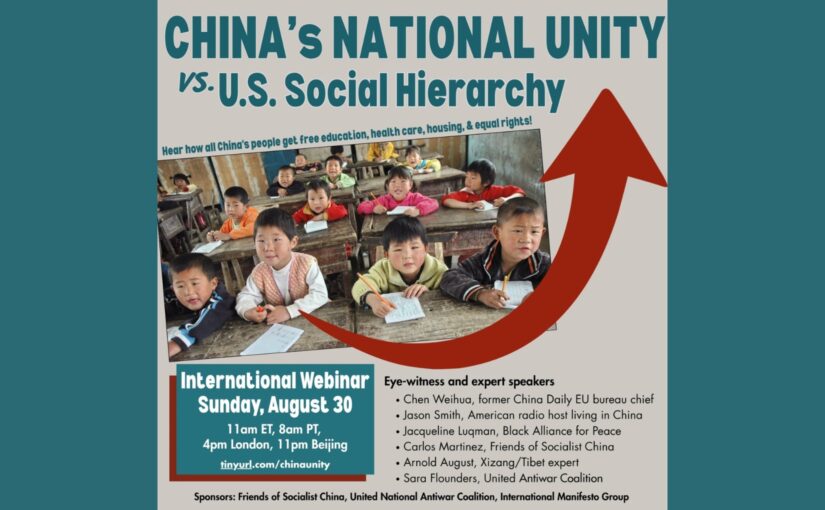
The following report from Workers World covers the webinar “China’s National Unity vs. U.S. Social Hierarchy”, held on August 30 and organised by the United National Antiwar Coalition (UNAC), which examined the significance of China’s new Ethnic Unity and Progress Promotion Law.
Chaired by Sara Flounders of UNAC, the panel brought together Friends of Socialist China co-editor Carlos Martinez, China Daily columnist Chen Weihua, China-based broadcaster Jason Smith, Jacqueline Luqman of the Black Alliance for Peace, and the Canadian writer Arnold August.
The speakers set out what the law actually says – that it prohibits discrimination against any ethnic group, reaffirms the right of all peoples to use and develop their own languages, and obliges the state to direct infrastructure, industry and public services towards minority regions – and contrasted this with the record of forced assimilation in the West. Several drew on first-hand visits to Xizang (Tibet) and Xinjiang, where, as Chen Weihua observes, the Tibetan language is not simply being preserved but is proliferating.
This article first appeared in Workers World.
A powerful webinar headlined “China’s National Unity vs. U.S. Social Hierarchy” took place on Aug. 30 and examined the importance of China’s new ethnic unity law. China has 54 distinct nationalities, and the challenge for China, still a developing country, is how to provide full opportunity and respect for each one, including smaller, often historically marginalized nationalities.
Sara Flounders of the United National Antiwar Coalition chaired the webinar and introduced each speaker. The entire webinar, organized by UNAC, can be found online at youtube.com/watch?v=NQpY3UV0_zk and also on Workers World’s YouTube channel at youtu.be/k45Eyl9Y_40.
Challenging capitalist media distortions
Carlos Martinez, a founding member of Friends of Socialist China, outlined the progressive measures in China’s new ethnic unity law and exposed the lies and distortions in the Western media, which claims that China has ordered its minority peoples to assimilate.
Martinez said: “The law itself makes national unity and ethnic solidarity the responsibility of all Chinese citizens. It prohibits discrimination and suppression against any ethnic group. It explicitly reaffirms the right of all peoples to use and develop their own spoken and written languages. And it requires the government to strengthen infrastructure, industry, public services and environmental protections in minority regions so that no ethnic group is left behind in China’s modernization.”
He explained: “This continues a long-standing framework that in the West would be called affirmative action: preferential university admissions for minority students; bilingual education; protected minority-language broadcasting; autonomy arrangements; and substantial transfers of resources from the central government. China’s minority nationalities were also exempt from the one-child policy throughout its existence. … Strange foundations indeed for a program of forced assimilation.”
Martinez contrasted China’s socialist progress with crimes of “assimilation” in Western countries, such as in the U.S., where boarding schools for Indigenous youth had the slogan “Kill the Indian and save the man” — well into the 1970s.
China is working towards “unity in diversity: equal political status, protection for minority languages and cultures, preferential support for historically disadvantaged regions, and participation in a common national project,” he said.
Martinez’s talk can be found online at youtu.be/N_iPXg3lzXg.
China’s new law
Chen Weihua is a veteran Chinese journalist and columnist and deputy editor of China Daily who has lived in the U.S. and Europe for the past 16 years. He read “all the 65 articles of the new Ethnic Unity and Progress Promotion Law” and concluded, “Far from being a tool of suppression, the law promotes ethnic harmony and prosperity, with particular emphasis on protecting and promoting the culture and tradition of all ethnic groups.”
Chen said he doubted whether any Western politicians have read the law or even its summary, stating, “Critics have never visited China’s ethnic minority regions, [yet] they continue to make sweeping accusations about the lives, cultures and traditions of ethnic groups there.”
During his trip to Tibet (Xizang), Chen “witnessed that nearly all Tibetans speak their mother tongue. That certainly does not look like a language being erased.”
He interviewed several Tibetans, noting: “Every one of them laughed off those Western accusations. … A young man, Tenzing, said they simply don’t understand the reality on the ground. There are no restrictions on learning the Tibetan language or engaging in cultural and religious activities. Tenzing emphasized that the 56 ethnic groups in China are one family. That sense of shared identity is something Western politicians would never understand given their deep-rooted prejudice against China.”
Chen’s talk can be found online at youtu.be/3o-XjkEC9fU.
China’s ‘model of cultural preservation’
Jason Smith lives in China. He is a U.S.-born radio host of “The Bridge to China” radio show and podcast.
Smith said: “Far from erasing culture and language, China is a model of cultural preservation from which the West should be learning. “I have traveled to Tibetan regions of China for many years now [and visited] schools in many areas, including Xizang and Xinjiang.
“In 2023, I went to an elementary school in Tibet. … Besides [China’s] national language, Mandarin, which will allow them jobs and access to the best national universities, they are most certainly learning Tibetan … their minority language.
The Tibetan language is not merely being preserved. It’s proliferating. Its seed is finding new soil in the minds of students from all over China. Businesses, banks and even road signs are written in both Tibetan and Hanzi.”
Smith’s talk can be found online at youtu.be/JFLdgUWgVEg.
Diversity in China
Jacqueline Luqman is the chairperson of the coordinating committee for Black Alliance for Peace. She traveled to China in 2025 with Friends of Socialist China. She said: “What I noticed about all those cities was the diversity of the populations … most notably the unrestricted presence and movement of Muslims, who are supposed to be undergoing a genocide in Xinjiang. What we have been told in the U.S. about China are just racist, imperialist lies.
“By codifying equal rights and human dignity for every ethnic group, the law does not destroy culture; it strengthens the communal bonds of a nation that refuses to be defined by narrow, Western-centric ideals.”
Luqman continued: “China’s commitment to a united, diverse and whole-society prosperity plan is evident in the success of its housing program, which has been a significant factor in the country’s remarkable progress in alleviating poverty. China’s commitments to its people, human rights, social equality and peaceful coexistence with the rest of the world are very real, and the impact on China’s development is stunning.”
Luqman’s talk can be found online at youtu.be/B3SEyMG7HaA.
Role of Dalai Lama
Arnold August, a Canadian, is an expert on Xizang (Tibet) and the treatment of Tibetan culture by the Chinese. August focused on the role of the Dalai Lama and a group of separatists who left Tibet and are “in India at this time, playing a leading role to defame the new Chinese legislation and oppose the PRC [People’s Republic of China].”
The Dalai Lama is approaching his 90th birthday, so there is debate about the replacement or “reincarnation” of the Dalai Lama as a so-called spiritual head of Tibet.
August said that the PRC holds views in line with Tibetan Buddhist tradition. He said, “The India-based separatists and U.S. and Canadian allies are trying to maneuver the situation so that the Dalai Lama personally anoints a new Dalai Lama and that the new Dalai Lama must be living outside of Tibet. … ”
“In conclusion, the internal Buddhist affairs must be handled according to Buddhist principles of morality rather than personal wishes, and this in coordination with the central government, an orientation that is a foundation of China’s new law,” he stated.
August’s talk can be found online at youtu.be/PmCYyFCqzek.
Reasons for hostile propaganda
Flounders gave a number of reasons why the U.S. corporate media relentlessly promotes hostile propaganda against China. She visited China in 2019 and 2023, including a visit to Xinjiang, which she said was “a proud, multinational culture of more than 40 ethnic groups with developing oil and mineral reserves, a major logistics center and gateway to Central and West Asia.”
Flounders explained: “China’s astounding development threatens U.S. global dominance. This is intolerable to the U.S. capitalist class. U.S. accusations that China is oppressing Muslims — no Muslim country has ever backed up the charges of genocide in Xinjiang. They are using their propaganda war to justify a sanctions war, a trade war and a ‘chip war.’
“China, with nationalized wealth and socialist planning, ended illiteracy, hunger and homelessness and is building a modern infrastructure — a science and technology powerhouse.”
Flounder stressed: “The greatest sources of profit are nationally owned. Production benefits the majority of the people, not just a handful of billionaires. There is no private profit to be made from war.
“China is now the number one trading partner of two-thirds — over 120 — of the world’s countries. Every one of the 40 countries confronting U.S. strangling economic sanctions now has an alternative.
“China’s rise disrupts the whole imperialist system, because China is governed in the interests of working people. The U.S. operates in the interests of private capital. … China is not a threat to ordinary people in the U.S. or globally.”
Flounders’ talk can be found online at youtu.be/Qf8AEG64Qvw.