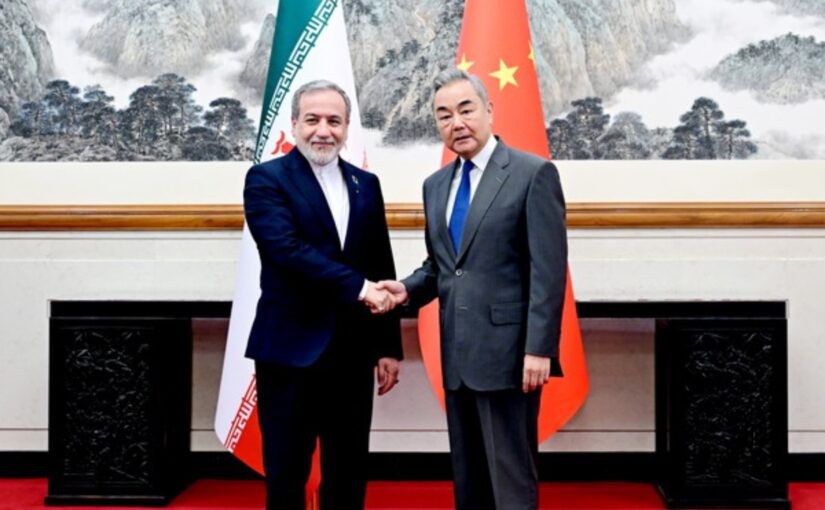
Iranian Foreign Minister Abbas Araghchi visited Beijing on September 16 and held talks with Chinese Foreign Minister Wang Yi.
The website of the Chinese Foreign Ministry reports that Wang Yi stated that the current situation in the Middle East remains turbulent, seriously affecting international peace and development. As a permanent member of the UN Security Council, China is willing to play a constructive role in resolving international disputes. China and Iran are comprehensive strategic partners, and China is also willing to strengthen dialogue and cooperation with Iran to safeguard Iran’s legitimate rights and interests. The continuation of the US-Iran war does not serve the common interests of the parties involved or the international community. We encourage Iran and the United States to remain rational and restrained, to return to the Memorandum of Understanding agreed in Islamabad as soon as possible, restructure negotiation mechanisms based on the consensus reached so far and conduct substantive consultations on issues of mutual concern. We support Iran’s dialogue with Gulf countries, respect for each other’s territorial sovereignty and national security, and safeguarding regional common interests in a constructive manner.
Wang further pointed out that the current situation once again proves that the existing security framework in the Middle East is not yet complete and needs reform and strengthening. During his visit to Egypt, President Xi Jinping put forward four proposals to support regional countries in upholding a common, comprehensive, cooperative, and sustainable security concept and building a new security architecture for the Middle East. We welcome beneficial exploration by regional countries on this topic. On Middle East issues, as a responsible major power, China will continue to contribute to peace and stability, to promoting peace talks, and to fairness and justice.
Araghchi briefed Wang Yi on the latest situation in the Middle East and the Gulf region and Iran’s next steps, stating that Iran does not want the conflict to continue and hopes to return to diplomatic resolution channels while firmly safeguarding its own interests. Iran believes the US-Iran Memorandum of Understanding remains valid, Iran has reached a plan with Oman to open the Strait of Hormuz, and the US should fulfil all its commitments. Iran is also willing to engage in dialogue and consultation with regional countries, establish and develop good-neighbourly and friendly relations, and promote the early restoration of peace and tranquillity in the region. Iran welcomes and supports President Xi Jinping’s four propositions for maintaining peace and stability in the Middle East and the four initiatives for promoting regional common security. It is willing to strengthen cooperation with China within this framework and looks forward to China playing a greater role in regional peace and stability.
The Tehran Times reported that Araghchi expressed strong support for President Xi Jinping’s landmark proposals on safeguarding peace in the Middle East, declaring that Tehran is fully prepared to deepen strategic coordination with Beijing to build a sustainable regional security framework.
The English language Iranian daily reported that: “Amid China’s consistent contributions to regional and global peace and stability, Araghchi’s call for a greater Beijing-led role further underscores the diplomatic significance of his visit.
“This is the second time that the Iranian foreign minister has paid an official visit to China since the US and Israel launched their war on Iran in late February. Araghchi last visited China in May, shortly before a trip by President Donald Trump to the country. Araghchi’s Wednesday visit comes ahead of the upcoming trip by President Xi to the US, where he will meet Trump.
“China is a trusted partner not only for Iran but also for other countries in the Middle East, in addition to maintaining open communication channels with Washington.
“When viewed alongside China’s principled stance during the Iran-US war, its emphasis on prioritising dialogue over confrontation, the two four-point initiatives put forward by President Xi, and his latest call for a ‘due role’ in resolving the conflict through BRICS, the significance of Araghchi’s trip becomes even clearer.”
The Tehran Times concluded: “By offering visionary peace initiatives and standing firmly against unilateralism and hegemony, Beijing provides a vital pillar of support for independent nations confronting external aggression. This diplomatic momentum underscores China’s constructive leadership and its contribution to advancing lasting security, development, and peace in the region.”
For its part, the Palestine Chronicle noted that Araghchi had stressed Iran’s strategic partnership with China and said that decisions being taken amid current regional developments would have “enormous repercussions.” It added:
“Against this backdrop, Tehran and Beijing have intensified diplomatic coordination, with Iran presenting China as an important strategic partner in shaping the political response to the war and its wider economic consequences.
“Araghchi said the choices being made during the current period would extend beyond the immediate crisis, affecting the future balance of power and political arrangements across the region.”
The following articles were originally published on the website of the Chinese Foreign Ministry and by the Tehran Times and Palestine Chronicle. The article from the Chinese Foreign Ministry was published in Chinese and has been machine translated and sub-edited by us.
Wang Yi held talks with Iranian Foreign Minister Abbas Araghchi
September 16 (MFA) – On September 16, 2026, Wang Yi, member of the Political Bureau of the CPC Central Committee and Minister of Foreign Affairs, held talks in Beijing with Iranian Foreign Minister Abbas Araghchi.
Wang Yi stated that the current situation in the Middle East remains turbulent, seriously affecting international peace and development. As a permanent member of the UN Security Council, China is willing to play a constructive role in resolving international disputes. China and Iran are comprehensive strategic partners, and China is also willing to strengthen dialogue and cooperation with Iran to safeguard Iran’s legitimate rights and interests. The continuation of the US-Iran war does not serve the common interests of the parties involved or the international community. We encourage Iran and the United States to remain rational and restrained, to return to the Memorandum of Understanding agreed in Islamabad as soon as possible, restructure negotiation mechanisms based on the consensus reached so far and conduct substantive consultations on issues of mutual concern. We support Iran’s dialogue with Gulf countries, respect for each other’s territorial sovereignty and national security, and safeguarding regional common interests in a constructive manner. We urge all parties to take effective measures to open the Strait of Hormuz as soon as possible, maintain the smooth and secure flow of international shipping lanes, and maintain the stability of international energy transportation and supply chains. We do not want regional tensions to spill further toward Yemen and the Red Sea. He called on all parties to stop further complicating the situation and to resolve the issue through dialogue and negotiation.
Wang Yi pointed out that the current situation once again proves that the existing security framework in the Middle East is not yet complete and needs reform and strengthening. During his visit to Egypt, President Xi Jinping put forward four proposals to support regional countries in upholding a common, comprehensive, cooperative, and sustainable security concept and building a new security architecture for the Middle East. We welcome beneficial exploration by regional countries on this topic. On Middle East issues, as a responsible major power, China will continue to contribute to peace and stability, to promoting peace talks, and to fairness and justice.
Wang Yi stated that China maintains continuity and stability in its Iran policy, always upholds fairness in the Security Council and multilateral platforms, opposes the use of force, and upholds the norms of international relations. China is willing to strengthen communication and coordination with Iran to promote new progress in China-Iran relations.
Araghchi briefed Wang Yi on the latest situation in the Middle East and the Gulf region and Iran’s next steps, stating that Iran does not want the conflict to continue and hopes to return to diplomatic resolution channels while firmly safeguarding its own interests. Iran believes the US-Iran Memorandum of Understanding remains valid, Iran has reached a plan with Oman to open the Strait of Hormuz, and the US should fulfil all its commitments. Iran is also willing to engage in dialogue and consultation with regional countries, establish and develop good-neighbourly and friendly relations, and promote the early restoration of peace and tranquillity in the region. Iran welcomes and supports President Xi Jinping’s four propositions for maintaining peace and stability in the Middle East and the four initiatives for promoting regional common security. It is willing to strengthen cooperation with China within this framework and looks forward to China playing a greater role in regional peace and stability.
Abbas Araghchi stated that Iran attaches great importance to its relationship with China and is willing to continue firm mutual support with China, strengthen exchanges at all levels, deepen pragmatic cooperation, jointly address challenges, and promote the sustained and in-depth development of bilateral relations.
Both sides also exchanged views on international and regional hotspot issues of mutual concern.
Iran FM backs Xi’s four-point proposals, calls for greater Chinese role in Middle East peace
TEHRAN (Tehran Times) – Iranian Foreign Minister Abbas Araghchi has expressed strong support for President Xi Jinping’s landmark proposals on safeguarding peace in the Middle East, declaring that Tehran is fully prepared to deepen strategic coordination with Beijing to build a sustainable regional security framework.
Araghchi made the comments during a meeting with his Chinese counterpart Wang Yi in Beijing on Wednesday, urging greater Chinese involvement in the Middle East’s security architecture.
“Iran welcomes and supports President Xi Jinping’s four-point proposal for maintaining peace and stability in the Middle East and his four-point initiative for promoting common regional security, and is willing to strengthen cooperation with China within this framework, expecting China to play a greater role in regional peace and stability,” the top Iranian diplomat said.
Araghchi was referring to two distinct four-point initiatives put forward by President Xi in recent months against the backdrop of the US-Israeli war on Iran that initially began on February 28.
President Xi detailed a four-point vision for a new security architecture during a meeting with Egyptian President Abdel Fattah El-Sisi in Cairo earlier this month. Centered on common, comprehensive, cooperative, and sustainable security, the vision has been warmly received in Tehran.
The initiative echoes the four-point peace proposal for the Middle East that the Chinese president put forward in April during his meeting with Abu Dhabi Crown Prince Sheikh Khaled bin Mohamed bin Zayed Al Nahyan. It called for peaceful coexistence, respect for national sovereignty, adherence to international law, and the coordination of development and security.
During the meeting with Araghchi, Wang, who is also a member of the Political Bureau of the Communist Party of China (CPC) Central Committee, hailed the Iran-China strategic partnership, stressing that Beijing is willing to strengthen dialogue and cooperation with Iran to safeguard its legitimate rights and interests.
He urged dialogue between Iran and the US to bring an end to the nearly seven-month conflict. Wang further called for talks between Iran and other Persian Gulf states to constructively safeguard the common interests of the region.
The top Chinese diplomat stressed that Beijing does not want regional tensions to spill further over into Yemen and the Red Sea, in reference to recent military escalation between Saudi Arabia and Yemen’s Ansarullah.
Wang further said China is willing to play a constructive role in resolving international disputes.
China has always advocated advancing multilateralism and played a constructive role in promoting global peace. President Xi’s recent comments at the 18th BRICS Summit in the Indian capital further highlighted this trajectory. In his address in New Delhi on Saturday, he emphasized that “China will work with fellow BRICS members to play a due role in bringing peace and tranquility” to the Middle East and the Persian Gulf region.
China’s peace diplomacy gains momentum
Amid China’s consistent contributions to regional and global peace and stability, Araghchi’s call for a greater Beijing-led role further underscores the diplomatic significance of his visit.
This is the second time that the Iranian foreign minister has paid an official visit to China since the US and Israel launched their war on Iran in late February. Araghchi last visited China in May, shortly before a trip by President Donald Trump to the country. Araghchi’s Wednesday visit comes ahead of the upcoming trip by President Xi to the US, where he will meet Trump.
China is a trusted partner not only for Iran but also for other countries in the Middle East, in addition to maintaining open communication channels with Washington.
When viewed alongside China’s principled stance during the Iran-US war, its emphasis on prioritizing dialogue over confrontation, the two four-point initiatives put forward by President Xi, and his latest call for a “due role” in resolving the conflict through BRICS, the significance of Araghchi’s trip becomes even clearer.
Former Iranian Foreign Minister Mohammad Javad Zarif said in a post on X on September 13 that “President Xi’s constructive initiatives offer timely openings to de-escalate tensions.”
Nearly 10 days before Zarif’s message, Mohammad Baqer Qalibaf, Iran’s parliament speaker and special representative for China affairs, highlighted Xi’s four-point proposal announced in Cairo. “China’s emphasis on fostering common security reflects a principle Iran has long championed,” Qalibaf noted. “True stability can only come through a new security architecture that is homegrown. Iran stands ready.”
In this context, Araghchi’s visit further highlights China’s important role as a responsible major country dedicated to upholding international fairness and justice.
By offering visionary peace initiatives and standing firmly against unilateralism and hegemony, Beijing provides a vital pillar of support for independent nations confronting external aggression. This diplomatic momentum underscores China’s constructive leadership and its contribution to advancing lasting security, development, and peace in the region.
Iran Says China Talks Successful amid Shifting Regional ‘Strategic Balance’
September 17 (Palestine Chronicle) – Iranian Foreign Minister Abbas Araqchi said Tehran had held “successful consultations” with its Chinese partners following talks in Beijing, highlighting the growing importance of the Iran-China strategic relationship.
In a post on X following his visit on Wednesday, Araqchi said Iran attaches significant importance to the strategic partnership it has developed with China over recent years.
The Iranian foreign minister met his Chinese counterpart, Wang Yi, during his visit on Wednesday.
“Today’s decisions will decide future strategic balance in the region, with immeasurable knock-on effects,” Araqchi wrote, stressing the significance of the rapidly changing regional and international environment.
He also highlighted the four principles for peace put forward by Chinese President Xi Jinping, describing them as a fundamental pillar for addressing the current regional situation.
The talks were expected to cover bilateral relations and implementation of the 25-year comprehensive strategic cooperation agreement between Tehran and Beijing, according to Iranian media.
Regional developments were also high on the agenda, with both sides seeking greater coordination as military and economic pressures reshape the Middle East.
Araqchi reportedly emphasized that Iran’s partnership with China has acquired greater importance amid the rapid changes underway across the region.
The Iranian foreign minister’s remarks also pointed to Tehran’s broader effort to deepen political and economic coordination with China as the international consequences of the regional war continue to expand.
Araqchi’s visit came as the US-Israeli war against Iran entered its seventh month, with no political settlement yet reached.
The war has severely disrupted navigation through the Strait of Hormuz, one of the world’s most important maritime routes for oil and gas supplies.
The resulting disruption has contributed to sharp increases in energy and industrial commodity prices internationally.
Against this backdrop, Tehran and Beijing have intensified diplomatic coordination, with Iran presenting China as an important strategic partner in shaping the political response to the war and its wider economic consequences.
Araqchi said the choices being made during the current period would extend beyond the immediate crisis, affecting the future balance of power and political arrangements across the region.






One thought on “Iranian Foreign Minister: Tehran is fully prepared to deepen strategic coordination with Beijing”