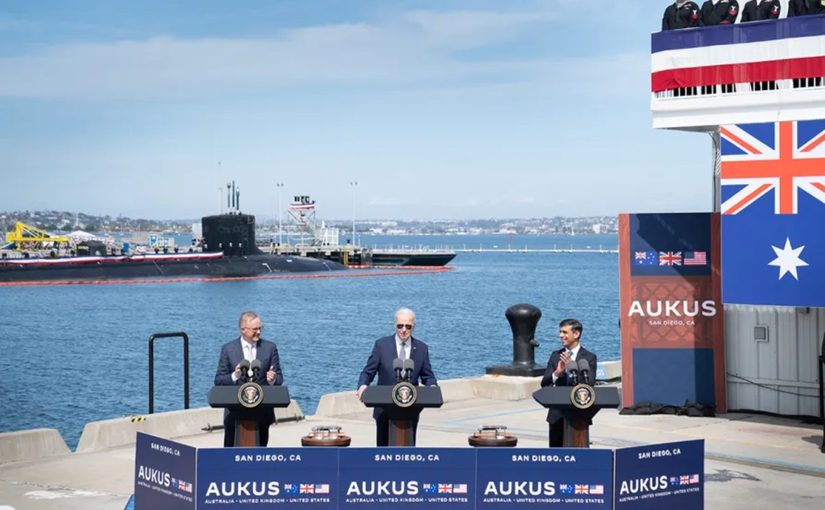
In the following article, which was originally published in the Morning Star, Jenny Clegg notes that five years have passed since the shock announcement of AUKUS – a three-way military pact between Australia, Britain and the US.
It is also, she notes, five years since Labour CND’s emergency motion opposing the deal gained over 70 per cent of the vote at the Labour Party conference. AUKUS, the motion stated, was in breach of the nuclear Non-Proliferation Treaty (NPT) stipulation that exchanging non-nuclear for nuclear technology must be for peaceful purposes.
But it is, Jenny continued, as if this vote never happened, “the Labour government now has not only embraced Aukus but expanded its commitment”.
“Australia has become the first country to break its non-nuclear status by acquiring nuclear-powered submarines. In the absence of proper public debate, peace groups and trade unions have now launched an independent public inquiry into the project sponsored by a new initiative – the Australian Peace and Security Forum.”
Adding that now seems as good a time as any to take stock of what it is exactly the British government has committed to, Jenny proceeds to give a detailed breakdown and concludes that former prime minister Keir Starmer had “saved AUKUS”:
“Britain then is deeply implicated in the violations of the NPT, in placing Australia on the front line of a US war on China and stoking a new arms race. As well Australia has become alienated from its regional neighbours — the south-east Asia states and Pacific Islanders, who after decades of nuclear testing now see their hard-won Nuclear Weapons Free Zones brushed aside.”
The government, Jenny writes, “claims that Aukus offers a ‘generational chance to revitalise the UK industrial base’ but CND’s Alternative Defence Review (2025) exposes the wastefulness of ‘military Keynesianism’ sucking desperately needed funds and skills from areas more beneficial to the economy. By the 2050s, when they are made fully operational, the submarines will likely be outdated. Spending billions is clearly a decision heavily influenced by the profit motives of the arms industry.
“Progress is slow too on Pillar 2’s Darc — Deep Space Advanced Radar Capability system — in Wales linking with facilities in North West Australia and Texas as part of Trump’s Golden Dome. Local opposition is building.”
Jenny concludes: “With the US military now swarming over Australian bases, the independent inquiry, due to report later this year, has been holding hearings in different locations around the country. Supported by crowdfunding through trade unions, environmental and other NGOs as well as individuals, the inquiry is led by a former environment minister with a team including a former admiral, a former state politician and leader of the Australian Labour Party, a human rights lawyer and a representative of the country’s First Nations.
“With a remit covering costs and jobs, strategic rationale, nuclear non-proliferation and environmental impact, it provides the space to conceive a different future for Australia which may prove to be the spark for a really broad popular front against militarisation. The anti-war movement in Britain should take note.”
Full details of the Australian inquiry, including all the submissions it has received, can be found here.
Jenny will be among the speakers at our Socialist China Conference in London on Saturday 3 October. Tickets are available on Eventbrite.
Britain’s submarine boomerang – Aukus pact five years on
The tripartite Australian, British and US militarist alliance is aimed at China, however it’s also likely to backfire on the three countries involved. Labour needs to end Britain’s Pacific ambitions, argues Jenny Clegg
IT IS FIVE years since the shock announcement of Aukus — a three-way military pact between Australia, Britain and the US.
President Joe Biden of the US with the support of Boris Johnson succeeded in hoodwinking then Australian PM, Scott Morrison into ditching a deal with France for diesel-powered submarines for promises to assist with much longer-range and stealthier nuclear-powered ones instead, all the better to counter the so-called “China threat.”
And it is five years since Labour CND’s emergency motion opposing the deal gained over 70 per cent of the vote at the Labour Party conference. Aukus, the motion stated, was in breach of the nuclear Non-Proliferation Treaty (NPT) stipulation that exchanging non-nuclear for nuclear technology must be for peaceful purposes.
As if this vote never happened, the Labour government now has not only embraced Aukus but expanded its commitment despite the cost, making a concerted effort to win over the trade unions and public with promises of tens of thousands of skilled jobs and apprenticeships.
Australia has become the first country to break its non-nuclear status by acquiring nuclear-powered submarines. In the absence of proper public debate, peace groups and trade unions have now launched an independent public inquiry into the project sponsored by a new initiative — the Australian Peace and Security Forum. Given our own lack of debate in Britain, now seems as good a time as any to take stock of what it is exactly the government has committed to.
Aukus has two pillars: the submarines (Pillar 1) and advanced technology sharing (Pillar 2). It was first launched as US military figures were hyping up predictions of a military attack by China on the island of Taiwan in 2027.
Thereupon, US-China relations took a dive with then House of Representatives speaker, Nancy Pelosi’s provocative visit to Taiwan in 2022 and then the absurd “spy-balloon” panic in 2023. By 2024, Nato was labelling China “the decisive enabler” of Russia’s Ukraine war, linking Euro-Atlantic security with that in the Indo-Pacific. But when Donald Trump returned to office on his “America First” ticket, the whole project fell into doubt.
At this point, Keir Starmer’s government jumped in waving the flag for “Global Britain.” With controversies raging over the defence budget, the Strategic Defence Review (SDR) announced its commitment to build up to 12 new SSN-Aukus nuclear-powered submarines. These would replace the seven Astute class submarines (two of which are still being built) and add a possible further five. However, under the new “Nato first but not Nato only” principle, none of the submarines were in fact destined for Australia — the North Atlantic and Arctic were the priority.
Aukus, though, was still incorporated, with government signing a 50-year pact with Australia specifically to underpin the two pillars. Britain’s role in Nato as a permanent Euro-Atlantic/Indo-Pacific link was thus assured: with the Aukus submarines covering two theatres the country would be war-ready in any “multi-fronted offensive.”
Trump then gave his endorsement: Starmer had saved Aukus.
Nuclear implications
As things stand now, the US commitment to sell up to five, some newly built, submarines to Australia is reduced to three second-hand ones, with four US submarines deployed on rotation in Perth. The Australians, with primarily British help, are to build five and Britain is sending one of its own Astute submarines to join the Americans on rotation.
Britain’s main commitment is to supply the welded nuclear-propulsion system from Rolls-Royce in Derby for both the British and Australian boats, and Australia is now paying A$4.6bn (£2.4bn) to support expansion at Derby.
Britain then is deeply implicated in the violations of the NPT, in placing Australia on the front line of a US war on China and stoking a new arms race. As well Australia has become alienated from its regional neighbours — the south-east Asia states and Pacific Islanders, who after decades of nuclear testing now see their hard-won Nuclear Weapons Free Zones brushed aside.
Warwick Powell, adjunct professor at Queensland University, hit the nail on the head at the public inquiry: seeing Australia as “mentally tethered by history to the Atlantic,” he noted how the nation is trapped between twin fears: fear of its Asian neighbourhood and fear “of being abandoned by a distant transatlantic protector.”
And Britain certainly can’t be relied on. Earlier this year, our first submarine sent on rotation to Perth was prematurely recalled. It is now in dock for repair along with the other four Astute submarines. Our commitment is clearly a stretch for the Royal Navy. In the meantime, amid acute engineering shortages BAE Systems and Rolls-Royce are struggling to meet their own sovereign defence “requirements,” let alone those of Australia.
Britain’s nuclear submarine industry is renowned for cost overruns and delays. The government’s original commitment was to build the four new Dreadnought submarines at a rate of one every five years — now the additional Aukus-build demands a huge leap in production to one submarine every 18 months.
The government claims that Aukus offers a “generational chance to revitalise the UK industrial base” but CND’s Alternative Defence Review (2025) exposes the wastefulness of “military Keynesianism” sucking desperately needed funds and skills from areas more beneficial to the economy. By the 2050s, when they are made fully operational, the submarines will likely be outdated. Spending billions is clearly a decision heavily influenced by the profit motives of the arms industry.
Progress is slow too on Pillar 2’s Darc — Deep Space Advanced Radar Capability system — in Wales linking with facilities in North West Australia and Texas as part of Trump’s Golden Dome. Local opposition is building.
To arm a country thousands of miles across the ocean against its main trading partner as Britain is doing is just stupid. As 2027 approaches, an attack by China on Taiwan looks less and less likely — the Pentagon is for the time being at least more accepting of China’s long-held peaceful intentions. Meanwhile China is now Britain’s third-largest trading partner, with Chinese investment flowing heavily into hi-tech sectors vital to our economic future.
Despite this, Britain insists on its role as a Pacific power, maintaining its naval presence in the Indo-Pacific, strengthening military links with Japan, participating in Rimpac exercises, the world’s largest international maritime warfare games, also sending its carrier strike group to lead an exercise for all G7 nations plus New Zealand and other European powers to coincide with the SDR decision.
Duped by its own global fantasies, the government’s flag-waving clouds Australians’ thinking on how to build a new peaceful future in Asia: having King Charles’s head on a postage stamp will not provide much cover in a US-China conflict.
With the US military now swarming over Australian bases, the independent inquiry, due to report later this year, has been holding hearings in different locations around the country. Supported by crowdfunding through trade unions, environmental and other NGOs as well as individuals, the inquiry is led by a former environment minister with a team including a former admiral, a former state politician and leader of the Australian Labour Party, a human rights lawyer and a representative of the country’s First Nations.
With a remit covering costs and jobs, strategic rationale, nuclear non-proliferation and environmental impact, it provides the space to conceive a different future for Australia which may prove to be the spark for a really broad popular front against militarisation. The anti-war movement in Britain should take note.