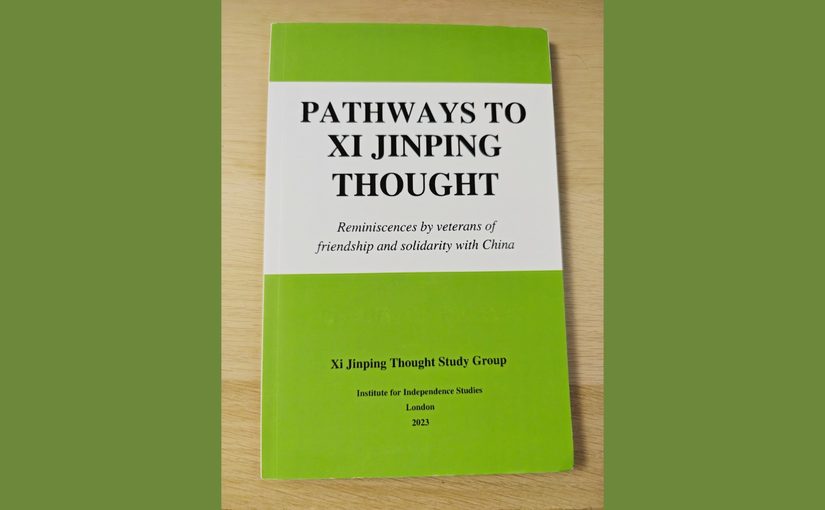
The following article by Zhuo Mingliang, Associate Research Fellow at the Academy of Marxism of the Chinese Academy of Social Sciences (CASS), examines the work of the Xi Jinping Thought Study Group, set up in 2020 by the London-based Institute for Independence Studies. Among its founders is our co-editor Keith Bennett.
Zhuo introduces the Study Group and its core members, and summarises the main arguments of its 2023 book of memoirs by long-standing friends of China. These include the view that China’s achievements demonstrate the superiority of socialism, and that Xi Jinping Thought is “a great gift to all humanity” that can help unite progressive forces worldwide. He also outlines the Institute’s distinctive positions, among them its emphasis on the non-Western development of scientific socialism and its critique of Western leftists who remain sceptical of socialism with Chinese characteristics.
The article offers an interesting insight into how Chinese scholars view the work of China’s friends in the West – and into the role of people-to-people movements in breaking through the anti-China consensus in the Western media.
The article was originally published in Chinese in the Journal of Handan University (Vol. 36, No. 3, September 2026). The English translation is by Friends of Socialist China; quotations from Keith Bennett’s preface are translated back from the Chinese and will not match his original wording.
The Purpose, Aims and Main Views of the UK’s “Xi Jinping Thought on Socialism with Chinese Characteristics for a New Era Study Group”
Abstract: The “Xi Jinping Thought on Socialism with Chinese Characteristics for a New Era Study Group” is an academic research organisation set up by left-wing British scholars who know China well and are friendly towards it. Writing from the standpoint of overseas people with first-hand experience, its members affirm the international influence of Xi Jinping Thought. They recognise the superiority of the socialist system as shown by China’s development path, and they rebut false anti-China narratives in the West.
Western non-governmental groups that know China and are friendly to it are an important force for breaking down US and Western media bias against China. The article therefore recommends four lines of work:
- identifying and engaging with such organisations in the West
- building platforms for exchange and mutual trust
- deepening practical cooperation at the level of theory
- strengthening their capacity to communicate in their own countries
The aim is to use civil-society forces to “tell China’s story well”, grow a friendly international climate of opinion towards China, and strengthen the popular basis for people-to-people ties between China and other countries.
Keywords: Xi Jinping Thought on Socialism with Chinese Characteristics for a New Era; Britain’s Institute for Independence Studies; scientific socialism
Introduction
At present, British people who know and are friendly towards China follow China’s achievements in reform and development closely. They actively study Xi Jinping Thought, Chinese modernisation, China’s global initiatives and “Chinese solutions”. In doing so they have helped improve mutual understanding between the Chinese and British peoples and helped the international community see China objectively and fairly.
One of these is the “Xi Jinping Thought on Socialism with Chinese Characteristics for a New Era Study Group”. It is an important academic body under the Institute for Independence Studies, and it works to study and spread Xi Jinping Thought in Britain and around the world. It has published a book, Paths to Xi Jinping Thought on Socialism with Chinese Characteristics for a New Era: Memoirs of Long-Standing Friends of China and Solidarity Activists. Its views and positions deserve our close attention.
I. The Purpose and Aims of the “Xi Jinping Thought” Study Group
The Institute for Independence Studies is an independent body based in London, founded by left-wing scholars from several countries. It is dedicated to researching and spreading the ideas of social and national liberation, and to applying them to social reality in the era of imperialism. This work is carried out especially through the writings and activities of Keith Bennett.
In August 2020 the Institute set up the Study Group. Its purpose is to study and spread Xi Jinping Thought, to draw from it experience of universal significance for understanding the new era, and to promote the flourishing of intellectual, academic and cultural life in its own country. Its core members include:
- Keith Bennett: a co-founder and patron of the Institute and of the Study Group. He has devoted more than half a century to studying socialist development, specialising in Chinese Marxism, and is also an editor of the London-based Friends of Socialist China website.
- Hugh Goodacre: Executive Director of the Institute. He was formerly a curator in the Asia, Pacific and Africa Collections of the British Library. Since 2005 he has lectured on the history of economic thought at University College London, where he is also a member of the Academic Board.
- Peter Hogg: a Director of the Institute. He worked for many years at the British Library and has been a friend of China since the late 1950s. He has long been active in the anti-imperialist movement, including solidarity with the Irish people’s struggle for national self-determination and the Korean people’s cause of national reunification.
- Janet St John-Austen: a Director of the Institute. She has organised Britain–China friendship activities since the late 1960s and was General Secretary of the Society for Anglo-Chinese Understanding from 1979 to 1981. In 1988–89 she served as press officer for the PLO’s London office, among other roles.
The Study Group’s first major undertaking after its founding was to edit and publish Paths to Xi Jinping Thought: Memoirs of Long-Standing Friends of China and Solidarity Activists. Published in 2023, it is a collection of memoirs by international friends and senior figures in friendship organisations who have long worked for friendship with China and firmly supported its development.
The authors draw on their own experience to review their history of engagement with China. They bear vivid witness to China’s leap forward in the new era. On that basis they explain how they understand and identify with the formation of Xi Jinping Thought and its practical power.
The book offers the distinctive observations of overseas eyewitnesses, stepping outside the usual perspectives of domestic research. It shows the far-reaching influence of Xi Jinping Thought in three areas: guiding China’s development, promoting friendship and mutual trust between China and other countries, and helping to build a community with a shared future for mankind. It also shows how this thought is being spread and recognised ever more widely in the international community.
II. Main Views of Paths to Xi Jinping Thought: Memoirs of Long-Standing Friends of China and Solidarity Activists
In the book’s Preface, Keith Bennett writes:
“Today the socialist countries are the collective leading force of the international working class and progressive movement. In terms of global reach and explanatory power, Xi Jinping Thought is the most influential body of thought among these countries. British socialists, like their comrades around the world, should therefore find effective ways to guide progressive people to study and deeply understand this valuable intellectual resource. Accomplishing this task means confronting many unresolved questions. We have long felt that how to make revolution in Western Europe remains an unanswered question, and for decades since we have been searching for the answer.” [1]
Bennett regards the book as an important contribution to that search. It collects the personal experiences and reflections of some long-standing friends of China. Over several decades these people have followed varied and complex political and intellectual paths, yet each in their own way confirms that “Xi Jinping Thought has universal applicability to the great task of uniting socialists and other progressive people and arming them ideologically.” [2]
Compiling the book took hundreds of hours of collaborative work. This included in-person meetings, in-depth interviews and thematic seminars, as well as telephone and online meetings during the Covid-19 pandemic. The process produced a large body of recordings and transcripts, which give a solid basis for further research. The main pieces in the book include “China Under Xi Jinping and the Anti-Imperialist Struggle of Our Time” and “China in the Xi Jinping Era and Communism”. Its main views are as follows:
(1) China now stands at the centre of the world stage. That reality alone should be reason enough for anyone who wants to understand the world rationally to study Xi Jinping Thought in depth. For socialists everywhere the need is more urgent still, in both theory and practice: Xi Jinping Thought offers invaluable practical experience and theoretical insight for the global socialist cause.
(2) Xi Jinping Thought is the guiding thought created and summed up by the Communist Party of China and its leaders. It has led China to great transformation and great achievements. It is now fully open to the peoples of the world, a great gift to all humanity. It can unite progressive forces worldwide, arm socialists and progressives ideologically, and encourage progressive people in the West to study the theory of socialism with Chinese characteristics in depth.
(3) Since the first socialist country was born in 1917, the development of socialism has profoundly influenced all forms of human civilisation and cultural development. Contemporary socialism takes rich and varied social and cultural forms. This vividly shows how scientific socialism develops creatively and adapts locally in different social and cultural settings. The most emblematic example is socialism with Chinese characteristics for a new era, whose guiding thought is Xi Jinping Thought.
(4) The great achievements of socialism with Chinese characteristics have shown the world clearly that the socialist system is markedly superior to the capitalist system. China was once a country long held back by decadent feudal rule, colonial and semi-colonial oppression, and economic and social backwardness. It has risen to reclaim its rightful place on the world stage and now has a distinctive capacity to resist interference and pressure from global imperialism. This undeniable fact has greatly strengthened unity and consensus among China’s own peoples and has also rallied progressive forces internationally.
(5) All the contributors to the book have had the privilege of exchanging views with iconic leaders in the history of world socialism, either by meeting them in person or by working with comrades close to them. These leaders include Comrade Mao Zedong and Comrade Xi Jinping, as well as outstanding leaders of national liberation and socialist revolution in Asia, Africa and Latin America, and pioneers of the international left such as James Connolly. For us, great socialist leaders are not abstract figures in history books and newspapers. They are comrades in the international revolutionary family, bound to us by shared blood and a common direction, with deep ties of shared ideals and mission.
(6) In building socialism with Chinese characteristics, China has achieved results that have drawn worldwide attention. It has lifted nearly a fifth of the world’s population out of absolute poverty and is building a modern socialist country in all respects. This iron-clad fact makes the anti-China smears and false narratives fabricated by imperialism less and less credible. However much the slanders intensify, they cannot deceive the world. The Institute has always been committed to refuting such lies and fallacies. The real purpose of this propaganda is to distract the people of the imperialist core countries, so that they cannot see the true causes of the security dilemmas and social crises they face.
III. The Basic Positions and Propositions of the Institute for Independence Studies
In its Statement of Principles, the Institute sets out its purpose: to research and spread the ideas of social emancipation and national independence. This position is unique among the various socialist and progressive currents in Britain today. The Institute holds the following positions.
(1) The socialist countries, as the collective leading force of the international workers’ movement, lead the cause of human progress and liberation, at the forefront of progressive countries, non-aligned countries and national liberation movements
Accordingly, the ideas the Institute promotes are closely aligned with the theories of revolution and construction put forward by the leaders of the socialist countries. They are also in direct line with the ideas creatively developed in the struggles for national liberation and social progress in Asia, Africa and Latin America. At the same time, the Institute firmly resists all opportunist and revisionist distortions of, and departures from, the basic principles of scientific socialism. It consciously defends the correct direction of the international communist movement.
(2) The influence of socialist ideas and their worldview is growing steadily in the Western world, and the Institute’s mission is to increase this influence further through research, publishing and other activities
This influence can already be seen in anti-racist movements within the imperialist countries. Anti-racist and other progressive movements in Europe and America have been deeply inspired by the African liberation movements and have built up a rich intellectual and cultural tradition. The Institute attaches particular importance to the intellectual legacy of the Irish republican and socialist movements. It also points out that British colonialism in Ireland created the prototype of modern colonial ideology and of the strategy of “divide and rule”. For this reason, internationalist struggle faces especially severe practical tests within Britain itself.
(3) The socialist countries, proceeding from their own national conditions, have given scientific socialism distinct characteristics and continually enriched and developed it, setting an international example
The Institute argues that a progressive idea should not be judged by whether it fits existing prejudices or fashionable dogmas. What matters is whether it can actually mobilise the broad masses and add strength to the cause of global human liberation, and socialism is precisely such an idea. Movements for social and national liberation around the world, in both their theoretical work and their practice, have creatively advanced progressive and socialist thought. Because these explorations are rooted in different social and historical conditions and diverse intellectual traditions, their theoretical results are richly varied. The Institute is committed to explaining in depth the richness, diversity and creativity of these bodies of thought.
(4) In Britain, some so-called progressive currents, even some that call themselves Marxist, remain negative or sceptical towards the non-Western content of international socialist thought
The worldview of Marx and Engels was strongly internationalist. They made penetrating analyses of developments in Asia and elsewhere, where the contradictions of global capitalism had begun to appear but conscious anti-capitalist class struggle had not yet emerged. Scientific socialism was therefore rooted at its founding in Western intellectual traditions: German dialectical philosophy, French socialism and British political economy.
Contemporary scientific socialism, however, has long since moved beyond the theoretical limits of its founding stage. It has undergone a rich intellectual and cultural evolution worldwide. Yet many Western left-wing scholars have not fully grasped this historical change and still hold various doubts about the theory and practice of socialism with Chinese characteristics.
(5) The Institute encourages the socialist movement to broaden its international outlook and break with narrow dogmatism
To this end, the Institute keeps to an independent academic position. It seeks constructive dialogue and cooperation with all Marxist and socialist schools of thought in Britain and internationally. Its work takes several forms: academic conferences and seminars, books and pamphlets, articles in specialist journals, and its official website. It also actively seeks varied channels of exchange with academia. It is willing to engage with any intellectual current that can discard the most reactionary core of capitalist ideology and that approaches discussion openly, constructively, and on an equal and friendly footing.
Notes
- IIS, “Publications” [EB/OL] (May 2023). https://independence-studies.org/academic/publications/, last accessed 7 March 2026.
- Same as note 1.