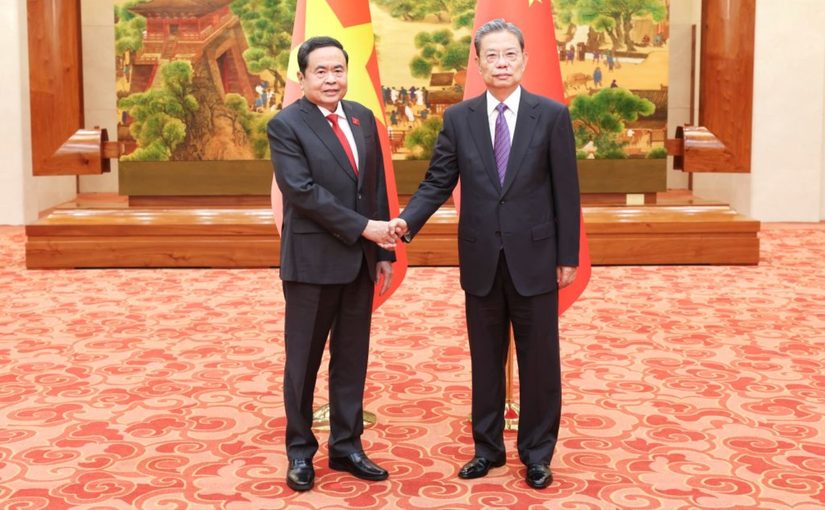
Tran Thanh Man, President of the National Assembly (NA) of Vietnam, visited China from October 11 to 15 at the invitation of his Chinese counterpart Zhao Leji, Chairman of the Standing Committee of the National People’s Congress (NPC) and to co-chair the second session of the cooperation committee between the two countries’ legislative bodies together with him.
The Vietnamese newspaper Nhân Dân reported: “This is NA President Man’s first visit to China in his capacity as Vietnam’s top legislator. The visit aims to further implement the foreign policy set out at the 14th National Party Congress, enhance the effectiveness of cooperation between Vietnam’s National Assembly and the National People’s Congress of China, and reaffirm the pivotal role of parliamentary cooperation in the overall Vietnam-China comprehensive strategic cooperative partnership.”
Tran Thanh Man met with Zhao Leji on October 12 and held the second session of their cooperation committee together.
According to the Xinhua News Agency, Zhao said that China is ready to work with Vietnam to follow the strategic guidance of the top leaders of the two parties and two countries, and push for deeper and more substantive progress in building the China-Vietnam community with a shared future.
He added that both sides should deepen practical cooperation, advance infrastructure connectivity, expand cooperation in emerging areas such as artificial intelligence, the digital economy, clean energy and communications satellites, cement public support, and deepen exchanges in culture, education and sports. He also called for close coordination on multilateral affairs and joint implementation of the four global initiatives proposed by President Xi Jinping.
Tran Thanh Man said Vietnam regards its relationship with China as a strategic choice and a top priority in its foreign policy, and is ready to enhance strategic mutual trust, expand cooperation in such areas as trade, investment, infrastructure and science and technology, and intensify people-to-people and cultural exchanges.
Vietnam’s Nhân Dân newspaper added that Man congratulated China on the 77th anniversary of the founding of the People’s Republic of China and its major development achievements, including the important contributions of the NPC. He expressed confidence that, under the leadership of the Communist Party of China Central Committee, with General Secretary and President Xi as its core, China would achieve its goal of becoming a modern socialist country that is prosperous, strong, democratic, culturally advanced, harmonious, and beautiful.
To deepen bilateral ties, the two sides agreed to maintain high-level exchanges and advance strategic trust, creating a firmer political foundation for cooperation. They called for more balanced and sustainable trade, high-quality investment, modern and coordinated railway connectivity, and stronger cooperation in science and technology. They also stressed the need to strengthen local-level cooperation, people-to-people exchanges, and education, culture and tourism collaboration, enhance coordination at multilateral forums, effectively manage the land border, and better control and resolve differences to maintain peace and stability at sea.
Zhao Leji proposed closer strategic coordination in digital and green economies, artificial intelligence, smart border gates and cross-border economic zones. He suggested accelerating the construction and development of railway lines connecting the two countries and linking them to the China–Europe railway network. He welcomed more Vietnamese agricultural products entering the Chinese market and encouraged Vietnam to make effective use of trade fairs hosted by China. He underscored the importance of public support for bilateral ties, calling for stronger cooperation in tourism, culture, media, healthcare and sports, particularly exchanges among young people. China also welcomed more Vietnamese students to study there.
Man met with Chinese Premier Li Qiang on the same day.
According to Xinhua, reflecting “camaraderie plus brotherhood,” Li said China is willing to work with Vietnam to continue traditional friendship, enhance unity and mutual trust, expand mutually beneficial cooperation, better benefit the two peoples, and inject positive energy into promoting regional and global stability and prosperity.
Man said Vietnam extends its heartfelt congratulations on China’s new and significant achievements in economic and social development, with its economic growth rate ranking among the top of the world’s major economies and its breakthroughs in scientific and technological innovation leading the world. Vietnam has always regarded China as a top priority and a strategic choice in its foreign relations, firmly adheres to the one-China policy, and will maintain close exchanges with China at all levels in accordance with the important consensus reached by the top leaders of the two parties and two countries. The National Assembly of Vietnam attaches great importance to and highly recognises Xi Jinping Thought on the Rule of Law and is willing to enhance exchanges of experience in governance with China, he noted.
Nhân Dân further reported that Man stressed that developing ties with China is a consistent policy, an objective requirement, a strategic choice, and a top priority in Vietnam’s foreign policy of independence, self-reliance, self-strengthening, multilateralisation and diversification of relations.
The previous day Man had met with Wang Huning, chairman of the National Committee of the Chinese People’s Political Consultative Conference (CPPCC).
According to Nhân Dân, he conveyed congratulations from General Secretary of the Communist Party of Vietnam Central Committee and President To Lam and other high-ranking Vietnamese leaders on the 77th anniversary of the founding of the People’s Republic of China on October 1. He also congratulated China on its major theoretical and practical achievements in reform, opening up and national modernisation, including the CPPCC National Committee’s contributions. He voiced confidence that under the CPC Central Committee’s leadership, with General Secretary and President Xi Jinping at its core, China will reach its goal of building a modern socialist country that is prosperous, strong, democratic, culturally advanced, harmonious and beautiful, contributing to common development and prosperity in the region and the world.
Wang, for his part, sent greetings to General Secretary and President Lam and other key Vietnamese leaders. He congratulated Vietnam on its major theoretical and practical achievements, which show the vitality and bright prospects of the country’s socialist cause, and affirmed support for Vietnam in achieving its development goals in the new era.
Agreeing with the guest’s proposals, Wang called for coordinated cooperation through all channels and at all levels, and an effective rollout of plans for high-level exchanges. He also urged full use of mechanisms such as the 3+3 strategic dialogue on diplomacy, national defence and security, and the bilateral cooperation steering committee. He suggested more exchanges of theory and experience in party building and national governance, closer alignment of the two countries’ quality development strategies, faster railway connectivity projects, and concrete early progress in trade, investment, smart border gates, cross-border economic cooperation zones, science and technology, artificial intelligence, digital economy and green economy.
The CPPCC values and supports friendly exchanges among people of all walks of life in the two countries, particularly the youth. He urged an effective rollout of people-to-people exchanges such as the Red Journey and the China-Vietnam Year of tourism cooperation, along with expanded cooperation in tourism, education, culture and locality-to-locality exchanges.
The two sides agreed to step up multilateral coordination and support each other in hosting the Asia-Pacific Economic Cooperation (APEC) meetings in 2026 and 2027 respectively.
As part of his packed programme of engagements during his stay in Beijing, Man and his delegation visited the Museum of the Communist Party of China (CPC).
After touring the museum and receiving briefings on its exhibition areas, Man said that Vietnam had also commenced construction of the Museum of the Communist Party of Vietnam (CPV) in Hanoi. The project is expected to be inaugurated in early 2030, marking the 100th anniversary of the founding of the CPV (February 3, 1930–2030). He expressed his hope that the Museum of the CPC will support Vietnam and share experience in structural planning, architectural design and the display of artefacts.
He also toured the Nanmofang township legislative liaison station in Beijing’s Chaoyang district shortly after his arrival in China.
He was briefed on effective and innovative approaches the station uses to collect public feedback on draft legal documents. This gives deputies to people’s congresses at all levels more chances to engage voters and feed public concerns into the drafting, review and adoption of policy documents.
Li Xiuling, Chairman of the Standing Committee of the Beijing Municipal People’s Congress, praised the visit’s significance, noting that the guest’s first stop on their China visit was at the grassroots to learn about legislative work and voter engagement mechanisms. It is important for the two countries to share experience in building socialist democracy, he said.
Describing China’s “whole-process people’s democracy”, Li said the model spans more than 70 years and covers the people’s congress system, political consultation, multiparty cooperation under the Communist Party of China (CPC) leadership, and regional ethnic autonomy. It runs through the entire cycle of elections, consultation, decision-making, implementation and oversight. He added that the model grew out of integrating Marxist principles with China’s realities and traditional culture.
Praising the model of bringing legislative work closer to grassroots communities, voters and the public in Nanmofang and Beijing at large, Man said Vietnam attaches importance to legislative work in building a socialist rule-of-law state of the people, by the people and for the people. That includes listening to experts, intellectuals, businesses, voters and the general public, especially those directly affected by policies and laws.
Besides Beijing, Man and his party visited Xi’an and Yan’an, in northwest China’s Shaanxi province.
Man met with Zhao Yide, Secretary of the Party Committee of Shaanxi province, in Xi’an on October 13. Nhân Dân noted that the province is the cradle of the Chinese revolution and holds memories of the years when President Ho Chi Minh stood shoulder to shoulder with generations of Chinese leaders in their arduous revolutionary struggle.
Zhao said President Man’s visit reflects the friendship and high regard that the Vietnamese party, state and NA attach to the Vietnam-China comprehensive strategic cooperative partnership, and to ties between Vietnamese localities and Shaanxi province in particular.
Briefing the Vietnamese delegation on Shaanxi’s history, revolutionary traditions and achievements across various fields, Zhao noted the province’s deep appreciation for President Ho Chi Minh’s numerous visits to Shaanxi and to Yan’an city.
For his part, Man suggested Shaanxi and Vietnamese localities step up collaboration in the fields of science and technology, energy, hi-tech agriculture, transport infrastructure and logistics, particularly railways, quality workforce training, culture and tourism.
On October 14, Man visited the Yangjialing and Zaoyuan revolutionary sites in Yan’an city.
Nhân Dân noted that the delegation travelled there by high-speed train, adding: “The city is regarded as the cradle of China’s revolution and a symbol of resilience, solidarity and self-reliance. It also bears the imprint of Nguyen Ai Quoc, or President Ho Chi Minh, whose revolutionary activities during his time in China contributed to the Chinese revolution and the international communist movement.
“Zaoyuan lies about 8km northwest of the city centre. Together with Yangjialing, Wangjiaping, Baota Mountain and the Yan’an Revolutionary Memorial Museum, it forms a prominent complex of revolutionary sites from the period when the Central Committee of the Communist Party of China (CPC) was based in the city. Chairman Mao Zedong and other Chinese revolutionary leaders lived and worked there…
“Zaoyuan carries particular significance for Vietnam because President Ho Chi Minh stayed there. According to the CPC history section of China’s People’s Daily, he returned to China from the Soviet Union in the winter of 1938, travelling through Xinjiang and Xi’an before reaching Yan’an, then the CPC’s hub.
“At Zaoyuan, President Ho Chi Minh was hosted by Wang Jiaxiang, Secretary of the CPC Central Committee. He also met Mao and other Chinese leaders to discuss the revolutions in both countries.
“The site is therefore significant to the history of both revolutions, particularly the period before President Ho Chi Minh returned to lead Vietnam’s. It reflects the close ties between the two countries’ leaders and revolutionary movements. President Ho Chi Minh revisited the house in 1959 and had his photos taken there…
“Man also toured Yangjialing, which has been preserved as a venue for teaching the public about CPC history and China’s revolutionary traditions. Yangjialing is linked to a pivotal period when the CPC consolidated its ideological, political and organisational foundations during the war of resistance against Japan, while preparing for the post-war period. It remains a prominent site for political and party history education in China…
“The Vietnamese guest lauded Yan’an’s development and its efforts to preserve its ‘red address’ sites. He called on the city and Vietnamese localities to foster connectivity and people-to-people exchanges, push tourism cooperation, particularly ‘red tourism’ that follows in the footsteps of both countries’ revolutionary leaders, and work together to preserve historical and cultural sites.”
The following articles were originally published by the Xinhua News Agency and Nhân Dân.
China’s top legislator holds talks with Vietnam’s National Assembly chairman
BEIJING, Oct. 12 (Xinhua) — China’s top legislator Zhao Leji held talks with Tran Thanh Man, chairman of the National Assembly of Vietnam, and co-chaired the second session of the joint committee between the legislative bodies in Beijing on Monday.
Zhao, chairman of the Standing Committee of the National People’s Congress (NPC), said China is ready to work with Vietnam to follow the strategic guidance of the top leaders of the two parties and two countries, and push for deeper and more substantive progress in building the China-Vietnam community with a shared future.
He called on the two sides to consolidate strategic mutual trust, maintain the sound momentum of high-level exchanges, and firmly support each other.
Zhao said both sides should deepen practical cooperation, advance infrastructure connectivity, expand cooperation in emerging areas such as artificial intelligence, the digital economy, clean energy and communications satellites, cement public support, and deepen exchanges in culture, education and sports. He also called for close coordination on multilateral affairs and joint implementation of the four global initiatives.
The NPC of China stands ready to work with the National Assembly of Vietnam to further enhance cooperation by focusing on implementing the important common understandings reached between the top leaders of the two parties and two countries and performing the functions and duties of legislative bodies, Zhao said.
He said both sides should establish and make good use of the regular exchange mechanism and share experience in legislation and oversight, urge the implementation of legal documents on mutually beneficial cooperation and foster a more fair, transparent and predictable business environment, and facilitate exchanges between localities, businesses and the people.
Tran Thanh Man said Vietnam regards its relationship with China as a strategic choice and a top priority in its foreign policy, and is ready to enhance strategic mutual trust, expand cooperation in such areas as trade, investment, infrastructure and science and technology, and intensify people-to-people and cultural exchanges.
The National Assembly of Vietnam stands ready to strengthen cooperation with the NPC of China, give play to the role of the committee mechanism, deepen the exchange of experience in legislation, oversight and deputy work, and contribute to bringing Vietnam-China relations to new heights, Tran Thanh Man said.
Viet Nam, China step up legislative cooperation, experience sharing
October 12 (Nhân Dân) – Vietnamese National Assembly (NA) President Tran Thanh Man held talks with Zhao Leji, Chairman of the Standing Committee of the National People’s Congress (NPC) of China, in Beijing on October 12, with both sides pledging to strengthen legislative cooperation, share professional experience and advance bilateral agreements.
The talks took place during NA President Man’s official visit to China. The two leaders also co-chaired the second meeting of the cooperation committee between the Vietnamese NA and the NPC.
Welcoming NA President Man and the high-ranking Vietnamese delegation, NPC Standing Committee Chairman Zhao congratulated the Communist Party of Viet Nam (CPV), under the leadership of General Secretary of the CPV Central Committee and President To Lam, on the successful organisation of the fourth plenum of the 13th Party Central Committee, as well as Viet Nam’s achievements in socio-economic development and socialist construction.
He expressed confidence that the Vietnamese Party and State would successfully implement the Resolution of the 14th National Party Congress and achieve further progress in the new era of development.
The leader affirmed that China attached great importance to relations with Viet Nam and was ready to follow the high-level common perceptions, particularly the important orientations agreed upon by General Secretary and President Lam and General Secretary of the Communist Party of China Central Committee and President Xi Jinping during the Vietnamese top leader’s visit to China in April 2026.
NA President Man congratulated China on the 77th anniversary of the founding of the People’s Republic of China and its major development achievements, including the important contributions of the NPC.
He expressed confidence that, under the leadership of the Communist Party of China Central Committee, with General Secretary and President Xi as its core, China would achieve its goal of becoming a modern socialist country that is prosperous, strong, democratic, culturally advanced, harmonious, and beautiful.
In a cordial and friendly atmosphere, the two sides briefed each other on the situation in their respective countries and parties and the activities of their legislative bodies. They welcomed the positive and comprehensive development of Viet Nam-China relations.
They reviewed progress in implementing the outcomes of the first meeting of the cooperation committee in August 2025, highlighting the role of the two legislatures in sharing experience in safeguarding national security, strengthening political trust, and promoting cooperation in economy, science-technology and innovation, strategic connectivity, and people-to-people exchanges.
The two sides also discussed measures to further implement the common perceptions reached by the top leaders of the two parties and countries.
To deepen bilateral ties, the two sides agreed to maintain high-level exchanges and advance strategic trust, creating a firmer political foundation for cooperation. They called for more balanced and sustainable trade, high-quality investment, modern and coordinated railway connectivity, and stronger cooperation in science and technology.
They also stressed the need to strengthen local-level cooperation, people-to-people exchanges, and education, culture and tourism collaboration, enhance coordination at multilateral forums, effectively manage the land border, and better control and resolve differences to maintain peace and stability at sea.
Regarding legislative cooperation, NA President Man proposed more exchanges and experience sharing in professional work and lawmaking. He called on the two sides to create favourable legal conditions for priority areas of bilateral cooperation, monitor the implementation of commitments and agreements, strengthen their role as representative bodies, and coordinate more closely at multilateral parliamentary forums.
NPC Standing Committee Chairman Zhao welcomed these proposals and said the NPC was ready to deepen friendly exchanges and practical cooperation with Viet Nam’s NA. He called for greater sharing of experience in legislation and oversight, improved national governance and stronger contributions by legislative bodies to bilateral cooperation.
He also proposed closer strategic coordination in digital and green economies, artificial intelligence, smart border gates and cross-border economic zones. He suggested accelerating railway lines connecting the two countries and linking them to the China–Europe railway network. The leader welcomed more Vietnamese agricultural products entering the Chinese market and encouraged Viet Nam to make effective use of trade fairs hosted by China.
He underscored the importance of public support for bilateral ties, calling for stronger cooperation in tourism, culture, media, healthcare and sports, particularly exchanges among young people. China welcomed more Vietnamese students to study there and sought closer coordination with Viet Nam at regional and international forums on development, security, civilisation and global governance initiatives.
Following the talks, the two leaders co-chaired the second meeting of the cooperation committee.
Discussions focused on three themes: strategic development connectivity, science and technology, and social governance and strengthening the social foundation of bilateral relations.
Committee representatives from both legislatures shared legislative experience and held in-depth discussions on measures to enhance the role of the supreme legislative bodies in policymaking and lawmaking, institutional and planning connectivity, and the creation of a favourable legal framework for cooperation. They also discussed exercising supreme oversight to promote the implementation of cooperation agreements and commitments in key areas, including synchronised connectivity of strategic infrastructure and development spaces, science and technology development, innovation, digital transformation, artificial intelligence, smart urban governance, cultural and tourism cooperation, high-quality human resource training, and people-to-people exchanges.
Both leaders praised the committee’s role and agreed that the specialised committees of the two legislatures should work closely with relevant ministries, sectors and localities to implement high-level agreements and common perceptions in line with major orientations.
They called for concrete outcomes from the meeting to deepen the Comprehensive Strategic Cooperative Partnership and build a Viet Nam-China community with a shared future that carries strategic significance.
Chinese premier meets Vietnam’s National Assembly chairman
BEIJING, Oct. 12 (Xinhua) — Chinese Premier Li Qiang met with Tran Thanh Man, chairman of the National Assembly of Vietnam, in Beijing on Monday.
Reflecting “camaraderie plus brotherhood,” Li said China is willing to work with Vietnam to continue traditional friendship, enhance unity and mutual trust, expand mutually beneficial cooperation, better benefit the two peoples, and inject positive energy into promoting regional and global stability and prosperity.
Li said that China stands ready to enhance alignment of development strategies with the Vietnamese side, expand and optimize the economic and trade pie between the two countries, and continuously improve the quality and efficiency of cooperation in areas such as connectivity, artificial intelligence, clean energy and the digital economy.
He called on the two sides to deepen people-to-people exchanges and cooperation in medicine, education, youth and other fields, to cement the public opinion foundation for China-Vietnam friendship. In the face of the complex and volatile international situation, China is ready to enhance communication and collaboration with Vietnam under multilateral frameworks such as APEC, China-ASEAN and the Lancang-Mekong Cooperation to jointly address risks and challenges, he said.
Li also expressed the hope that the legislative bodies of the two countries will strongly support the bilateral practical cooperation and play a greater role in providing legal guarantees and promoting people-to-people bonds.
Tran Thanh Man said Vietnam extends its heartfelt congratulations on China’s new and significant achievements in economic and social development, with its economic growth rate ranking among the top of the world’s major economies and its breakthroughs in scientific and technological innovation leading the world.
Vietnam has always regarded China as a top priority and a strategic choice in its foreign relations, firmly adheres to the one-China policy, and will maintain close exchanges with China at all levels in accordance with the important consensus reached by the top leaders of the two parties and two countries, Tran Thanh Man added.
The National Assembly of Vietnam attaches great importance to and highly recognizes Xi Jinping Thought on the Rule of Law, and is willing to enhance exchanges of experience in governance with China, he noted.
NA President meets with Chinese Premier in Beijing
October 12 (Nhân Dân) – China always considers Viet Nam a priority in its overall neighborhood diplomacy, and stands ready to push for deeper and more substantive ties between the two Parties and countries, said Premier of the State Council of China Li Qiang.
National Assembly (NA) President Tran Thanh Man met with Li Qiang, member of the Standing Committee of the Political Bureau of the Communist Party of China (CPC) Central Committee and Premier of the State Council of China in Beijing on October 12.
NA President Man relayed greetings from General Secretary of the Communist Party of Viet Nam (CPV) Central Committee and President To Lam, Prime Minister Le Minh Hung and other key Vietnamese leaders to CPC General Secretary and President Xi Jinping, Premier Li and other Chinese leaders. On behalf of the Vietnamese Party, State and NA, he congratulated China on its 77th founding anniversary (October 1) as well as on its strong theoretical and practical advances and major socio-economic achievements.
Welcoming the top Vietnamese legislator on his official visit to China, Li congratulated the CPV on the success of its fourth plenum and said he is strongly impressed by Viet Nam’s development gains.
China always considers Viet Nam a priority in its overall neighborhood diplomacy, and stands ready to push for deeper and more substantive ties between the two Parties and countries, he said.
The two leaders expressed satisfaction with the positive momentum in Viet Nam-China relations, citing substantive progress in political ties, economic, trade and investment cooperation, strategic infrastructure connectivity and people-to-people exchanges.
NA President Man stressed that developing ties with China is a consistent policy, an objective requirement, a strategic choice, and a top priority in Viet Nam’s foreign policy of independence, self-reliance, self-strengthening, multilateralisation and diversification of relations.
On future cooperation, he proposed that the two sides maintain high-level contacts, strengthen strategic exchanges, make effective use of strategic dialogue mechanisms and step up cooperation among key agencies, particularly those responsible for diplomacy, national defence and public security.
He wished that both sides would enhance strategic infrastructure connectivity, especially in railways, begin and complete construction of rail links at an early date to facilitate exchanges between their people.
The guest also urged stronger bilateral trade, particularly more favourable conditions for Vietnamese goods and farm produce to enter the Chinese market. He called for closer border gate cooperation, wider use of the smart border gate model, development of cross-border economic cooperation zones and broader quality investment cooperation.
Other priorities include cooperation in science-technology, innovation, and the training of highly skilled personnel, particularly in artificial intelligence, smart cities and manufacturing.
In this process, the Vietnamese NA will work alongside the Vietnamese Government and closely work with Chinese agencies to share experience and jointly build and refine a legal framework conducive to bilateral cooperation, he said.
Lauding the guest’s proposals, Li affirmed that China stands ready to maintain strategic exchanges with Viet Nam, promote high-level contacts and make full use of the cooperation committee between the two legislatures, the Steering Committee for Bilateral Cooperation, and the 3+3 Strategic Dialogue covering diplomacy, national defence and public security.
Praising the Vietnamese legislature’s support for railway cooperation, he proposed speeding up construction of standard-gauge lines and linking them to China’s regional development strategies. He also pushed for stronger waterway and road connectivity, development of smart border gates and cross-border cooperation zones, and better electricity grid links between the two countries.
The Premier lauded Viet Nam’s role as a founding member of the World Artificial Intelligence Cooperation Organisation and suggested closer cooperation in AI application in manufacturing, smart agriculture, and skilled personnel training.
China is ready to open its market further to quality Vietnamese goods and agricultural products and deepen inspection and quarantine cooperation, he said. He welcomed Viet Nam’s involvement as the theme country in the “Big Market for All: Export to China” initiative and encouraged capable Chinese companies to invest in Viet Nam.
China supports expanded people-to-people exchanges, early establishment of a Viet Nam-China education cooperation committee and faster delivery of aid projects, he said, proposing that the two sides work closely to make the Viet Nam-China Tourism Cooperation Year 2026-2027 a success.
The two sides also agreed to bolster coordination in multilateral affairs to raise their international roles and standing, manage their land border effectively, and better control and settle maritime issues.
China’s top political advisor meets Vietnam’s National Assembly chairman
BEIJING, Oct. 11 (Xinhua) — Wang Huning, chairman of the National Committee of the Chinese People’s Political Consultative Conference (CPPCC), met with Tran Thanh Man, chairman of the National Assembly of Vietnam, in Beijing on Sunday.
Wang said that China stands ready to work with Vietnam, following the strategic guidance of the top leaders of the two parties and two countries, and guided by the overarching goals characterized by “six mores,” to advance high-quality and mutually beneficial cooperation across all areas and the building of a China-Vietnam community with a shared future.
The CPPCC National Committee is willing to deepen exchanges and cooperation with the Vietnamese side and contribute to each other’s modernization efforts, he added.
Tran Thanh Man congratulated China on its achievements, noting that Vietnam firmly adheres to the one-China policy. The National Assembly of Vietnam stands ready to strengthen exchanges with China, enhance friendly interactions among all sectors of society, and advance the building of a Vietnam-China community with a shared future, Tran Thanh Man added.
Viet Nam, China to boost legislative, people-to-people exchanges
October 11 (Nhân Dân) – National Assembly President Tran Thanh Man met with Wang Huning, member of the Standing Committee of the Political Bureau of the Communist Party of China (CPC) Central Committee and Chairman of the National Committee of the Chinese People’s Political Consultative Conference (CPPCC) in Beijing on October 11 during his official visit to China.
NA President Man conveyed congratulations from General Secretary of the Communist Party of Viet Nam Central Committee and President To Lam and other high-ranking Vietnamese leaders on the 77th anniversary of the founding of the People’s Republic of China (October 1).
He also congratulated China on its major theoretical and practical achievements in reform, opening-up and national modernisation, including the CPPCC National Committee’s contributions.
He voiced confidence that under the CPC Central Committee leadership, with General Secretary and President Xi Jinping at its core, China will reach its goal of building a modern socialist country that is prosperous, strong, democratic, culturally advanced, harmonious and beautiful, contributing to common development and prosperity in the region and the world.
Wang, for his part, sent greetings to General Secretary and President Lam and other key Vietnamese leaders. He congratulated Viet Nam on its major theoretical and practical achievements, which show the vitality and bright prospects of the country’s socialist cause, and affirmed support for Viet Nam in achieving its development goals in the new era.
Wang praised the highly successful state visit to China by General Secretary and President Lam and welcomed the top Vietnamese legislator’s visit, saying it will help put into effect the common understandings reached by the top leaders of the two Parties and countries.
China always attaches importance to its relations with Viet Nam and stands ready to follow through on the high-level common understandings and six major orientations to advance the China-Viet Nam Community with a shared future that carries strategic significance.
Both sides hailed important and comprehensive progress in Viet Nam-China relations in recent years. Political trust has deepened; exchanges among legislatures, Fatherland Front organisations and political consultative bodies have grown closer and more substantive, practical cooperation has made new breakthroughs across various fields, and people-to-people exchanges have become increasingly vibrant and diverse.
To further consolidate the three pillars of political, material and social foundations underpinning ties between the two Parties and countries, NA President Man proposed maintaining exchanges at all levels, strengthening national defence-security ties, and supporting each other’s development and international standing.
He called for more effective economic, trade and investment ties, greater connectivity and tangible benefits for their people. He urged faster cooperation on railway lines linking the two countries and international rail transport, wider opening of the Chinese market to Vietnamese farm produce, more visible progress in science – technology, and an effective launch of the Viet Nam-China Year of tourism cooperation.
The Vietnamese leader also suggested both sides further uphold the particularly important role of the Viet Nam Fatherland Front (VFF) Central Committee and the CPPCC National Committee in building popular support for bilateral ties, increase exchanges among mass organisations, and step up public communication to foster friendship.
Agreeing with the guest’s proposals, Wang called for coordinated cooperation through all channels and at all levels, and an effective rollout of plans for high-level exchanges. He also urged full use of mechanisms such as the 3+3 strategic dialogue on diplomacy, national defense – security, and bilateral cooperation steering committee.
He suggested more exchanges of theory and experience in Party building and national governance, closer alignment of the two countries’ quality development strategies, faster railway connectivity projects, and concrete early progress in trade, investment, smart border gates, cross-border economic cooperation zones, science – technology, artificial intelligence, digital economy and green economy.
China stands ready to facilitate more imports of Vietnamese farm produce and support Chinese enterprises in expanding investment in Viet Nam, Wang said, praising the guest’s contributions to friendly cooperation between the CPPCC National Committee and the VFF Central Committee.
The CPPCC values and supports friendly exchanges among all walks of life in the two countries, particularly the youth, Wang said. He urged an effective rollout of people-to-people exchanges such as the Red Journey and the China-Viet Nam Year of tourism cooperation, along with expanded cooperation in tourism, education, culture and locality-to-locality exchanges.
The two sides agreed to step up multilateral coordination and support each other in hosting the Asia-Pacific Economic Cooperation (APEC) meetings in 2026 and 2027. They also pledged to better manage and settle differences, helping maintain peace and stability at sea and in the region.
NA President Tran Thanh Man visits Museum of the Communist Party of China
October 12 (Nhân Dân) – Writing in the museum’s guestbook, President of the Vietnamese National Assembly (NA) Tran Thanh Man expressed his pleasure at visiting the museum and wished that the traditional friendship, Comprehensive Strategic Cooperative Partnership and the Viet Nam-China community with a shared future that carries strategic significance will remain evergreen and endure for generations to come.
President of the Vietnamese National Assembly (NA) Tran Thanh Man and a high-ranking Vietnamese delegation visited the Museum of the Communist Party of China (CPC) on October 12 morning as part of his official visit to China and co-chairing of the second meeting of the Cooperation Committee between the Vietnamese NA and the National People’s Congress of China (NPC).
The delegation was received by Bayanqolu, Chairman of the NPC’s Ethnic Affairs Committee and President of the China-Viet Nam Friendship Parliamentarians’ Group; Song Rui, Deputy Secretary-General of the NPC Standing Committee; and the museum’s leaders.
After touring the museum and receiving briefings on its exhibition areas, NA President Man said that Viet Nam also commenced construction of the Museum of the Communist Party of Viet Nam (CPV) in Ha Noi. The project is expected to be inaugurated in early 2030, marking the 100th anniversary of the founding of the CPV (February 3, 1930–2030).
He expressed his hope that the Museum of the CPC will support Viet Nam and share experience in structural planning, architectural design and the display of artefacts.
Writing in the museum’s guestbook, the NA President expressed his pleasure at visiting the museum and wished that the traditional friendship, Comprehensive Strategic Cooperative Partnership and the Viet Nam-China community with a shared future that carries strategic significance will remain evergreen and endure for generations to come.
The Museum of the CPC is a major historical and cultural institution established to honour and present the entire process of the Party’s formation and development from 1921 to the present, highlighting the Party’s leadership throughout China’s national development.
Construction of the museum began on September 10, 2018, and it was inaugurated on June 18, 2021, ahead of the Party’s 100th founding anniversary (July 1, 1921–2021). The museum began opening to the public on July 15, 2021.
Covering a total construction area of 147,000 square metres, the museum is divided into four main exhibition sections, featuring more than 2,500 photographs and over 4,500 artefacts.
NA President visits Beijing legislative liaison station
October 11 (Nhân Dân) – National Assembly (NA) President Tran Thanh Man toured the Nanmofang township legislative liaison station in Beijing’s Chaoyang district shortly after arriving for an official visit to China on October 11.
NA President Man was briefed on effective and innovative approaches the station uses to collect public feedback on draft legal documents. Those give deputies to people’s congresses at all levels more chances to engage voters and feed public concerns into the drafting, review and adoption of policy documents.
The top Vietnamese legislator later co-chaired a discussion with Wang Dongming, Vice Chairman of the Standing Committee of China’s National People’s Congress (NPC), on legislative affairs, grassroots democracy and other issues of shared interest.
Li Xiuling, Chairman of the Standing Committee of the Beijing Municipal People’s Congress, praised the visit’s significance, noting that the guest’s first stop was at the grassroots to learn about legislative work and voter engagement mechanisms. That matters for the two countries to share experience in building socialist democracy, he said.
Describing China’s “whole-process people’s democracy”, Li said the model spans more than 70 years and covers the people’s congress system, political consultation, multiparty cooperation under the Communist Party of China (CPC) leadership, and regional ethnic autonomy. It runs through the entire cycle of elections, consultation, decision-making, implementation and oversight.
China consistently combines CPC leadership, the people’s role as masters of the country and law-based governance, creating distinctive advantages for the socialist system with Chinese characteristics. The model grew out of integrating Marxist principles with China’s realities and traditional culture, he said.
On Beijing’s own practices, Li said grassroots legislative liaison stations and “deputies’ homes” have been set up across the city. Linked to the city’s 12345 public service hotline, they collect public feedback on everything from draft policy and legal documents to pressing issues in daily life. They have become an innovative way to put whole-process people’s democracy into practice and bring legislative work closer to communities across the capital.
NA President Man said his visit aims to turn high-level consensus into concrete action, lift cooperation between the Vietnamese NA and China’s NPC, deepen political trust and make legislative cooperation a pillar of ties between the two Parties and countries.
Praising the model of bringing legislative work closer to grassroots communities, voters and the public in Nanmofang and Beijing at large, he said Viet Nam attaches importance to legislative work in building a socialist rule-of-law state of the people, by the people and for the people. That includes listening to experts, intellectuals, businesses, voters and the general public, especially those directly affected by policies and laws.
Channels for public feedback at the grassroots level keep expanding. Beyond traditional face-to-face formats such as seminars, discussions and conferences, online platforms and digital and smart technologies are increasingly used to make consultations more democratic, objective and inclusive and improve policies and laws.
According to him, the Vietnamese NA is shifting its legislative mindset from management to enabling development, aiming to create an optimal policy and legal environment for rapid and sustainable growth. Treating digital transformation as a key, ongoing task, it has taken the lead in using artificial intelligence and virtual assistants to draft and refine the legal system.
He said effective legislative practices offer valuable opportunities for cooperation and experience-sharing between the two legislatures, particularly between their specialised committees, consultative and local people’s congress bodies, and among elected representatives.
Established in 2022, the Nanmofang station has become a model for gathering public opinion on draft laws and related policies. People’s congresses at various levels have so far adopted 177 opinions and feedback items covering 30 draft laws, contributing to legislative work.
Vietnamese National Assembly President receives leader of China’s Shaanxi province
October 13 (Nhân Dân) – As part of his official visit to China, President of the Vietnamese National Assembly Tran Thanh Man received Zhao Yide, Secretary of the Party Committee of Shaanxi province, which is the cradle of the Chinese revolution and holds memories of the years when President Ho Chi Minh stood shoulder to shoulder with generations of Chinese leaders in their arduous revolutionary struggle, in Xi’an city on October 13.
Zhao said NA President Man’s visit reflects the friendship and high regard that the Vietnamese Party, State and NA attach to the Viet Nam-China comprehensive strategic cooperative partnership, and ties between Vietnamese localities and Shaanxi province in particular.
Briefing the Vietnamese delegation on Shaanxi’s history, revolutionary traditions and achievements across various fields, Zhao noted the province’s deep appreciation for President Ho Chi Minh’s numerous visits to Shaanxi and Yan’an city.
Shaanxi always follows the common perceptions reached by top leaders of the two countries and the guidance of General Secretary of the Communist Party of China and President Xi Jinping, he said, adding that it attaches importance to and stands ready to foster friendly exchanges and substantive cooperation with Vietnamese localities, thus helping to advanc the building of a Viet Nam-China Community with a shared future that carries strategic significance to a higher level.
NA President Man, for his part, congratulated Shaanxi on its impressive and robust development gains, expressing his confidence that substantive cooperation between the province and Vietnamese localities will yield further positive results.
He suggested Shaanxi and Vietnamese localities step up collaboration in the fields of science – technology, energy, hi-tech agriculture, transport infrastructure and logistics, particularly railways, quality workforce training, culture and tourism.
The Vietnamese leader also commended the success of a seminar on investment connectivity and cooperation in innovation, industry and high technology, along with exchanges on education and culture, between two twinned localities of Viet Nam’s Hung Yen and China’s Shaanxi during this visit.
He urged the two localities to promptly agree on specific cooperation areas and push bilateral investment, making their partnership a model of cooperation among localities.
Agreeing with the NA President’s important directions, Zhao affirmed Shaanxi’s readiness to work with Vietnamese ministries, sectors and localities, including Hung Yen, to step up friendly exchanges and substantive cooperation across various fields, making practical contributions to further deepening the Viet Nam-China comprehensive strategic cooperative partnership and advancing the building of a Viet Nam-China Community with a shared future that carries strategic significance.
NA President tours revolutionary sites in China’s Shaanxi
October 14 (Nhân Dân) – National Assembly (NA) President Tran Thanh Man on October 14 visited the Yangjialing and Zaoyuan revolutionary sites in Yan’an city, northwest China’s Shaanxi province during his official visit to China.
He was accompanied by Chairman of the Standing Committee of the Yan’an municipal People’s Congress Wang Junying, and Secretary-General of the Standing Committee of the municipal People’s Congress Ren Gaofei.
NA President Man and his delegation travelled to Yan’an by high-speed train. The city is regarded as the cradle of China’s revolution and a symbol of resilience, solidarity and self-reliance. It also bears the imprint of Nguyen Ai Quoc, or President Ho Chi Minh, whose revolutionary activities during his time in China contributed to the Chinese revolution and the international communist movement.
Zaoyuan lies about 8km northwest of the city centre. Together with Yangjialing, Wangjiaping, Baota Mountain and the Yan’an Revolutionary Memorial Museum, it forms a prominent complex of revolutionary sites from the period when the Central Committee of the Communist Party of China (CPC) was based in the city. President Mao Zedong and other Chinese revolutionary leaders lived and worked there.
Zaoyuan carries particular significance for Viet Nam because President Ho Chi Minh stayed there. According to the CPC history section of China’s People’s Daily, he returned to China from the Soviet Union in the winter of 1938, travelling through Xinjiang and Xi’an before reaching Yan’an, then the CPC’s hub.
At Zaoyuan, President Ho Chi Minh was hosted by Wang Jiaxiang, Secretary of the CPC Central Committee. He also met Mao and other Chinese leaders to discuss the revolutions in both countries.
The site is therefore significant to the history of both revolutions, particularly the period before President Ho Chi Minh returned to lead Viet Nam’s. It reflects the close ties between the two countries’ leaders and revolutionary movements. President Ho Chi Minh revisited the house in 1959 and had his photos taken there.
NA President Man also toured Yangjialing, which has been preserved as a venue for teaching the public about CPC history and China’s revolutionary traditions.
Yangjialing is linked to a pivotal period when the CPC consolidated its ideological, political and organisational foundations during the war of resistance against Japan, while preparing for the post-war period. It remains a prominent site for political and Party history education in China.
Welcoming the visit, member of the Standing Committee of the Shaanxi provincial Party Committee and Secretary of the Yan’an municipal Party Committee Wang Haipeng said it offers a special opportunity to boost exchanges between Vietnamese localities and Yan’an.
Wang said the city has a strong revolutionary tradition and ample potential, particularly in energy, agriculture and tourism. Yan’an has followed the guidance of China’s and Shaanxi’s leaders in attaching importance to friendly cooperation with Viet Nam and staying ready to work with Vietnamese localities to effectively follow high-level common understandings.
The Vietnamese guest lauded Yan’an’s development and its efforts to preserve its “red address” sites. He called on the city and Vietnamese localities to foster connectivity and people-to-people exchanges, push tourism cooperation, particularly “red tourism” that follows in the footsteps of both countries’ revolutionary leaders, and work together to preserve historical and cultural sites.