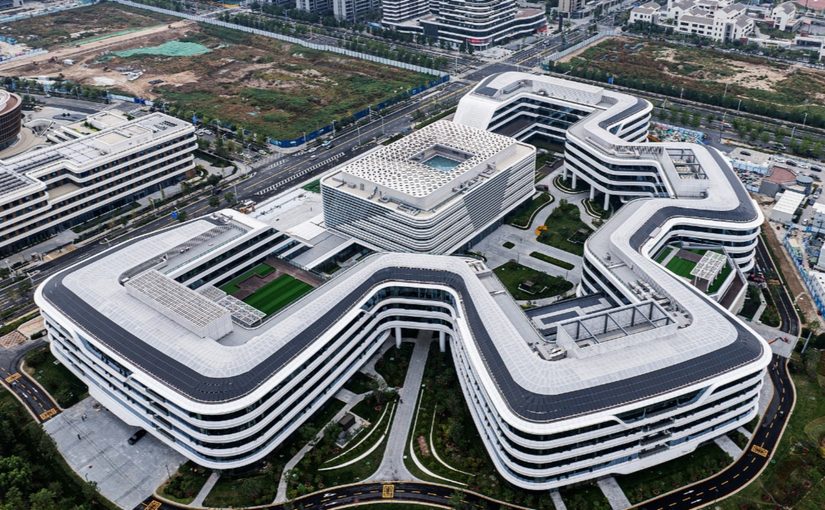
The 2026 Global Governance Forum (Xiong’an), the first gathering of its kind, was held in Xiong’an New Area, Hebei province from October 23-25. Hosted by the Chinese People’s Institute of Foreign Affairs (CPIFA), it was themed “Rebuilding Confidence and Cooperation: Reforming and Improving Global Governance in a Transforming World”. It was attended by around 400 representatives from political, strategic, academic, business, media, and youth sectors from more than 90 countries and international and regional organisations, including the United Nations.
Our co-editor Keith Bennett attended at the invitation of CPIFA and spoke at a roundtable on “Revitalising the World Trade Organisation: Where is the path forward?”, which formed part of a parallel session on the overall theme of “Upholding equality and mutual benefit, and deepening reform of the economic and financial governance system”. The roundtable was organised and hosted by Beijing’s University of International Business and Economics (UIBE).
Interventions were also made by speakers from China, Singapore, Georgia, Germany and Brazil and a lively discussion followed.
The following is the main body of Keith’s prepared opening remarks.
Today, the World Trade Organisation stands at a critical crossroads. An institution that once claimed to stand at the forefront of an inexorable tide of globalisation now faces mounting challenges. Protectionism is resurgent. Geopolitical tensions increasingly influence trade policy. Unilateral sanctions, tariff wars, and export restrictions have become a favoured and capricious modus operandi of a certain big power in particular. As a result, confidence in multilateral institutions is weakened.
A fundamental question therefore confronts us:
Will international trade continue to be governed by common rules, or will it increasingly be governed by hegemony and brute force?
In such a situation I would suggest that revitalising the WTO requires three things:
- First, defending multilateralism.
- Second, restoring confidence in the rules-based trading system.
- Third, ensuring that the voices and interests of developing countries remain at the centre of WTO reform.
When China joined the WTO in December 2001, there were many sceptics, not least, it must be said, among friends of China who feared that both the country’s competitiveness in international markets and its socialist system might be swept away in a neoliberal tsunami. However, the actual results surely surpassed nearly all expectations.
Over the following decades, China became the principal engine of global economic growth. Hundreds of millions of Chinese people were lifted out of poverty. China became the major trading partner for the majority of countries in the world.
Indeed, China’s experience stands as perhaps the greatest demonstration of what globalisation can achieve when supported by stable institutions and predictable rules.
Today some of the countries that championed globalisation most enthusiastically in 2001 now appear increasingly sceptical of it. Meanwhile, China, which entered the WTO later than many others, has become one of the strongest advocates of multilateralism, open trade, and international economic cooperation.
A key purpose of the WTO was to ensure that trade disputes could be resolved through agreed rules rather than through coercion or economic strength. The WTO therefore held the potential to give smaller and developing nations and emerging and frontier economies in particular confidence that their rights would be protected regardless of their economic size.
Of course, the WTO was far from perfect. But it provided a framework within which countries with different political systems, cultures, and levels of development could cooperate for mutual benefit.
However, that capacity has been severely weakened by the continuing paralysis of the WTO Appellate Body. Since 2017, the United States has repeatedly blocked the appointment of new Appellate Body members, preventing the institution from functioning normally and effectively crippling the final stage of WTO dispute settlement.
Without a fully functioning appeals process, disputes can remain unresolved. Enforcement becomes more difficult and confidence in the system declines. The fallout disproportionately affects developing countries, who often lack economic leverage and extensive legal resources.
The importance of an effective dispute settlement system can be illustrated by the experience of Brazil. In a famous dispute, back in 2002, Brazil successfully challenged aspects of US cotton support programmes through the WTO. The WTO found that important elements of those subsidies were inconsistent with international trade obligations and distorted global markets.
This showed that a major developing country could successfully use multilateral rules to defend its legitimate interests, even when confronting the world’s largest economy.
Against such a backdrop, of which the Brazilian case is but one example, China’s position deserves careful attention:
- China has consistently argued that WTO reform should strengthen rather than undermine multilateralism.
- China has called for the restoration of a fully functioning dispute settlement system.
- China has emphasised the importance of openness, consultation, and cooperation.
- China has repeatedly stressed that developing countries must retain a meaningful voice in shaping the future trading system.
Naturally, these positions, which embody President Xi Jinping’s concept of an equitable and inclusive globalisation that benefits all, resonate strongly throughout Asia, Africa, and Latin America.
A revitalised WTO cannot be built solely around the priorities of advanced economies. The majority of WTO members are developing countries and their interests need to be respected. Any reform process that ignores this reality is destined not to succeed.
Humanity is presently standing at a crossroads. Between the law of the jungle, ‘might makes right’ and ‘either at the table or on the menu’ on the one hand and a community of shared future for humanity on the other.
If the WTO is to be revitalised, if globalisation is to become genuinely equitable and inclusive, and if developing countries are to be able to repose faith in the international economic order, then the principles of equality and multilateralism need to be truly placed at the centre of global trade governance.
In that effort, China’s role will be indispensable.