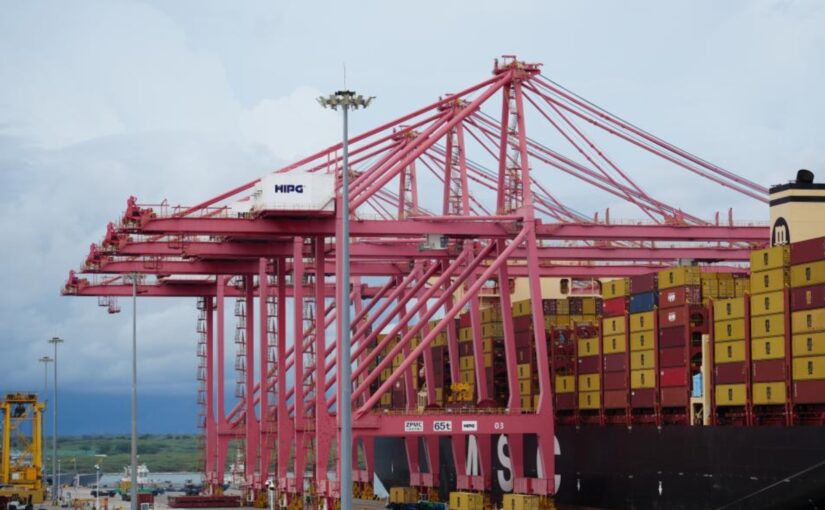
For years, Sri Lanka’s Hambantota port was the textbook example of what Western politicians called Chinese “debt-trap diplomacy” – the claim that Beijing lures poor countries into unpayable loans and then seizes their strategic infrastructure. In the following article, Friends of Socialist China co-editor Carlos Martinez shows how comprehensively that story has collapsed.
Drawing on studies by Chatham House, the Johns Hopkins economist Deborah Bräutigam and Sri Lankan officials themselves, Carlos sets out the facts: the port was a Sri Lankan initiative, not a Chinese one; Washington and Delhi were asked to fund it and declined; and Chinese loans made up just 9 percent of Sri Lanka’s government debt. As the country’s then ports minister put it, “We thank China for arranging this investor to save us from the debt trap.” Sri Lanka’s debt crisis “was made on Wall Street, not in Beijing.”
Far from a predatory white elephant, Hambantota has become one of the fastest-growing trans-shipment hubs in the Indian Ocean, drawing the largest foreign investment in Sri Lankan history. The real debt trap, the article argues, is sprung by the IMF, the World Bank and Western bond markets – and the campaign against the Belt and Road is “a blatant act of self-projection.”
Hambantota, the deep-water port on the south coast of Sri Lanka, was for years the canonical example of what the Trump administration’s erstwhile vice-president Mike Pence labelled “debt-trap diplomacy” – the supposed Chinese practice of luring poor countries into unsustainable loans, then seizing strategic infrastructure when repayment failed.
Presenting a menacing, predatory China exploiting hapless developing nations to extend its reach and dominance, Hambantota became a top New Cold War talking point, propagated by Western journalists, Indian think tanks and Washington policy advisors alike.
However, the most obvious problem with the story was that it was patently untrue.
A succession of careful studies – by Chatham House, by Deborah Bräutigam at Johns Hopkins, and by Sri Lankan officials with first-hand knowledge of the negotiations – has now systematically dismantled the whole story.
First, the port project was not proposed by China. It was conceived in the 1970s by a Sri Lankan parliamentarian, D. A. Rajapaksa, and championed by his son, the future president Mahinda Rajapaksa. Feasibility studies were carried out by Canadian and Danish firms. Sri Lanka approached the United States and India for funding, and both declined. Only then did China step in, with the China Export–Import Bank (Exim Bank) lending and China Harbour Engineering as the contractor.
When Sri Lanka subsequently fell into debt crisis, this was driven not by Chinese lending but by Sri Lanka’s massive borrowing on Western-dominated capital markets – borrowing made cheap by post-2008 quantitative easing, then made suddenly expensive when the US Federal Reserve began winding down its programme in 2013. Chinese loans constituted just 9 percent of Sri Lankan government debt by 2016. The Hambantota loans specifically constituted 4.8 percent.
The 2017 concession agreement was painted as a debt-for-asset swap, but the reality was considerably less sinister: China Merchants Port leased the port for $1.12 billion in fresh investment, which Sri Lanka used to pay down its much larger Western creditors. Sri Lanka’s minister of ports at the time, Mahinda Samarasinghe, put it plainly: “We thank China for arranging this investor to save us from the debt trap”.
Sri Lanka’s debt trap was made on Wall Street, not in Beijing. As for the accusation that the Chinese military would use Hambantota as a naval base, that was always nonsense. The lease agreement explicitly prohibits the use of the port for military purposes. There have been no Chinese naval vessels at Hambantota, and the port is subject to US Coastguard inspections under the International Port Security scheme.
What has actually happened at Hambantota over the last few years? The port has actually become a major regional success.
Under the management of China Merchants Port – a state-owned operator with stakes in 42 ports across 25 countries, including Greece, Belgium and France – Hambantota has been transformed from a loss-making white elephant into one of the fastest-growing trans-shipment hubs in the Indian Ocean. By 2023 it was handling 700,000 vehicles, up 26 percent year-on-year. It has expanded its Sri Lankan staff from 300 in 2017 to more than 1,000 today. In November 2023 the Sri Lankan cabinet approved a $4.5 billion oil refinery to be built by Sinopec adjacent to the port – the largest foreign direct investment in Sri Lankan history.
Now, in 2026, comes the next phase. In March, the Hambantota International Port Group signed a $108 million agreement with Shanghai Zhenhua Heavy Industries – the world’s leading manufacturer of port cranes – for six quay cranes, 16 rubber-tyred gantry cranes and 40 trailers. The new quay cranes will have a 72-metre outreach and a 65-tonne lifting capacity, enabling the port to handle the largest container vessels currently in operation. The investment will activate the port’s 1,300-metre container berth and lift annual capacity to around two million TEUs (Twenty-Foot Equivalent Units). Sri Lanka’s minister of ports has described Hambantota as “evolving into a modern, integrated port and industrial ecosystem capable of meeting the diverse needs of global maritime stakeholders”.
This is the Belt and Road Initiative in practice: massive long-term investment; transfer of technology; training of local workers; integration into a global logistics network; substantial revenue generation for the host country’s economy.
Sri Lanka’s ambassador to China between 2020 and 2023, Palitha Kohona, summarised the partnership: “It was not unusual that Sri Lanka, like many other developing countries, decided to work with Chinese companies due to China’s advanced skill levels, stunning technology and cost advantages. The Chinese role in Sri Lanka’s debt is grossly exaggerated and exploited mischievously for political advantage.”
You will not, of course, read any of this in the Western press. The same news organisations that carried out a multi-year campaign against Chinese “neocolonialism” have shown no interest whatever in the port’s subsequent transformation. Their interest in Hambantota was never journalistic; it was ideological. The story existed to serve a specific anti-China narrative. Once it could no longer be credibly sustained, the Western media simply moved on to the next anti-China story.
Who actually traps developing countries in debt? The IMF and the World Bank do. Wall Street’s bond markets do. The European Central Bank’s monetary policy does. The US Federal Reserve does. Across the Global South, more than three-quarters of external sovereign debt is owed not to other states but to private Western financial institutions – institutions with no obligation to consider the development needs of their borrowers, and every incentive to extract the maximum possible return. The track record of structural-adjustment programmes, debt-driven austerity and IMF-imposed privatisations across Africa, Latin America and South Asia over the last four decades is the actual story of debt and neocolonialism in our time.
The Belt and Road Initiative offers, by contrast, infrastructure, technology transfer, training and long-term investment on terms vastly more favourable than the major Western institutions have ever extended. That is why some 150 countries have signed up to it.
The BRI embodies three things that Western imperialism hates: the Global South’s emergence from dependency; the growing influence of the People’s Republic of China and its friendly, mutually beneficial relations with the rest of the developing world; and the emerging multipolar alternative to the Western-dominated global order. The Western media’s obsession with Chinese “debt traps” is thus nothing more than a demonisation campaign and a blatant act of self-projection.






I am very pleased to read this report. I always suspected the “debt-trap” narrative to be false and more of a projection than any reality. The profound ideological difference between China’s BRI and Western IMF is clear in this story.
China has a long history of involvement in Africa. Mao saw African development as central to its own modernisation. The US has the very opposite view: Global South development challenges US hegemony.