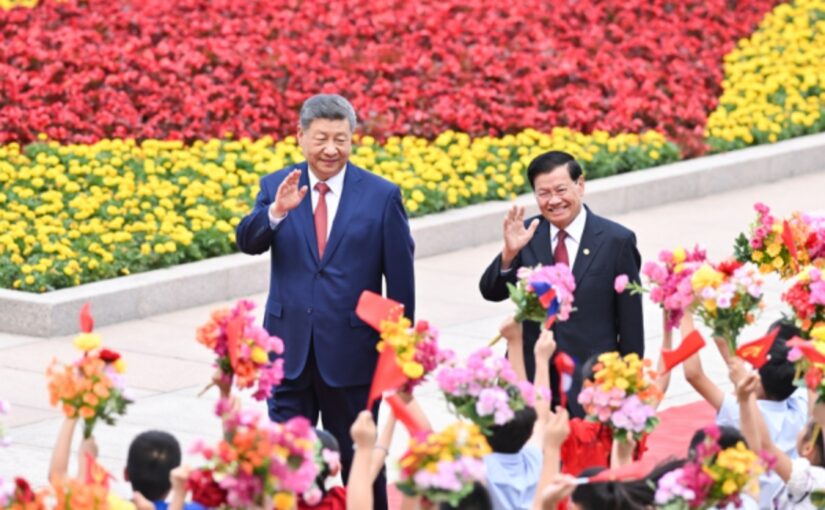
General Secretary of the Lao People’s Revolutionary Party (LPRP) Central Committee and President of the Lao People’s Democratic Republic (LPDR) Thongloun Sisoulith paid a state visit to China from June 2-6 at the invitation of his Chinese counterpart Xi Jinping.
Sisoulith began his visit in Hangzhou, capital of east China’s Zhejiang Province.
On the afternoon of June 5, General Secretary of the Central Committee of the Communist Party of China (CPC) and President Xi Jinping held talks with Sisoulith at the Great Hall of the People in Beijing.
According to the Chinese Foreign Ministry report, Xi Jinping once again congratulated Thongloun Sisoulith on his re-election as General Secretary of the LPRP Central Committee and President of Laos. Xi noted that China has always regarded Laos as a priority in its neighbourhood diplomacy, firmly supports Laos in pursuing a socialist path suited to its own national conditions, and stands ready to work with the Lao side to carry forward traditional friendship, deepen mutually beneficial cooperation, and enhance solidarity and coordination. China is willing to work with Laos to achieve a new leap in bilateral ties and build an all-weather China-Laos community with a shared future in the new era.
Xi Jinping put forward four points for advancing China-Laos relations and building a higher-standard, higher-quality and higher-level bilateral community with a shared future:
- Keep to the socialist path. The two sides should jointly safeguard the socialist system and the leadership of communist parties, maintain close strategic communication, implement the new five-year cooperation plan between the two parties and deepen exchanges on governance experience.
- Consolidate the foundation of mutually beneficial cooperation. China is willing to strengthen strategic alignment with Laos and foster new growth drivers for cooperation. The two countries should capitalise on the advantages of the China-Laos Railway as a golden transport corridor. They should deepen cooperation in traditional sectors such as agriculture and electricity while expanding collaboration in emerging areas including artificial intelligence and the digital economy, and China will continue to provide assistance within its capacity to Laos.
- Strengthen traditional friendship between the two peoples. Taking the Year of China-Laos Friendship as an opportunity, the two sides should expand cooperation in culture, education, health care and local exchanges, make good use of their shared revolutionary heritage, and enhance mutual understanding and friendship between the two peoples.
- Improve coordination on foreign policies. China appreciates Laos for adhering to the one-China principle, supporting the four major global initiatives, taking an active part in the Belt and Road cooperation, as well as firmly supporting China’s core interests and major concerns. China looks forward to Laos playing a greater role in regional and international affairs. The two sides should strengthen multilateral coordination and safeguard the common interests of the Global South.
Thongloun Sisoulith stated this visit carries great significance, as it is his first official overseas visit since his re-election as General Secretary of the LPRP Central Committee and President of Laos, which also falls on the 65th anniversary of bilateral ties and the Year of Laos-China Friendship. The Lao side expresses sincere gratitude for China’s long-standing support and assistance to Laos.
China now stands as the leading banner for the socialist system and developing countries, and a mainstay in safeguarding world peace and promoting the building of a multipolar world. China’s development has provided valuable experience for the vast number of developing countries, including Laos.
After the talks, the two sides jointly witnessed the signing of cooperation documents covering areas such as inter-party exchanges, people’s wellbeing, finance, customs, trade, youth exchanges and media.
The KPL Lao News Agency also carried a report of the meeting.
The Lao leader also met with Chinese Premier Li Qiang on the same day.
Li said that China is willing to enhance strategic communication and close collaboration with Laos and promote the building of the China-Laos community with a shared future.
Noting that this year marks the 65th anniversary of diplomatic relations, Li said China and Laos have always relied on each other and offered mutual assistance over the years. Especially in recent years, under the strategic guidance of the top leaders of the two parties and countries, China-Laos relations have ushered in the best period in history.
He added that China is willing to enhance the alignment of development strategies with Laos and fully unleash the positive effects of China’s zero-tariff policy. China will continue to scale up bilateral trade, further advance cooperation on the China-Laos railway, accelerate the construction of the China-Laos Economic Corridor, and expand cooperation in energy and mineral resources, artificial intelligence, the digital economy and other fields to deliver more practical results.
Thongloun expressed gratitude to China for the valuable support and assistance it has provided over a long period of time, adding that Laos will firmly adhere to the one-China principle and firmly support China’s core interests on issues such as Taiwan, Xinjiang and Hong Kong.
The Lao News Agency added that both sides welcomed the growing cooperation in trade, investment, infrastructure, energy and connectivity, including the recent inauguration of the 500-kilovolt Laos-China power transmission line.
Thongloun Sisoulith also met with Zhao Leji, a member of the Standing Committee of the Political Bureau of the Communist Party of China Central Committee and chairman of the National People’s Congress (NPC) Standing Committee.
During his visit to Zhejiang prior to his arrival in Beijing, Sisoulith visited Yucun Village in Anji County. This is where President Xi Jinping first advanced the concept that “lucid waters and lush mountains are invaluable assets” in August 2005. (An article reproduced below provides detailed background on this.)
Prior to his high-level meetings in Beijing, on June 4, Sisoulith visited the Central Party School of the Communist Party of China as well as the Beijing Aerospace City, where he was briefed on China’s latest achievements in aerospace science and technology.
He also met with former Chinese ambassadors and Chinese volunteer veterans who supported Laos during its national liberation struggle and participated in road construction projects in northern Laos during the 1960s and 1970s. The meeting provided an opportunity for the Lao leader to express appreciation for their contributions to the longstanding friendship and cooperation between Laos and China.
In a special article written for the 65th anniversary of China-Laos diplomatic relations, Thongloun Sisoulith wrote that: “Regardless of how the international landscape has evolved, the Laos-China friendship has remained steadfast, resilient, and ever stronger, demonstrating the ideological values, and the remarkably stable and vibrant strategic cooperation that characterise the Laos-China relations.
“Guided by the spirit of the ‘Four Goods’, namely good neighbours, good friends, good comrades, and good partners, our two countries elevated relations to a comprehensive strategic cooperative partnership in 2009. This important milestone laid a solid political foundation conducive to expanding cooperation across all fields. In 2017, our two Parties and States further enhanced cooperation and established the Laos-China Community of Shared Future, opening a new chapter of deeper solidarity, greater mutual trust and closer strategic coordination.
“Today, the Laos-China relationship stands at its highest point in history, serving as a model of equality, mutual respect and mutually beneficial cooperation…
“The Lao PDR reaffirms its unwavering commitment to closely cooperate with the People’s Republic of China, in supporting efforts to coordinate comprehensive joint development strategies, advance mutual development, deepen reform, and broaden international cooperation, and jointly pursuing the path of socialist development in accordance with the respective national conditions.”
On June 4, China’s People’s Daily released a video highlighting the deep friendly ties between China and Laos, told largely through the eyes of successive generations of the Lao Pholsena family, who have long maintained a personal friendship with Xi Jinping, since the children of the family studied at Beijing Bayi School in the 1960s, where they came to know and befriend their schoolmate Xi, inaugurating a friendship that has lasted for over half a century.
The video is embedded below, and the following articles were originally published on the website of the Chinese Foreign Ministry and by the Xinhua News Agency and the KPL Lao News Agency.
Xi Jinping Holds Talks with General Secretary of the Central Committee of the Lao People’s Revolutionary Party and Lao President Thongloun Sisoulith
June 5 (MFA) – On the afternoon of June 5, 2026, General Secretary of the Central Committee of the Communist Party of China (CPC) and President Xi Jinping held talks with General Secretary of the Central Committee of the Lao People’s Revolutionary Party (LPRP) and Lao President Thongloun Sisoulith, who is on a state visit to China, at the Great Hall of the People in Beijing.
Xi Jinping once again congratulated Thongloun Sisoulith on his re-election as General Secretary of the LPRP Central Committee and President of Laos. Xi Jinping noted that China has always regarded Laos as a priority in its neighborhood diplomacy, firmly supports Laos in pursuing a socialist path suited to its own national conditions, and stands ready to work with the Lao side to carry forward traditional friendship, deepen mutually beneficial cooperation, and enhance solidarity and coordination. China is willing to work with Laos to achieve a new leap in bilateral ties and build an all-weather China-Laos community with a shared future in the new era.
Xi Jinping put forward four points to advancing China-Laos relations and building a higher-standard, higher-quality and higher-level bilateral community with a shared future.
First, keep to the socialist path. The two sides should jointly safeguard the socialist system and the leadership of communist parties, maintain close strategic communication, implement the new five-year cooperation plan between the two parties and deepen exchanges on governance experience. The two countries should take the establishment of a “3+3” strategic dialogue mechanism involving diplomacy, defense and public security as an opportunity to strengthen law enforcement and security cooperation and crack down on cross-border crimes.
Second, consolidate the foundation of mutually beneficial cooperation. China is willing to strengthen strategic alignment with Laos and foster new growth drivers for cooperation. The two countries should capitalize on the advantages of the China-Laos Railway as a golden transport corridor, advance development along the route and push for the “juxtaposed border control” so as to upgrade cooperation under the China-Laos Economic Corridor. It is important to accelerate the connectivity of the China-Laos-Thailand Railway to achieve broader regional interconnectivity at an early date. The two sides should deepen cooperation in traditional sectors such as agriculture and electricity while expanding collaboration in emerging areas including artificial intelligence and the digital economy, and China will continue to provide assistance within its capacity to Laos.
Third, strengthen traditional friendship between the two peoples. Taking the Year of China-Laos Friendship as an opportunity, the two sides should expand cooperation in culture, education, health care and local exchanges, make good use of their shared revolutionary heritage, and enhance mutual understanding and friendship between the two peoples. China is willing to work with Laos to implement talent training programs and deliver more “small and beautiful” livelihood projects.
Fourth, improve coordination on foreign policies. China appreciates Laos for adhering to the one-China principle, supporting the four major global initiatives, taking an active part in the Belt and Road cooperation, as well as firmly supporting China’s core interests and major concerns. China looks forward to Laos playing a greater role in regional and international affairs. The two sides should strengthen multilateral coordination and safeguard the common interests of the Global South.
Thongloun Sisoulith stated this visit carries great significance, as it is the first official overseas visit since his re-election as General Secretary of the LPRP Central Committee and President of Laos, which also falls on the 65th anniversary of bilateral ties and the Year of Laos-China Friendship. The Lao side expresses sincere gratitude for China’s long-standing support and assistance to Laos. During the visit, Thongloun Sisoulith noted that he witnessed China’s tremendous achievements under the guidance of Xi Jinping Thought on Socialism with Chinese Characteristics for a New Era. China now stands as the leading banner for the socialist system and developing countries, and a mainstay in safeguarding world peace and promoting the building of a multipolar world. China’s development has provided valuable experience for the vast number of developing countries, including Laos. The bilateral relations are at their best in history, and the Lao side firmly adheres to the one-China principle and supports the series of major global initiatives put forward by General Secretary Xi Jinping. Laos highly values and supports the elevation of bilateral relations and stands ready to strengthen political mutual trust, enhance defense and law enforcement cooperation, jointly combat online gambling and telecom fraud, deepen cooperation in trade, investment, mineral resource development, clean energy, digital economy, modern agriculture and ecological protection, and promote people-to-people exchanges, so as to elevate the building of an all-weather Laos-China community with a shared future for the new era to higher levels.
After the talks, the two sides jointly witnessed the signing of cooperation documents covering areas such as inter-party exchanges, people’s wellbeing, finance, customs, trade, youth exchanges and media.
Prior to the talks, Xi Jinping and his wife Peng Liyuan held a welcome ceremony for Thongloun Sisoulith and his wife Naly Sisoulith on the square outside the eastern entrance of the Great Hall of the People. As Thongloun Sisoulith arrived, honor guards lined up in salutation. After Xi Jinping and Thongloun Sisoulith stepped onto the reviewing stand, the military band played the national anthems of China and Laos. A 21-gun salute was performed on the Tian’anmen Square. Thongloun Sisoulith reviewed the guard of honor of the People’s Liberation Army and watched the march-past in Xi Jinping’s company. Children holding flower bouquets and waving the party flags and national flags of China and Laos cheered to greet them.
In the evening, Xi Jinping and Peng Liyuan hosted a welcome banquet for Thongloun Sisoulith and his wife in the Golden Hall of the Great Hall of the People.
Cai Qi, Wang Yi, and other officials attended the relevant events.
Chinese premier pledges efforts with Laos to advance community with shared future
BEIJING, June 5 (Xinhua) — China is willing to enhance strategic communication and close collaboration with Laos, and promote the building of the China-Laos community with a shared future to a higher level, Chinese Premier Li Qiang said here on Friday.
Li made the remarks when meeting with General Secretary of the Lao People’s Revolutionary Party Central Committee and Lao President Thongloun Sisoulith, who is on a state visit to China.
Noting that this year marks the 65th anniversary of diplomatic relations, Li said China and Laos have always relied on each other and offered mutual assistance over the years. Especially in recent years, under the strategic guidance of the top leaders of the two parties and countries, China-Laos relations have ushered in the best period in history.
Li said China is willing to enhance the alignment of development strategies with Laos and fully unleash the positive effects of China’s zero-tariff policy. China will continue to scale up bilateral trade, further advance cooperation on the China-Laos railway, accelerate the construction of the China-Laos Economic Corridor, and expand cooperation in energy and mineral resources, artificial intelligence, the digital economy and other fields to deliver more practical results.
China is willing to import more high-quality products from Laos and encourage Chinese-funded enterprises to invest in Laos, and hopes that Laos will provide a more favorable business environment for Chinese companies, said Li.
Noting that this year marks the Year of China-Laos Friendship, Li said China is ready to work with Laos to successfully host a series of celebration activities, deepen cooperation in culture, tourism, education, healthcare and other fields, and carry forward the traditional friendship between the two countries.
He also urged close coordination between the two countries to encourage all parties to jointly uphold the rules-based multilateral trading system and protect free trade and economic globalization.
Thongloun expressed gratitude to China for the valuable support and assistance it has provided over a long period of time, adding that Laos will firmly adhere to the one-China principle and firmly support China’s core interests on issues such as Taiwan, Xinjiang and Hong Kong.
He added that Laos is willing to strengthen cooperation in trade, digitalization, minerals, energy and other fields, promote exchanges and cooperation in culture and tourism, enhance coordination under mechanisms such as the Lancang-Mekong Cooperation, and work for more achievements in building a community with a shared future between Laos and China.
Lao president visits Zhejiang to learn about China’s green development practices
HANGZHOU, June 4 (Xinhua) — General Secretary of the Lao People’s Revolutionary Party Central Committee and Lao President Thongloun Sisoulith made a trip to Anji County in east China’s Zhejiang Province Wednesday to learn about China’s practices in green development.
At the entrance of Yucun Village, Thongloun took a photo of the inscription carved on a boulder, which reads “lucid waters and lush mountains are invaluable assets.”
Yucun is the concept’s birthplace and the boulder stands as a spiritual landmark that has guided the village to pursue an eco-friendly development path.
On his visit, Thongloun talked with the operator of Chunlin Villa, Yucun’s first agritainment business. He was impressed when told it now earns over 1 million yuan (around 146,621 U.S. dollars) annually, which reflects the village’s transformation from reliance on quarrying to developing eco-tourism.
Before leaving, Thongloun presented the village with a hand-made souvenir plate patterned with Laos’ national treasure That Luang Temple, and received a miniature replica of the inscription boulder as a return gift.
Thongloun also visited a homestay cluster in Anji’s Lingfeng national tourist resort. The national model homestay community has drawn over 100 young entrepreneurs and generated an annual revenue of more than 100 million yuan.
He spoke highly of Anji’s practices of attracting investment and rolling out supportive policies, which had created job opportunities for local young people and college graduates returning to their hometown.
Thongloun said his visit to Zhejiang has given him first-hand insight into China’s socialist modernization achievements.
This year marks the 65th anniversary of diplomatic relations between China and Laos and the China-Laos Friendship Year. Thongloun said he expects the state visit, which also includes a visit to Beijing, to further deepen bilateral practical cooperation and deliver more outcomes for the two countries’ comprehensive strategic cooperative partnership.
Xi Story: When lush mountains become a measure of governance
HANGZHOU, June 5 (Xinhua) — In August 2005, sweltering heat hung over a hilly village in east China. Inside a modest meeting room, an air conditioner hummed against the summer heat as Xi Jinping, then chief of the Zhejiang provincial committee of the Communist Party of China (CPC), met local officials during an inspection tour.
Yucun Village in northern Zhejiang had made a painful yet pivotal choice: shutting down three quarries and a cement plant that had long been its economic lifeline.
In the 1990s, the village had prospered on limestone mining and cement production, but at a visible cost: hillsides were carved open, streams had turned murky and dust constantly hung in the air.
The economic impact of the closures was immediate. As incomes fell, growing discontent from the villagers placed mounting pressure on local officials.
When village Party chief Bao Xinmin reported the decision to Xi, the atmosphere in the room was tense. At a time when economic development, mostly measured by GDP growth, dominated official performance evaluation, abandoning lucrative industries was no easy choice.
Sensing the concern among the village officials, Xi asked why the quarries and the plant were shut down.
Pollution had become unbearable, Bao replied. “Years of mining and lime production left our village constantly covered in dust and thick smoke. It felt as if we were living in a toxic cage,” he said.
“Your decision is a wise choice!” Xi said, to everyone’s surprise.
“Every choice comes with gains and losses. When you can’t have it both ways, you need to know what to give up and what to choose. Development can take many forms, but it must be sustainable,” he said.
It was then that Xi put forward what would later become one of China’s best-known environmental concepts: “Lucid waters and lush mountains are invaluable assets.”
Such thinking emerged from Zhejiang’s own realities. As one of China’s coastal provinces, Zhejiang was among the early movers in dealing with the tension between short-term economic gain and long-term ecological sustainability.
Xi’s tenure in Zhejiang from October 2002 to March 2007 was also a pivotal transformation period for the province’s development. While Zhejiang maintained steady economic progress, the problems stemming from its extensive growth model were looming large, in the form of tight land supply, worsening pollution and severe power shortages resulting from over-dependence on resource-driven investment.
At the height of the energy crunch, in some rural parts of Zhejiang, power was only available half the week. More than 50 percent of enterprises had experienced power outages. Many businesses, and even ordinary households, had to install their own generators.
After a series of field visits, Xi in 2003 unveiled a development blueprint in which ecological advancement was given a prominent place.
This overarching plan guided local cadres to recalibrate their views on governance achievement.
Sun Wenyou, then Party secretary of the city of Huzhou, recalled that Xi stressed on multiple occasions that short-term economic gains must never come at the expense of the environment, nor should officials seek vanity projects to polish their performance records.
Li Jinming, a former deputy Party chief of Zhejiang, recalled that Xi cautioned against overemphasis on GDP growth as the sole criterion for officials’ performance, stressing that what mattered most to ordinary people was tangible improvements in livelihoods.
Improving the ecological environment, Xi argued, is a form of developing productive forces.
This idea found its clear expression in Yucun. The former cement plant site was turned into green fields. As environmental conditions improved, villagers began opening guesthouses and farm stays.
What began in Yucun has come to reflect a provincial and then national shift in development philosophy, embedding green principles into the pursuit and evaluation of development.
After assuming the top office as the general secretary of the CPC Central Committee in 2012, Xi made ecological civilization a national priority. China launched a series of far-reaching environmental initiatives, expanding both the scope of regulation and the capacity to enforce it.
Environmental performance has also become an important criterion in cadre evaluation. Central government environmental inspections have prodded local officials to place greater emphasis on ecological protection.
After years of smog and severe air pollution, blue skies are now the new normal in China. In 2025, 89.3 percent of the days in the year recorded good or excellent air quality, the highest level ever recorded.
By championing green development, China has also recorded the world’s fastest growth in forest resources, taken a global lead in renewable energy development, and achieved one of the fastest reductions in energy intensity worldwide.
To underpin such progress, China’s top legislature in March this year adopted a landmark Ecological and Environmental Code, laying a solid legal cornerstone for pursuing Chinese modernization with human-nature harmony as one of its distinctive features.
When Xi revisited Yucun in 2020, he found a village transformed, with verdant hills, crystal-clear streams, tidy roads and rows of modern homes. Ecotourism projects were flourishing, and villagers were earning decent incomes.
Xi looked back on the village’s green transformation and said its experience had proved that green development was the right path.
“Once the right direction has been chosen, it should be pursued with determination,” Xi said.
Lao Party Leader Visits CPC Central Party School, Aerospace Research Center
June 5 (KPL) – Lao Party General Secretary and President Thongloun Sisoulith visited the Central Party School of the Communist Party of China in Beijing on June 4 as part of his state visit to China.
Thongloun and his delegation were welcomed by Xie Chuntao, Executive Vice President of the Central Party School, who briefed the delegation on the institution’s role in training senior Party and government officials and conducting policy research for the Chinese leadership. The Lao leader praised the school’s contributions to political education, public administration and governance, and highlighted its support in training Lao officials in areas such as Party building, leadership and state management. Later, Thongloun visited Beijing Aerospace City, where he was briefed on China’s latest achievements in aerospace science and technology. He also met with former Chinese ambassadors and Chinese volunteer veterans who supported Laos during its national liberation struggle and participated in road construction projects in northern Laos during the 1960s and 1970s. The meeting provided an opportunity for the Lao leader to express appreciation for their contributions to the longstanding friendship and cooperation between Laos and China.
Opinion on the 65th Anniversary of the Diplomatic Relations between Laos and China
By Thongloun Sisoulith, General Secretary of the Lao People’s Revolutionary Party and President of the Lao PDR
June 5 (KPL) – This year marks the 65th anniversary of the establishment of diplomatic relations between the Lao People’s Democratic Republic and the People’s Republic of China. The two sides have designated 2026 as the “Laos-China Friendship Year” and have jointly organized a wide range of meaningful activities to commemorate this historic occasion.
Over the past six and a half decades, our bilateral relations have withstood the tests of global transformations and uncertainties. Regardless of how the international landscape has evolved, the Laos-China friendship has remained steadfast, resilient, and ever stronger, demonstrating the ideological values, and the remarkably stable and vibrant strategic cooperation that characterize the Laos-China relations.
Guided by the spirit of the “Four Goods”, namely good neighbors, good friends, good comrades, and good partners, our two countries elevated relations to a comprehensive strategic cooperative partnership in 2009. This important milestone laid a solid political foundation conducive to expanding cooperation across all fields. In 2017, our two Parties and States further enhanced cooperation and established the Laos-China Community of Shared Future, opening a new chapter of deeper solidarity, greater mutual trust and closer strategic coordination.
Today, the Laos-China relationship stands at its highest point in history, serving as a model of equality, mutual respect and mutually beneficial cooperation. High-level political trust and shared ideals have continuously delivered tangible benefits to the peoples of both nations.
In the field of economic cooperation, China has become the largest investor and the second-largest trading partner of the Lao PDR. In key sectors of shared potential, including energy, mining, agriculture and infrastructure development.
Most notably, the Laos-China Railway stands as a landmark symbol of this successful cooperation and a flagship project of the high-quality Belt and Road Initiative. This project has become a “golden corridor” connecting the two countries and the wider region, transforming the Lao PDR from a landlocked to a land-linked country, bringing transformative changes and new development opportunities to the Lao PDR.
China remains important development partner, providing financial assistance to the Lao PDR. In particular, the Party, Government and people of China have extended generous support through the “4×100 Project” announced by President Xi Jinping in 2017, which has made significant contributions to the development of healthcare, human resources and the improvement of the living standards for the Lao people.
At the regional and international levels, in the current uncertain global situation, it is increasingly important for developing countries to stand united, uphold multilateralism, and build a more just, fair, and equitable global order. Laos and China share a common commitment to promoting development and ensuring that the benefits of globalization are more equitably shared.
The Lao PDR fully supports China’s global initiatives, such as the Global Development Initiative, the Global Security Initiative, the Global Civilization Initiative, and the Global Governance Initiative.
Within the ASEAN framework, Laos and China have closely supported each other through the implementation of the five ASEAN-China Action Plans covering the three pillars of the ASEAN Community and ASEAN Connectivity. The Lao PDR highly values the 5th anniversary of the ASEAN-China Comprehensive Strategic Partnership (2021-2026), which will be jointly commemorated, and expresses its deep appreciation to the People’s Republic of China for its steadfast support during Laos’ three ASEAN Chairmanships.
In addition, in 2027, the Lao PDR stands ready to assume the role of the ASEAN-China Coordinating Country for the period 2027-2030 to further advancing the ASEAN-China Comprehensive Strategic Partnership and continuously advance deepening the Laos-China bilateral relations.
Within the Mekong-Lancang Cooperation (MLC) Framework, Laos and China have jointly created a new era in transforming natural rivers into rivers of peace, friendship and sustainable development, becoming an efficient and effective cooperation mechanism capable of translating shared visions into tangible and lasting results for the peoples of the region.
The Lao PDR reaffirms its unwavering commitment to closely cooperate with the People’s Republic of China, in supporting efforts to coordinate comprehensive joint development strategies, advance mutual development, deepen reform, and broaden international cooperation, and jointly pursuing the path of socialist development in accordance with the respective national conditions.
We will further strengthen the traditional friendship, the stable and long-term comprehensive strategic partnership guided by the Four Good Principles, and build a Laos-China Community with a Shared Future that is deeper, higher standards, higher quality, and at higher level, to truly bring greater civilization and prosperity to the people of our two nations.






Thank you, Laos and Friends of Socialist China!