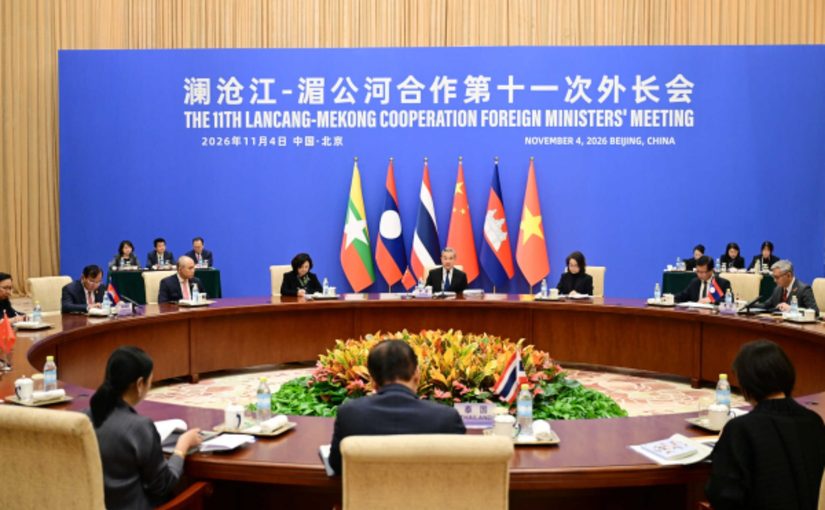
On November 4, 2026, the 11th Lancang-Mekong Cooperation (LMC) Foreign Ministers’ Meeting was held in Beijing. The meeting was co-chaired by Chinese Foreign Minister Wang Yi and Deputy Prime Minister and Minister of Foreign Affairs of Thailand Sihasak Phuangketkeow. The LMC mechanism links China with its five neighbours who jointly share this major Asian river and the meeting was also attended by Cambodian Deputy Prime Minister and Foreign Minister Prak Sokhonn, Lao Deputy Prime Minister and Foreign Minister Thongsavanh Phomvihane, Vietnamese Foreign Minister Le Hoai Trung, and Union Minister for National Planning, Investment and Foreign Economic Relations of Myanmar U Aung Kyaw Hoe.
Addressing the meeting, Wang Yi said that this year marks the 10th anniversary of the first LMC Leaders’ Meeting. Over the past decade, under the strategic guidance of the leaders of the six countries, the LMC has moved from a phase of building, in which the framework was set up and areas of cooperation expanded, to a phase of deep engagement, in which mechanisms are strengthened and practical results are emphasised, becoming the most dynamic and promising “golden example” of regional cooperation.
He put forward a five-point proposal:
- Pool new synergies for solidarity and collective strength. We should conduct regular exchanges between the legislative bodies and political parties of Lancang-Mekong countries, resolve differences and disputes through dialogue and consultation, and enhance security and resilience through development and cooperation.
- Build a new frontier for opening-up and win‑win outcomes. We should effectively implement the Lancang-Mekong Special Cooperation Plan on Poverty Reduction through Science and Technology, advance the building of the information sharing platform for water resources cooperation, and increase the sense of gains of the people in the basin through more exemplary small and beautiful livelihood programmes.
- Foster new impetus for green innovation. We should expand cooperation in emerging areas such as the digital economy, artificial intelligence, smart manufacturing and smart agriculture, and promote the transformation of regional industrial cooperation toward new, smarter and greener development.
- Consolidate new underpinnings for security. We should oppose external interference and intervention, oppose instigating bloc confrontation, resist the building of exclusive “small circles”, and never allow the resurgence of militarism.
- Foster new highlights in disaster management. We should push for the establishment of the Lancang-Mekong cross-border disaster early-warning cooperation mechanism, set up a real-time multi-source data exchange mechanism among Lancang-Mekong countries on hydrology, meteorology, geology and forest fires, and strengthen cooperation in disaster monitoring, early warning and emergency response, create a regional network for meteorological disaster monitoring and early warning, and build a demonstration network of earthquake early warning stations, so as to jointly enhance capabilities of disaster prevention, mitigation and relief.
The meeting participants agreed to strengthen the building of the LMC Economic Development Belt, deepen cooperation in priority areas such as connectivity, water resources and the environment, expand digital transformation and green innovation, and promote people‑to‑people and cultural exchanges. They agreed to strengthen disaster management, maintain close security coordination, combat cross‑border crimes, and safeguard regional tranquillity. They further agreed to promote the alignment and mutual reinforcement between the LMC and other regional mechanisms, uphold multilateralism, jointly address global challenges, and work together to build a Lancang‑Mekong community with a shared future.
Wang Yi also held bilateral meetings with his five counterparts, from Laos, Myanmar and Thailand on November 3, and from Vietnam and Cambodia on November 4.
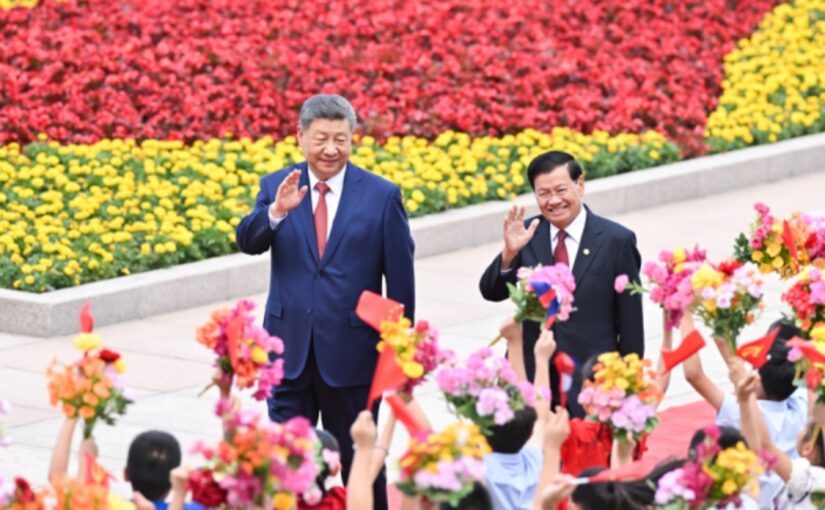
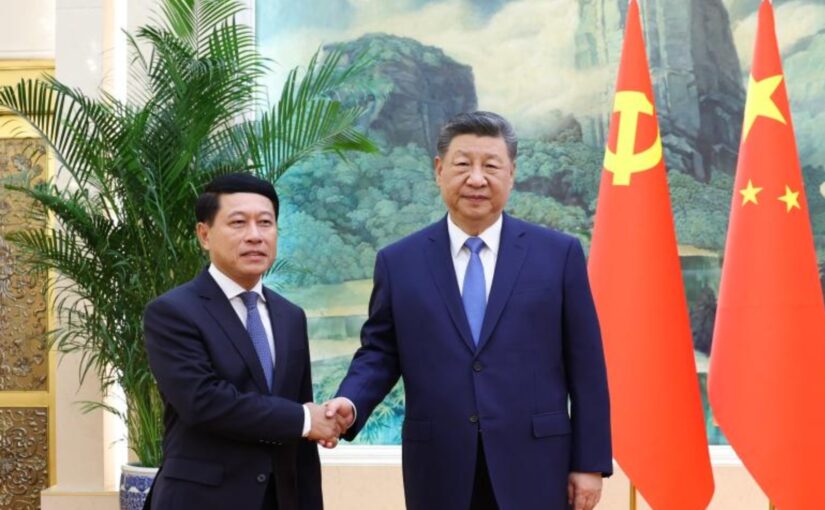
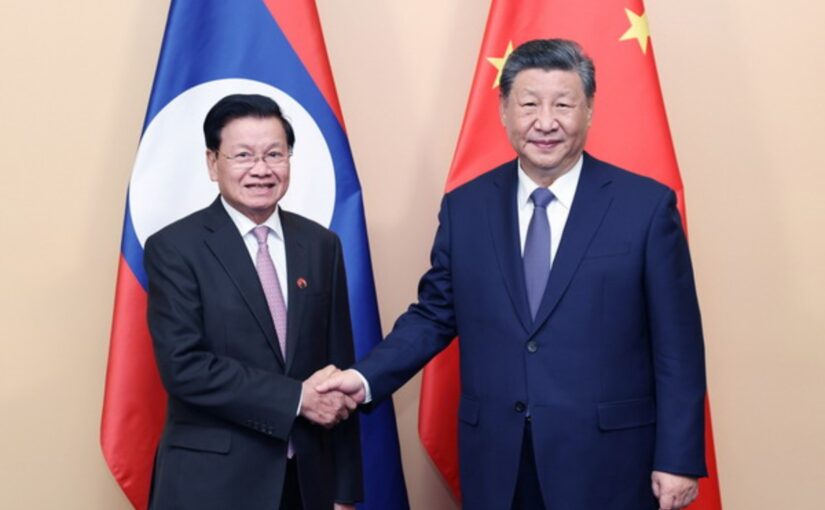
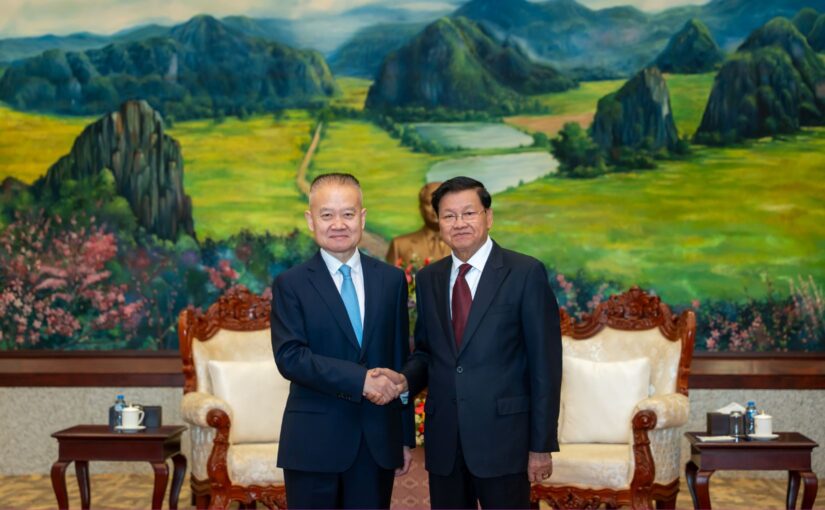
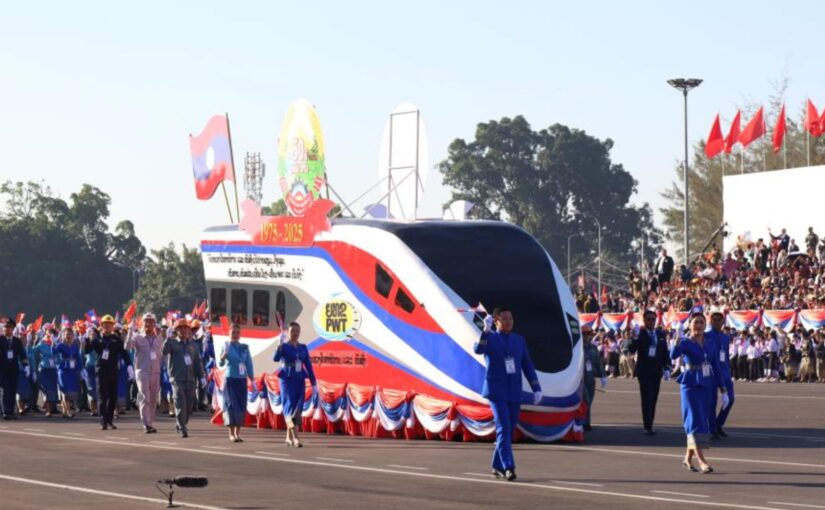
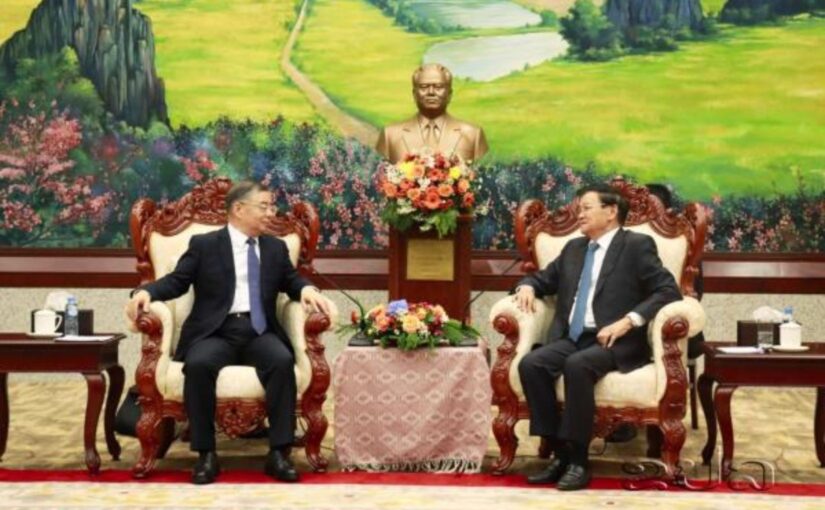
Meeting with Lao Deputy Prime Minister and Foreign Minister Thongsavanh Phomvihane, Wang Yi stated that China and Laos are friendly socialist neighbours sharing a common future, with shared ideals and convictions, the same social systems and similar development paths. This year marks the 65th anniversary of the establishment of diplomatic relations between China and Laos and the “Year of China-Laos Friendship”. In June, General Secretary of the Communist Party of China (CPC) Central Committee and President Xi Jinping and visiting General Secretary of the Central Committee of the Lao People’s Revolutionary Party (LPRP) and Lao President Thongloun Sisoulith jointly announced the decision to build an all-weather China-Laos community with a shared future in the new era. China and Laos are socialist comrades and brothers. The two sides should maintain strategic resolve and focus on managing their own affairs well. In the next stage, the two sides should make joint preparations for high-level exchanges, make good use of the Joint Committee for China-Laos Economic Corridor Cooperation, and accelerate the development of the China-Laos Railway and cooperation in trade, minerals and other fields. They should jointly organise activities for the “Year of China-Laos Friendship”, vigorously promote people-to-people and cultural exchanges, strengthen solidarity and coordination in multilateral and regional affairs, and deliver more tangible results in building a China-Laos community with a shared future.
Thongsavanh Phomvihane stated that the Lao side warmly congratulated the CPC on the important outcomes of the Fifth Plenary Session of the 20th Central Committee of the party. Laos stands ready to strengthen exchanges with the CPC on its experience in Party and state governance, learn from the CPC’s valuable experience, and advance the development of the LPRP and the state. Taking the 65th anniversary of the establishment of diplomatic relations between Laos and China as an opportunity, Laos is ready to unswervingly advance the building of a Laos-China community with a shared future in accordance with the consensus reached by the top leaders of the two parties and countries.
Meeting with Minister of the Ministry of National Planning, Investment and Foreign Economic Relations of Myanmar U Aung Kyaw Hoe, Wang Yi said that in June this year, President Xi Jinping held an important meeting with President Min Aung Hlaing during his state visit to China. The two sides agreed to accelerate the building of a China-Myanmar community with a shared future. China supports political reconciliation in Myanmar and supports the country’s new government in stabilising the situation, developing the economy, improving people’s livelihoods and revitalising the country.
U Aung Kyaw Hoe stated that Myanmar upholds the Five Principles of Peaceful Coexistence, carries forward the traditional friendship between Myanmar and China, and always adheres to the one-China principle. President Min Aung Hlaing’s successful visit to China recently gave a strong boost to the development of bilateral relations. Myanmar thanked China for its assistance with post-earthquake reconstruction and expressed its readiness to work with China to accelerate the implementation of projects under the Myanmar-China Economic Corridor and continuously enhance the level of mutually beneficial cooperation between the two countries. Myanmar will step up efforts to combat telecom fraud in cooperation with China and other countries in the region.
Meeting with Deputy Prime Minister and Minister of Foreign Affairs of Thailand Sihasak Phuangketkeow, Wang Yi said that the concept of “China-Thailand Family” has become more deeply rooted in the hearts of the two peoples. The two countries have always understood, trusted and supported each other, continuously enriching their traditional friendship with new dimensions suited to the times. China appreciates the new Thai government, led by Prime Minister Anutin Charnvirakul, for its firm commitment to a friendly policy toward China. This serves Thailand’s fundamental and long-term interests and contributes to regional peace and stability. He noted that, amid a turbulent and volatile international landscape, strengthening cooperation among neighbouring countries is of vital importance. Lancang-Mekong Cooperation is one of the most successful subregional cooperation mechanisms in the region. China highly appreciates Thailand’s important contributions to the development of Lancang-Mekong Cooperation and stands ready to work with Thailand, as co-chair countries, to make good preparations for the Fifth Lancang-Mekong Cooperation Leaders’ Meeting.
Meeting with Vietnamese Foreign Minister Le Hoai Trung, Wang Yi said that since the beginning of this year, under the personal guidance of the top leaders of the two Parties and two countries, the building of a China-Vietnam community with a shared future has been deepened and consolidated. The two sides have strengthened strategic communication, deepened economic, trade and investment cooperation and connectivity, carried out more active people-to-people and cultural exchanges, jointly responded to the new challenges of the world’s unprecedented changes in a century, and made new contributions from China and Vietnam to building a community with a shared future for humanity. General Secretary Xi Jinping emphasised that to govern the country, the Party must be governed first, and only when the Party thrives can the country be strong. The just-concluded Fifth Plenary Session of the 20th Central Committee of the CPC made strategic arrangements for persevering with full and rigorous party self-governance, demonstrating the firm determination of the CPC to carry out the great self-reform to the end. We will earnestly and solidly implement the major arrangements of the Fifth Plenary Session, so that the CPC will always maintain its advanced nature and purity, consolidate the flesh-and-blood ties with the people, and continue to be the core force leading the Chinese people in advancing Chinese modernisation. The current global political and economic situation proves that the socialist path and institutional choices adhered to by China and Vietnam are correct. The two parties share common ideals and beliefs as well as common practices in party and state governance. They should strengthen mutual learning and mutual support, continuously enrich the contemporary connotation of the China-Vietnam community with a shared future, promote the modernisation process of their respective countries, and inject new impetus into the revitalisation of the world socialist cause, so that Marxism will radiate vitality in the 21st century.
Le Hoai Trung congratulated the successful convening of the Fifth Plenary Session of the 20th CPC Central Committee, expressing the belief that the important arrangements of the session will push China into a new stage of development. The 14th National Congress of the Communist Party of Vietnam (CPV) also put forward the line and policies for the self-renewal of the CPV and the realisation of the two centenary goals. Under the strategic guidance of the top leaders of the two parties and two countries, Vietnam-China relations have continued to develop, with fruitful cooperation results in various fields.
Meeting with Cambodian Deputy Prime Minister and Foreign Minister Prak Sokhonn, Wang Yi said that China and Cambodia are ironclad friends, and the friendship between the two countries, which has stood the test of time, embodies the painstaking efforts of leaders of successive generations. Facing the intertwined and turbulent international situation, the stability and resilience of China-Cambodia comprehensive strategic cooperation have become increasingly prominent. As Cambodia’s most reliable strategic support, China will continue to firmly support Cambodia in taking a development path that suits its national conditions and is ready to strengthen strategic communication with Cambodia to jointly meet external challenges and better promote the respective modernisation drives of the two countries.
Prak Sokhonn said that China is Cambodia’s most trustworthy partner. The historic mutual visits between the leaders of the two countries have pointed out the direction for developing the all-weather Cambodia-China community with a shared future in the new era. The Cambodian side fully supports all initiatives put forward by President Xi Jinping, congratulates the CPC on the successful convening of the Fifth Plenary Session, thanks China for its long-term support and assistance for Cambodia’s economic and social development, reaffirms its adherence to the one-China principle, supports China’s great cause of peaceful reunification, and opposes all forms of “Taiwan independence”.
Wang Yi also had an informal “tea chat” with his Cambodian and Thai counterparts as part of China’s ‘quiet diplomacy’ aimed at resolving tensions between the two countries centring on their disputed border.
Following the conclusion of the meeting, Wang Yi met the press jointly with Deputy Prime Minister and Minister of Foreign Affairs of Thailand Sihasak Phuangketkeow.
Wang said that since its launch in 2016, under the strategic guidance of the leaders of the six countries, the LMC has maintained strong momentum and built an all-round, multi-level, and wide-ranging cooperation architecture, continuously delivering tangible and inclusive outcomes. The saying that the six LMC countries have not only a shared river but also a shared future has taken even deeper roots among the people, and the LMC can be called the most dynamic stellar example of regional cooperation.
The six foreign ministers agreed that more in-depth and substantive progress has been made in building communities with a shared future between China and the five Mekong countries, and noted that the annual trade between the two sides now surpassed US$500 billion, an increase of 150 percent over a decade ago and accounting for about half of the trade volume between China and ASEAN (Association of South East Asian Nations). Wang Yi added that a river surges on ceaselessly, linking us with a shared future. China will work with Mekong countries to act not as “talk shops” but as “bulldozers,” stay problem-oriented, deliver more real benefits, put people’s livelihoods first, take action as the priority, and adopt more robust measures to advance common modernisation, so as to keep the LMC at the forefront of regional cooperation, set a benchmark for the solidarity and collective strength of the Global South, and jointly inject the positive energy of the LMC into today’s turbulent and complex world.
Continue reading ‘Mekong Six’ meet in Beijing