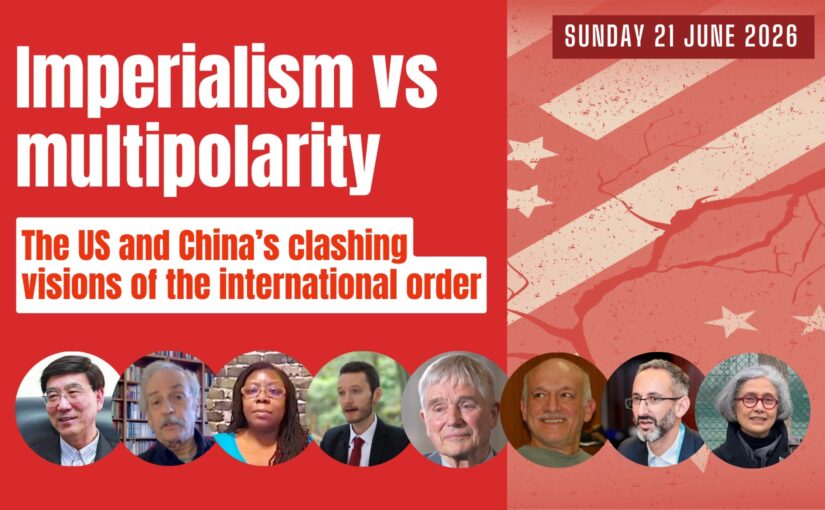
On 21 June, Friends of Socialist China and the International Manifesto Group co-hosted a webinar, “Imperialism vs multipolarity”, bringing together a distinguished international panel to discuss the Trump-Xi summit in Beijing, the tariff and Iran wars, US military aggression across the Global South, and the emerging shape of the world order.
The discussion was moderated by Radhika Desai (Professor at the University of Manitoba and convenor of the International Manifesto Group), and brought together Ben Norton (founder and editor-in-chief of Geopolitical Economy Report); Cheng Enfu (President of the World Association for Political Economy), whose paper was presented by Professor Ding Xiaoqin; Ken Hammond (Professor of History at New Mexico State University and a founder of Pivot to Peace); Jacquie Luqman (coordinator with the Black Alliance for Peace); Mick Dunford (Emeritus Professor at the University of Sussex); Mike Klonsky (educator, author and veteran activist); Jenny Clegg (author of China’s Global Strategy: Towards a Multipolar World); and Carlos Martinez (co-editor of Friends of Socialist China).
The full livestream can be viewed at the end of this article, below our report of the discussion.
When Donald Trump arrived in Beijing in May for talks with Xi Jinping – the first visit by a US president in nine years – the observant could detect a major shift in the international order. The trip Trump had hoped to make in triumph was made instead amid the wreckage of his failing war on Iran, on top of the earlier failure of his tariff war against China. Rather than projecting power, he was left with little choice but to treat China as a peer.
It was against this backdrop that, on 21 June, a panel of analysts, scholars and activists gathered online for a wide-ranging discussion of the summit and its aftermath, the tariff war, US military aggression across the Global South, and the prospects for the world to come.
Moderated by Radhika Desai, the panel brought together Ben Norton, Cheng Enfu, Ken Hammond, Jacquie Luqman, Mick Dunford, Mike Klonsky, Jenny Clegg and Carlos Martinez. What follows is a summary of their arguments.
The direction of the chaos
Radhika Desai opened by insisting on a point that runs against most mainstream commentary: the turbulence convulsing the world is not a symmetrical “clash of great powers” but has a definite direction. All of it – the violence, the sanctions, the threats – emanates from the North Atlantic, from the homelands of a capitalism whose ability to subordinate the periphery has been deteriorating since 1914 and is now failing fast.
For the same reason, she argued, this is not a third world war. The First World War was a conflict between rival capitalist-imperialist powers; today capitalism’s principal adversaries are socialist and anti-imperialist states committed not to advancing their own hegemony but to rolling imperialism back, defending their sovereignty and trying – unlike the West – to keep the escalation ladder long rather than short.
Even the fashionable disdain for the United Nations, she suggested, misses what the UN represents: the moment when the sovereign equality of formerly colonised nations had to be acknowledged, and the inclusion of the Soviet Union and finally the People’s Republic of China among the permanent members of the Security Council.
Two speeches, two visions
Ben Norton, joining from Beijing, distilled the clash into two speeches delivered back to back this February. Marco Rubio – now both Secretary of State and National Security Adviser – gave what Ben called “an ode to colonialism”, condemning anti-colonial uprisings and lamenting the spread of the hammer and sickle across the map.
Moments later, China’s foreign minister Wang Yi called for true multilateralism, greater democracy in international relations, and respect for sovereignty and the UN Charter.
The difference, Ben said, is night and day. China’s newly elaborated Global Governance Initiative – set out in a comprehensive white paper this June – is a direct response to American unilateralism, but it explicitly refuses to swap US hegemony for a Chinese one; it calls instead for democratising the UN so that it represents the global majority rather than a Western minority. And that majority, Ben stressed, increasingly sees things China’s way: polling by Gallup, Pew and even the NATO-linked Democracy Perception Index now finds China more popular than the United States across most of the world, with large majorities opposing the empire of some 800 US military bases.
Multipolarity is not a new hegemony
Cheng Enfu’s paper, read by Professor Ding Xiaoqin, developed the philosophical core of the Chinese position. The central question of our time, he argued, is “not China or the United States” but a choice between two visions of order: one based on hegemony, bloc politics and zero-sum competition, the other on sovereign equality, peaceful development and mutual benefit. Multipolarity, properly understood, does not mean China replacing the US at the apex of a hierarchy; it means democratising international relations so that the rising Global South can participate as equals. China’s initiatives – the Belt and Road, and on development, security, civilisation, global governance and AI – embody principles of sovereign equality, common development, dialogue among civilisations, common security and shared benefit. The transition will be long and contested, because hegemonic structures do not dissolve of their own accord; but it expresses an objective trend in world development whose purpose is to move beyond hegemony altogether.
The long view of history
Ken Hammond set the present moment in a longer arc. The world of 1780, he reminded the audience, was genuinely multicentric – China, India, the Islamic world, West Africa and north-western Europe, among others, were all dynamic, none dominant. The Western monopoly on modern industrial technology, established through the industrial revolution, produced a historically brief but brutal two-century interlude of imperialist domination, in which economies from China to Bengal were deliberately hollowed out.
That monopoly has now been broken, decisively, by China – a country whose scale and, crucially, whose socialism make it impossible to assimilate to the usual story of post-colonial development. What we are living through, Ken argued, is not the birth of a new hegemony but a return to a multicentric world, with China as an example and a partner rather than a new dominant centre.
What the summit revealed
Jacquie Luqman, of Black Alliance for Peace, brought the discussion down to the texture of the summit itself. The decision to take the CEOs of Amazon, Tesla, Palantir and so on to Beijing said everything about what the “rules-based order” really is: not diplomacy but capitalism, backed by the military as the alternative on offer. She drew out the revealing gap between the US and Chinese accounts of the agricultural and rare-earth deals – Washington trumpeting Chinese purchases while concealing its own concessions on Chinese dairy and seafood, and China calmly declining to expand rare-earth access for weapons rather than green energy. The lesson other nations are drawing, from Bolivia to the Congo, is that they no longer face US dollar hegemony alone.
Mick Dunford deepened the civilisational argument. Five hundred years before Europeans put guns on ships, the Chinese mariner Zheng He sailed the Indian Ocean bearing gifts and colonised nobody. China, he argued, is not merely a different society but a different kind of civilisation – a civilisation-state whose traditions of tianxia (all under heaven) and gongsheng (symbiosis) stand opposed to Western individualism, and whose history shows that the absence of a hegemon need not mean chaos, contrary to Antony Blinken’s insistence that without US “leadership” the world falls apart.
Western prosperity, Mick noted, is sustained by vast net inflows extracted through dollar seigniorage, intellectual-property rents and military dominance – which is precisely why China, by refusing debt dependence and protecting its resources and policy autonomy, represents such a fundamental challenge.
Contradictions inside the empire
Veteran activist Mike Klonsky, speaking from the US, returned to Lenin: imperialism is not a policy but a system of monopoly finance capital. Multipolarity, on this reading, is the breakdown of that system’s old order. He pointed to two recent events that expose the contradictions running inside the imperialist camp: Israel’s sabotage of the Iran peace deal it was supposed to honour over Lebanon, and Washington’s lawsuit against Germany for daring to lower its drug prices. Both show allies beginning to act independently – and both, Mike argued, create openings for organisers in the imperialist heartlands themselves, who can now point to concrete alternatives.
China plays the long game
Jenny Clegg offered a granular strategic analysis. The US, unable to meet China’s technological challenge alone, has readjusted: burden-sharing with proxies (Europe against Russia, Israel in West Asia, Japan in the Pacific), a focus on choke-points from the Malacca Strait to semiconductors, and a “might is right” abandonment of international law.
But China has built a toolkit to manage this – its huge market, its growing use of sanctions, and above all its control of the critical minerals on which the new US strategy depends, with which it gripped Washington “in a finger-lock”.
The Iran war exposed the limits of the US’s financial strategy too, with the Saudis now selling a good deal of their oil in renminbi. Drawing a firm red line on Taiwan while declining to demand the “full package”, China, Jenny suggested, is playing a patient, long game – inching forward bit by bit, and, in her memorable phrase, looking to “let the US down gently”.
Iran as the sharpest illustration
Carlos Martinez closed by arguing that the war on Iran was the clearest expression of the two clashing visions. It was a last throw of the dice for the “new American century” – aimed not only at the last great pole of resistance in West Asia but, through Iran’s position on the Belt and Road and its role as a BRICS and SCO partner, at China itself.
It backfired spectacularly: the US burned through perhaps 30 percent of its Tomahawks and half its THAAD interceptors – weapons stockpiled for a confrontation with Beijing – and emerged diplomatically isolated.
Today’s Iran survived where Mossadegh’s Iran could not, thanks to its own unity and preparedness, its ability to throttle a fifth of the world’s energy through the Strait of Hormuz, and a more multipolar world willing to act: China condemned the war, kept buying Iranian oil, and openly ordered its firms to defy US secondary sanctions; China and Russia vetoed a war-enabling Security Council resolution, having learned the lesson of Libya in 2011; and Pakistan brokered the ceasefire with Beijing’s backing.
The outcome has accelerated rather than arrested multipolarity: Iran emerges strengthened and oriented eastward, the divide-and-rule strategy of Shia–Sunni conflict is eroded, Israel is more isolated than ever, and the Abraham Accords are effectively doomed. The choice now before every country is whether to cling to a declining empire or join the rising majority of humanity building a world based on sovereignty, development and peace.