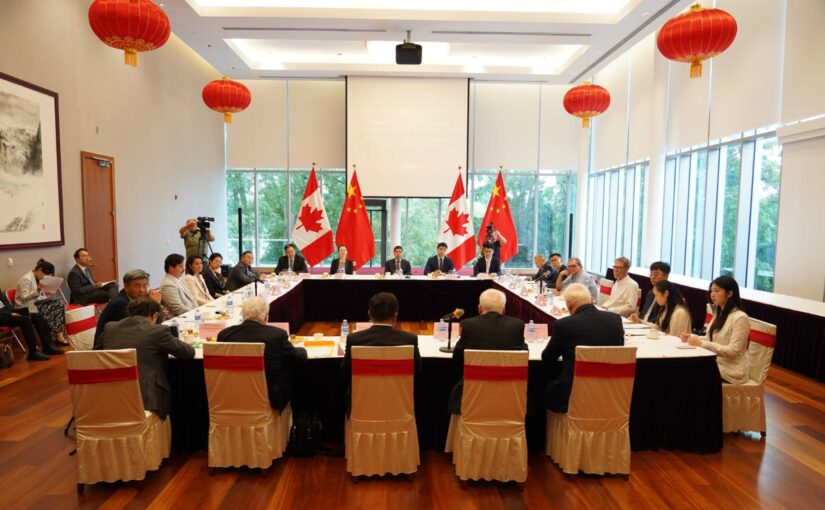
On July 3, 2026, the Embassy of the People’s Republic of China in Ottawa, Canada, organised a Roundtable Discussion to celebrate the 105th anniversary of the founding of the Communist Party of China, under the theme, ‘Working Together to Build the China-Canada New Strategic Partnership’. In his opening remarks, Ambassador Wang Di highlighted that throughout its 105-year history, the CPC has been and remains the backbone of all advances in China. This includes the period of reform and opening up. As part of the development of modern China based on socialism with Chinese characteristics, the CPC, he continued, has changed the future and life of all Chinese people and has always stood on the right side of history. On the international stage, the Ambassador highlighted, among other points, the Chinese notion of a shared future for world peace. He stated that this gathering is taking place in the context of the new China-Canada Strategic Partnership, an important milestone since China and Canada first established diplomatic relations in 1970. The following guests participated in the roundtable:
- Victor Oh: former Canadian Senator;
- Warren Bethune: President of the Canada-China Friendship Association in Toronto and a relative of the legendary Canadian internationalist Dr. Norman Bethune;
- Arnold August: author and journalist, who is a contributor to this website and active participant in the work of Friends of Socialist China in North America;
- Dan Donovan: Publisher and Editor-in-Chief, Ottawa Life Magazine;
- Julian Karagusian: Visiting Lecturer, McGill University, Montreal;
- Claire Citeau: Senior Vice-President, Trade and Global Relations, Canadian Meat Council;
- Miguel Figueroa: former President of the Canadian Peace Congress;
- Maxime Proud: Co-Founder and President, China Canada Futures Foundation;
- Alex MacDonald: Member of the Executive of the Ottawa Club of the Communist Party of Canada;
- Lu Hongmin: Chairman, Board of Directors, Federation of Ottawa Chinese Canadian Community Organisations;
- Deng Jun: President of the Canada China Chamber of Commerce;
- Chen Chen: Chinese student representative, the University of Ottawa.
In his concluding remarks, Ambassador Wang mentioned the important role of Norman Bethune, about whom everyone in China knows. Other speakers also noted that Bethune was the most famous member of the Communist Party of Canada.
The following article was originally published on the website of the Chinese Embassy in Canada. It is followed by the remarks delivered by Arnold August.
We also embed a brief video for which Arnold recently received the Best Friendship Award, presented by the Chinese Embassy in Canada, the Chinese People’s Institute of Foreign Affairs (CPIFA), and The Paper, as part of the short video contest, ‘My Story with China’.
In the video, Arnold recalls his lifelong interest in China and the Chinese revolution, stemming first from his father’s travels as one of the first Canadian businessmen to engage with the new China. The video also includes clips from trips made to China by Arnold in 2006 and 2022. He concludes with an endorsement of the late Pierre Trudeau’s 1961 call for a positive approach to China. Trudeau visited China in 1949 and 1960. As Prime Minister he established diplomatic relations with the country on October 13, 1970, and visited China, October 11-18, 1973, meeting Mao Zedong, Zhou Enlai and other leaders.
Chinese Embassy in Canada holds roundtable marking the CPC’s 105th anniversary
July 7 (Chinese Embassy in Canada) – On July 3, the Chinese Embassy in Canada held a roundtable celebrating the 105th anniversary of the founding of the Communist Party of China (CPC) and discussing the building of the China-Canada New Strategic Partnership. H.E. Wang Di, Chinese Ambassador to Canada, delivered remarks at the event. Representatives from various sectors of Canadian society, Chinese enterprises and students in Canada, and members of the Chinese community attended the roundtable.
Ambassador Wang elaborated on President Xi Jinping’s speech at the gathering in celebration of the 105th anniversary of the founding of the CPC. He emphasized that China will continuously promote the building of a community with a shared future for humanity, injecting more positive energy into world peace and development. Ambassador Wang noted that China and Canada should implement the important consensus reached by leaders of the two countries, be partners that respect each other, stand to gain from cooperation, trust each other and collaborate with each other in a bid to build the China-Canada New Strategic Partnership.
The participants extended their congratulations on the CPC’s 105th anniversary, spoke highly of China’s remarkable development achievements under the leadership of the CPC, and expressed their hope that China and Canada will deepen exchanges and cooperation across various fields, strengthen friendship between the two peoples, and advance bilateral relations for greater progress.
Arnold August remarks
Chinese Ambassador to Canada, His Excellency Wang Di, and the very attentive Embassy staff here in Ottawa.
Thank you very much for inviting me to this important roundtable on the occasion of the 105th anniversary of the founding of the Communist Party of China (CPC). Greetings to all participants. I am a Canadian author and journalist who strongly supports further development of the China-Canada New Strategic Partnership. Allow me to contribute to the discussion here today by highlighting two personal experiences that I hope will illustrate my view: namely, that the CPC is the leading force in what many recognise as an earth-shattering transformation of China towards a modern socialist economy with Chinese characteristics. This took place from its founding in 1921, modestly led by Mao Zedong, until today, under all its leaders, now including President Xi Jinping.
Speaking of the humble yet farsighted, courageous founding of the CPC 105 years ago, allow me to share one of my two personal experiences with you.
The first took place many decades ago, in 1966, when I read the groundbreaking book by the American journalist Edgar Snow, titled Red Star Over China: The Classic Account of the Birth of Chinese Communism, which I still have today. Snow, who met Chairman Mao on several occasions, wrote this about the founding of the party. On another night, Snow recounts, Mao continued his narrative:
“In May 1921, I went to Shanghai to attend the founding meeting of the Communist Party. In its organisation, the leading roles were played by Ch’en Tu-hsiu (Chen Duxiu) and Li Tao-chao (Li Dazhao), both of whom were among the most brilliant intellectual leaders of China. Under Li Tao-chao, as assistant librarian at Peking University, I had rapidly developed towards Marxism, and Ch’en had been instrumental in my interest in that direction too. I had discussed with Ch’en during my second visit to Shanghai, about the Marxist books that I had read, and about Ch’en’s own assertions of belief that had deeply impressed me at what was probably a critical period of my life.”
“In May 1922, the Hunan Party, of which I was then secretary, had already organised more than twenty trade unions among miners, railway workers, municipal employees, printers, and government workers. A vigorous labour movement began that winter. The work of the Communist Party was then concentrated mainly among students and workers, and very little was done among the peasants.”
“Formerly I had not fully realised the degree of class struggle among the peasantry, but after the May 30 Incident in 1925 [British Settlement police fired on demonstrators and killed several], and during the great wave of political activity which followed, the Hunan peasantry became very militant. I left my home, where I had been resting, and began a rural organisational campaign. In a few months we had formed more than twenty peasant unions, which had aroused the wrath of the landlords, who demanded my arrest and sent troops after me.”
This unflinching courage characterises all of the leaders to date, allowing them to go against the tide toward building modern China.
Speaking about contemporary Chinese modernity, allow me to share my second personal experience with you. This is a 2023 visit to Xizang (Tibet), specifically to a newly built town near old Lhasa, with its High-Tech Zone Innovation and Entrepreneurship Service Platform. Paraphrasing from my contributed chapter on Xizang, published in the new book China Changes Everything, of all places, this autonomous region exemplifies current socialism with Chinese characteristics. Why do I say, “of all places?” Well, the participants we met there were only several generations away from one of the most brutal systems in the history of mankind, serfdom in Tibet, which included forced slave labour, illiteracy, prison camps, and torture.
In this High-Tech Zone, innovation and entrepreneurship are encouraged. Anyone with a computer can apply. The appeal is simple: “Bring your ideas.” Yet there are conditions. Applicants must agree to work toward the goals of socialism and modernisation set by the People’s Republic of China (PRC) and the CPC. Membership in the CPC is not required, but anyone expelled from the party is ineligible to apply. This political orientation is clear even in the murals inside the tech centre, which display portraits of leaders from Chairman Mao to President Xi, alongside milestones of the CPC and PRC’s development, including in Xizang.
Does this political framework stifle individual initiative? Some in the West, shaped by the US-centric notion of the sacred “individual,” may think so. But what I observed suggested otherwise. The tech centre represents a refreshing balance between collective purpose and individual market creativity, a hallmark of socialism with Chinese characteristics. Innovators there integrate social responsibility with personal ambition. They are rewarded not only with the moral satisfaction of turning their ideas into reality but also with solid incomes from marketing their products, thus simultaneously contributing to the development of socialism with Chinese characteristics.
In conclusion, my main point is that, irrespective of one’s political views, open-minded individuals should not shy away from recognising the CPC’s leading role, from its humble beginnings in 1921 to its still-modest domestic and international orientation. On the contrary, by asserting the CPC’s role, one can help dismantle the US-led narrative against the CPC. And thus, in the context of the China-Canada New Strategic Partnership, contribute to its further development.
Thank you.