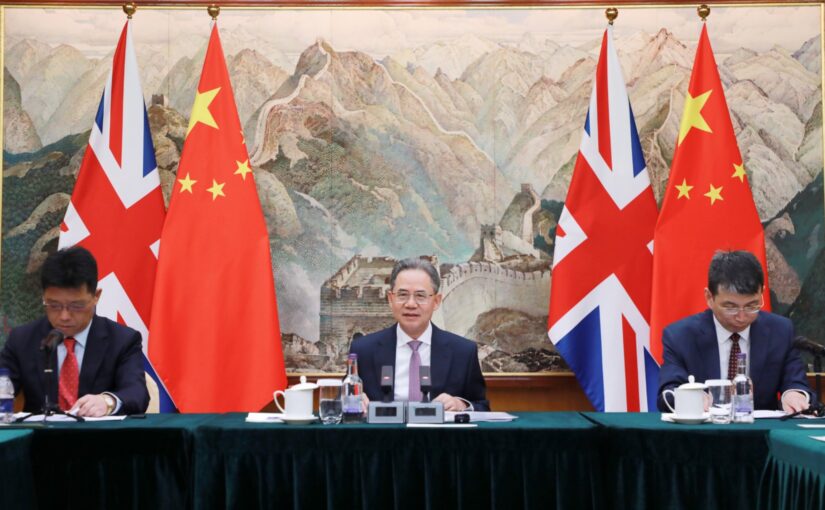
On the morning of July 6, 2026, the Chinese Embassy in the UK held a symposium entitled “The Communist Party of China and the World”, marking the CPC’s 105th founding anniversary.
The event was chaired by Minister Zhao Fei and Ambassador Zheng Zeguang delivered a keynote speech entitled ‘Reviewing the Glorious Journey, Creating New Historic Success, and Jointly Promoting the Building of a Community with a Shared Future for Humanity’.
In his presentation, Ambassador Zheng elaborated on General Secretary Xi Jinping’s important speech at the rally celebrating the 105th anniversary of the founding of the CPC, held in Beijing on July 1.
He described the speech as a political declaration for Chinese Communists to uphold and develop socialism with Chinese characteristics and continuously achieve new victories in Chinese modernisation on the new journey in the new era. It also serves as an important window through which friends from around the world can better understand the CPC.
He said that on the journey ahead, China will study and implement Xi Jinping Thought on Party Building, uphold a correct view of governance performance, persist in exercising full and rigorous self-governance of the Party, and carry forward the Party’s outstanding qualities, thus ensuring that the Party always maintains strong creativity, cohesion and combat effectiveness. Although the road ahead is full of risks and challenges, requiring constant readiness to withstand high winds, strong waves, and even turbulent storms, the CPC has strong confidence and firm resolve, and will remain steadfast and forge ahead with courage to create new historic successes.
Ambassador Zheng noted that while the CPC is committed to seeking happiness for the Chinese people and rejuvenation for the Chinese nation, it is also dedicated to advancing human progress and promoting harmony for the world.
He stressed the CPC’s readiness to engage in dialogue and exchanges and strengthen mutual learning with political parties and governments of all countries on the basis of mutual respect and equality and also briefed the participants on the development of China-UK relations since the beginning of this year.
Following the ambassador’s keynote report, contributions to the discussion were made by the following guests:
- Alex Gordon, General Secretary of the Communist Party of Britain (CPB)
- Andy Brooks, General Secretary of the New Communist Party of Britain (NCP)
- Daniel O’Brien, Vice Chair of the Communist Party of Great Britain (Marxist-Leninist) (CPGBML)
- Stephen Perry, Honorary President of the 48 Group
- The Right Honourable Lord (Neil) Davidson KC, Baron of Glen Cova, Labour Member of the House of Lords
- Sir Mark Hendrick, Labour Member of Parliament and Vice Chair of the China All-Party Parliamentary Group (APPG)
- Professor Kerry Brown, Director of the Lau China Institute, King’s College London
- Keith Bennett, Co-editor of Friends of Socialist China
- Kevan Nelson, International Secretary of the CPB
- Dr Ali Al Assam, Committee member of Friends of Socialist China
- Dr Francisco Dominguez, Committee member of Friends of Socialist China
- George Korkovelos, Culture Secretary of the CPGBML
We republish below the report of Ambassador Zheng’s keynote presentation, as originally published on the website of the Chinese Embassy to the UK, followed by the remarks of Keith Bennett, Ali Al Assam and Francisco Dominguez, speaking on behalf of Friends of Socialist China.
Chinese Embassy in the UK holds “The CPC and the World” symposium
July 7 (Chinese Embassy in the UK) – On 6 July 2026, the Chinese Embassy in the UK held a symposium entitled “The Communist Party of China and the World”. Chinese Ambassador to the UK Zheng Zeguang delivered a keynote speech entitled “Reviewing the Glorious Journey, Creating New Historic Success, and Jointly Promoting the Building of a Community with a Shared Future for Humanity”. Representatives from the UK’s political, business, academic and other sectors attended the symposium and took part in the discussion.
Ambassador Zheng elaborated on General Secretary Xi Jinping’s important speech at the rally celebrating the 105th anniversary of the founding of the CPC. He noted that General Secretary Xi’s speech comprehensively reviewed the CPC’s glorious journey over the past 105 years in uniting and leading the Chinese people of all ethnic groups and the remarkable achievements it has made. The speech identified the outstanding qualities that have enabled the CPC’s continued success, and served as a clarion call on the entire Party and the Chinese people of all ethnic groups to strengthen confidence, carry forward the struggle, and strive for new historic achievements.
He described the speech as a political declaration for Chinese Communists to uphold and develop socialism with Chinese characteristics and continuously achieve new victories in Chinese modernisation on the new journey in the new era. It also serves as an important window through which friends from around the world can better understand the CPC.
Ambassador Zheng pointed out that over the past 105 years, the CPC has remained committed to the pursuit of truth, stayed deeply rooted in the people, courageously shouldered its historical missions, followed the trend of the times, dared to fight and fight well, and continued to strengthen itself. These outstanding qualities are the key to the CPC’s great achievements.
He said that on the journey ahead, China will study and implement Xi Jinping Thought on Party Building, uphold a correct view of governance performance, persist in exercising full and rigorous self-governance of the Party, and carry forward the Party’s outstanding qualities, thus ensuring that the Party always maintains strong creativity, cohesion and combat effectiveness. Although the road ahead is full of risks and challenges, requiring constant readiness to withstand high winds, strong waves, and even turbulent storms, we have strong confidence and firm resolve, and will remain steadfast and forge ahead with courage to create new historic success.
Ambassador Zheng noted that while the CPC is committed to seeking happiness for the Chinese people and rejuvenation for the Chinese nation, it is also dedicated to advancing human progress and promoting harmony for the world. At present, changes unseen in a century are accelerating, and the world has entered a new period of turbulence and transformation. China will always stand on the right side of history and on the side of human progress, uphold the banners of peace, development and win-win cooperation, promote humanity’s common values, advance the implementation of the Global Development Initiative, the Global Security Initiative, the Global Civilisation Initiative, and the Global Governance Initiative, and work together with the peoples of all countries to build a community with a shared future for humanity and inject more positive energy into a turbulent world.
He stressed the CPC’s readiness to engage in dialogue and exchanges and strengthen mutual learning with political parties and governments of all countries on the basis of mutual respect and equality.
Ambassador Zheng also briefed the participants on the development of China-UK relations since the beginning of this year. He said that closer dialogue and cooperation between China and the UK serve the interests of both countries and the wider world. China’s policy towards the UK remains stable and consistent. Both sides should keep to the right direction of developing a long-term and consistent comprehensive strategic partnership, strengthen exchanges and cooperation, properly manage differences, and promote the steady and sustained development of bilateral relations.
Participants congratulated the CPC on its 105th anniversary. They spoke highly of China’s remarkable achievements, commended its important contribution to world peace and development, and expressed their readiness to play an active role in promoting inter-party dialogue between China and the UK, and between China and other countries.
Keith Bennett, co-editor of Friends of Socialist China
Your Excellency Ambassador Zheng Zeguang, friends and comrades,
Thank you for your invitation to myself and to my colleagues from Friends of Socialist China to take part in this important and timely exchange and for your enlightening presentations.
To pay close attention to the experience of the Communist Party of China, and the lessons drawn therefrom, on the occasion of the 105th anniversary of its founding is not simply a matter of formality – of the kind of spirit excoriated by Mao Zedong as, “so long as one is a monk one must go on tolling the bell.”
Rather today, not only the future and wellbeing of the Chinese people but also the destiny and fate of world socialism and the very future of humanity depend to a huge extent on everything going well with the Communist Party of China and on its leadership.
As General Secretary Xi Jinping pointed out in his important anniversary speech this July 1st:
“One hundred and five years of unremitting struggle have profoundly shaped the course of world history. Our Party has always stood on the right side of history and on the side of human progress… Today, as the Party leads the people in advancing Chinese modernisation, it has created a new form of human civilisation and broadened the paths by which developing countries can achieve modernisation.”
This thesis, first put forward by Xi Jinping, at the nineteenth party congress in October 2017, that socialism with Chinese characteristics offers a new path and new option for countries that wish to rapidly develop their economies while maintaining their independence, now occupies an increasingly important place in the international practice based on Xi Jinping Thought on Party Building. A fine example is the Mwalimu Julius Nyerere Leadership School in Tanzania, which brings the CPC together with the six main liberation movement parties of South Africa, Namibia, Zimbabwe, Angola, Mozambique and Tanzania.
In our view, Xi Jinping Thought on Party Building, as an important component of Xi Jinping Thought on Socialism with Chinese Characteristics for a New Era, is the latest application and development of the Marxist theory of political party building. As China is the most advanced socialist country, the CPC is a huge Marxist ruling party in a large country with a big population, and further plays a major role in world affairs, including effectively shouldering the primary responsibility for the destiny of world socialism at the present time, this has enormous significance both for China and the world.
The Thought inherits and embodies the original aspiration and intention of Marxist party building, as set out by Marx and Engels in the Manifesto of the Communist Party, that the communists, “have no interests separate and apart from those of the proletariat as a whole”.
They, “therefore, are on the one hand practically, the most advanced and resolute section of the working-class parties of every country, that section which pushes forward all others; on the other hand, theoretically, they have over the great mass of the proletariat the advantage of clearly understanding the lines of march, the conditions, and the ultimate general results of the proletarian movement.”
How to carry this forward through succeeding generations, how to inherit the red gene, amidst once in a century changes unfolding at an accelerating pace, is a crucial question that Xi Jinping Thought on Party Building addresses.
Both Mao Zedong and Deng Xiaoping pointed out, in their respective distinctive fashions, that if the socialist cause in China were to meet a serious challenge, it would likely come from within the party itself. The profound if tragic proof of this can be seen in the fate of the Soviet Union and the former socialist countries of eastern and central Europe.
As the CPC has often stressed, historical experience merits attention. Comrade Xi Jinping explained in November 2021:
“Our Party has such a long history, such a large scale, and has been in power for so long, how can we break free from the historical cycle of order and chaos, of rise and fall? Comrade Mao Zedong gave the first answer in a cave dwelling in Yan’an, namely, ‘Only by letting the people supervise the government will the government not dare to slacken’. Through a century of struggle, and especially through the new practice since the 18th Party Congress, our Party has given a second answer: self-revolution.”
Therefore, it clearly follows that among the most important aspects of Xi Jinping Thought on this question is his insistence that upholding the leadership of the Party is the most essential feature of socialism with Chinese characteristics. He has also stressed this point in his interaction with the party leaders of fraternal socialist countries such as Vietnam and it may be said to embody and sum up the entire history of proletarian party building by the international communist movement and of actually existing socialism. His thought also entails, among other crucial features, upholding the centralised and unified leadership of the Party Central Committee; strict and comprehensive self-governance of the Party; never forgetting the original aspiration and keeping the mission firmly in mind; and the integrated development of an environment in which officials dare not, cannot, and do not wish to be corrupt.
In terms of the relations between parties, I consider that Xi Jinping Thought includes, among other things, the following key elements:
Whether a party is big or small the CPC is genuinely interested in exchanging views and in mutual learning.
It makes its experiences and the lessons it has drawn available to others for their reference but does not seek to impose its views or insist on unanimity. Rather, the emphasis is on finding common ground while reserving differences.
Party-to-party relations have always been a key part of China’s diplomacy alongside state-to-state and people-to-people relations. Xi Jinping Thought on Party Building has refined and developed this so that party-to-party relations can also complement, assist and enhance state relations. And the Political Party Plus mechanism can further facilitate party diplomacy’s role in strengthening people-to-people ties, including at subnational and regional levels and in academic and cultural exchange as well as in economic affairs.
The relations between communist parties, including the ruling parties in the socialist countries, have a special character in that, whilst differences of opinion can and do exist, they share a common basis in dialectical and historical materialism along with shared aims, goals and ideals. Close similarities in aspirations, views and policies can also often be found with other socialist, national liberation, national and revolutionary democratic, and other progressive parties and movements.
However, even when sharp ideological and political differences exist, there is still value in maintaining links, exchanging views and engaging in dialogue to enhance mutual understanding, lower tensions and possibly identify areas for cooperation, including in instances where governmental channels may be blocked or hindered for whatever reason.
The significance of this therefore goes well beyond China’s borders, not least coming as it does at a time when the western bourgeois political party system is in a profound and deepening crisis that is increasingly eroding traditional parties of both right and left and also spawning such dangerous phenomena as far right and even neo-fascist parties and trends gaining in popularity and influence and contending for power 80 plus years since the victory in the world anti-fascist war. As the great Italian Marxist Antonio Gramsci aptly put it:
“The crisis consists precisely in the fact that the old is dying and the new cannot be born; in this interregnum a great variety of morbid symptoms appear.”
Xi Jinping Thought on Party Building therefore provides valuable reference and inspiration for us, in the communist and workers movements in the capitalist heartlands, too, as we seek to address and reverse such morbidity and give birth to the new.
Thank you for your attention.
Dr Ali Al Assam, committee member of Friends of Socialist China
Mr Ambassador Zheng Zeguang, distinguished guests, comrades and friends,
It is a great honour to join you today in celebrating the 105th anniversary of the founding of the Communist Party of China. I would like to thank Ambassador Zheng Zeguang and the Embassy for this kind invitation.
Over the past century, and especially since the founding of the People’s Republic of China in 1949, China has undergone one of the most remarkable transformations in human history. Hundreds of millions of people have been lifted out of poverty, scientific and technological capabilities have advanced dramatically, and China has become a major force for economic development, international cooperation and global stability.
As President Xi Jinping said in his speech marking this anniversary:
“One hundred and five years of unremitting struggle have profoundly influenced the course of world history.”
For many of us in the international progressive movement, the experience of the Communist Party of China is significant not simply because of China’s achievements, but because of the lessons it offers for socialist movements around the world.
I had the privilege of visiting China in 2024 as part of a Friends of Socialist China delegation led by Keith Bennett. During that visit we spent valuable time with Party schools, discussing Marxism, governance and China’s development experience. It was an inspiring opportunity for reflection and learning.
The Communist Parties of China and Iraq were both founded during the early decades of the twentieth century. Both emerged under conditions of foreign domination, and both sought national liberation, social justice and the mobilisation of working people.
Yet history has taken very different paths.
As communists, it is important that we continually learn from both successes and failures. President Xi’s anniversary speech highlighted several principles that I believe have particular importance.
The first is the commitment to seek truth through Marxism while continually adapting theory to changing conditions.
The second is maintaining deep roots among the people. As President Xi reminds us, “the country is the people, and the people are the country.” This principle of serving the people wholeheartedly has been central to China’s long-term success.
The third is confidence, resilience and the willingness to confront difficult challenges while maintaining faith in eventual success.
These are lessons that extend well beyond China.
Self-reliance
Another lesson that has always impressed me is the emphasis on self-reliance.
Among Iraqi communists there emerged a tradition of building democratic social and economic institutions owned by the people themselves. The late Iraqi communist leader Ibrahim Allawi called this approach Mushtarek—shared ownership and cooperative development. It continues to inspire much of our work today.
Through our Cooperative we are applying these ideas to the knowledge economy.
Working together with Iraqi universities, Huawei and many other partners, we are building the Iraqi Memory Project and the Manara University Knowledge Network. These initiatives use artificial intelligence not as a replacement for human knowledge, but as a tool to preserve culture, support research and strengthen education.
We see this as a practical contribution towards the vision expressed in China’s Global AI Governance Initiative: developing artificial intelligence for the benefit of humanity.
We are also honoured to work with China’s publishing institutions in making Chinese scholarship more accessible to Arabic-speaking readers. President Xi’s recent anniversary speech is already available within the Iraqi Memory Project, together with numerous recent publications from the Chinese publisher Contemporary World Press, translated into Arabic, Kurdish, Farsi, Urdu and other regional languages.
Together these projects are contributing to what some Chinese scholars describe as an “autonomous knowledge system”—knowledge infrastructures that preserve national memory while encouraging international cooperation and mutual learning. I look forward to discussing these ideas further during the World AI Conference in Shanghai later this month.
Comrades and friends,
We meet during a period of profound international uncertainty. US and Israeli aggression in West Asia continue to bring immense human suffering to many parts of the world, including Gaza, Lebanon and Iran. At such times, people’s solidarity and resistance backed up by China’s efforts to encourage peaceful development, mutual respect and international cooperation become even more important.
Finally, as President Xi has often reminded us, “The people are the creators of history.” As we build new knowledge infrastructures, develop new AI systems and deepen international cooperation, may we always remember that technology has value only when it serves the people.
Allow me to conclude by once again thanking Ambassador Zheng Zeguang and the Embassy for this invitation.
I wish the Communist Party of China continued success in serving the Chinese people. I wish the people of China continued peace, prosperity and scientific progress. And I wish the friendship between the peoples of China, Iraq and the United Kingdom continued growth in the years ahead.
May our shared efforts contribute to a more peaceful, more just and more knowledgeable world.
Thank you very much.
Dr Francisco Dominguez, committee member of Friends of Socialist China
The first National Congress of the Communist Party of China, held in Shanghai in July 1921, founded a party that had less than 60 members, represented by 13 delegates at the congress. The small membership were not just individuals, they gave expression to vigorous intellectual and political currents that had undertaken the gigantic task to rejuvenate the nation.
These currents included the May Fourth Movement, the New Culture Movement of 1919, the Society for the Study of Marxism, and activists organized around the New Youth Magazine (La Jeunesse). The impact and influence of the 1917 Bolshevik Revolution was also a major factor.
In his major speech marking 105 years of the Communist Party of China, President Xi Jinping described the big obstacles that needed to be removed in the historic context of 1921 so that China’s rejuvenation could be brought about: imperialism, feudalism and bureaucratic capitalism. We need to also mention another major obstacle: warlordism. And not to forget the Kuomintang. This is how some of the major obstacles did actually present themselves.
During the Warlord Era (1916-1928) there were between 100 to 200 individual military generals who operated as independent regional rulers, all of which ended up in roughly 15 to 20 warlord military factions. The number of soldiers they commanded went from 500,000 in 1916 to over two million in 1928.
President Xi Jinping said that in 1921, China was “beset by internal turmoil and external aggression and mired in poverty and weakness.” With time, China’s situation would become much worse than that.
In these 105 years have been decades, especially in the period 1921-1953, where the CPC was involved in life-or-death struggles, tests in which the CPC either managed to survive impossible odds, snatched victory from the jaws of defeat, excelled in efficiency and astuteness to overcome them, or through sheer will power and discipline succeeded in prevailing. The CPC confronted all of those situations through an objective assessment of the balance of forces, objectivity informed by an understanding of the class dynamics of the specific challenge to be confronted. Marxism played a key role.
The Shanghai Massacre of 12 April 1927 resulted in an estimated 5,000 to 10,000 deaths within Shanghai itself, though the nationwide purge it triggered—known as the White Terror—led to the execution of hundreds of thousands including communists, trade unionists, and peasant activists across China over the following years. All instigated by Chiang Kai-shek. The CPC suffered massive losses.
The Long March (1934-1936) was a 6,000-mile military retreat from Jiangxi to Yan’an. The troops crossed 18 mountain ranges, 24 major rivers, treacherous high snow mountains and deadly swampland marshes. In the journey the troops fought roughly 600 battles. The march departed with 100,000 soldiers. It ended with around 20,000 to 30,000. Throughout they were harassed by between 400,000 to 700,000 Kuomintang troops.
Then there was the all-out Japanese invasion in 1937, including the Nanjing massacre – over six weeks Japanese forces murdered some 300,000 civilians. Followed by the civil war with the Kuomintang between 1946 to 1949. Then there was the Korean War of 1950-53.
And many, many more deadly threats and challenges. The CPC survived them all and came out of it as the undisputed leadership of the working class, the peasantry and the nation.
In 2014, President Xi declared that China as a socialist, prosperous and strong nation would not exist without the CPC. He is absolutely right. Given the obstacles – imperialism, feudalism, warlordism, the Kuomintang, and bureaucratic capitalism – perhaps we can stretch his argument further. China without the CPC would not exist as a united and independent nation; it would have been balkanised, divided up among Western powers, and colonised.
Despite all of these extraordinary odds, the CPC not only survived, it has built a modern, industrially developed, technologically advanced socialist society that has massively benefitted its people, and has projected a beneficial influence in the world: building a Global Community of Shared Future. All in less than a century, and with no colonies or the exploitation or domination over other nations.
As asserted by President Xi in his speech on the CPC’s 105th anniversary: “Today, as the Party leads the people in advancing Chinese modernisation, it has created a new form of human civilisation and broadened the paths by which developing countries can achieve modernisation.”
It has indeed.
Congratulations to the CPC on being 105 years wiser!






One thought on “Chinese Embassy in London holds symposium on the CPC and the world”