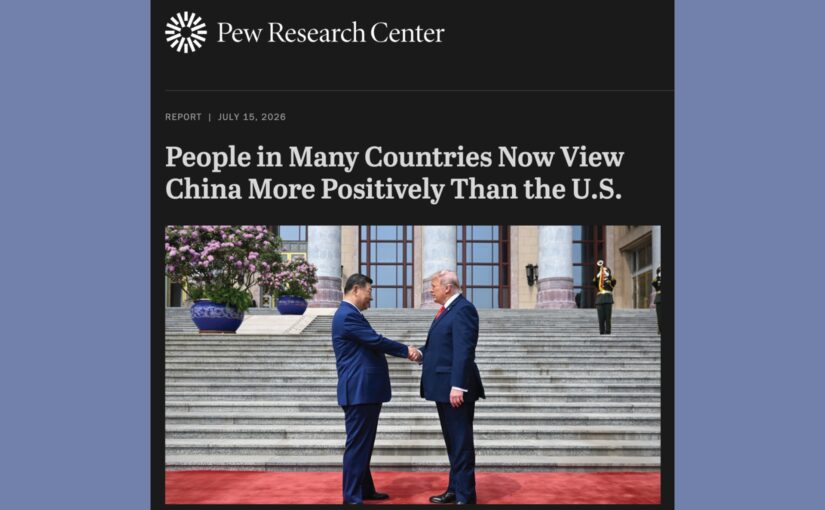
A newly published survey by the Pew Research Center – covering more than 42,000 people across 36 countries – has found that China is now viewed more positively than the United States in most of the countries polled, with more people worldwide expressing confidence in Xi Jinping than in Donald Trump. It is a striking measure of how far Washington’s global standing has fallen.
In the following article, Carlos Martinez, co-editor of Friends of Socialist China, examines what lies behind this historic shift. He argues that the single most important factor is the war on Gaza – a genocide watched in real time by a global public that has also seen the governments of North America and Western Europe arm, finance and shield it, all while lecturing the world about a “rules-based order”. The same collapse of credibility, he notes, has quietly buried the “Uyghur genocide” narrative, and has been compounded by the US-Israeli war of aggression against Iran.
Set against this, the article points to what China offers the world: the greatest poverty alleviation in history, a global clean-energy transition, and cooperation on terms of sovereign equality – together with a new visibility that is allowing hundreds of millions of people to see Chinese life for themselves, bypassing the distorting filter of the Western press.
For decades, Washington has been able to console itself with the notion that, whatever the world thought of its never-ending criminal wars, it could always rely on its vast apparatus of cultural hegemony to win hearts and minds around the world. At some level, it has always remained the land of the free and the home of the brave. But nothing lasts forever.
According to a new Pew Research Center survey of 42,151 people across 36 countries, China is now viewed more positively than the United States in most of the countries surveyed – and more people worldwide express confidence in Xi Jinping than in Donald Trump.
Even Canadians view China more favourably. In 2023, 57 percent of Canadians had a positive view of the US and just 14 percent viewed China positively; today China leads by 44 percent to 33.
In 17 middle-income countries, a median of 75 percent say the US interferes in the affairs of other countries, against 45 percent for China. In South Africa, 72 percent call China a reliable partner, compared with 46 percent for the US; in Pakistan the figures are 84 and 36. Even on “personal freedoms” – over which the West considers itself to have a monopoly – the share saying the US government respects the freedoms of its own people has collapsed, falling in Sweden from 61 percent in 2021 to 27 percent today, with drops of 25 points or more in Canada, France, Germany, Italy and Spain.
Gaza: the mask dropped
There are several factors undermining global confidence in the West, but the most important is the war on Gaza. A generation has watched a genocide unfold on its phones, in real time, for more than two years: the flattened hospitals, the famine as policy, the mass graves, the torture of prisoners, the deaths of tens of thousands of children. And it has watched the governments of North America and Western Europe arm, finance and provide diplomatic cover for this genocide – vetoing ceasefire resolutions, keeping the weapons flowing, and shielding Israel from accountability at every international forum, all while lecturing humanity about the “rules-based international order”.
China, by contrast, called for a ceasefire and Israeli withdrawal from the first days of the onslaught. It brought 14 Palestinian factions to Beijing to work for reconciliation, and affirmed at the International Court of Justice the Palestinian people’s right under international law to resist occupation. China stood with the UN Charter and the most fundamental principles of justice; Washington stood with mass murder, ethnic cleansing and apartheid. The world noticed.
Another consequence of the Gaza genocide has been the collapse of the “Uyghur genocide” narrative which was so pervasive only a few years ago. People now know what a genocide actually looks like. They have seen the bodies, the rubble, the trauma. And they have registered that the politicians and journalists who deny the genocide in Gaza are the very ones who insisted that China was committing one in Xinjiang – without bodies, without bombs, without refugees. A few years ago the accusation was widely believed; today it is quietly evaporating, another casualty of the West’s squandered credibility.
Iran: aggression versus de-escalation
A similar pattern repeated with Iran. In February, the US and Israel launched a criminal war of aggression against a sovereign nation that was in negotiations when the bombs started falling – a war that killed Iran’s top leader and dragged the region to the brink of catastrophe. China condemned the assault from the outset, called consistently for de-escalation and dialogue, and joined Russia in vetoing a Security Council resolution that would have opened the door to further escalation. Incidentally, a recent Asia Group report concluded that the war’s clear winner was China – vindicated diplomatically, and resilient economically even when the Strait of Hormuz closed, thanks in no small part to a renewable energy programme that reduces its dependence on imported hydrocarbons with every passing year.
What China offers the world
The comparison between China and the US is also about development. China has lifted an estimated 800 million people out of poverty – the greatest anti-poverty achievement in history – and is working with governments across the Global South to apply that experience abroad. It installed 315 gigawatts of new solar capacity last year, more than half the global total, and its solar panels, wind turbines, batteries and electric vehicles are driving the energy transition worldwide.
Just this week, Zambia signed contracts with Chinese firms to build a solar plant with battery storage in every one of its 156 constituencies – decentralised clean power for an entire nation, on terms that leave ownership in Zambian hands. Cuba, strangled by the US blockade, is carrying out one of the fastest solar transitions in history with Chinese support. The countries that spent centuries extracting Africa’s copper offer lectures; China offers modernisation.
There is one more crucial factor: visibility. Platforms such as RedNote (Xiaohongshu) and TikTok, along with a wave of Western streamers living in or travelling through China, have given hundreds of millions of people unmediated access to Chinese life – its safe cities, high-speed rail, thriving public spaces – bypassing the dystopian filter of the Western press. Among young people this has fed a wave of curiosity and admiration about China that would have been unthinkable five years ago. It turns out that when people can see for themselves, the propaganda stops working.
None of this means the New Cold War is over; indeed, a declining hegemon deprived of the world’s consent may become more dangerous, not less. But the Pew findings record something historic: the moral collapse of the US-led order in the eyes of the world’s peoples, and the emergence of a credible alternative grounded in sovereignty, development, international law and peace. Between a superpower that bombs and blockades, and one that builds solar plants and brokers ceasefires, the world is making its choice.





