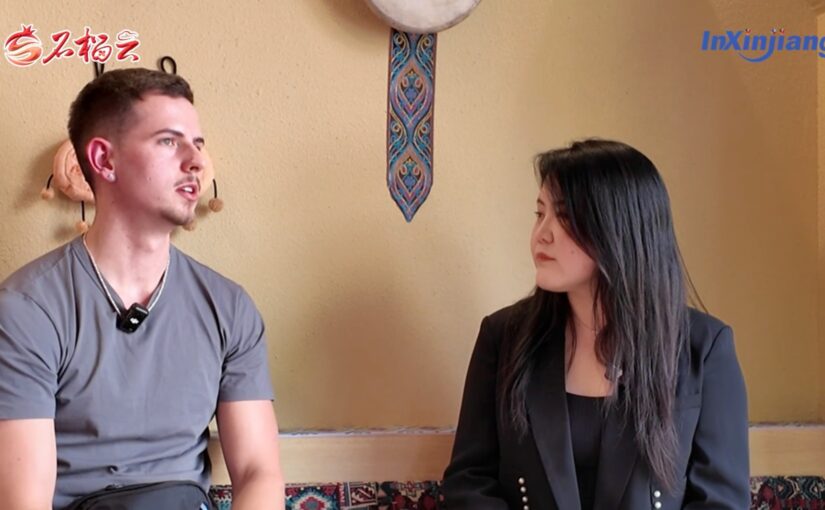
Amar, a 22-year-old activist from London, visited Xinjiang in April 2026, wanting to see the region for himself after years of Western media coverage alleging genocide there. In this interview with Xinjiang Today, recorded in a coffee shop in Urumqi, he describes what he found.
He talks about the ordinariness of daily life in Urumqi, and the surprise of local people that a visitor would think to ask whether their lives are normal at all. He recounts a conversation with a barista about how the region has changed since his childhood – the journey from Urumqi to Kashgar cut from around 40 hours by rail to roughly 11, and the four-day bus trip across the Tianshan Mountains reduced to a few hours by the 22-kilometre Tianshan Shengli Tunnel, the longest expressway tunnel in the world, which opened in December 2025. Infrastructure on that scale, Amar argues, is built because it improves people’s lives rather than because it returns a profit, and would never be undertaken in a society run by a capitalist class.
He also discusses the very different relationship between the public and the police in China compared with Britain, why his family came to see China as a beacon of hope, and what worries and encourages him as a young person facing the prospect of imperialist war.
The interview was conducted by Xinjiang Today. The video is embedded below, followed by a lightly edited transcript.
Transcript
Xinjiang Today: Hello everyone, welcome to Xinjiang – telling you the most true story about Xinjiang from expert eyes. Today we are in Urumqi, in a very cozy coffee shop, and today our guest is Amar. He’s 22, from London, and he has been travelling across Asia. Before he goes back to the UK, he wanted to visit Xinjiang to see what life is really like here. So let’s welcome Amar. Please introduce yourself.
Amar: Hey everyone, my name is Amar. I’m a 22-year-old traveller from London. I pretty much came to China because I’m a young communist, and China is obviously the most successful communist country. I wanted to see what life here is like, and particularly to get a better idea of the reality for the people living in China. So I came to Xinjiang because there’s a lot of Western propaganda about mistreatment of the people here, and I just wanted to see it for myself.
Xinjiang Today: Thank you so much. And you’ve been in Urumqi for a few days, right?
Amar: Yes.
Xinjiang Today: So how do you feel about walking on the streets in Urumqi? What’s the atmosphere you feel like?
Amar: The atmosphere is really good. You can see people just going about their daily lives. It’s so normal – I think the main thing is just normal. When you speak to local people, they’re almost surprised that you’re asking them how life is, because to them it’s just – they go about their daily lives, they don’t really think about it. They can’t see why there would be a reason that I would doubt that their life is normal, if you get what I’m saying.
Xinjiang Today: Okay, I get it. And since you said you have seen some propaganda from Western media – before you came here, what kind of impression about Xinjiang did you have from the reports? And did the real situation you have seen here match those reports?
Amar: No way. Not at all. I feel like in the West, in Western media, there’s talk of genocide happening here. And in fact, I would say that the culture here is being protected and enriched by both the local and central governments. People seem to be very happy, and people’s lives are improving all the time – that’s what I can see and what I’ve heard.
Xinjiang Today: Okay, so during your trip this time, did you have conversations with local people about Xinjiang, about their life?
Amar: Yeah.
Xinjiang Today: What was the most impressive conversation?
Amar: The most impressive conversation – I would say with the barista of this shop. Lovely guy. He tells me many things about the way Xinjiang has changed since he was a child, talking especially about public transport: how the journey to Kashgar used to be 40 hours by train, and now it’s only, I think, 10, 11 hours by high-speed rail. And the bus used to take four days, but now, with the road through the Tianshan Mountains –
Xinjiang Today: The Tianshan Shengli Tunnel.
Amar: Yeah, yeah, yeah – the 22-kilometre tunnel. It’s only three to four hours to get to the other side. One more thing I’d like to say is that there’s a lot of – I think all across China – the perception of the police. A lot of Western people will come and see police here and think that the people are being oppressed by the police. But the person who was guiding me around has told me that the police in China are seen as public servants. They represent the public, and they’re respected. We had a funny moment the other day, yesterday at the International Bazaar. I told my guide that I was scared of the police, because in the UK they arrest people for no reason, they stop and search people. And he’s like, “No, go say hi to the policeman and get a picture with him.” And we just had a nice conversation with the policeman, took a picture with him and then went. And he’s just a normal person – a nice person, here to help people.
Xinjiang Today: And you told me that you have studied socialism and Chinese history. So what made you do that?
Amar: So I think because of my family – obviously you’ve interviewed my grandmother before. Everyone’s really into politics; we’re all communists. And we see the decline of Western society, of Western capitalism, and China is something of a beacon of hope. I think it’s a country that’s committed to building socialism in the long term, and to improving the lives of the people. So for us it’s a type of system – we got interested in it because this is what we want to see for our own country. We can take a lot of inspiration from China as communists in the West, I think.
Xinjiang Today: So do you find any inspiration reflected here in Xinjiang?
Amar: Yeah, yeah, definitely. Just because my guide tells me that every time he comes back here – he comes back maybe a couple of times a year – all the time there are new buildings being built, infrastructure improving, high-speed rail, connectivity getting better. And all of these things are done not for profit; they’re being done to improve people’s lives. Especially the Tianshan tunnel, the 22-kilometre tunnel. Apparently it was such an expensive project, but it makes people’s lives better, so they do it anyway. And in a capitalist society – or in a society where the capitalist class is the ruling class – an infrastructure project like this would never happen.
Xinjiang Today: Today there is some inequality; tensions rise among different political parties and different regions. So as a young person – you’re only 22 – what gives you hope, and what do you worry about?
Amar: So I think I’ll start with what worries me. What worries me is that the capitalist class, the ruling class in the Western powers, in Western countries – they don’t know how far they’re willing to go to protect their interests. I think especially with the Iran war, we can see that the behaviour of a declining empire is just so irrational and dangerous for the entire world. And it’s very worrying because, as a young person, you think about world war. Are you going to have any opportunities to live a normal life? This is a worry of many young people, I think – are they going to be able to have a normal life? And things are continuing to get worse, especially in the West. But when you can come to a country like China, which is committed to peace and stability and is leading the charge for a multipolar world, where there can be no more imperialist wars of aggression – it definitely gives you hope as a Westerner that the future is not all bad, it’s not all dark. Obviously this government represents the people’s interests: it wants to improve life for everyone, and it wants to have an equal and prosperous society. So yeah, it definitely gives me hope that this is possible in the West too.






Excellent interview!