Communist youth see Chinese socialism in action

In the following article, which was originally published by People’s World, Cameron Harrison reflects on what he learned from his participation in the recent delegation to China of young cadres from communist parties in Europe and North America. Cameron represented the Communist Party USA (CPUSA) on the visit.

Noting that the delegation partially overlapped with the state visit of US President Donald Trump, he writes:

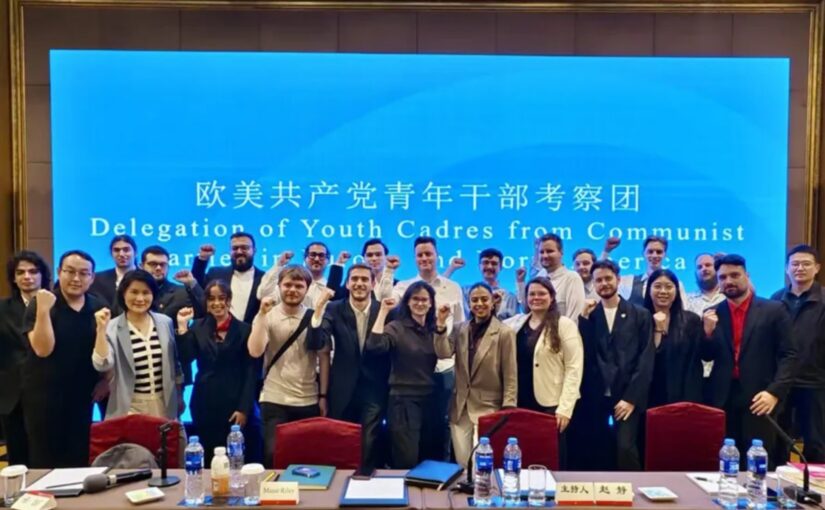
“Traveling as a delegate of the Communist Party USA alongside 20 other young communists from 18 countries across Europe and North America, I spent two weeks abroad in a youth delegation organised by the International Department of the Communist Party of China (IDCPC). With an average age of just 27, and unlike the billionaires in Washington, our delegation didn’t come to trade diplomatic pleasantries and attempt to secure zero-sum corporate market access. We came to witness what they call ‘socialism with Chinese characteristics,’ a living alternative to the decaying, financialised capitalism that currently grips the Western world… While the Trump administration enforces punishing tariff wars that squeeze workers in my city of Detroit with inflation and layoffs, China’s socialist project is demonstrating what becomes possible when a society is built around the needs of a multi-ethnic working class rather than the dictates of the billionaire class.”

He further illustrates this by reference to China’s achievements in poverty alleviation, putting AI in the service of the working class, and the revolution in green development:

“China is currently executing the most aggressive green transition in human history. Here, the planet is treated as a valuable and essential productive force with economic, social, and cultural value.”

Revolutionary history also formed an important part of the trip:

“Between rides on the country’s whisper-quiet autonomous metro systems and ultra-high-speed bullet trains, our delegation spent long hours tracing the historical roots of these contemporary accomplishments of the CPC. We walked the mountain pathways of Yan’an, the revolutionary city where Mao and the CPC Central Committee headquartered from 1937 to 1947 to organise the resistance against Japanese aggression.

“We stood in the dwellings of Liangjiahe Village, where a young Xi Jinping spent seven years doing hard manual labour alongside local peasants… It was here that the now General Secretary solidified his understanding of the ‘mass line’—the core communist practice of consulting the masses, distilling their practical needs, and translating those needs into state policy.”

Cameron also writes about coming across a statue depicting Mao alongside Edgar Snow—the courageous American journalist who braved the Kuomintang blockades in the 1930s to tell the true story of the Chinese Revolution to Western readers in his seminal book, Red Star Over China.

Continue reading Communist youth see Chinese socialism in action

Young communists from Europe and North America visit China

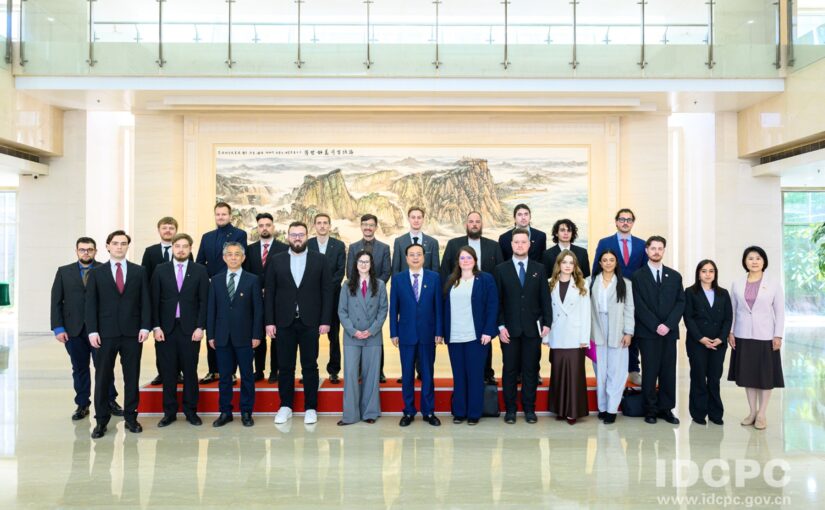
A delegation of young cadres from communist parties in Europe and North America recently visited China.

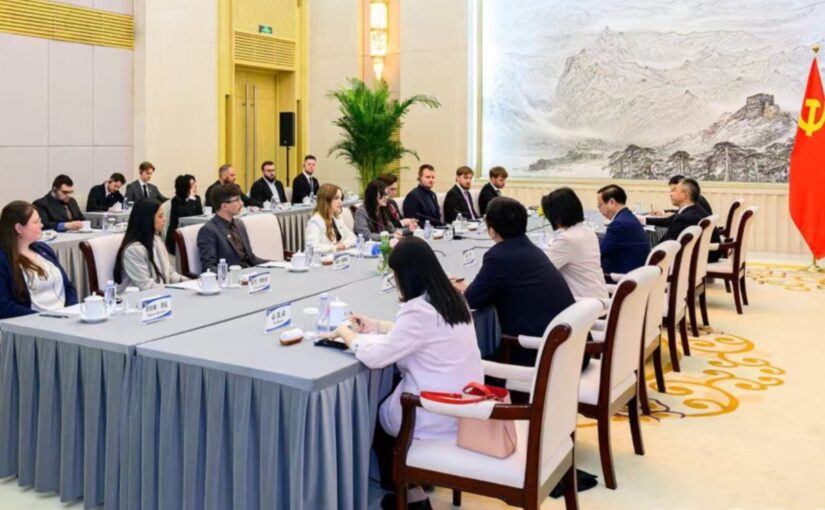
On the second day of a two-week trip they met with Jin Xin, Vice-minister of the International Department of the Communist Party of China (CPC) Central Committee (IDCPC).

According to the report issued by the IDCPC, Jin elaborated on the scientific connotations and global significance of Xi Jinping Thought on Socialism with Chinese Characteristics for a New Era and stated that the CPC stands ready to enhance youth exchanges with socialist forces worldwide, including communist parties in Europe and the US, deepen mutual learning on party governance and state administration, and jointly explore practical paths for adapting Marxism to local contexts and the times.

Members of the delegation noted that the successful practice of socialism with Chinese characteristics in the new era has greatly inspired progressive forces across the world. As young Marxists, they expressed anticipation of learning from the CPC’s successful experience.

According to Paulius Eidukas, who represented the Communist Party of Norway on the delegation, Jin said that the world is in the process of change and the global winds are blowing in the direction away from capitalism. This is the moment that communist parties in the West should consider carefully, to find out how they can seize the opportunity.

“You, the generation of younger communists, with your admirable courage and fervour, are at the forefront of this change. The future of the world rests on your shoulders.”

Having listened to presentations from various delegation members, the vice-minister spoke about the problem of imperialism and warmongering carried out by the United States and Israel. He also noted the growing concern for Latin American countries, with the Venezuelan and Cuban people in particular experiencing direct military aggression and threats coming from the United States. Jin Xin noted that Cuba finds itself in a dangerous geographical position, being so close to the United States, and so far away from China. Regardless, China is committed to helping the Cuban comrades with all available means. He also celebrated the close solidarity, cooperation and growing ideological dialogue and ties between the “five golden flowers of socialism”, that is China, Vietnam, Laos, Cuba, and the DPRK.

Jin also discussed the state of Marxism in the West, noting that there are some disagreements and splits, in terms of how Marxism is understood and applied. He criticised the dogmatic approach chosen by some parties, which disregard national conditions, and automatically assume that certain aspects, such as the existence and development of the private sector, are a “betrayal” of Marxism.

The parties and organisatons participating in the delegation were:

  • Communist Party of Britain/Young Communist League
  • Communist Party of Belarus/League of Communist Youth
  • Communist Party of Canada
  • Progressive Party of the Working People of Cyprus (AKEL)/United Democratic Youth Organisation (EDON)
  • Communist Party of Bohemia and Moravia
  • Communist Party (Denmark)
  • Communist Party of Finland/Communist Youth
  • German Communist Party/Socialist German Workers Youth (SDAJ)
  • Hungarian Workers’ Party
  • Communist Refoundation Party of Italy
  • Italian Communist Party
  • Communist Party (Italy)/Federation of Communist Youth
  • Communist Party of Luxembourg
  • Levica (Left), Slovenia
  • Communist Party of Norway
  • Portuguese Communist Party/Portuguese Communist Youth
  • Romanian Socialist Party
  • Communist Party of Spain
  • Communist Party (Switzerland)
  • New Communist Party of Britain
  • Communist Party USA

The article below was originally published on the IDCPC website. It is followed by a report kindly provided to us by Comrade Paulius Eidukas from Norway.

Jin Xin Meets with a Delegation of Young Cadres from Communist Parties in Europe and the US

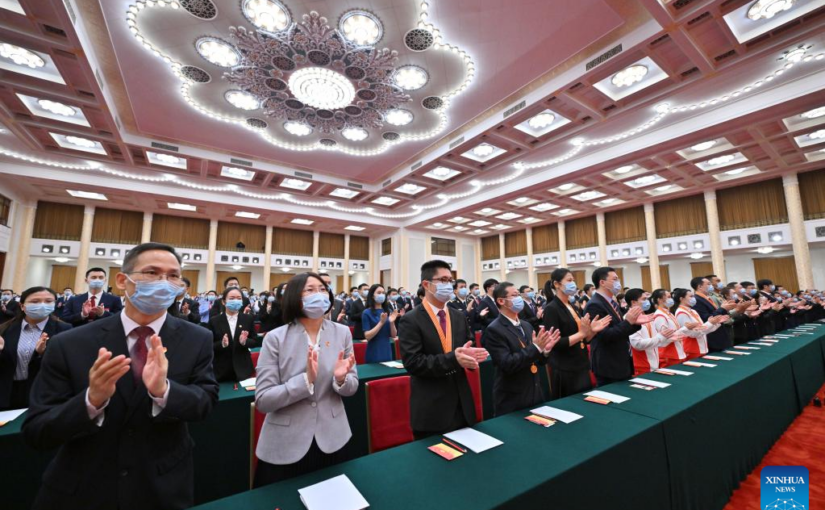
Beijing, May 7 (IDCPC) — Jin Xin, Vice-minister of the International Department of the CPC Central Committee, met here today with a delegation of young cadres from communist parties in Europe and the US.

Jin elaborated on the scientific connotations and global significance of Xi Jinping Thought on Socialism with Chinese Characteristics for a New Era, and briefed the guests on the CPC’s efforts to strengthen self-building since the beginning of the new era, particularly the educational campaign on establishing and practicing a correct view on governance performance. He stated that the CPC stands ready to enhance youth exchanges with socialist forces worldwide, including communist parties in Europe and the US, deepen mutual learning on party governance and state administration, and jointly explore practical paths for adapting Marxism to local contexts and the times.

The delegation members noted that the successful practice of socialism with Chinese characteristics in the new era has greatly inspired progressive forces across the world. As young Marxists, they expressed anticipation of learning from the CPC’s successful experience in strengthening self-building, conducting youth work, and improving social governance efficiency through this visit, so as to contribute to strengthening their own parties and advancing the world socialist movement.


Report by Paulius Eidukas

“The far-right parties in the capitalist West can only offer unsustainable, short-term solutions to the problems facing their societies. Socialists, on the other hand, have a long-term plan and vision that is proven to work. This is our advantage.

“Socialism has already transcended the low ebb of the collapse of the Soviet Union. The world is in the process of change and the global winds are blowing in the direction away from capitalism. This is the moment that communist parties in the West should consider carefully, to find out how they can seize the opportunity.

“You, the generation of younger communists, with your admirable courage and fervour, are at the forefront of this change. The future of the world rests on your shoulders.”

These are some of the words said by Jin Xin, Vice Minister and Director-General of the General Office of the International Department of the Central Committee of the Communist Party of China. We had the pleasure of meeting him on our second day in Beijing, and that meeting was certainly one of the highlights of the day.

Comrade Jin Xin listened carefully as several communists from our group presented on the situation in their respective countries. We heard analysis from Maise Riley, from the Communist Party of Britain and the YCL; from Iryna Maliuk, from the Communist Party of Belarus and the LCY; and from Nichita Iris Liga, from the Romanian Socialist Party.

Thanking the comrades for their analysis and explanation of the work and strategy of communists in their countries, Jin Xin gave a thoughtful response, discussing the possibilities and responsibilities of young Communists, who are organizing under the conditions of Western capitalism and imperialism.

He talked about the problem of imperialism and warmongering carried out by the United States and Israel. He also noted the growing concern for Latin American countries, with the Venezuelan and Cuban people in particular experiencing direct military aggression and threats coming from the United States. Jin Xin noted that Cuba finds itself in a dangerous geographical position, being so close to the United States, and so far away from China. Regardless, China is committed to helping the Cuban comrades with all available means. He also celebrated the close solidarity, cooperation and growing ideological dialogue and ties between the “five golden flowers of socialism”, that is China, Vietnam, Laos, Cuba, and the DPRK.

Jin Xin also discussed the state of Marxism in the West, noting that there are some disagreements and splits, in terms of how Marxism is understood and applied. He criticised the dogmatic approach chosen by some parties, which disregard national conditions, and automatically assume that certain aspects, such as the existence and development of the private sector, are a “betrayal” of Marxism. China is also being mischaracterised by the right-wing in the US, where many congressmen still treat China as a poor and underdeveloped country. Most of these congressmen, he noted, have not actually visited China to see the modernisation and development that would disprove their misconceptions.

Jin Xin noted that China has made great strides not only in modernisation and development, but also in terms of creating a prosperous and safe society. He noted that China is one of the safest places in the world, where people can walk alone at night without any fear, or where they can leave their belongings unattended. This is not the case in most other countries.

The comrade also noted that China has grown in its “soft power”, with global opinions shifting in favour of China. From social media trends, such as “Becoming Chinese”, to actual Chinese diaspora gradually returning back to their home country, when they realise that countries, such as the US, are not as they imagined. This is a reversal of the tendencies seen a couple of decades ago, where Chinese people would look up to the West as an example to follow.

Jin Xin emphasised that China does not subscribe to a vision of the world ruled by hegemonic countries and blocs, nor the idea of “superior” civilisations. Rather, China would see a world led by many civilisations in tandem. The goal is a harmonious world, which China strives for in its diplomatic efforts. It seeks to build friends, rather than create enemies. In developing China, the CPC does not not seek to compete with or replace any other countries, their industries, or their politics, but rather to lift the whole world up together.

Addressing the young Communists in particular, Jin Xin gave several points of guidance:

1. Be the guardians of ideas and convictions. You chose to join the communist movement in the finest years of your lives. While older generations often have fears and reservations, the youth is what really breathes life and growth into the movement.

2. Be strivers who make a difference. Socialism represents the future of humanity. It brings courage and hope. Young people should work hard to determine the best way forward in their respective countries, and to find out how to attract support to the communist cause.

3. Be the promoters of solidarity and cooperation. Internationalism is at the heart of socialism, and human progress comes through cultural exchange. We need our own media and outlets to showcase our movements and to learn from each other via online platforms. The IDCPC will be active in the development of these.

4. Be the defenders of fairness and justice. Oppose power politics, hegemony and bullying. Be a progressive voice in the international arena.

Jin Xin ended the discussion remarking on the rise in the acceptance and support of communist parties and ideas around the world, with the youth in particular showing high affinity for socialism, more so than in the decades earlier. This, Jin Xin noted, is the single spark that can start a prairie fire.

This whole discussion, to us, communists from the Western countries, was extremely emotional, uplifting and inspiring. We thank the International Department of the Central Committee of the Communist Party of China for organising and supporting this international exchange.
China marks Youth Day

On May 3, Chinese President Xi Jinping sent a reply note to representatives of youth honour recipients, encouraging young Chinese to integrate their personal aspirations into the bigger picture of national development. Xi’s message came on the eve of China’s Youth Day on May 4, which commemorates the 1919 May Fourth Movement, which is widely seen as a turning point in the country’s modern history.

Giving various examples, an article carried by the Xinhua News Agency notes that around this time, Xi usually extends greetings to young people, underscoring the close link between youth empowerment and national progress.

In his message this year to representatives of recipients of the China Youth May Fourth Medal and New Era Youth Pioneer, Xi urged young Chinese to stay rooted in their roles, strive for new achievements and channel their youthful dynamism into advancing the nation’s new journey of development.

The article explains that: “About a decade ago, Xi guided the formulation of a national youth development plan that identified volunteer service as a priority. Through letters and in-person exchanges, he has repeatedly encouraged young volunteers to ‘serve where the country and the people need them most.’

“Xi’s own early experience has shaped his outlook. In his youth, he left Beijing to work in a rural village on the Loess Plateau, where he lived and laboured alongside farmers. Known for his diligence, he earned the trust of villagers and was elected local Party chief, where he led efforts to boost production and reduce poverty.

“Xi’s aspiration at that time was to ensure that all fellow villagers could have enough to eat. It was there that he forged the commitment to serving the country and the people.”

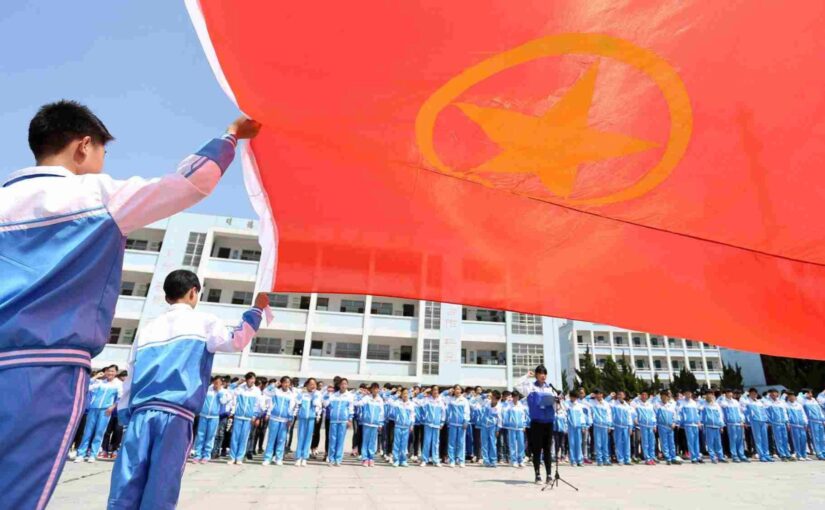
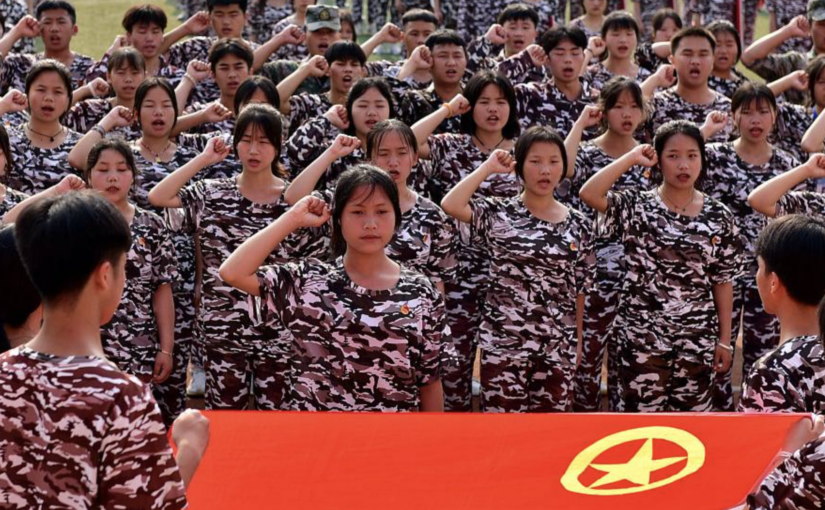
Also on May 3, it was announced that the Communist Youth League of China (CYLC) had about 78.34 million members by the end of 2025, with about 9.14 million new members joining last year.

On April 30, 2019, Xi Jinping delivered an important speech marking the centenary of the May 4 Movement. Xinhua’s report of that event explains that:

“The May Fourth Movement started with mass student protests on May 4, 1919, against the government’s response to the Treaty of Versailles that imposed unfair treaties on China and undermined the country’s sovereignty after World War I. It then triggered a national campaign to overthrow the old society and promote new ideas, including science, democracy and Marxism… Xi said the May Fourth Movement was a great patriotic and revolutionary campaign pioneered by advanced young intellectuals and joined by the people from all walks of life to resolutely fight imperialism and feudalism.”

“As long as the banner of patriotism is being held high, the Chinese people can unleash great powers in the endeavours to transform China and the world,” Xi said. The essence of patriotism is having unified love for the country, the Party and socialism, he added, urging young Chinese to follow the instructions and guidance of the Party, and remain dedicated to the country and the people. Young people are also urged to establish belief in Marxism, faith in socialism with Chinese characteristics, as well as confidence in the Chinese Dream of national rejuvenation.

Xi said Chinese youth of the new era should bear their responsibilities of the times and carry on the spirit of arduous struggle. He also encouraged young people to not only care about their family and country but also have concerns for humanity.

Continue reading China marks Youth Day

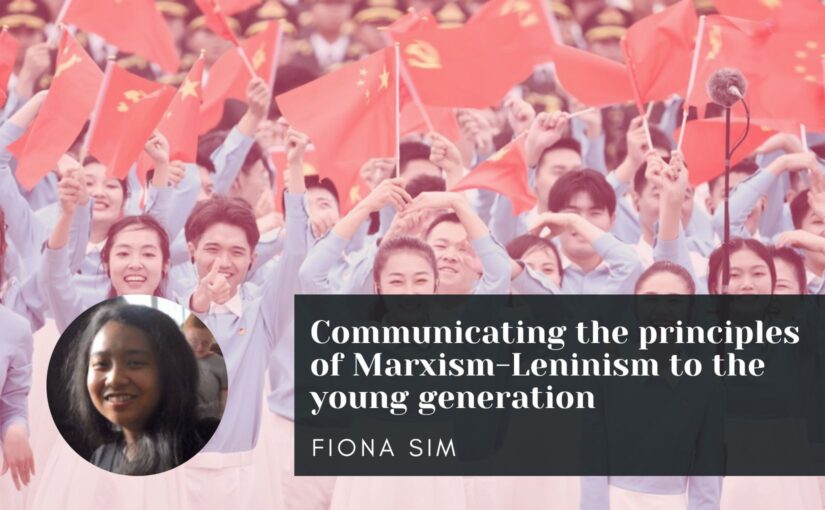
Communicating the principles of Marxism-Leninism to the young generation

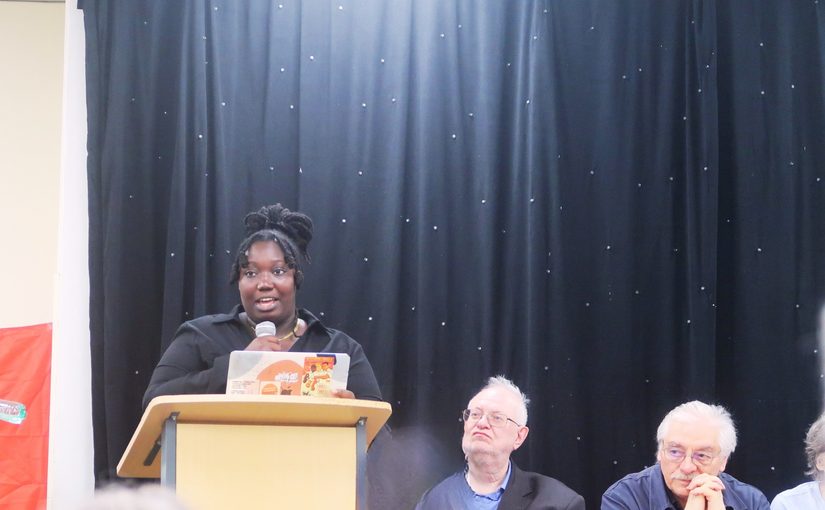
What follows is the text of a speech given by Fiona Sim (co-founder of the Black Liberation Alliance and member of the Friends of Socialist China Britain Committee) at our recent bilateral webinar with Renmin University of China, held on 26 February 2026.

Fiona describes the economic, political and ideological conditions faced by young people in the West in the present era: a brutal neoliberalism, characterised by rising poverty, inequality and alienation; witnessing devastating wars and seemingly inevitable climate collapse; and being fed relentless propaganda fomenting “a culture of nihilism and pessimism”.

In academia, ruling class ideology prevails and seeks to either ignore Marxism or to paint it as some sort of failed experiment. Certainly young people are “protected” from the fact that “there is another world possible and it is being built now – by China, Cuba, Vietnam, DPRK, Laos, and many more entering their own revolutionary processes” that people can take inspiration from. And yet objective reality is increasingly radicalising young people; increasingly they understand that they “can organise, unite, and work together to resolve the contradictions and build a socialist alternative”.

The young generation are rejecting the right-wing and neoliberal ideologies that shamelessly capitulate to the reactionary rhetoric of the far-right. In Venezuela, we have seen how young people formed the biggest demographic that voted for Maduro. In Britain, young people started encampments in support of Palestine and continue to turn out in their tens, if not hundreds of thousands to protest the fascists on the streets as well as the government’s war mongering policies in lieu of the “cost of living crisis” and plummeting employment rates. In China, we see how Socialism with Chinese Characteristics has shown the proof is in the proverbial pudding and the young people are drawn to the hope it brings, with 74 million young people as proud members of the Communist Youth League.

Fiona concludes:

Right now the contradictions of imperialism are at their sharpest. Presidents like Donald Trump expose the barefaced brutality of US hegemony and the capitalist system is leaving millions in destitution and despondence. The conditions could not be more ripe for revolution. To get there, the young people must be prepared. The young generation must be encouraged to study the revolutionary histories and ongoing resistance movements of the world because in a world so rife with despair, Marxism-Leninism remains humanity’s hope for the future. 

For young people, there is a lot of reason to be nihilistic about the future and the current state of the world. We have inherited a world that is heating up. With the global average temperature rise predicted to climb permanently above 1.5°C, a mass extinction event of thousands of species grows more likely by the day. In recent decades, millions have died in the wars and genocides in Palestine, the Democratic Republic of Congo, Sudan, Ukraine, and so on. Millions more around the world have died from the sanctions regime of the United States government whether by Democrat or Republican. Many young people have been permanently displaced from their homelands as a result. 

The young people are the next generation, but will this next generation be the last of humanity? What will be left for the generations to come?

In the West, these are the logical questions for a generation that has been conditioned to believe that the everyday person has no influence on the systems of a society or the governance of the world. The neoliberal philosophy has poisoned the human psyche, presenting Capital as a god and capitalists as its angels. The proletariat make offerings of commodities to the bourgeois gods while driven to fight among themselves for the scraps that fall off the table. Here the idea of “meritocracy” takes root. 

In such a system, working class young people become cogs in the capitalist machine–taught to worship brands and TikTok trends while being forced into minimum-wage jobs that keep them trapped in poverty, living at the behest of slum-like landlords and lining the pockets of CEOs of privatised infrastructure (whether that be water, rail, or energy). This form of alienation is a means of crushing revolutionary spirit: separating the individual from the collective, from the community, from the vanguard. At its core, as Mao says in Combat Liberalism, liberalism is “a corrosive which eats away unity, undermines cohesion, causes apathy and creates dissension.” This is demonstrated in its highest form under neoliberalism. 

Continue reading Communicating the principles of Marxism-Leninism to the young generation

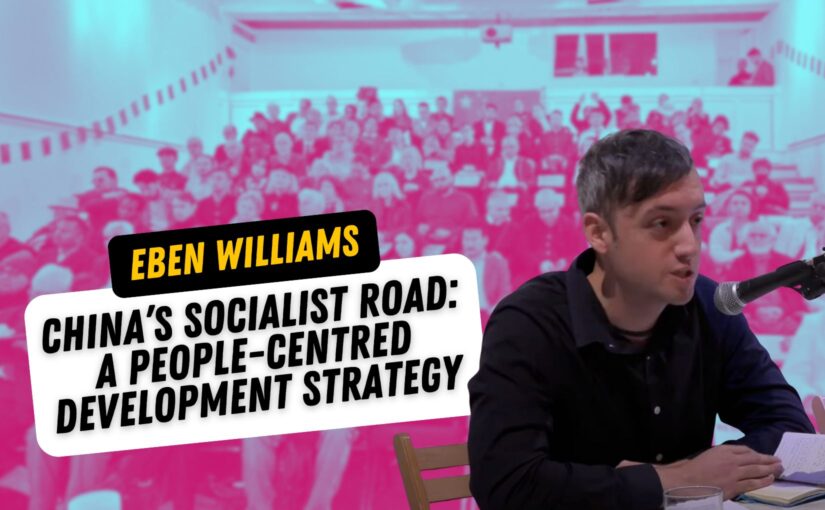
China’s socialist road: a people-centred development strategy

We are pleased to publish below the text of a speech given by Eben Williams, Education Officer for the Young Communist League of Britain, at our September 28 conference celebrating the 75th anniversary of the founding of the People’s Republic of China.

The speech reflects on the strategy of the united front, and how the Chinese leadership applies it at an international level. Discussing the recent World Youth Development Forum held in China, Eben notes that “it was not a specifically socialist event as such”, and yet “it was revolutionary precisely because of this focus on development which naturally brings the developing or so-called ‘third world’ camp into conflict with US-led imperialism and neo-colonialism, which is also the primary obstacle to a more advanced level of socialist development, both in China, and the world”.

Eben goes on to describe some of the progress that has been made in youth development in China in recent years. For example: “This is the best educated generation in Chinese history, and over the past ten years, average years in education has increased from 12.7 to 13.8, and higher education enrolment has increased by 27.8%, with nearly doubled attendance in vocational schools.” Further, “thanks in part to nutrition subsidies and lunch programmes, in the last ten years, nutrition and fitness have increased in rural areas with 86.7% of students now passing physical fitness tests, up from 70.3% ten years before, and a huge drop in rates of malnutrition.”

The Communist Youth League, with a membership of 74 million, is involved in organising 90 million youth volunteers, “including the 5.5 million young people who volunteered during COVID-19 to provide medical care, transport supplies, and build medical facilities; the nearly six million youth volunteers who have been paired up with rural children with disabilities or in need of long-term support; and the more than 4.9 million youth volunteers who took part in relief efforts during the earthquakes in 2008 and 2010. These efforts are deliberately linked up with China’s wider socialist project and the promotion of young heroes of the Chinese revolution, like Lei Feng.”

Eben works as a Chinese translator, speaks and reads Mandarin, and has lived and worked in China.

Hi comrades, thanks very much for having me here, thanks to Friends of Socialist China for co-hosting this event and congratulations to all Chinese comrades on the 75th anniversary of the founding of the People’s Republic of China. My name’s Eben and I work as a Chinese translator but I’m here today as the Education Officer for the Young Communist League, so I’m going to be speaking a bit about what Chinese socialism means for the youth in China and Britain, as well as the importance of promoting socialist education and Marxist theoretical discussions through events like this one.

But first, I’d like to kick off with two basic Marxist-Leninist concepts which are really helpful in framing Chinese strategy and policy. Firstly, understanding that socialism is primarily the product of economic development, moving from an idealistic and moralistic framing toward a more scientific one that recognises capitalism as a system that has outstayed its welcome as a historical stage of human development, and that it is when the ever-increasing development of the productive forces of a country come into contradiction with the fetters of the private relations of production that it becomes necessary for a revolutionary break.

Secondly, Mao’s understanding of the need for a united front of different patriotic classes led by the proletariat against the primary threat of imperialism, but with the understanding that these other classes, and especially the national bourgeoisie, are unstable and untrustworthy and will later betray to the side of the enemy. The Chinese flag represents this understanding, with the four smaller stars representing the four main classes of Chinese society: the proletariat, the peasantry, the petty-bourgeoisie, and the national bourgeoisie, under the leadership and firm hand of the large star, representing the dictatorship of the proletariat and the communist party. So, we have here these two central elements of Chinese socialism: the focus on the development of the productive forces and the united front against imperialism.

Last month, the YCL sent delegates to China’s World Youth Development Forum which is a really good example of this socialist strategy in practice, just like China’s strategy regarding BRICS, the Shanghai Cooperation Organisation, the Belt and Road Initiative, and other development-focused united front projects. The World Youth Development Forum is an annual event ran by the Communist Youth League of China which looks to unite youth organisations from around the world and promote contributions to global youth development via the UN’s Sustainable Development Goals. Aside from the small number of communist youth organisations like ours that have good relations with the Chinese Party, the forum was dominated by liberal NGOs, UN representatives, and charity projects from around the world who often could not make the political connection between socialism and China’s success. This meant that it was not a specifically socialist event as such, but it was certainly revolutionary.

Continue reading China’s socialist road: a people-centred development strategy

On the work of young communists in China

We are pleased to publish here the text of a speech by Ms Li Na, Communist Youth League branch secretary of Bureau VII of the International Department of the Communist Party of China (IDCPC), given on 17 December at the second of two online seminars on the theme ‘The 20th National Congress of the Communist Party of China and its World Significance’, organised jointly by Friends of Socialist China and IDCPC.

Li Na’s speech gave a fascinating insight into the workings of the Communist Youth League at a branch level, including the league’s role in organizing study of Marxist theory and recruiting young members – “as the Party’s development needs new blood.”

I am Li Na from the Bureau for North American, Oceanian and Nordic Affairs of IDCPC. I am very honored and grateful to have this opportunity to speak here with you all.

The successful convocation of the 20th CPC National Congress marks a milestone in our Party’s history, as the whole Party and the entire nation embark on a new journey toward building a modern socialist country in all respects, and advance toward the Second Centenary Goal. As one of the youngest Party member of our Bureau’s Party branch and the Secretary of the Communist Youth League branch of our Bureau, today I want to share with you the CPC’s operation at primary-level and the Party’s youth work basing on our own practice.

I. Primary-level CPC organization

As is pointed out in the Report to the 20th CPC National Congress, “the Party’s advantage and strength lie in its close-knit organizational system”. As world’s largest political party of government with over 96 million members, the CPC attaches great importance to strengthening its over 4 million primary-level Party organizations, including those in Party and government offices and public institutions. Today I want to focus on 3 major functions of primary-level CPC organization, taking our Bureau’s Party branch as an example.

Continue reading On the work of young communists in China

Xi Jinping’s speech marking the centenary of the Communist Youth League of China 

We are very pleased to publish the full text of the speech given on May 10th 2022 by President Xi Jinping marking the 100th anniversary of the founding of the Communist Youth League of China.

In his comprehensive exposition, President Xi outlines how the youth have always stood in the forefront of the struggles and striving of the Chinese people and nation. The May Fourth Movement of the youth and students in 1919, “promoted the spread of Marxism in China, ushered in the new-democratic revolution, and marked the beginning of the youth’s role as the pioneers advancing social changes in China… As Marxism-Leninism was becoming closely integrated with the Chinese workers’ movement, the Communist Party of China was born. Since the day of its founding, the Party has paid particular attention to the youth and placed the hopes of revolution on them.”

He further outlined the indispensable role of the Communist Youth League and young people generally in the periods of the new-democratic revolution, socialist revolution and construction, reform, opening up and socialist modernisation, and the new era of socialism with Chinese characteristics.

“Inspired by ideals and convictions,” Xi pointed out, “the Communist Youth League has organised and united young people with firm belief and scientific thinking. The first national congress of the League defined building a communist society as its ultimate ideal and made clear its banner of socialism, which has lit the beacon of ideals and convictions among generations of young people. This is the most fundamental and enduring cohesion of the League. History tells us that only by holding high the banner of communism and socialism, can the Communist Youth League form the most solid unity, forge the most effective organisation, and ensure that the youth are united under the banner of the Party’s ideals and convictions.”

Expressing the hope that the League would continue to play its vanguard role, President Xi noted that: “Young people are the most vigorous, enterprising, and least conservative group in society, who possess infinite power to improve the objective world and promote social progress,” adding:

“Revolutionaries are always young. Today, a hundred years on from its founding, the Communist Party of China is still in its prime, and remains as determined as ever to achieve lasting greatness for the Chinese nation. Quoting from Engels, Lenin once said, ‘We are the party of the future, and the future belongs to the youth. We are a party of innovators, and it is always the youth that most eagerly follows the innovators. We are a party that is waging a self-sacrificing struggle against the old rottenness, and youth is always the first to undertake a self-sacrificing struggle.’ Both history and reality have shown that the Communist Party of China is a party that always preserves its youthful features and a party that is worthy of the young people’s trust and worth following.”

Party organisations, the Chinese President said, “must attach great importance to the training and recruitment of outstanding young people and should particularly focus on cultivating and admitting outstanding League members into the Party, so as to ensure our socialist country never changes its nature.”

Members of the Communist Youth League of China (League), young friends, and comrades,

Youth gives rise to infinite hope, and young people are the creators of a bright future. A nation can thrive and prosper only when it places hopes on its youth and maintains its youthful vigor.

Today, we are gathered here at the ceremony marking the centenary of the Communist Youth League of China to encourage League members and young people to forge ahead on the new journey toward realizing the Chinese Dream of national rejuvenation.

Continue reading Xi Jinping’s speech marking the centenary of the Communist Youth League of China