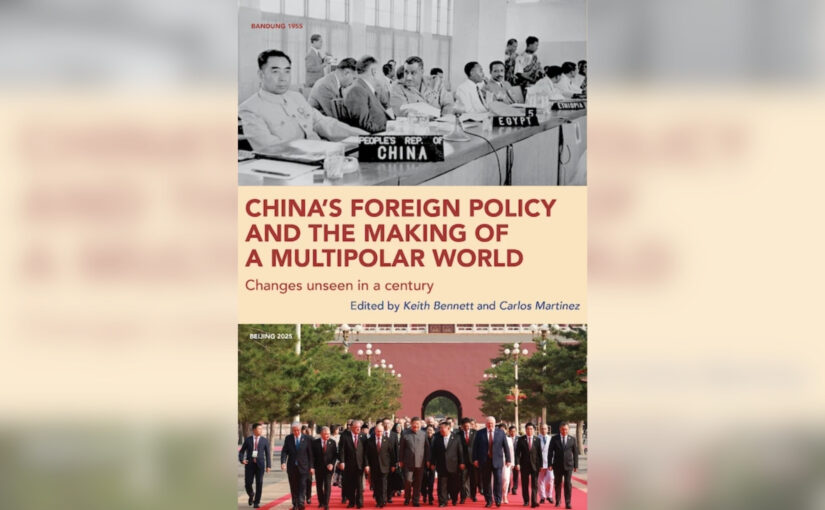
Friends of Socialist China is delighted to announce the publication of China’s Foreign Policy and the Making of a Multipolar World: Changes unseen in a century, edited by Keith Bennett and Carlos Martinez and published by Praxis Press. The book is available now in paperback and as an ePub.
The volume aims to set out the broad contours, historical background and theoretical underpinnings that shape and guide China’s practice on the global stage. What are the historical roots of China’s foreign policy? What are its theoretical foundations? How has it been applied in practice, across radically different historical circumstances? Is China an imperialist power? Is its foreign policy “good enough”? And what does China’s rise mean for the rest of humanity – for the Global South, for peace, and for the struggle to build a just world order?
The ten essays collected here approach these questions from a range of angles, but they share a common premise: that China’s emergence as a global power, far from being a threat to humanity, offers the best hope for a peaceful, multipolar and ultimately socialist future.
Alongside the editors, the contributors are Ken Hammond, Andrew Murray, Jenny Clegg, Danny Haiphong, Cheng Enfu, Torkil Lauesen and Michael Dunford, with a foreword by João Pedro Stédile, founding member of the national leadership of Brazil’s Landless Workers’ Movement (MST).
The full contents, the endorsements the book has received, and a review by former China Daily EU bureau chief Chen Weihua’s (the first to appear) are all reproduced below.
Contents
Foreword – João Pedro Stédile
Introduction – Keith Bennett and Carlos Martinez
- Understanding the changes unseen in a century – Keith Bennett and Carlos Martinez
- Change and continuity in China’s international relations, 1949-2025 – Ken Hammond
- China, Cold War and empire – Andrew Murray
- Is China imperialist? – Carlos Martinez
- Taking the Five Principles of Peaceful Coexistence as a guide – Jenny Clegg
- Is China’s foreign policy “good enough”? – Danny Haiphong
- How China’s peaceful rise is changing the world – Cheng Enfu
- The principal contradiction in the world and China’s pursuit of socialism – Torkil Lauesen
- Why Chinese and Western visions of world order differ and why the difference matters – Michael Dunford
- The four global initiatives and the political meaning of a community of shared future for humanity – Carlos Martinez
Endorsements
Only the light-minded care naught for where China goes next. The future of China will shape yours. Thankfully from the hands of the masters, Keith Bennett and Carlos Martinez, we have the best writing possible on what the new world will look like.
– George Galloway, Leader of the Workers Party of Britain, broadcaster and former Member of Parliament
This is a very useful collection of essays on a subject about which there is far too little. This is hardly surprising given that modern Chinese foreign policy only really began to take shape after 2012. The editors are expert and well informed followers of China and have chosen the subjects and authors wisely. I highly recommend this book for anyone who wants to understand a hugely important topic that will shape the world.
– Martin Jacques, author of When China Rules the World
A timely scholarly study that captures the essence of the rapidly changing global scenario, marked by Retrenchment of the West, Resurgence of the Global South and the phenomenal Rise of China, remarkably achieving that leadership role without hegemony, exploitation or force.
– Senator Mushahid Hussain, Chairman, Pakistan-China Institute and former Member of the Senate of Pakistan
This engaging book unpacks heated debates surrounding China’s foreign policy and persuasively argues that the rise of China and its ties with the Global South are reshaping the existing global order far beyond prevailing Western visions or narratives.
– Zhang Weiwei, Dean, the China Institute, Fudan University, China
This comprehensive, provocative, stimulating and engaging book is indispensable for those seeking to understand the present global correlation of forces.
– Gerald Horne, author of The Counter-Revolution of 1776, Professor of History and African American Studies at the University of Houston
Changes unseen in a century are reshaping the world. This book of ten essays concentrates the mind on the one factor that can be relied on to take the world out of the chaos unleashed by a declining, unproductive, financialised, increasingly unequal and profoundly illegitimate capitalist world trying to hold on to the imperial privileges to which it is accustomed: socialist China. It explores the deep historical roots and social moorings of the foreign policy of the only enduring great power that seeks not imperialism, not hegemony, not domination, not even technological monopoly, but a shared future for humanity. It provides the concepts and understanding that are already necessary to understanding the workings of the geopolitical economy, what Marx called ‘the relations of producing nations’, of the twenty-first century. If you want to understand what really makes China tick, not what a hostile western press claims makes it tick, this book is essential.
– Radhika Desai, Professor, University of Manitoba; author of Capitalism, Coronavirus and War: A Geopolitical Economy
As Washington rages against the dying of the light, Keith Bennett and Carlos Martinez lead their contributors to explore what this means for the West and the rest as China takes centre stage in a multipolar world.
– Glyn Ford, Labour Member of the European Parliament, 1984-2009; author of Talking to North Korea
This book offers a strong and well-documented case supporting China’s claim to be pursuing a new multilateral diplomacy of universal benefit. Those who take a more critical or more nuanced view will find much to disagree with, but it is a useful contribution to the debate.
– John Gittings, veteran China specialist and former assistant foreign editor and chief foreign leader-writer of The Guardian
A crucial contribution to two of the most important issues of our day – how China views the world, and the changing dynamics of international politics. The impressive roster of authors examines the relationship between the two. China’s re-emergence is changing the world, and this outstanding collection offers a critical and sympathetic analysis of these changes ‘unseen in a century’.
– Richard Sakwa, Professor, University of Kent
This collection of essays addresses fundamental issues that confront the human species at the crossroads of civilisation. It presents a view of China’s role in international relations that is radically different from the mainstream of academic and policy discourse.
– Peter Nolan, Founding Director of Cambridge University’s Centre of Development Studies, Emeritus Chong Hua Professor in Chinese Development
This book is an indispensable read for anyone who wants to understand the crucial role of China in the fast-changing world today. The rich contributions reflect a wide variety of perspectives, providing important historical context and a sharp political-economic analysis of the new multipolar global order. The text is a much-needed rejoinder to the absurd, misinformed discourse claiming that China is “imperialist”, and it offers a highly informed examination of Socialism with Chinese Characteristics and how China’s system is fundamentally different from that of the capitalist West.
– Ben Norton, founder and editor of the Geopolitical Economy Report
This is an indispensable guide to understanding China’s place in the contemporary world and its historic contributions to overcoming imperialism. With chapters written by leading specialists, it provides the reader with scholarly studies of key aspects of Chinese foreign policy, while also bringing clearly into focus some of the most urgent political questions of our time. A must read for anyone who wants to understand the shifting dynamics of a rapidly changing world!
– Gabriel Rockhill, Professor of Philosophy and Global Interdisciplinary Studies at Villanova University and Founding Director of the Critical Theory Workshop
China’s Foreign Policy and the Making of a Multipolar World is far more than a fascinating analysis of China’s shifting role on the global stage. It offers a realist, lucid, and critical reading of what China is becoming, fundamentally challenging our collective understanding of this new era. Whether viewing China through a geopolitical, ideological, or economic prism, this volume expertly guides us through the seismic changes underway, unpacking their profound implications for a world rapidly returning to multipolarity. By probing China’s ascendancy from several vital angles, the book answers lingering questions regarding the rising Asian giant, the trajectory of US imperialism, and the future of Western hegemony. Most critically, it illuminates the shifting margins and new possibilities available to the Global South. It is an essential read and an indispensable introduction to understanding the world taking shape before our eyes.
– Ramzy Baroud, journalist, author and editor of The Palestine Chronicle
This outstanding collection of essays addresses one of the biggest questions of the century – what does a rising China mean for the world? Comprehensive yet accessible, the authors detail the guiding principles of China’s foreign policy, its history of engagement with the Global South and explain why China is not just not an imperialist power but an actively anti-imperialist one – and how the so-called ‘new Cold War’ is more a product of US decline than China’s growing power. This is essential reading for anyone interested in international relations or building a peace movement capable of opposing the West’s Trump-led drive to war. Packed with fascinating history and sharp political and economic analysis, it belongs on every anti-imperialist bookshelf.
– Ben Chacko, Editor of the Morning Star
Bennett and Martinez and eight other experts with widely different backgrounds examine China’s ever-growing influence in the transformation of the contemporary world order. Covering Chinese history and principles, initiatives and achievements, this collection provides a unique introduction to challenges the West fails to answer.
– Martin Albrow, author of China’s Role in a Shared Human Future and former President of the British Sociological Association
This book is an invaluable source of information and analysis for anyone who wants to understand the course of China’s foreign policy up to and including the present day. An array of well-informed contributors don’t duck any sensitive or difficult issues as they counter misinformation and disinformation from the right, the centre and the left.
– Robert Griffiths, author and former General Secretary of the Communist Party of Britain
China’s foreign policy plays a central role in global affairs and has a significant transformative impact on the Global South. It seeks to build “an open, inclusive, clean and beautiful world that enjoys lasting peace, universal security, and common prosperity.” In contrast, imperialism has generated existential threats to humanity, including “climate catastrophe, the danger of nuclear war, the challenges posed by artificial intelligence, and the ever-present threat of pandemics.” President Xi Jinping’s formulation of China’s foreign policy, Building a Global Community of Shared Future, is a rich and comprehensive concept that encapsulates centuries of history, political development, class struggle, and human sacrifice. This collective volume skilfully examines them in authoritative detail. A must read.
– Francisco Domínguez, National Secretary of the Venezuela Solidarity Campaign and former Head of the Research Group on Latin America at Middlesex University
Decoding contemporary Chinese foreign policy requires a framework the West routinely leaves off the map. On the Right there are demands for ‘communist’ containment while on the Left large sections critique ‘Chinese imperialism’. This unapologetically pro-China volume offers a radically different analysis of the logic driving Beijing’s actions. While mainstream Western China scholars try to decode China’s ideas through the country’s ancient dynastic traditions, these authors demonstrate the living influence of a far more recent and significant current of thought: Marxism-Leninism. Whether you agree with this committed political stance or not is secondary – this is a book you need to know, for it is providing a vital window into an ideological perspective that the West routinely crowds out through its fixation on relentless negative critique and containment.
– Michael Dutton, Emeritus Professor, Goldsmiths, University of London
China’s rise as a major factor in global politics is universally recognized by its friends and its enemies. The major imperialist powers work non-stop to obstruct, inhibit, and subvert the Chinese Revolution and yet are incapable of fully decoupling China from the world economy that is still dominated by world capitalism. Inside the Marxist movement, the political and class character of China is the subject of intense debate and thus considerable confusion. China’s Foreign Policy and the Making of a Multipolar World: Changes Unseen in a Century, offers a uniquely informative and thoughtful perspective that will be understood as a significant contribution to this important debate.
– Brian Becker, host of the Socialist Program, BreakThrough News
The immense successes of Chinese socialism are increasingly visible to the world – not least through the dazzling images of China’s infrastructure and technology that permeate our screens. But the role of its foreign policy remains misunderstood, contested, and outright distorted by those who would have us believe that no alternative to imperialist domination is possible. This collection helps set the record straight. It reveals China as the leading force in a historic transformation of the international system – one that is creating breathing room and new development opportunities for nations long stunted by the underdevelopment imposed on them by colonialism and imperialism.
– Paweł Wargan, organiser and researcher; coordinator of the secretariat of the Progressive International
Through a selection by 10 focused authors, who have studied the Chinese Revolution, Carlos Martinez and Keith Bennett give us a capsule view of the new options that China’s revolutionary experience is providing for the developing world. This book is a valuable resource for all who seek to understand and defend these new possibilities, against the falsehoods meant to weaken China’s growing popularity among the world’s people.
– Sara Flounders, co-director of the International Action Center and a leading member of the Workers World Party
It is impossible to understand the world without understanding more about China. This book, beautifully written and dealing with many relevant complexities and contradictions, deepens such understanding. It shows how China’s foreign policy is advancing solidarity, development and climate action in a multipolar world. It deserves to be read with care.
– Derek Wall, political economist and former International Coordinator of the Green Party of England and Wales
Bringing together historians and political economists, this book traces China’s foreign policy from the Five Principles of Peaceful Coexistence through the fast-moving events of the 21st century, offering a coherent, well-argued account of how Beijing sees its role in a shifting global order. It is essential reading for anyone trying to make sense of the multipolar world now taking shape, and China’s role in it.
– Jostein Hauge, development economist; Assistant Professor at the University of Cambridge and author of The Future of the Factory
The world is changing – “profound changes not seen in a century”. If you want to understand what is happening in the confusing, contradictory, crisis-ridden contemporary moment, read this book: Carlos Martinez and Keith Bennett have done everyone a favour with this beautifully curated book on the tectonic changes shaking up the planet. Is this an apocalyptic time of monsters, or is it the flowering of hope? Is this a new era of inter-imperialist rivalry, or is it the opening up of a genuine multipolar, multilateral system? Are we seeing fundamental transformation of the economic order or merely the transfer of hegemony? What is really happening, what can we actually hope for, and what, in the current moment, should we do? – these are the fundamental questions addressed by the penetrating essays of this brilliant group of activist thinkers. Their deeply researched answers – grounded in history, philosophy, and contemporary actualities, offer clarity, vision, and a compass for action.
– KJ Noh, journalist, political analyst and peace activist specialising in the geopolitics of the Asia-Pacific; member of the Veterans For Peace China Working Group
At a time when US military firepower is being purposefully concentrated in the Pacific, this book is of immediate importance. Too often, even on the left, China’s foreign policies are portrayed as self-regarding, even actively imperialist. This is both wrong and dangerous. The nine contributors, from Britain, China and elsewhere, rebut it in detail. As its editors Keith Bennett and Carlos Martinez argue, China’s foreign policies provide the basis for something the world desperately needs: a ‘global united front against imperialism’. Jenny Clegg demonstrates the continuity of such policies from 1949 while Andrew Murray underlines the immediacy of the threat posed by America’s failing imperialism. No less important for Britain, Cheng Enfu contrasts the bankruptcy of private monopoly capitalism in the West with the people-centred developments that are transforming China into a fully socialist country. This important book is more than timely.
– John Foster, Marxist historian and Emeritus Professor at the University of the West of Scotland
China’s aspiration for multipolar world explained
The following review by Chen Weihua appeared in China Daily on 28 August 2026.
August 28 (China Daily) – China’s foreign policy has long been misinterpreted or deliberately distorted in the West, with many assuming that a rapidly rising China will behave just like the United States as a hegemonic power.
China, however, rejects such claims. Its foreign policy is based on the Five Principles of Peaceful Coexistence: mutual respect for sovereignty and territorial integrity; mutual non-aggression; non-interference in each other’s internal affairs; equality and mutual benefit; and peaceful coexistence.
While the term “multipolar world” is missing in official US vocabulary, it is central to China’s vision for a global order where developing countries, especially those in the Global South, have a bigger say in global governance.
The recently published book, China’s Foreign Policy and the Making of a Multipolar World — Changes Unseen in a Century, edited by London-based China specialists Keith Bennett and Carlos Martinez, offers valuable insights into China’s foreign policy, its historical context, its positions on global issues and its vision for the future.
Published by Praxis Press this month, the book features 10 essays by nine Chinese and international experts and scholars on China, each providing unique perspectives on critical questions, such as whether China is an expansionist and imperial power or whether the Belt and Road Initiative for building connectivity is a “debt trap” as labeled by some China hawks.
According to Bennett and Martinez, the 10 essays share a common premise that China’s emergence as a global power, far from being a threat to humanity as claimed by many in the West, is in reality a beacon of hope for a just, peaceful and multipolar world.
In their joint essay on “the world is undergoing profound changes unseen in a century”, a phrase used by President Xi Jinping, the two argue that the collective rise of the Global South, with China in the vanguard, is bringing a decisive end to the unipolar moment briefly enjoyed by the US following the dramatic changes in the international landscape in the 1990s.
The authors commend Xi’s strategic vision of building a community with a shared future for humanity, highlighting the initiatives proposed by China on global security, development, civilization and governance.
Ken Hammond, professor emeritus of East Asian and Global History at New Mexico State University, provides a historical perspective on China’s foreign policy since the founding of the People’s Republic of China in 1949.
He traces it back to China’s bitter experience under Western and Japanese imperialism in the “century of humiliation” that followed the Opium War. This history is critical to understanding China’s current mindset.
Jenny Clegg, a China specialist who first visited the country in 1971, elaborates on the Five Principles of Peaceful Coexistence as a guiding framework for China’s foreign policy over the decades.
In “How China’s Peaceful Rise is Changing the World”, an essay by Cheng Enfu, former president of the Academy of Marxism of the Chinese Academy of Social Sciences, the author discusses China’s global impact across six domains: science and technology, economy, politics, culture, ecology and people’s livelihood.
With anti-China smear campaigns reaching hysterical levels in recent years, this book provides a more accurate portrayal of China’s foreign policy, its philosophy of win-win cooperation in contrast to the zero-sum game pursued by the US, and China’s strong opposition to a new Cold War that threatens to divide the world into confrontational blocs.
China’s peaceful rise is remarkable, achieved over a few decades without waging wars, engaging in colonization, pursuing regime change or carrying out assassinations.
China firmly believes that countries with different histories, cultures and political systems can coexist and should cooperate for the benefit of their peoples and the world. BRICS, which includes a diverse group of countries, exemplifies this belief.
The world is undeniably shifting toward a multipolar global order.
It is an unstoppable trend that aligns with China’s foreign policy vision and is also the aspiration for most countries in the world.