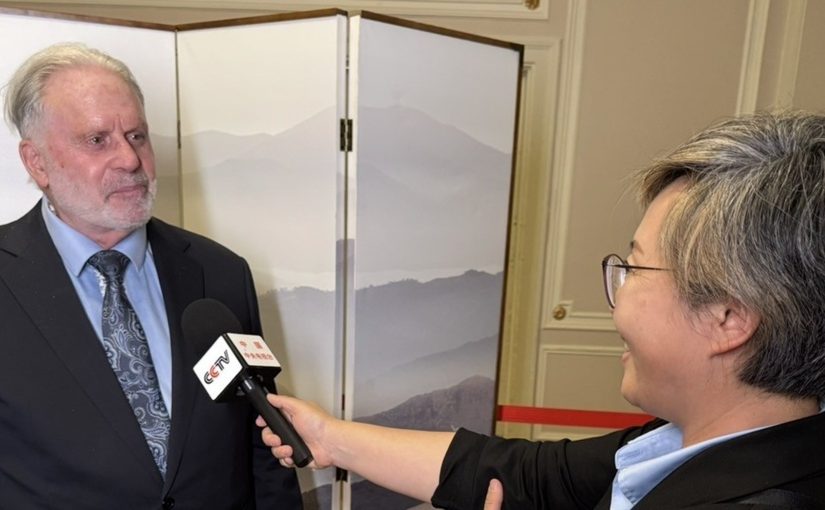
In the following article, Arnold August, Canadian author, political activist and an active contributor to the work of Friends of Socialist China, takes the recent celebration of the 77th anniversary of the founding of the People’s Republic of China as an occasion to assess the prospects for both enhanced bilateral relations and greater people-to-people friendship.
This year’s anniversary found echoes right across the vast land of Canada, from Prince Edward Island in the Atlantic to British Columbia facing the Pacific. Arnold lays particular emphasis on the role of Canada’s Chinese community, who, often in the face of discrimination and oppression, have, particularly since mass settlement began in the 1850s, made such an important contribution to building and developing their adopted nation and at the same time acting as the sturdy bridge of friendship back to their ancestral homeland.
He also assesses the recent positive developments in the relations between Canada and China, following a somewhat grim period, and especially since Prime Minister Mark Carney’s visit in January this year. Ambassador to Canada Wang Di provides a comprehensive survey of the present state of the relationship in an article contributed to a special supplement of The Hill Times. The Ambassador’s article is reproduced in full in the body of the article below.
Finally, Arnold notes: “Should this new situation mean we should still be careful not to overestimate Canada’s current positive role, since there are always pressures to throw a wrench into this present trend? Yes, it is right to be cautious. On the other hand, should one underestimate the Carney government’s role? The answer to this is no.”
More than 400 guests attended the Chinese Embassy in Canada’s 77th anniversary national day reception on September 24, 2026, held in the capital Ottawa at the iconic Fairmont Château Laurier.
Prince Edward Island (PEI) is one of Canada’s easternmost provinces, situated on the Atlantic coast. This small island is 980 km from Ottawa. Yet the Chinese overseas community there, whose settlement began as early as 1850 amid racist discrimination by the then Canadian government, was well represented at the celebration. The Chinese Society of Prince Edward Island posted on their Facebook account:
“The Chinese Society of Prince Edward Island (CSPEI) was honoured to attend the National Day reception hosted by the Embassy of China in Canada. It was a valuable opportunity to reconnect with old friends, meet new partners, and share how our volunteers bring people together in PEI. We are grateful for the warm conversations, encouragement, and continued support. We’re bringing that energy back to the Island as we prepare for CSPEI’s Mid-Autumn Festival celebration this Saturday [September 26].”
The CSPEI representative at the Ottawa event, Mengyun Candice Chen, posted on her social media: “When you live far from home [China], it means a lot to know there is a place you can turn to for support.” Furthermore, on the eve of the October 1 national day, the CSPEI was instrumental, along with the mayor of PEI’s capital, Charlottetown, in proudly raising the five star red Chinese flag at City Hall.
On October 4, during Golden Week (October 1–7), the CSPEI visited Stratford Elementary School in the province’s capital to highlight Chinese culture, with the Chinese national flag clearly on display.
From the other coast, on the Pacific Ocean, Ali Feiz, from Burnaby (near Vancouver), 3,552 km from Ottawa, was not only present in the nation’s capital at the event, but, as usual on such occasions, made a very important contribution. Ali Feiz has visited and reported on Xinjiang seven times and is one of Canada’s main voices against disinformation about this autonomous region of the People’s Republic. He also posted a photograph with Canadian Senator Victor Oh, the first male Chinese Canadian senator, appointed in 2013, who has consistently advocated for the rights of Chinese Canadians and constructive bilateral engagement. Ali Feiz published this on social media:
In a period marked by renewed dialogue between Canada and China, the Honourable Victor Oh, a prominent figure in the Chinese Canadian community, has emerged as a leading voice for pragmatic engagement. As the first male Chinese Canadian senator, appointed in 2013, he has consistently advocated for the rights of Chinese Canadians and for constructive bilateral engagement. His recent firsthand visit to Xinjiang and his address at the 77th anniversary celebration of the People’s Republic of China in Ottawa illustrates a consistent approach that prioritizes direct observation and people-centered development over distant speculation. In September 2026, the Honourable Victor Oh visited China and traveled to Xinjiang. During his time in Xinjiang, he visited a range of locations. In his address, the Honourable Victor Oh told the story of asking three Uyghur children in a Urumqi school what they wanted to be when they grew up. Without hesitation, they answered, “I want to be a doctor.” This moment, he said, crystallized for him the true measure of development. It is not about abstract statistics but about giving the next generation confidence and hope, ensuring that every hardworking ordinary person can see a tangible future.
On the speech by Honourable Rob Oliphant, Parliamentary Secretary to the Canadian Minister of Foreign Affairs, Ali Feiz pointed out in his X account the following – (it is particularly useful to note Oliphant’s comment on the One China Policy, which is always under pressure):
In his remarks, Honourable Rob Oliphant acknowledged the remarkable achievements of the Chinese people over the past 77 years while also addressing the need for honest dialogue between Canada and China. He stated that Canada will honour and stand up for the One China policy. He emphasised that a mature relationship is built on mutual respect, direct communication, and a shared commitment to addressing global challenges such as climate change, public health, and economic stability. The speech was notable for its balance. Honourable Rob Oliphant highlighted the importance of people-to-people ties, the contributions of Chinese Canadians to the fabric of Canadian society and the value of educational, cultural, and economic exchanges. Honourable Rob Oliphant’s address comes at a pivotal moment in Canada-China relations. Earlier this year, PM Mark Carney’s visit to China brought new momentum to bilateral ties, with both governments describing efforts to build what has been called a new strategic partnership. As Canada and China navigate a pivotal moment in their relationship, the speech served as a reminder that diplomacy is not merely about managing differences but about building bridges. His words will likely be remembered as a significant contribution to that ongoing effort.
In addition to Rob Oliphant, in attendance were Kody Blois, Parliamentary Secretary to the Prime Minister; Deputy Minister of International Trade, Glenn Purves; Deputy Minister of Canadian Heritage, Francis Bilodeau; and more than a dozen Members of Parliament and Senators, Members of the diplomatic corps, and representatives of Chinese enterprises.
HE Wang Di, the PRC’s Ambassador to Canada, and his wife Liu Yuyu were the hosts. Ambassador Wang addressed the gathering, noting that October 1 this year marks the 77th anniversary of the founding of the PRC, and this year also marks the 105th anniversary of the founding of the Communist Party of China (CPC), and the start of China’s 15th Five-Year Plan (2026—2030). Under CPC leadership, the Chinese people are advancing with confidence toward the goals of building China into a great modern socialist country in all respects and realising the great rejuvenation of the Chinese nation.
On September 30, the embassy published a special supplement in Ottawa-based The Hill Times celebrating the 77th national day. Ambassador Wang Di contributed a bylined article titled “Chinese Modernization Brings New Opportunities to the World: A Sound and Stable China-Canada Relationship Injects Positive Energy into the World”. The article was accompanied by an infographic highlighting China’s development achievements during the 14th Five-Year Plan period and outlining prospects for the 15th Five-Year Plan.
The full text of Ambassador Wang Di’s ‘oped’ reads:
October 1 this year marks the 77th anniversary of the founding of the People’s Republic of China. In retrospect, China has realized industrialization that took developed countries several centuries in only a few decades. It has achieved the two miracles of rapid economic growth and enduring social stability and brought about a historic leap in people’s lives from having only adequate food and clothing to enjoying moderate prosperity in general, and then to leading a well-off life.
This year marks the 105th anniversary of the founding of the Communist Party of China (CPC) and the beginning of China’s 15th Five-Year Plan (2026—2030). Under the leadership of the CPC, the Chinese people are advancing with confidence toward the goals of building China into a great modern socialist country in all respects and realizing the great rejuvenation of the Chinese nation. Over the past decade and more, China’s contribution to global economic growth has remained at around 30 percent, which makes China an important contributor to global development and prosperity. In the first half of this year, China’s GDP grew 4.7 percent year on year, among the highest in major economies. In particular, China’s latest trio of export stars of AI, robots and innovative drugs are developing at a faster pace. China has released the world’s first open-source Kimi K3 large language model. Chinese companies accounted for more than 97 percent of global humanoid robot shipments. The total value of Chinese innovative drug out-licensing deals reached approximately 110 billion US dollars. Meanwhile, China is committed to an open approach to innovation. Much of its innovation is open source. This enables more countries, particularly developing countries, to access affordable new technologies, which has enhanced their development capacity.
In China, green development is demonstrating strong momentum. China has the world’s largest installed capacity of photovoltaic (PV) power, surpassed coal-fired power capacity for the first time by the end of July this year, and becoming the country’s largest power source by installed capacity. This marks a major milestone in China’s energy transition. According to a report from the International Renewable Energy Agency, over the past decade, the average cost per kilowatt-hour of global wind projects has decreased by more than 60%, and that of PV power projects has dropped over 80%. The reductions are largely attributable to China’s innovation, manufacturing and production capacity. Today, while continuing to provide even greater “market dividends”, China is also offering “development dividends” as an anchor of stability and a hub for global industrial cooperation through its industrial development. Moreover, with its technological progress, China is offering more and more “innovation dividends” and accelerating global green and low-carbon transition. What these combined dividends generate for the world are greater opportunities and potential of development.
This year marks the 55th anniversary of the restoration of the People’s Republic of China’s lawful seat in the UN. China has firmly supported the UN in playing its core role in international affairs. At a time when multilateralism is facing headwinds, China has stepped up to shoulder its responsibilities. We have earnestly fulfilled our financial obligations as the second largest contributor to the UN budget. And we are also the largest troop contributor to UN Peacekeeping Operations among the permanent members of the UN Security Council. While some countries are turning toward protectionism, China remains committed to openness and cooperation. We have extended zero-tariff treatment to 63 countries and eliminated all restrictions on foreign investment in the manufacturing sector.
In the face of serious challenges to the international order, last September, President Xi Jinping solemnly put forward the Global Governance Initiative. It is built on five core concepts: sovereign equality, international rule of law, multilateralism, a people-centered approach, and real actions. Upon its introduction, it swiftly gained support from nearly 160 countries and international organizations, with over 60 countries joining the Group of Friends of Global Governance. No matter how the landscape may evolve, we will continue to hold high the torch of genuine multilateralism and continue to advocate an equal and orderly multipolar world and universally beneficial and inclusive economic globalization, building together a community with a shared future for humanity.
This year also marks the 56th anniversary of diplomatic relations between China and Canada. Our two countries have a long history of friendly exchanges, and the fruitful outcomes of bilateral cooperation in various fields have brought tangible benefits to the two peoples. In January this year, Prime Minister Mark Carney’s successful visit to China opened a new chapter of building China-Canada new Strategic Partnership. The two sides have since resumed and established dialogue mechanisms in a range of areas, including diplomacy, parliamentary affairs, trade and the economy, people-to-people exchanges and law enforcement, with tangible results continuing to emerge. According to Chinese statistics, in the first eight months of this year, bilateral trade volume grew by 17.1 percent year-on-year, with China’s imports from Canada increasing by 24.8 percent. Canada has become an important energy supplier to China. Canadian agricultural products such as canola and beef have returned to the Chinese market, while high-quality and affordable Chinese electric vehicles are providing Canadian consumers with more choices.
Following its role as the Guest Country of Honor at the China International Consumer Products Expo in April this year, Canada will once again serve as the Guest Country of Honor at the ninth China International Import Expo in November, for the first time in eight years. According to the latest survey by the Canada-China Chamber of Commerce, nearly 70 percent of Canadian companies expect their trade with China to increase over the next two years. Looking ahead, China will create new opportunities and provide new driving force for bilateral cooperation through its high-quality development and high-standard opening up. Regarding Canada’s ambitious goal to increase exports to China by 50% by 2030, we have every reason to believe that, as long as both sides work in the same direction and create the necessary conditions, this target will not only be achieved but even greater breakthroughs will be made.
As countries with significant influence in the Asia-Pacific region and around the world, China and Canada both actively support multilateralism and free trade and share similar positions on many international issues. The Kunming-Montreal Global Biodiversity Framework reflects the responsibility and commitment demonstrated by China and Canada in working together to lead global ecological governance. During Prime Minister Carney’s visit to China, leaders of the two countries reached the consensus on working together to improve global governance, accelerate implementation of the UN 2030 Agenda for Sustainable Development, advance the reform of the international financial system and other issues. In response to the evolving geopolitical landscape and global economy, China and Canada should jointly advocate and practice true multilateralism, strengthen multilateral coordination and work together to address global challenges. These efforts will not only benefit the two peoples but also inject stability and certainty into a turbulent world.
China will continue to work with Canada to effectively implement our leaders’ consensus. The two sides should lengthen the list of cooperation while reducing the list of irritants, and work to be partners that respect each other, pursue shared development, trust each other and collaborate with each other, so as to promote steady and sustained development of China-Canada relations, better benefit the two peoples, and contribute more positive energy to world peace and development.
During this year’s Golden Week, reports indicate that there will have been an increase in family visits to China by, on the one hand, Chinese overseas settled in Canada, and, on the other hand, Chinese from the PRC to Canada compared to last year, in part due to the vastly improved relations between the two countries since the beginning of this year, something noted by this writer in an interview given to China’s CCTV.
Should this new situation mean we should still be careful not to overestimate Canada’s current positive role, since there are always pressures to throw a wrench into this present trend? Yes, it is right to be cautious. On the other hand, should one underestimate the Carney government’s role? The answer to this is no. After all, Canada is part of NATO and yet seems to be taking a relatively independent position regarding China, at least for the moment. As Carlos Martinez, author and co-editor of Friends of Socialist China, in a recent in-depth interview on China and geopolitics, put it, cautiously hedging the role of Canada, with regard to the Project for a New American Century: “In reality the world doesn’t support it. The Global South doesn’t support it. Even the rest of the Global North – Europe, and to a certain extent Canada – is starting to realise and understand that, whether we like it or not, the world is becoming multipolar” (emphasis added).
Moreover, based on the experience outlined above regarding the Chinese diaspora in Canada, Canadians hoping to maintain and improve good relations with China can count on overseas Chinese in this country. From the beginning, after the formation of the PRC in 1949, the Chinese leadership has always maintained a clear position. For example, President Xi Jinping pointed out on March 17, 2013 that “overseas Chinese should carry forward fine traditions of diligence and kindness and contribute to the development of the country and friendship between the Chinese people and the people in their host countries.” (The Governance of China, Xi Jinping, Volume I, Foreign Languages Press, Beijing, China, 2014, page 45.)