The Seventh Summit of the Conference on Interaction and Confidence Building Measures in Asia (CICA) was held in Baku, the capital of Azerbaijan, on 15 October.
The summit adopted and issued the Baku Declaration of the Seventh CICA Summit. The declaration reaffirmed member states’ commitments to the UN Charter and the universally recognised norms and principles of international law, as well as their resolve to implement confidence-building measures in five dimensions — military-political, new challenges and threats, economic, environmental and human — as set out in the CICA Catalogue of Confidence Building Measures. It further underscored the need for multilateralism and enhanced cooperation amid an increasingly complex international environment.
The full text of the declaration can be read here.
The summit also admitted Laos as CICA’s 29th full member. Chinese Foreign Minister Wang Yi attended the summit as the Special Representative of President Xi Jinping.
The creation of CICA was proposed by Kazakhstan in 1992 at the 47th session of the United Nations General Assembly. The multinational forum aims to promote peace, security and stability in Asia by developing and implementing multilateral confidence-building measures and strengthening cooperation in related areas. China is a founding member of the body.
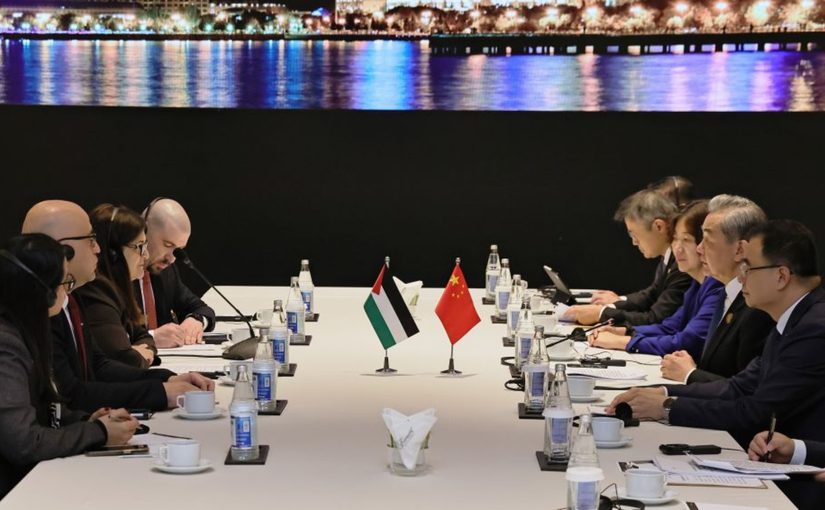
On October 15, Wang Yi met with Palestinian Foreign Minister Varsen Aghabekian Shahin on the sidelines of the summit.
Wang Yi noted that China is one of the first countries to recognise Palestine. China and Palestine are good friends and good brothers, and the two sides have carried forward their friendship for decades. No matter how the international landscape changes, the Chinese people have always stood together with the Palestinian people and firmly supported the Palestinian people’s just cause of restoring their legitimate national rights.
The Chinese foreign minister added that the Palestinian question is the most prolonged hotspot issue and the biggest historical injustice in the world since World War II. Unless this issue is resolved fairly, lasting peace and stability cannot be achieved in the Middle East. The Palestinian question should not be marginalised, and the world must not forget the two million Palestinian people in Gaza struggling on the brink of death. Justice may be delayed but never absent. As a responsible major country, China will continue to stand on the side of international justice and remain on the side of the oppressed nations and continue to speak up for the just cause of Palestine on multilateral platforms.
Varsen Aghabekian Shahin briefed on the latest developments of the Palestinian question. She stressed that the international community should not apply double standards to the Palestinian question, and highly appreciated China’s just position. Varsen Aghabekian Shahin said that Palestine appreciates China for its long-standing strong support for the Palestinian people to restore their legitimate national rights, for insisting on speaking up for Palestine on international and multilateral occasions, and for providing selfless help in the humanitarian assistance to Gaza. Palestine and China have maintained traditional friendship and the two sides enjoy sound cooperation.
The next day Wang Yi met with the Israeli President Isaac Herzog, in the highest-level contact between China and the Zionist entity since before October 2023. (CICA is unusual as an Asian regional body in that both Israel as well as the Arab and Muslim nations participate as members.) The Chinese reports of the meeting with Herzog pointedly note that it took place at his request.
However, he is unlikely to have been pleased by what he heard. Wang said that promoting peace and reconciliation in the region is the cornerstone of China’s Middle East policy. China has consistently maintained that the Palestinian question is the greatest historical injustice of this century. He added that the current top priority is to open full access to the Gaza Strip. The two million civilians there must not be left struggling on the brink of survival, nor should the humanitarian catastrophe be allowed to continue spreading; Israel should halt and reverse the forced establishment of settlements in the West Bank.
Wang Yi’s meeting with Herzog predictably drew considerable international media attention.
Palestine Chronicle headlined their report: “‘Greatest Historical Injustice’: China Challenges Herzog Over Palestinian Rights”. It wrote:
“Wang Yi called the Palestinian cause ‘the greatest historical injustice of this century’ during talks with Israeli President Isaac Herzog. China demanded an immediate halt to settlement expansion in the occupied West Bank and the full reopening of access routes to Gaza.”
It added: “Several delegations representing Arab and Islamic countries walked out of the conference hall in opposition to Israeli aggression and continued settlement expansion in the occupied West Bank [when Herzog rose to deliver his speech] …
“Wang’s demands in Baku focused on stopping Israeli settlement expansion, restoring access to Gaza and addressing the Palestinian question through that framework. The exchange placed those demands directly before Herzog as Israel faced protests from other delegations attending the summit.”
Al Jazeera headlined: “China tells Israel to stop ‘forced establishment’ of West Bank settlements. ‘The Palestinian question is the greatest historical injustice of this century,’ China’s foreign minister said.”
It further recalled: “In September, Chinese President Xi Jinping visited Cairo for the first time in a decade and called on Middle East countries to oppose external influence and consider reshaping the region’s security order… In March, China criticised the US and Israeli attacks on Iran, with Beijing demanding an immediate halt to the joint attacks.”
Wang Yi also held a number of other bilateral meetings during his stay in Baku.
In their meeting, President Ilham Aliyev of Azerbaijan said that his country appreciates China’s long-standing strong support for Azerbaijan’s economic and social development and the safeguarding of its national interests. It regards China as a leading force in the rise of the Global South and believes Chinese modernisation has set an example for developing countries including Azerbaijan. Azerbaijan is one of the first countries to support and participate in the Belt and Road Initiative. A series of cooperation projects between the two countries have yielded fruitful results. Azerbaijan is ready to strengthen strategic alignment with China and continue to expand cooperation in energy, connectivity and other fields. Azerbaijan welcomes more Chinese enterprises to invest and do business in the country.
Wang Yi said that China supports Azerbaijan in following a development path suited to its national conditions and is ready to strengthen cooperation with Azerbaijan and other relevant parties on the Middle Corridor (Trans-Caspian International Transport Route), and continue to serve as a reliable long‑term strategic partner in Azerbaijan’s development. China appreciates Azerbaijan’s long-standing strong support on issues concerning China’s core interests, and supports Azerbaijan in safeguarding its independence, sovereignty and territorial integrity. China’s development represents the increasing force of the Global South and the growing strength of developing countries. China is ready to maintain close coordination and cooperation with Azerbaijan to jointly safeguard the common interests of Global South countries. China supports Azerbaijan in playing an important role in multilateral platforms such as CICA and in international affairs and making greater contributions to peace and stability of the region and the world.
Wang also held talks with Azerbaijani Foreign Minister Jeyhun Bayramov.
Jeyhun Bayramov said that Azerbaijan and China are sincere friends and reliable partners to each other. The friendship between the two countries has a long history, and exchanges at all levels have become increasingly closer, bringing bilateral relations to an unprecedentedly high level. Azerbaijan firmly adheres to the one-China principle and is ready to follow the guidance of the two heads of state with China to advance the comprehensive strategic partnership, deepen cooperation in energy, transportation, climate change, artificial intelligence, culture and people-to-people exchanges and other fields, and step up efforts in the Belt and Road cooperation and the joint building of the Middle Corridor. Azerbaijan agrees with and values China’s leading role among Global South countries, fully supports the series of global initiatives put forward by President Xi Jinping, and is ready to strengthen mutual support and cooperation with China in international affairs.
In his meeting with Turkish Foreign Minister Hakan Fidan, Wang Yi noted that China and Turkey share a traditional friendship. Deepening bilateral strategic cooperation serves the interests of both countries and peoples and will contribute to world economic recovery. China has always attached great importance to China-Turkey relations and is ready to take the 55th anniversary of diplomatic relations as an opportunity to work with Turkey to implement the important understandings reached by the two heads of state and bring China-Turkey strategic cooperation to a new level.
He added that China appreciates Turkey’s repeated emphasis on attaching importance to China’s security concerns and its efforts to curb terrorist acts endangering China’s national security. It is hoped that Turkey will continue to understand and support China’s position on issues concerning China’s core interests, safeguard the common interests of the two countries and consolidate the political foundation of bilateral relations.
Wang Yi stated that China supports Turkey in hosting the 31st Session of the Conference of the Parties (COP31) to the United Nations Framework Convention on Climate Change (UNFCCC), appreciates Turkey’s efforts in addressing climate change, and is ready to deepen cooperation with Turkey in this field. In the next period, the two sides should strengthen the alignment between the Belt and Road Initiative and the Middle Corridor programme, create a sound environment for two-way investment, and achieve mutual benefit and win-win outcomes.
Hakan Fidan said that Turkey attaches great importance to relations with China and hopes to accelerate high-level exchanges between the two countries in the next stage. Turkey-China economic and trade relations enjoy good development prospects. Turkey welcomes Chinese enterprises to invest in the country and welcomes more Chinese tourists to visit Turkey, so as to achieve more balanced development in cooperation in various fields. Turkey understands China’s concerns in combating extremist terrorism.
In his meeting with Russian Foreign Minister Sergei Lavrov, Wang Yi congratulated Russia on the successful State Duma election and the smooth conclusion of this important domestic political agenda. Wang noted that President Xi Jinping and President Vladimir Putin held fruitful meetings in May and August this year, steering the China-Russia Comprehensive Strategic Partnership of Coordination for the New Era to sustained high-level development. The APEC Economic Leaders’ Meeting will be held in Shenzhen next month. It is believed that with support from Russia and other parties, the APEC “China Year” will yield fruitful outcomes, jointly revitalising the historical process of the Asia-Pacific community and injecting strong impetus into development and cooperation across the Asia-Pacific region.
Lavrov said that China and Russia hold similar positions on international affairs. Russia is ready to further strengthen coordination with China under multilateral frameworks including the United Nations, the G20, APEC and the BRICS mechanism to jointly uphold international fairness and justice.
The two sides also coordinated their respective positions and reached new consensus on the next-stage high-level exchanges between China and Russia as well as international and regional hotspot issues of common concern.
Wang Yi also met with Bahraini Foreign Minister Abdullatif bin Rashid Al Zayani.
Wang said that China is ready to work with Bahrain on the basis of mutual respect and mutual support to enhance political mutual trust, deepen practical cooperation, strengthen people-to-people and cultural exchanges and advance coordination on multilateral platforms, so as to promote the continuous development of China-Bahrain relations. He also stated that the protracted conflicts in the Middle East have exerted a severe impact on regional peace and stability. This does not serve any party’s interest. President Xi Jinping has put forward a series of initiatives and proposals dedicated to peace in the Middle East, which represent the insight and solutions contributed by China to addressing the security dilemma in the Middle East. China has always believed that conflicts should not be escalated and fighting should not spread. Confrontation worsens tensions, while dialogue is the right path. The sovereignty and territorial integrity of all countries should be respected, and the legitimate concerns of all parties should be valued. It is necessary to remove interference and continue to adhere to the direction of political settlement. China is ready, based on the series of initiatives put forward by President Xi Jinping, to strengthen communication and coordination with regional countries including Bahrain to help the region achieve lasting peace and stability.
Abdullatif bin Rashid Al Zayani said that the current security situation in the Gulf countries is very grave. Bahrain welcomes the Chinese initiatives and solutions put forward by President Xi Jinping, which are all important ideas that benefit regional countries. Bahrain appreciates China’s consistent commitment to fairness and justice, its communication with regional countries, and its active efforts to bring an end to military operations.
In his speech to the CICA summit, Wang Yi said that it is a platform for dialogue and cooperation initiated and jointly built by Asian countries. Since its establishment, CICA has actively championed the Five Principles of Peaceful Coexistence, systematically advanced cooperation on confidence building measures, consistently practised multilateralism, and worked tirelessly to strengthen the foundation of trust for peace and security in Asia.
Amid accelerating changes unseen in a century, only by fostering a sense of community with a shared future, standing on the right side of history, and upholding solidarity and cooperation can Asian countries stand at the forefront of the times, turn crises into opportunities and jointly create a better future, he said.
He put forward four proposals:
- First, jointly safeguard peace and stability. Asia does not need a Cold War mentality and does not welcome bloc confrontation. Asia’s problems should ultimately be addressed by the people of Asia through solidarity and cooperation.
- Second, jointly promote prosperity and revitalisation. Development is the master key to solving all problems. Efforts should be made to better align high-quality Belt and Road cooperation with the development initiatives of various countries.
- Third, jointly promote exchanges and mutual learning among civilisations. Asia is the continent with the greatest diversity of civilisations. Efforts should be made to firmly promote the Asian values of peace, cooperation, openness and inclusiveness, respect countries’ independent choices of development paths and governance models.
- Fourth, jointly improve global governance. Efforts should be made to reinvigorate the authority and role of the United Nations and to uphold the basic norms governing international relations established by the UN Charter.
Following his meetings in Baku, Wang Yi paid a visit to Croatia.
Meeting with President Zoran Milanovic on October 16, Wang Yi said that with a civilisation spanning 5,000 years, China’s deep-rooted commitment to peace means that it does not seek to use its strength to dominate others but instead pursues cooperation and mutual benefits with all countries. President Xi has put forward the goal of building a community with a shared future for humanity, emphasising that all countries should stand together, embrace their shared destiny and jointly protect and develop the only planet that humanity calls home. China advocates an equal and orderly multipolar world in which all countries, large and small, are equal and uphold the basic norms of international relations based on the United Nations Charter. China will strive to make the world more peaceful, stable and prosperous, Wang said, adding that China’s success is not only its own, but also a success for all countries of the Global South.
The two sides also exchanged views on China-Europe relations. Wang noted that there is no fundamental conflict of interests between China and the European Union (EU), and that the two sides can help each other succeed and achieve common prosperity. Regarding the EU’s concerns over China’s trade surplus, Wang said that the surplus is a result of market demand and the international division of labour. China and the EU are partners, not adversaries, and should pursue cooperation rather than confrontation.
Milanovic said that Croatia, as an EU member, adheres to the bloc’s common foreign and security policy while striving to maintain its own independence. On current economic and trade disputes between China and the EU, he said that he shares China’s position and believes that China’s strong competitiveness stems mainly from an efficient, comprehensive system for organising production.
In their meeting on October 17, Prime Minister Andrej Plenkovic told Wang Yi that Chinese enterprises have participated in infrastructure projects in Croatia, including roads, bridges and tunnels, noting that the Peljesac Bridge has played a significant role in improving connectivity between different parts of the country.
Stressing that Croatia attaches great importance to cooperation with China under the China-Central and Eastern European Countries (CEECs) framework and the Belt and Road Initiative, Plenkovic said Croatia is willing to continue contributing to these efforts and looks forward to the early resumption of the CEEC-China leaders’ meeting mechanism to create new opportunities for closer high-level exchanges between the two sides. (The China-CEEC mechanism currently groups China with 14 countries in central and eastern Europe following the accession of Greece in 2019 and the withdrawal of Lithuania in 2021 and of Estonia and Latvia in 2022. Four countries and two international organisations have observer status. The grouping met annually from 2012 to 2019 and then by video conference, due to the COVID pandemic, in 2021. Until now it has not held a further summit meeting.)
Wang Yi noted that China firmly believes that China and the European Union (EU) are partners, not rivals. China supports European integration and Croatia’s efforts to achieve faster development through this process and hopes Croatia will play a constructive role in deepening China-EU cooperation. Meanwhile, Wang stressed that China and CEECs share a practical need to strengthen exchanges and cooperation. Such cooperation is entirely open and transparent and contributes to European integration, he added.
China is willing to strengthen cooperation with interested countries in the region through established mechanisms, appreciates Croatia’s positive attitude in this regard and is ready to use the 15th anniversary of the China-CEEC cooperation mechanism next year as an opportunity to reinvigorate mutually beneficial cooperation between the two sides.
On trade issues between China and the EU, Wang Yi reiterated that these stem from the international division of labour and market demand. Imports of high-quality, competitively priced Chinese goods benefit European consumers and help curb inflation, reflecting demand in the European market, and there is no so-called “overcapacity” problem.
China is willing to import more high-value-added products from Europe and hopes the EU will ease restrictions on exports to China. China is committed to promoting balanced growth in bilateral trade, with both sides moving forward rather than backward and expanding shared benefits rather than diminishing them.
Plenkovic briefed Wang on the situation in the Western Balkans. Wang said that China does not interfere in the internal affairs of countries in the region and hopes that all countries will enhance understanding, rebuild mutual trust and coexist in harmony through dialogue. China is willing to play a constructive role in line with the needs of countries in the region.
In his meeting with Croatian Minister of Foreign and European Affairs Gordan Grlic Radman, Wang Yi said that Croatia, an important stop on the ancient Silk Road, has once fostered mutual learning between Eastern and Western civilisations. It was also noted that this marks the first visit to Croatia by a Chinese foreign minister in 33 years and serves as a reciprocal visit following Radman’s trip to China last year.
Radman said that Croatia attaches great importance to its relations with China and respects China’s sovereignty and territorial integrity. Croatia has consistently adhered to the one-China policy and will continue to uphold it firmly, neither participating in nor supporting any “Taiwan independence” activities.
Following his visit to Croatia, Wang Yi visited Montenegro. The visit was notable for assuming strong anti-fascist overtones.
Montenegrin President Jakov Milatovic met with Wang in Cetinje, a city near Montenegro’s capital, Podgorica, on October 17, expressing his country’s willingness to deepen friendly relations and practical cooperation with China.
Milatovic asked Wang to convey his sincere greetings to Chinese President Xi Jinping and welcomed the first-ever visit by a Chinese foreign minister to Montenegro. Noting that this year marks the 20th anniversary of diplomatic relations between Montenegro and China, he said the visit holds important symbolic significance. Recalling his experience studying in China, he said he had gained a deeper understanding of China’s economic and social development and the lives of its people, as well as the importance of cooperation with China. Noting that European Union (EU) accession is currently a priority on Montenegro’s foreign policy agenda, Milatovic said his country also attaches great importance to relations with China, with Montenegro firmly adhering to the one-China principle and remaining committed to friendly and mutually beneficial cooperation with China.
Wang conveyed Xi’s cordial greetings to Milatovic, saying that despite the geographical distance, China and Montenegro have always respected each other and treated each other as equals, setting an example of friendly exchanges between countries of different sizes. Wang said China appreciates Milatovic’s rational and objective understanding of China and his active efforts to promote bilateral relations. He said China has consistently maintained that all countries, big or small, are equal, and has always followed the path of partnership over alliance and dialogue over confrontation.
Wang added that China has engaged in practical cooperation with Montenegro in good faith, delivering tangible results. Describing Montenegro’s north-south expressway as a landmark project of historic significance, he called on both sides to ensure the high-quality completion of its second phase.
Montenegro enjoys unique tourism resources and has a historical tradition of anti-fascism, Wang said, adding that China is helping restore the Tara River Bridge, which was featured in the famous Yugoslav film “The Bridge,” and that more Chinese tourists are expected to visit Montenegro.
China has always maintained that China and the EU are partners, not rivals, he said, noting that differences over economic and trade issues, which have emerged amid increasingly closer cooperation, can be resolved through dialogue and should not affect the overall development of China-EU relations. Wang said China understands Montenegro’s efforts to join the EU and its choice to pursue European integration, noting that the process is fully compatible with deeper cooperation with China. China believes Montenegro will become another good friend of China within the EU after its accession and hopes Montenegro will play a unique and important role in promoting regional peace and stability and advancing China-EU relations.
The following day, Wang Yi met with Montenegrin Prime Minister Milojko Spajic in the capital Podgorica.
Spajic said Wang’s visit demonstrates the importance China attaches to bilateral relations. Montenegro and China share historical memories and traditional friendship, as both countries fought against fascism and foreign aggression during World War II.
Montenegro highly values China’s status and influence as a major country and appreciates China’s responsible efforts to curb rising global oil prices amid the conflicts in the Middle East, which have helped Montenegro and other small and medium-sized countries cope with the energy crisis, demonstrating China’s sense of responsibility as a major country.
Noting Montenegro’s sound economic and social development in recent years, Spajic said Chinese enterprises have helped the country complete the construction of its north-south expressway. The ongoing joint restoration of the Tara River Bridge is a project of great historical significance, bringing the two peoples closer and serving as a testament to their traditional friendship, he added.
Wang conveyed Chinese leaders’ best wishes to Spajic, saying that China and Montenegro have always been good friends on their paths toward development and revitalisation. Wang said China and Montenegro share much in common. Both peoples are unafraid of bullying and firmly defend their national dignity. They both achieved victory in the World Anti-Fascist War and should remain vigilant against the resurgence of militarism.
Both countries uphold and practise multilateralism and oppose a return to the “law of the jungle”, he said. The Tara River Bridge connects the hearts of the two peoples and carries both the history and future of bilateral relations. China’s assistance in restoring the bridge is of great historical and social significance, he added.
Also, on October 18, Wang Yi met with his Montenegrin counterpart Deputy Prime Minister and Foreign Minister Ervin Ibrahimovic in Podgorica.
Wang said China and Montenegro are good friends despite the geographical distance. China was among the first countries to recognise Montenegro’s independence and establish diplomatic relations with it, demonstrating China’s respect for Montenegro and the importance it attaches to bilateral ties.
Over the past 20 years, China-Montenegro relations have maintained sound and steady development, bringing benefits to both peoples and setting an example of win-win cooperation between countries with different sizes, national conditions and social systems.
Wang added that both countries share a history of anti-fascism and a national spirit of resilience and defiance in the face of aggression, noting that China is helping restore the Tara River Bridge featured in the famous Yugoslav film “The Bridge,” which he believes will also connect the hearts of the two peoples. China supports Montenegro’s independence, sovereignty and territorial integrity, supports the path of development and revitalisation chosen by the Montenegrin people, and supports Montenegro in playing an active role in international affairs. China has both the willingness and the capability to help Montenegro achieve development and stands ready to be a reliable and long-term partner.
Noting that the China-CEEC cooperation mechanism was established in response to the development needs of Central and Eastern European countries (CEECs), Wang said China pursues such cooperation without geopolitical considerations, does not interfere in the internal affairs of regional countries, and looks forward to mutually beneficial outcomes. Noting that all Balkan countries are good friends of China and maintain sound cooperation with China, he expressed the hope that countries in the region will live in harmony, build mutual trust and achieve common development.
For his part, Ibrahimovic said Montenegro and China enjoy a long-standing friendship, and despite the geographical distance, the two peoples share a strong sense of friendship, with the Tara River Bridge symbolising their shared historical memories.
He added that Montenegro warmly welcomes the first-ever visit by a Chinese foreign minister, adding that frequent visits to China by Montenegrin representatives from various sectors have sent a positive signal of the country’s commitment to exchanges and cooperation with China. Montenegro firmly adheres to the one-China policy, and no official from any Montenegrin government institution will engage in exchanges with Taiwan, he stressed.
Regarding the Tara River Bridge and the Yugoslav film “The Bridge” repeatedly invoked above, on May 24, 2025, our co-editor Keith Bennett spoke at a remembrance and discussion event at the Bishop Nikolaj Community Centre in West London, marking 26 years since NATO’s war of aggression against Serbia and the former Yugoslavia, organised by the Round Table of Serbian organisations and community groups in the United Kingdom, and said as follows:
“The enduring friendship between China and Serbia has its root in this common struggle [against fascism] on the eastern and western fronts. The 1969 Yugoslav film, The Bridge, vividly depicted those days. It was one of the first foreign films to be shown in China at the start of reform and opening up. Both the film, and through it the song Bella Ciao, became favourites of a generation of Chinese people, including President Xi Jinping.”
Following his visit to Montenegro, Wang Yi was scheduled to visit Bulgaria before returning home.
The following articles were originally published by the Xinhua News Agency and on the website of the Chinese Foreign Ministry.
7th CICA summit held in Azerbaijan’s Baku
BAKU, Oct. 16 (Xinhua) — The Seventh Summit of the Conference on Interaction and Confidence Building Measures in Asia (CICA) was held in Baku, the Azerbaijani capital, on Thursday.
Participants exchanged views on security and development in the CICA region, the implementation of confidence-building measures and ways to strengthen practical cooperation.
Azerbaijani President Ilham Aliyev chaired the summit and delivered a speech.
Azerbaijan’s two-year CICA chairmanship has helped advance cooperation in areas such as transport, connectivity, digitalization, environment, tourism, education, science and technology, while strengthen CICA’s capacity to promote dialogue, economic development and mutual understanding among member states, he said.
The summit adopted and issued the Baku Declaration of the Seventh CICA Summit.
The declaration reaffirmed member states’ commitments to the UN Charter and the universally recognized norms and principles of international law, as well as their resolve to implement confidence-building measures in five dimensions — military-political, new challenges and threats, economic, environmental and human — as set out in the CICA Catalogue of Confidence Building Measures.
The declaration underscored the need for multilateralism and enhanced cooperation amid an increasingly complex international environment.
It also commended the progress made under Azerbaijan’s CICA chairmanship in CICA’s institutional development, including establishing the CICA Women Council, institutionalizing the CICA Finance Summit, and operationalizing the Partnership Network of Leading Universities.
The summit also admitted Laos as CICA’s 29th full member. It extended Azerbaijan’s CICA chairmanship for the 2026-2028 period and appointed Sultan Hajiyev as CICA secretary general for 2026-2030.
Chinese Foreign Minister Wang Yi, as Special Representative of Chinese President Xi Jinping, attended the Summit.
Wang, also a member of the Political Bureau of the Communist Party of China Central Committee, put forward four proposals to advance cooperation among CICA member states, urging efforts to jointly safeguard peace and stability, promote prosperity and revitalization, promote exchanges and mutual learning among civilization, and improve global governance.
The creation of CICA was proposed by Kazakhstan in 1992 at the 47th session of the United Nations General Assembly.
The multinational forum aims to promote peace, security and stability in Asia by developing and implementing multilateral confidence-building measures and strengthening cooperation in related areas. China is a founding member of CICA.
Wang Yi Meets with Palestinian Foreign Minister Varsen Aghabekian Shahin
October 16 (MFA) – On October 15, 2026 local time, Member of the Political Bureau of the CPC Central Committee and Foreign Minister Wang Yi met with Palestinian Foreign Minister Varsen Aghabekian Shahin in Baku on the sidelines of the Summit of the Conference on Interaction and Confidence Building Measures in Asia.
Wang Yi noted that China is one of the first countries to recognize Palestine. China and Palestine are good friends and good brothers, and the two sides have carried forward their friendship for decades. No matter how the international landscape changes, the Chinese people have always stood together with the Palestinian people and firmly supported the Palestinian people’s just cause of restoring their legitimate national rights. At present, the China-Palestine strategic partnership maintains the momentum of development, and China is ready to work with Palestine to further enhance strategic mutual trust and advance the development of bilateral relations.
Wang Yi said that the Palestinian question is the most prolonged hotspot issue and the biggest historical injustice in the world since World War II. Unless this issue is resolved fairly, lasting peace and stability cannot be achieved in the Middle East. The current situation in the Middle East remains tense, posing new difficulties to the settlement of the Palestinian question. The Palestinian question should not be marginalized, and the world must not forget the two million Palestinian people in Gaza struggling on the brink of death. Justice may be delayed but never absent. As a responsible major country, China will continue to stand on the side of international justice and remain on the side of the oppressed nations, and continue to speak up for the just cause of Palestine on multilateral platforms. China will also call on all peace-loving countries to firmly support the two‑State solution and jointly promote the comprehensive, just, and lasting settlement of the Palestinian question at an early date.
Varsen Aghabekian Shahin briefed on the latest developments of the Palestinian question. She stressed that the international community should not apply double standards to the Palestinian question, and highly appreciated China’s just position on the Palestinian question. Varsen Aghabekian Shahin said that Palestine appreciates China for its long-standing strong support for the Palestinian people to restore their legitimate national rights, for insisting on speaking up for Palestine on international and multilateral occasions, and for providing selfless help in the humanitarian assistance to Gaza. Palestine and China have maintained traditional friendship and the two sides enjoy sound cooperation. Palestine hopes to continuously deepen bilateral relations with China, and expects that China will continue to uphold justice for Palestine on the Palestinian question and play a more important role in realizing the two‑State solution.
Chinese FM attends 7th CICA summit
BAKU, Oct. 15 (Xinhua) — Chinese Foreign Minister Wang Yi, as Special Representative of Chinese President Xi Jinping, attended the Seventh Summit of the Conference on Interaction and Confidence Building Measures in Asia (CICA) here on Thursday and delivered a speech.
Wang, also a member of the Political Bureau of the Communist Party of China Central Committee, said that CICA is a platform for dialogue and cooperation initiated and jointly built by Asian countries.
Since its establishment, CICA has actively championed the Five Principles of Peaceful Coexistence, systematically advanced cooperation on confidence building measures, consistently practiced multilateralism, and worked tirelessly to strengthen the foundation of trust for peace and security in Asia.
China highly appreciates Azerbaijan’s efforts during its CICA chairmanship to advance CICA cooperation, and stands ready to continue its strong support for and active participation in the CICA process, Wang said.
Amid accelerating changes unseen in a century, only by fostering a sense of community with a shared future, standing on the right side of history, and upholding solidarity and cooperation can Asian countries stand at the forefront of the times, turn crises into opportunities and jointly create a better future, he said.
Wang put forward four proposals:
First, jointly safeguard peace and stability. Asia does not need a Cold War mentality and does not welcome bloc confrontation. Asia’s problems should ultimately be addressed by the people of Asia through solidarity and cooperation, and Asia’s security should be ensured by upholding the vision of common, comprehensive, cooperative and sustainable security.
Second, jointly promote prosperity and revitalization. Development is the master key to solving all problems. Efforts should be made to better align high-quality Belt and Road cooperation with the development initiatives of various countries, safeguard an open environment for cooperation, advance trade and investment liberalization and facilitation, ensure the stable and efficient operation of international transport corridors, and strengthen supply security for critical raw materials, energy resources and food, so that Asian countries can work together to accelerate their progress toward modernization.
Third, jointly promote exchanges and mutual learning among civilizations. Asia is the continent with the greatest diversity of civilizations. Efforts should be made to firmly promote the Asian values of peace, cooperation, openness and inclusiveness, respect countries’ independent choices of development paths and governance models, deepen exchanges and cooperation in culture, tourism and health, as well as among women’s and youth groups, media organizations and think tanks, and promote people-to-people exchanges and closer bonds between peoples, so that diverse civilizations can learn from one another and flourish together.
Fourth, jointly improve global governance. Efforts should be made to reinvigorate the authority and role of the United Nations, uphold the basic norms governing international relations established by the UN Charter, strengthen capacities in digital governance, disaster prevention and mitigation, and public health, and jointly build a more efficient, inclusive and resilient governance system in Asia.
Wang stressed that China will remain firmly committed to the path of peaceful development, bring greater stability to the international landscape through its own high-quality development, and provide stronger impetus for global growth.
China stands ready to work with all parties to build consensus, deepen cooperation and jointly build a peaceful, stable, prosperous, open and inclusive Asian community with a shared future, making greater Asian contribution to world peace and development, Wang said.
Azerbaijani President Ilham Aliyev briefed on the work undertaken by Azerbaijan during its two-year CICA chairmanship and put forward proposals for cooperation.
Participants exchanged views on the security and development situation in the CICA region and the implementation of confidence building measures. They agreed that CICA member states should practice multilateralism, strengthen solidarity and cooperation, address common challenges, safeguard the common interests of the Global South, and promote peace and development in Asia.
The summit adopted and issued the Baku Declaration of the Seventh CICA Summit.
On the sidelines of the summit, Wang also met separately with Israeli President Isaac Herzog, Russian Foreign Minister Sergei Lavrov, Bahraini Foreign Minister Abdullatif bin Rashid Al Zayani, Turkish Foreign Minister Hakan Fidan and Palestinian Foreign Minister Varsen Aghabekian Shahin, and had friendly exchanges with dignitaries from various countries.