Alfie Howis is impressed by a socialist realist crime drama that was China’s national day box office hit.
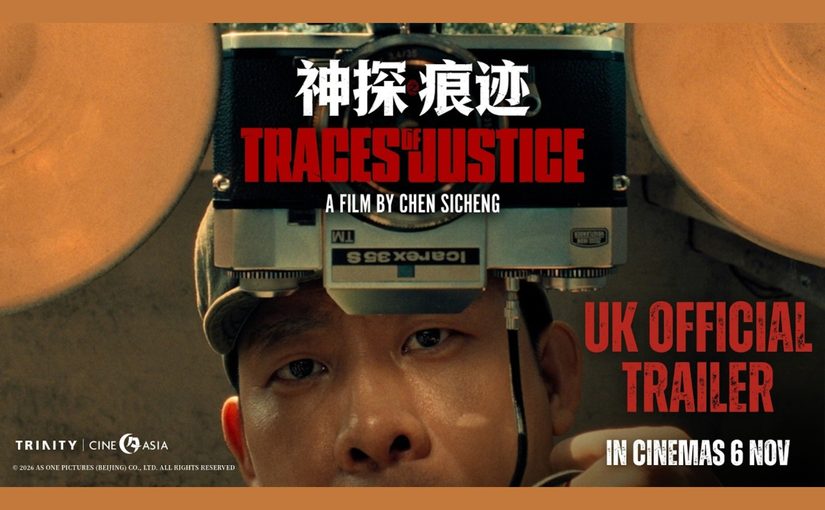
Traces of Justice is a crime drama tracing the real life story of Cui Daozhi, a police detective who was a key innovator in developing forensic science in China, but whose overall message is that the institutionalisation of materialist investigation techniques has contributed to developing people’s justice in China. Released on 1 October, China’s national day, it dominated the holiday release season grossing over 420 million Yuan (£48m) in its first week. The success of the film indicates an audience increasingly interested in real stories more than over-dramatised, personality-driven releases, amid a national effort to celebrate China’s true role models and dilute excessive celebrity culture. Traces of Justice is a big step forward in that direction, a film which centres national development, the progress of socialist rule of law, and the power of ordinary workers to make positive and massively impactful change through persistence and innovation.
The film follows the career of Cui Xun, a composite protagonist based on the real person Cui Daozhi. He starts his career in 1971 in Harbin, capital of northeast China’s Heilongjiang province, where he is attempting to solve the case of a murder of a young girl. His superiors insist on closing the case through obtaining a forced confession, however Cui Xun instead insists on instigating a scientific method of evidence gathering. He develops the method of bite-mark identification based on a bite mark on the dead body, creating the procedure from scratch using potatoes for dental impressions and having scientists bite each other to test the concept. By challenging old ideas within the police force, Cui Xun successfully proves his methodology is correct and successfully identifies the killer. Bite-mark identification is subsequently institutionalised by authorities nationwide, showing how the socialist law and order system self-corrects and is ready to discard old ideas rather than cling on to dogmatic, outmoded and unscientific methods.
The second case is also in Heilongjiang, where a disgruntled worker kills his colleagues after they make minor insults about his privileged background. He is the son of a ‘founding general’ and his powerful father had arranged his job for him and carried a lot of influence nationally due to his status, the exact nature of which isn’t revealed. When Cui Xun develops the method of fingernail identification, after collecting the nail clippings of 200 police academy students every 20 days, the killer tries to use his family connection to escape justice. He offers a bribe to a senior officer and his father abuses his power to send soldiers to the police station to intimidate them into letting his son go. He even goes so far as to fake injury and pretend that he was tortured in custody, which was taken very seriously until proven false by forensic analysis of his self-inflicted injuries. Nevertheless, his bribery succeeds and he is wrongly released, but Cui Xun soon apprehends him again, tackling him to the ground and splitting open a bag of cash. The scattering bills mark the final collapse of the killer’s corrupt protection, highlighting that without his father’s power he has nothing.
The third case takes us to Wuhan in the 1990s, to the scene of a bus bombing on a bridge over the Yangtze River. Cui Xun, now a nationally recognised, leading expert in his field, is called in to work on the case. This represents the full articulation of the film’s central message: what began as a one-man-led struggle to win recognition for innovative methods has now become a large-scale investigation grounded in those materialist investigative principles that he pioneered. It is not a case solved by an individual hero, but the collective effort of forensic experts mobilised on a national scale, as they work together to reconstruct the timeline of the explosion and calculate who placed the bomb based on fragments in the debris field. The structure works and springs into action based on the progress already made in the previous cases.
The final case returns to Wang Weiguo, an officer who previously chastised Cui Xun for challenging old techniques in the first case. Wang Weiguo is now at the end of his career and has been found to be corrupt, taking a bribe so that he can fund his daughter’s education abroad. He takes his own life, guilty that he betrayed his own principles and belief in serving the people, and his ill-gotten gains are swiftly found by Cui Xun and returned to the public treasury. This case serves to highlight how anyone can fall victim to the lure of corruption and greed if they lose their ideals and convictions and forget why they started.
The film’s popularity at the box office was unusually geographically balanced: tier-three-to-five cities contributed 41% of its box office, almost exactly the holiday baseline, while rival titles skewed sharply toward more prosperous coastal markets. It achieved this without a big marketing spend and barely any initial social media campaign, its popularity in lower-tier cities driven by success in smaller cinemas, where audiences recommended it to family and friends in person, allowing it to sustain viewings rather than immediately peak. In Shiyan, Hubei, a single prefecture-level city, for example, it took 65.1% of the national day holiday market to top the local chart, with patrons said to have returned for second and third viewings. This suggests that the film genuinely resonated with the average audience in China, focussing on the success of an ordinary worker to deliver socialist justice and contribute to institutional reform, commendably crowding out imported action films in some places.
Traces of Justice is a socialist realist epic. Cui Xun is a construction, borne from a real person, of an ordinary figure who embodies historical forces and is the expression of a social process, rather than an individual genius. He is the inversion of the celebrity protagonist, whose individuality is realised only through serving the people and the collective within the overall framework of the socialist state. The narrative construes history as a progressive arc in which unglamorous, procedural labour and collectivism accumulate into historic changes. It also highlights contradictions to be found in a developing socialist country, as with Wang Weiguo’s descent into corruption, but locates correction within the collective process rather than a redemption narrative. Ultimately the film’s didactic function is achieved through its genre rather than despite it, fusing entertainment with a serious message. The lower-tier city audiences who made it the holiday’s biggest film are proof that socialist realism can succeed as popular culture rather than bureaucratic imposition, the surest sign that this direction of travel in China’s film industry is meeting success.
Traces of Justice is directed by Chen Sicheng and stars Zhang Yi, Ma Li, Cheng Minghao, Karry Wang, Fan Chengcheng, Chen Feiyu, and Li Xuejian. It is distributed in the UK by Trinity Cine Asia and has a BBFC classification of 15. Details of UK showtimes can be found here.