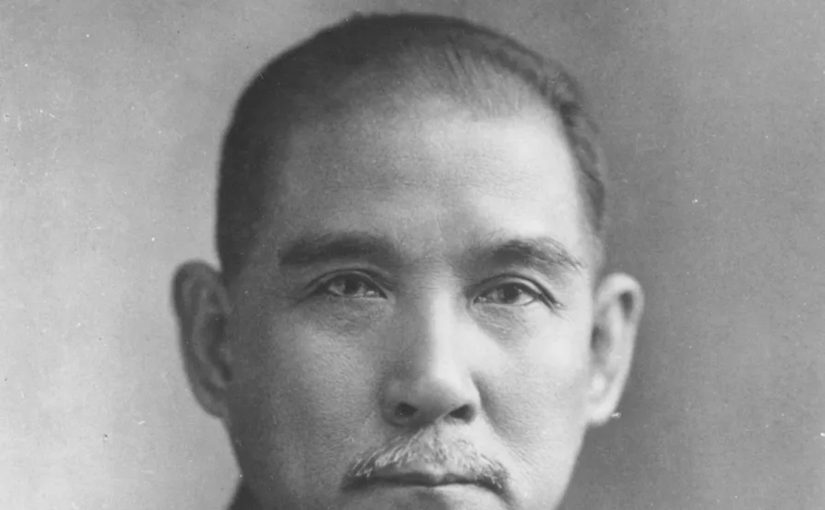
We are very pleased to republish the below article by Joe Dwyer, marking the 160th anniversary of the birth of Dr. Sun Yat-sen, China’s great revolutionary forerunner, which was originally published in the Morning Star.
Joe evokes the country that Sun was born into: “Effectively partitioned between the major colonial powers, China was a divided nation, with several territories under the direct administration of France, Portugal, Japan, Russia, and Britain.”
His appeals to reform the incompetent Qing dynasty having fallen on deaf ears, Sun single-mindedly dedicated the rest of his life to organising for revolution, at both home and abroad, specifically among the Chinese diaspora.
“This international crusade, however, almost came to an abrupt end in October 1896, when he was abducted in London by Qing agents. Under lock and key, he was detained inside the Chinese Legation, with the intention of smuggling him back to China for execution. Thanks to his former medical tutor [in Hong Kong], Dr James Cantlie, Sun was released after 12 days.”
The 1996 centenary of this incident was marked by the publication of ‘Prisoner of Portland Place: The 1896 Kidnapping of Dr. Sun Yat Sen’, written by the late Indian social activist and historian Dr. Vidya Sagar Anand, edited and with an introduction by our co-editor Keith Bennett. It is sadly out of print but at time of writing was available on eBay.
Joe notes that: “Speaking in the House of Commons, Michael Davitt, the Irish republican, former Fenian prisoner, land reformer, and MP for South Mayo challenged the British colonial secretary to explain why British-governed Hong Kong had banished Dr Sun Yat-sen. When the colonial secretary attempted to explain that ‘this gentleman is now leading the rebels in China, and…’ Davitt boldly interjected: ‘I hope he will be successful!’”
Regarding Lenin’s interest in Sun Yat-sen, Joe writes: “In 1912, an article Sun wrote for the Belgian socialist organ Le Peuple piqued the interest of Lenin. While critical of his economic analysis, Lenin praised Sun as an enlightened and noble revolutionary-democrat: ‘Before us is the truly great ideology of a truly great people capable not only of lamenting its age-long slavery and dreaming of liberty and equality, but of fighting the age-long oppressors of China.’”
In his article, Democracy and Narodism in China, Lenin also wrote: “This enlightened spokesman of militant and victorious Chinese democracy, which has won a republic, poses purely Russian questions. A progressive Chinese democrat, he argues exactly like a Russian. His similarity to a Russian Narodnik is so great that it goes as far as a complete identity of fundamental ideas and of many individual expressions.
“The onlooker sees most of the game. The platform of the great Chinese democracy – for that is what Sun Yat-sen’s article represents – impels us, and provides us with a convenient occasion, to examine anew, in the light of recent world events, the relation between democracy and Narodism in modern bourgeois revolutions in Asia. This is one of the most serious questions confronting Russia in the revolutionary epoch which began in 1905. And it confronts not only Russia, but the whole of Asia, as will be seen from the platform of the provisional President of the Chinese Republic, particularly when this platform is compared with the revolutionary developments in Russia, Turkey, Persia and China. In very many and very essential respects, Russia is undoubtedly an Asian country.”
“Every line of Sun Yat-sen’s platform”, Lenin continues, “breathes a spirit of militant and sincere democracy. It reveals a thorough understanding of the inadequacy of a ‘racial’ revolution. There is not a trace in it of indifference to political issues, or even of underestimation of political liberty, or of the idea that Chinese ‘social reform’, Chinese constitutional reforms, etc., could be compatible with Chinese autocracy. It stands for complete democracy and the demand for a republic. It squarely poses the question of the condition of the masses, of the mass struggle. It expresses warm sympathy for the toiling and exploited people, faith in their strength and in the justice of their cause.”
In a further article he wrote the next year, Lenin concluded: “Sun Yat-sen’s party is becoming (to the extent to which this process is taking place) a great factor of progress in Asia and of mankind’s progress. Whatever defeats it may suffer from political rogues, adventurers and dictators, who rely on the country’s reactionary forces, this party’s efforts will not have been in vain.”
Joe concludes his article: “Today, the tools of history may have changed, but the core revolution continues – demonstrating that when a nation awakens to its own potential, even the most impossible of dreams can become an unshakeable reality.”
Joe Dwyer is Sinn Féin’s London office manager and has been senior researcher for Sinn Féin MPs at Westminster since 2016.
The following article was originally published in the Morning Star.
TODAY marks the 160th anniversary of the birth of Dr Sun Yat-sen, the founding father of modern China. Born Sun Deming, his life began during the decline of the Qing dynasty. Effectively partitioned between the major colonial powers, China was a divided nation, with several territories under the direct administration of France, Portugal, Japan, Russia, and Britain.
The man who would eventually come to reshape the Chinese nation emerged from a humble peasant household in Guangdong. As his wife, Soong Ching-ling, later recalled: “It was in those early days, as a poor son of a poor peasant family, that he became a revolutionary,” driven forward by a simple yet radical belief “that little boys in China should have shoes to wear and rice to eat.”
In 1879, at the age of 13, Sun was sent to Hawaii to join his older brother. In Oahu’s private schools, he studied the Enlightenment principles of the French Revolution and American Republic, developing a lifelong affection for the writings of Abraham Lincoln. Fearing that his younger brother was becoming too Westernised, Sun’s brother sent him back to China in 1883.
However, in 1884, he was christened in Hong Kong, choosing the Cantonese baptismal name “Yat-sun,” meaning “to renew oneself daily.” This was later modified to “Yat-sen,” meaning “Free-spirited immortal” — the name by which the world would come to know Sun. In 1886, Sun began studying medicine at Guangzhou Boji hospital before transferring in 1887 to the Hong Kong College of Medicine for Chinese where he graduated.
Sun submitted a comprehensive list of reforms to Li Hongzhang, a high-ranking Qing official, in 1894. When the imperial administration flatly his counsel, however, Sun recognised that revolution was the only viable route. Sun abandoned medicine, committing himself to the overthrow of the imperial dynasty.
Entering political exile, he criss-crossed the globe from 1894 to 1911, rallying Chinese emigrants and sympathetic foreign allies to his cause. He slowly built his revolutionary National People’s Party, the Kuomintang (originally the Revive China Society), and led a sprawling underground network of anti-Qing factions.
This international crusade, however, almost came to an abrupt end in October 1896, when he was abducted in London by Qing agents. Under lock and key, he was detained inside the Chinese Legation, with the intention of smuggling him back to China for execution. Thanks to his former medical tutor, Dr James Cantlie, Sun was released after 12 days. The episode was later chronicled in Sun’s Kidnapped in London (1897).
Speaking in the House of Commons, Michael Davitt, the Irish republican, former Fenian prisoner, land reformer, and MP for South Mayo challenged the British colonial secretary to explain why British-governed Hong Kong had banished Dr Sun Yat-sen. When the colonial secretary attempted to explain that “this gentleman is now leading the rebels in China, and…” Davitt boldly interjected: “I hope he will be successful!”
Revolutionary wave
The triumph of the what became known as the Xinhai Revolution began with an army mutiny in Wuchang (now Wuhan), on October 10 1911. It unleashed a revolutionary tide that engulfed China, forcing the abdication of the six-year-old Emperor Puyi.
On October 12, on a fundraising tour in the United States, Sun read reports of the Chinese uprising. He travelled first to London and then to Paris, to secure diplomatic assurances that the European powers would not prop-up the faltering Qing forces. By December 21, Sun was back in China. Eight days later, in the new capital of Nanjing, Sun was elected by provincial representatives to be the first Provisional President of the Republic of China.
Sun’s Vision, Lenin’s Verdict
His wife Soong Ching-ling later wrote, “From the very beginning, Sun believed that only through a radical change of her economic system could China achieve her emancipation.”
Sun immediately moved to ban opium, prohibit the exploitation of cheap labour, and prevent retaliatory violence against deposed Qing officials.
He governed according to his Three Principles of the People.
First, Sun championed a fierce brand of nationalism, seeking to unite 400 million individuals into a single people.
Second, he advocated a collective form of democracy, where the common good would be elevated over fragmented interests.
Finally, under his principle of people’s welfare — or as it was increasingly translated: “socialism’” — his administration introduced social welfare measures and land reform.
In 1912, an article Sun wrote for the Belgian socialist organ Le Peuple piqued the interest of Lenin. While critical of his economic analysis, Lenin praised Sun as an enlightened and noble revolutionary-democrat: “Before us is the truly great ideology of a truly great people capable not only of lamenting its age-long slavery and dreaming of liberty and equality, but of fighting the age-long oppressors of China.
The Cost of Compromise
To avoid further bloodshed after the fall of the Qing, Sun relinquished his presidency to Yuan Shikai, leader of the powerful Beiyang Army.
Sun hoped that Yuan would be loyal to the new republic, but Yuan soon became a brutal tyrant at home and a colonial puppet abroad.
Yuan dismantled the structures of Sun’s Republic. As his revolutionary comrades were hunted, imprisoned, and executed, Sun slipped back into political exile in Japan.
However, Yuan overreached in December 1915 when he proclaimed himself Emperor of China. As public sentiment turned against him, he was forced to abdicate his throne, Yuan died in June 1916, clearing the path for Sun’s return.
Sun rallied over 150 members of parliament to Guangzhou in 1917 but political infighting and the mobilisation of southWestern warlords drove him from office. Sun retreated to Shanghai. In 1921, he returned to Guangzhou to set up the Canton Government of the Republic of China, an alternative base to the anti-democratic Beiyang government in the north.
Sun advocated a military campaign — or Northern Expedition — to reunify the country. To secure military support for this venture, Sun signed a joint manifesto with the Soviet Union’s Adolph Joffe in 1923. Following this agreement, the Comintern emissary Mikhail Borodin arrived in China to cement the first united front between the Kuomintang and the Communist Party of China.
Just one year later, Sun issued his Three Great Policies. These updated principles called for: an alliance with the Soviet Union, co-operation with the Chinese Communist Party, and assistance to peasants and workers.
Mao Zedong would later recall: “Dr Sun was a modest man. I heard him speak on many occasions and was impressed by the force of his character.” Adding, “From the way he applied himself to the study both of China’s past and present and of foreign countries, including the Soviet Union, I knew he was a man with a receptive mind.”
The Revolution continues
Sun died on March 12 1925. As his final testament instructed: “The revolution has not yet succeeded. Comrades, you must carry on!”
Chiang Kai-shek, one of Sun’s subordinates, soon seized control of the Kuomintang. Chiang steered the party towards an anti-Soviet platform. To reinforce his status as Sun’s natural successor, he married Sun’s sister-in-law, Soong Mei-ling.
Meanwhile, Soong Ching-ling, resisted this right-wing shift and defended her late husband’s alliance with the Soviet Union.
When Chiang brutally purged the Chinese communists in April 1927, he sparked a bloody civil war that raged intermittently for the next 22 years, pausing only to resist the Japanese invasion. Following his defeat in 1949, Chiang retreated to Taiwan, where he ruled as a dictator until his death in 1975.
Soong Ching-ling, on the other hand, remained on the Chinese mainland, aligning herself with the communists and eventually becoming the first woman head of state of the People’s Republic of China, and Honorary President just before her death in 1981.
In 2016, President Xi Jinping stated: “The best way for us to commemorate Sun Yat-sen is to learn from his noble character, uniting all forces that can be united and mobilising all elements that can be mobilised in the continuing struggle to achieve the revitalisation of China that was his dream.”
Today, the tools of history may have changed, but the core revolution continues — demonstrating that when a nation awakens to its own potential, even the most impossible of dreams can become an unshakeable reality.