The following article by Carlos Martinez marks the 50th anniversary of the death of Zhu De – founder of the People’s Liberation Army and, with Mao Zedong, one of the leading architects of the Chinese Revolution’s victory.
Drawing on the classic accounts of Agnes Smedley, Edgar Snow and Evans Carlson, it traces Zhu De’s journey from a tenant’s hut in Sichuan, through to the founding of the Red Army and the rostrum at Tiananmen Square – and asks what his life still teaches, half a century on.
Fifty years ago, on 6 July 1976, Zhu De died in Beijing at the age of 89. It was a year of terrible losses for the Chinese people: Zhou Enlai had died in January; Mao Zedong would follow in September. Of the three, Zhu De is the least remembered in the West – and yet the army he built, the People’s Liberation Army, remains the guarantor of everything the Chinese Revolution has achieved, and his life traces the arc of that revolution more completely than almost any other.
Red Virtue: origins in Sichuan
Zhu De was born in December 1886 into a tenant family in Yilong county, Sichuan, on an estate whose landlord was known locally as the “King of Hell”. By what Edgar Snow called “a strange accident of language”, the two characters of his name mean “Red Virtue” – a fact his parents could hardly have foreseen, “or they would surely have changed it in terror”.
His mother bore 13 children; the last five were drowned at birth because the family could not feed them. She herself, he recalled, “was so humble that she had no name of her own”. The clan pooled its resources to educate a single son who could talk back to the tax collectors – and so Zhu De, almost by accident, became literate, passed through the old examination system in its dying days, and entered the Yunnan Military Academy, where he joined Sun Yat-sen’s revolutionary Tongmenghui (a radical secret society and precursor to the Kuomintang) and took part in the 1911 Revolution and the campaigns that destroyed Yuan Shikai’s attempted monarchy.
The hardest battle
By his mid-thirties Zhu De was a general in the warlord armies of the south-west: wealthy, decorated, and addicted to opium. The 1911 Revolution, he concluded, had been “aborted by republican compromise with foreign imperialism”; warlordism was a dead end, and he was part of it. So he walked away. He gave up his commands and his fortune, and broke his opium addiction alone – pacing the deck of a Yangtze steamer for a month, in what Snow called “the hardest battle of his life”, proof that “this man had more steel in his will than his acquaintances supposed”.
Then he asked to join the infant Communist Party. His reasoning was characteristically direct: if the foreign imperialists attacked this party with everything ugly in their vocabulary, “it was the party for Chu Teh” (Chu Teh being the older Western spelling of his name). Rejected in Shanghai by then CPC General Secretary Chen Duxiu – who could not believe a former warlord general capable of becoming a communist – he sailed for Europe, and in Berlin in late 1922 presented himself to a student organiser more than ten years his junior named Zhou Enlai. His old life, he said, “had turned to ashes beneath his feet”. He was admitted to the party he would serve for the remaining 54 years of his life.
Zhu and Mao: the birth of the Red Army
On 1 August 1927, after Chiang Kai-shek’s massacre of the Shanghai workers had drowned the first united front between the Kuomintang and the Communist Party in blood, Zhu De helped lead the Nanchang Uprising – the date still marked as the founding of the People’s Liberation Army. When the uprising’s forces were shattered, it was Zhu De who held the remnant together through a desperate winter retreat, facing down the defeatists: “I refused to return to warlordism. I had chosen the road of the people’s revolution and I would follow it to the end.”
In the spring of 1928 he brought his survivors to Jinggangshan and joined forces with Mao Zedong. From that meeting the two men’s lives became, in Agnes Smedley’s memorable phrase, “like the two arms of one body”; the Kuomintang press, unable to conceive of them separately, called the Red Army the “Chu Mao Army”.
An army of a new kind
What kind of army was it? Its commander-in-chief spun, wove, planted vegetables and carried supplies like any soldier. “Chu Teh’s devotion to his men was proverbial”, Snow recorded in Red Star Over China: he “lived and dressed like the rank and file, had shared all their hardships, often going without shoes in the early days, living one whole winter on squash, another on yak meat, never complaining”. Corporal punishment – which Zhu De had campaigned against as a cadet – was abolished; officers and men ate the same food; after every battle, conferences were held at which any fighter could criticise any commander, Zhu De included.
A comrade who knew him in his Berlin years told Snow that “he always invited criticism; he had an insatiable appetite for criticism”. It was an army that opened prison doors, divided the land, taught peasants to read, and understood – in Zhu De’s famous conclusion – that “the peasants of China are the most revolutionary people on earth”.
The Long March and the war of resistance
On the Long March he marched farther than anyone, spending an extra year in the Tibetan borderlands – and refusing the disastrous ‘southern retreat’ tactic advanced by Zhang Guotao, a founding member of the party who later abandoned the revolution: “We had not made the Long March in order to stick in the high Tibetan–Chinese borderland while the Japanese continued lopping off province after province.”
Snow’s verdict was unequivocal: “For pure military strategy and tactical handling of a great army in retreat nothing has been seen in China to compare with Chu Teh’s splendid generalship of the Long March.”
As commander-in-chief of the Eighth Route Army he led the resistance behind Japanese lines, launching the Hundred Regiments Offensive in 1940 – and ordering, against every convention of that savage war, that Japanese prisoners be treated humanely, as “the sons and brothers of the toiling Japanese masses”. This was not sentiment but strategy: an army that could distinguish the enemy’s conscripts from the enemy’s rulers was fighting a different kind of war.
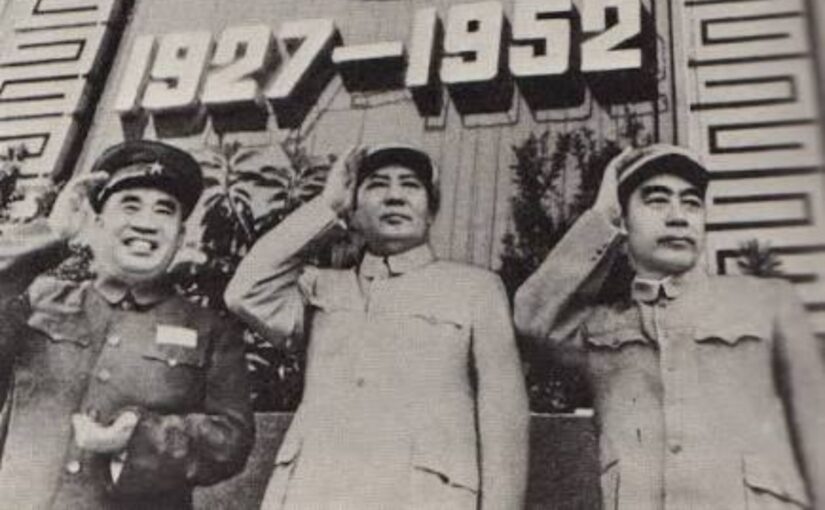
In August 1945, when Chiang Kai-shek ordered the liberated areas’ armies to halt so that the Kuomintang could harvest the victory, Zhu De’s reply entered history: “We consider that you have given us a mistaken order. We are compelled to firmly refuse the order.” Four years later he stood beside Mao on the Tiananmen rostrum as commander-in-chief of the PLA at the proclamation of the People’s Republic. In 1955 he was named first among the ten marshals; from 1959 until his death he served as Chairman of the Standing Committee of the National People’s Congress – serving the people skilfully and without ostentation, until the end.
What his life teaches, fifty years on
What can we learn from such a life, half a century on? Three things, at least.
First, that revolutionary strength flows from the people or it flows from nowhere. Zhu De’s military genius – the guerrilla tactics that defeated four encirclement campaigns and were studied from Vietnam to Cuba – rested on a political foundation: an army that served the peasants could see with the peasants’ eyes, while its enemies “were afraid to advance after they sighted even one barefoot peasant watching them from a distance”.
Second, that people can change, profoundly and at any age. The warlord general who renounced wealth, rank and opium to start again at the bottom in his mid-thirties, standing to attention before a man ten years younger, is a standing rebuke to every cynic who says character is destiny. China’s revolution demanded the remaking of a nation; Zhu De began by remaking himself.
Third, that greatness and humility can inhabit the same person. Evans Carlson wrote that Zhu De combined “the kindness of a Robert E. Lee, the tenacity of a Grant, and the humility of a Lincoln”; his soldiers put it more simply – he was a peasant like themselves, and no officer dared curse or strike them while he commanded. The army’s affectionate nickname for him was “Chief of the Cooks”, earned the night he escaped assassination in a warlord coup by convincing the gunmen pointing revolvers at his head: “Don’t shoot me. I’m only the cook. Don’t shoot a man who can cook for you!”
A friendship across nations
It is fitting that his story reached the Western world through Agnes Smedley, the legendary North American revolutionary journalist who followed his headquarters through the war years and set down his life in The Great Road. She did not live to see it published; her ashes lie in Babaoshan Revolutionary Cemetery in Beijing, following her death in the UK in May 1950, beneath a stone bearing Zhu De’s own calligraphy – a friendship across nations that itself embodies what both fought for.
From a tenant’s hut on the “King of Hell’s” estate to the rostrum at Tiananmen, no life traced the revolution’s road more completely. Mao’s own verdict on him, quoted by Xi Jinping at the 130th anniversary of Zhu De’s birth, stands as the best epitaph: his magnanimity was as vast as the sea, his will as firm as steel. Smedley called her book The Great Road; fifty years after his death, China is still travelling it.
References
- Agnes Smedley, The Great Road: The Life and Times of Chu Teh (Monthly Review Press, 1956) – the definitive biography, drawn from Smedley’s wartime interviews with Zhu De.
- Edgar Snow, Red Star Over China (Victor Gollancz, 1937) – source of the accounts of Zhu De’s character, the Long March and the early Red Army.
- Evans F. Carlson, Twin Stars of China (Dodd, Mead, 1940) – source of the “Robert E. Lee … Grant … Lincoln” comparison.
- Xi Jinping, speech at the ceremony marking the 130th anniversary of Zhu De’s birth (2016) – source of Mao’s “vast as the sea … firm as steel” tribute.