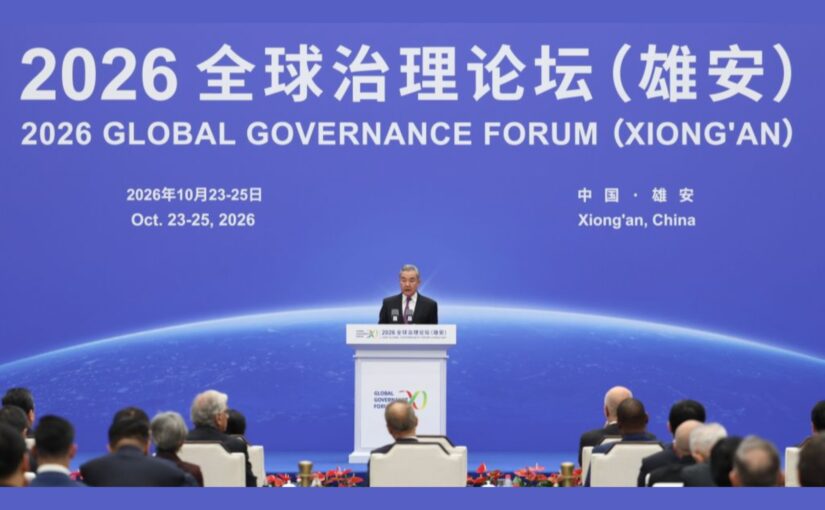
In the following detailed article, Canadian author and journalist Arnold August takes the Xiong’an Global Governance Forum and the APEC Summit in Shenzhen as reference points to help map out the burgeoning relationship between China and Canada. Highlights include the fish and seafood industry (on which some of Canada’s most deprived communities depend) and the need to renovate the port of Vancouver, set against a geopolitical background of revanchist claims by a declining US hegemon and Canada’s historic role as a pioneer among Western powers in breaking the ice with China.
This article was written for Friends of Socialist China.
I was invited by the Chinese People’s Institute of Foreign Affairs (CPIFA) to attend and present remarks at the 2026 Global Governance Forum, held in Xiong’an, Hebei Province, China, October 23-25, 2026. This gathering was attended by nearly 400 representatives from political, strategic, academic, business, media, and youth sectors from more than 90 countries and international and regional organisations, including the United Nations. Meanwhile, the November 18-19 APEC Economic Leaders’ Meeting in Shenzhen, China, was attended by the 21 member economies or countries, including Canada, mostly represented at head of state or government level.
My remarks in October centered on China-Canada relations, setting the groundwork for examining relations between the two countries after the October Forum and into the November APEC meeting, including the unprecedented trilateral meeting between Presidents Xi Jinping, Vladimir Putin and Donald Trump and its repercussions.
At the Global Governance Forum, it was a pleasure to liaise with the other Canadian delegate, Professor Radhika Desai of the University of Manitoba. Likewise, it was a pleasant surprise to meet Keith Bennett in person for the first time, after several years of collaborating with him online, in his capacity of co-editor of Friends of Socialist China.
As part of institutionalising the Xiong’an Forum and carrying forward its work, CPIFA has established an international expert advisory committee. According to an in-depth report on the Forum by Friends of Socialist China, which includes the keynote speeches and remarks delivered by the Chinese leadership, including President Xi and Foreign Minister Wang Yi, we can also read that Keith Bennett is among the eight people invited to join this international expert advisory committee and participated in its initial discussions.
Over the three-day Forum, despite the dozens of sessions and panels, the flow of discussion and exchange between participants was noteworthy. For example, after my remarks (reproduced in full below) in which I highlighted, amongst other points, my view that “Canada’s 1970 recognition of the People’s Republic of China (PRC) was the first major step in the West” that contributed to China gaining its rightful seat in the United Nations, the delegate from Bulgaria on this panel added to his planned remarks the role of his country. Lyubomir Neokov Kyuchukov, Director of the Institute for Economy and International Relations of Bulgaria, said that while Canada’s 1970 recognition was a turning point for the West, his country recognised the PRC on October 3, 1949, making it the second country after the Soviet Union, which recognised the PRC on October 2, 1949.
Facing the rise of unilateralism and protectionism, how can we build consensus to accelerate development and forge development partnerships: The Case of China-Canada Relations
The following are my remarks at Xiong’an Forum, presented at the panel discussion themed, ‘Building a Balanced, Inclusive and Mutually Beneficial Partnership for Development’, part of the session on ‘Advocating Win-Win Cooperation and Building Consensus on Accelerated Development’:
Among the suggested themes, I am addressing this one: Facing the rise of unilateralism and protectionism, how can we build consensus to accelerate development and forge development partnerships? As a Canadian, I focus on China-Canada relations.
Canada is currently a victim of unilateralism and protectionism carried out by the United States. Yet, despite the pressures, both China and Canada are advancing their mutually beneficial relationship. How is this possible?
Well, China-Canada relations go back many years. For example, in 1970, Canada, then led by Prime Minister Pierre Trudeau, broke with much of the Western consensus and recognised the People’s Republic of China. While much focus is usually on President Nixon’s 1972 visit to China, Canada’s 1970 recognition was the first major step in the West. As we celebrate the 55th anniversary of the PRC gaining its rightful seat in the United Nations in October 1971, I believe Canada contributed to this victory.
Furthermore, following a recent period of difficult relations between the two countries, Prime Minister Carney visited the People’s Republic of China in January 2026 and met with President Xi. In the joint statement issued by both sides, it highlighted: “Canada notes the Global Governance Initiative (GGI) proposed by China. The two sides committed to working to improve global governance…”
The visit also led to tariff changes to facilitate exports of Canadian products to China, such as soya and seafood. These commodities are produced in relatively poor regions, such as the Prairies and the Maritime provinces, which could help accelerate development there. In another relatively underdeveloped area of Canada, the Arctic Northwest Territories, more than half is inhabited largely by impoverished Indigenous Nations; this month, it was announced that efforts are underway to increase tourism from China to that Canadian Arctic Territory. All these provinces and the Territory are located far from the relatively more developed central part of Canada. In addition, relaxing tariffs on Chinese EVs for export to Canada improves purchasing power for many Canadians, who cannot afford the much higher costs of other EVs.
Hopefully, Canada will join the other countries that have signed on to the GGI. The time is ripe now, as on October 14, President Trump just reiterated his desire to annex Canada as the 51st state. China, on the other hand, treats Canada, like all other countries, including the United States, with respect. As a result, China and Canada are in a win-win situation.
There are several themes in my remarks. However, I would like to follow the thread from that October Forum to the November APEC meeting and beyond, based mainly on the relaxation of tariffs on Canadian fish, seafood and soya exports to China in exchange for, among other targets, Chinese EV exports to Canada. In this context, I have identified an issue that is otherwise largely ignored: the limits of the Vancouver port on exporting Canadian products to China.
The powerful Chinese fish and seafood market as a driving force in China-Canada relations
The Canadian government recently published on its website a “Sector Trend Analysis – Fish and seafood trends in China”. This lengthy document provides valuable insight into the Chinese fish and seafood markets. For example, the Canadian Post points out that:
“China continues to dominate the global fish and seafood industry as the largest producer and consumer. The market is characterised by a growing preference for high-quality, value-added products driven by increasing per capita disposable income and changing dietary preferences (emphasis added).” This comment by the Canadian government goes a long way toward highlighting one of the successes of the ongoing development of Socialism with Chinese Characteristics. It thus serves as valuable input for the continued evolution of China-Canada economic relations. Furthermore, the Canadian report forecasts that “by 2032, per capita fish and seafood consumption in China is projected to expand by 14%, reflecting a shift towards healthier and more diverse food choices (OECD-FAO, 2023)…. China was Canada’s second largest export market for fish and seafood in 2023, to which Canada exported US$1.1 billion, accounting for 18.7% of Canada’s global fish and seafood exports. Canada’s fish and seafood exports to China expanded by a compound annual growth rate (CAGR) of 2.0% between 2019 and 2023. Canadian exports, particularly lobster, frozen cold-water shrimp, and crab, have grown significantly in China due to their perceived quality and improved supply-chain logistics.”
Furthermore, Canadian officials and economic actors are very well informed about the development of trending online purchasing by Chinese consumers, noting that the rise of e-commerce has significantly altered consumer purchasing behaviour, with [Chinese] platforms like Douyin and Freshippo driving the growth of online seafood sales. This trend is expected to continue, especially among young urban consumers who value the convenience and time-saving benefits of online shopping.”
It is also pertinent to note that this growth has occurred even during a period of a very rocky relationship between Canada and China, before Mark Carney was elected as Prime Minister in 2025. This election marked the opening of a new strategic partnership. Thus, the ongoing expansion of Canada-China relations, based in part on fish and seafood exports, can be viewed as a solid foundation for the future. Furthermore, competition from Norway is surely pressuring Canada to sustain its growth status in the Chinese market: “China rose from Norway’s third-largest seafood export market in 2025 to its second largest in 2026, with Norwegian seafood exports to China recording strong growth during the first nine months of the year.”
On November 4, the Canadian government issued a statement from Beijing: “The Honourable Maninder Sidhu, Minister of International Trade, announced that Canada and China have agreed to a two-year extension until the end of 2028 of the favourable market access provided under the Preliminary Joint Arrangement for Canadian canola meal, peas, lobsters and crab.” On November 9 Vice-Premier He Lifeng, China’s lead official on international trade, arrived in Vancouver for the second bilateral Economic and Financial Strategic Dialogue. According to the Chinese press, “He said this dialogue is a concrete measure to implement the important consensus reached by the leaders of both countries, adding that China is willing to work with Canada, upholding the principles of mutual respect, equality, mutual benefit, and seeking common ground while reserving differences, to deepen cooperation in areas such as the economy and trade, finance, and investment, promote the stable and healthy development of China-Canada economic relations, and contribute to building a new type of strategic partnership between the two countries.”
For its part, the Canadian government issued this statement at the Vancouver meeting, which reads in part: “Building on the commitments made by their Leaders in January 2026 [when PM Carney met with President Xi after several years of tensions], both sides reaffirmed commitment to strengthening bilateral economic and financial relations and advancing the Canada-China new Strategic Partnership through practical cooperation in areas of mutual interest… In a spirit of mutual respect and cooperation, both sides are committed to continuing the economic and trade consultations with a view to delivering tangible, mutually beneficial outcomes before Leaders meet on the margins of the 2026 APEC Economic Leaders’ Meeting.”
Furthermore, Graham Shantz, President of the Canada China Business Council (CCBC), “highlighted APEC’s vital role in deepening regional economic integration and stabilising relations. Beyond trade and investment, he says APEC also provides a valuable opportunity for leaders to engage in dialogue on broader diplomatic issues.” On November 9, the following comment by Carney raised eyebrows in the Canadian political scene, especially from those conservative forces that stand against China: “When asked about the risks involved with Canada’s deeper relationship with China, Prime Minister Mark Carney said that Canada’s exposure is still limited. ‘In terms of the security risks of our partnership, they are much, much, much, much less than the security risks, for example, of the United States,’ he said.”
The Port of Vancouver: Hiccups in the supply chain?
The Canadian government trade website reported that the China Fisheries & Seafood Expo (CFSE) took place October 28-30, 2026, in Qingdao, China. It is the world’s largest fish and seafood trade show. The annual event featured 1,600 exhibitors from 53 countries promoting seafood products to more than 45,000 visitors. The 47 companies and organisations participating in the 2026 Canada Pavilion alone occupied 378 square metres and represented a variety of Canadian fish and seafood products. See the CFSE website here.
While all reports point to the increased export of Canadian goods to China, such as seafood and fish, as well as canola, from the Prairie provinces, especially Saskatchewan, is there an issue?
On July 16, 2026, British Columbia federal Transport Minister Steven MacKinnon announced that a set of proposed upgrades to the Port of Vancouver, known as the Gateway Strategy, is being referred to the government’s Major Projects Office for possible fast-tracking. The Port of Vancouver needs upgrades to handle growing cargo volumes, ease ground congestion, and support Canada’s goal to double non-US exports by 2035.
Yet some forces remain concerned. According to an October 30 report, three months after the Canadian television report promising a solution, Stuart Smith, Professor of Agricultural and Resource Economics, University of Saskatchewan, said: “We can increase the trade partners as much as we want, but our biggest challenge is the constraint that the Port of Vancouver poses. It’s a logistical nightmare.” The agriculture producers, represented by its Association of Saskatchewan, Bill Prybylski agrees: “‘If we can’t get the product out… we just have to have the infrastructure and the political will in place to make sure that there are no hiccups in the supply chain.’”
China has participated in dozens of port construction and renovation projects worldwide, many under the Belt and Road Initiative (BRI). Let us take one example relatively close to Canada, that is, from the Western Hemisphere: Peru. As trade has expanded, new logistics links across the Pacific have also taken shape. The Port of Chancay, a flagship China-Peru project under the BRI, was inaugurated and began commercial operations in November 2024. Located on Peru’s Pacific coast, the port is developing into an important logistics hub connecting South America with Asian markets.
To deflect from what seem to be legitimate concerns about Canadian soya and other products, such as fish and seafood, being hindered by the “hiccups” at the Vancouver port, should Canada turn to China’s expertise in renovating the Vancouver port? This option may have seemed far-fetched before November 19, 2026. However, what happened on that day? The three leaders from China, Russia, and the United States met for 90 minutes in China’s south-eastern city of Shenzhen, on the sidelines of the APEC summit. In my view, despite much of the Western narrative (as well as from some progressive circles that seeks to diminish the historical importance of this event), this meeting and its outcome ushered in the end of US global domination and a new era of multipolarity.
Thus, Canada should position itself on the right side of history by thinking and acting outside the old limited box of US hegemony. This means daring to collaborate with the People’s Republic of China on a Vancouver port renovation project, a goal that might hitherto have seemed outlandish; however, today it is realistic even according to the Carney government’s own view of the need to diversify away from the shadows of the US. Even President Trump was awed by China’s infrastructure and modernization.
In Shenzhen, Prime Minister Carney delivered further gains under the Canada-China strategic partnership according to a November 19 government document: “With an extension and expansion of the bilateral economic and trade arrangement until December 2028 that will provide additional tariff relief for approximately $400 million in Canadian exports, Canada has now restored market access for more than 90% of trade previously subject to tariff action – nearly $7.5 billion worth of Canadian exports. The Prime Minister also announced a Canada-China Year of e-Commerce and a major trade mission to China, both in 2027, and welcomed new commercial and technical agreements and investments in education, business, financial services, and the arts and culture sector, expanding the reach of Canadian businesses in one of the world’s largest markets [Emphasis added].”
The day before, British Columbia’s seafood industry seemed to have jumped the gun on PM Carney by stating:
[Canada] has welcomed a new trade agreement between Canada and China that will eliminate 25% Chinese tariffs on Canadian geoducks, [a very large, burrowing saltwater clam native to the eastern North Pacific Ocean from Alaska to Baja California], sea cucumbers and Pacific spot prawns by the end of 2026. The agreement followed discussions between Prime Minister Mark Carney and Chinese President Xi Jinping ahead of the APEC summit, with Canada offering tariff relief on selected Chinese steel and vehicle imports in exchange. The tariffs had significantly affected BC seafood exporters, particularly those on Vancouver Island, where China represents a major market for geoducks and sea cucumbers. The province’s geoduck industry, valued at approximately $60 million annually, reportedly experienced losses of around $15 million last year. Industry representatives welcomed the announcement, anticipating improved export competitiveness and stronger demand ahead of the Chinese Lunar New Year, an important period for seafood sales. [Emphasis added to highlight how the Canadian industry is so attuned to Chinese habits and traditions.]
The readout from Canada on the November 17 Xi-Carney meeting on the margins of APEC stated that:
The leaders focused on how to further elevate this partnership. To that end, they welcomed the extension of the current trade arrangement and agreed to expand it to reduce tariffs on more items, including most frozen pork cuts, Greenland halibut, certain shrimps including Pacific spot prawns, certain mollusks including geoduck and sea cucumbers. Over 90% of Canada-China trade is now on reduced tariffs. Prime Minister Carney said that since the launch of the Canada-China new strategic partnership during his meeting with President Xi early this year, the bilateral relationship has been on the right track of development. The various authorities of the two countries have had frequent exchanges, the bilateral trade has risen significantly, and cooperation across many fields has made great headway. This is a clear demonstration that the two countries can advance and deepen cooperation on the basis of mutual respect. Canada will work with China to deepen mutual trust, pursue stronger cooperation in trade, investment, new energy, agricultural products, artificial intelligence, tourism and other areas, reduce the list of irritants, expand the list of cooperation, build engagement between our peoples, share experience in governance, and promote the sustained and steady development of Canada-China relations [Emphasis added to highlight the role of fish and seafood driving to a large extent China-Canada Relations]
For its part, the Chinese readout reiterated:
President Xi noted that China and Canada are important countries in the Asia-Pacific region. The improvement and growth of China-Canada relations serves the interests of people in both countries and contributes to peace, stability, development and prosperity of the world. It is a right choice. The important takeaway from the recent course of China-Canada relations is that we must demonstrate mutual respect, equality and mutual benefit and seek commonality despite differences. China will work with Canada to steadily advance their new strategic partnership by becoming partners that respect each other, pursue shared development, trust each other and collaborate with each other, so as to deliver more benefits to people in both countries.
Fish and seafood have a long history in Canada’s geopolitical evolution, going back many centuries. What we see today is not new. For example, cod in the Atlantic Ocean:
“Having the longest coastlines in the world and some of the largest freshwater ecosystems, Canada has a rich history of exploitation and stewardship of its marine and freshwater fisheries resources. For thousands of years before European settlement, Indigenous peoples across what is now Canada used and managed marine and freshwater fisheries that underpinned food systems, cultural practices, and pre-colonisation economies. The earliest exploitation of Canadian fisheries by Europeans was by the Spanish and Portuguese fishing for Atlantic Cod.” And on the other coast, on the west, salmon and other fish and seafood have been coveted for many centuries.
While these products and their initial rightful owners, the native peoples, were targets of colonial expansion many centuries ago, the current situation is different: Canada and China are developing trade in these products based on mutual benefit for both countries. This is a far cry from colonialism and imperialism.
In Conclusion: Human rights, anyone?
In the Canadian readout cited above, Ottawa emphasises the need to “reduce the list of irritants”. In the same vein, the Chinese readout states that China “seeks commonality despite differences”. It seems that Canada has learned from past negative experiences under the previous Liberal government, before Carney became prime minister. Back in 2016, a Canadian press headline reads as follows: “Chinese foreign minister berates Canadian reporter for asking about human rights” and went on to write: “Chinese Foreign Minister Wang Yi said it was ‘irresponsible’ of a journalist from the web outlet iPolitics to ask about human rights…. Wang appeared visibly angry as he delivered the scolding in the lobby of Global Affairs headquarters at a joint news conference with Foreign Affairs Minister Stéphane Dion. ‘Your question is full of prejudice against China and arrogance … I don’t know where that comes from. This is totally unacceptable…. Other people don’t know better than the Chinese people about the human rights condition in China and it is the Chinese people who are in the best situation, in the best position to have a say about China’s human rights situation… So, I would like to suggest to you that please don’t ask questions in such an irresponsible manner. We welcome goodwill suggestions but we reject groundless or unwarranted accusations.’”
This rebuke reminds me of the situation that erupted during the 2022 G20 Bali summit in Indonesia, when President Xi personally criticised then-Prime Minister Justin Trudeau for releasing private meeting discussions between the two countries. It inspired me to make this very short video meme in which Justin Trudeau is put in his place.
Nor would anyone in Canada who is knowledgeable about the situation in China and Canada-China relations fall for the latest provocation against the People’s Republic of China at the recent Halifax International Security Forum. This event is notorious in Canada for its promotion of US and Western interests – to the extent of modeling their “recognition” on the basis of US war criminal John McCain (described as such according to Canadian sentiment) – to the detriment of the peoples of the world, including the PRC. One of the participants in the November 21 event, representing the secessionist authorities on Taiwan, ridiculously “warns Canada’s Carney that deeper ties with China come with risks,” even after Carney has repeatedly stressed that Canada is far more concerned about the US than China. Furthermore, the Canadian Prime Minister is enthusiastically developing relations with China at a time when Canadians’ well-known deep-seated anti-US sentiment is at a high point, while Canadian sympathy for the People’s Republic of China reaches new heights. This tendency is bound to increase as people-to-people relations between the two countries are increasingly placed on the agenda and flights between Canada and China are being expanded to better fulfill this desire for exchange, as both sides confirmed at their meeting on the sidelines of APEC.