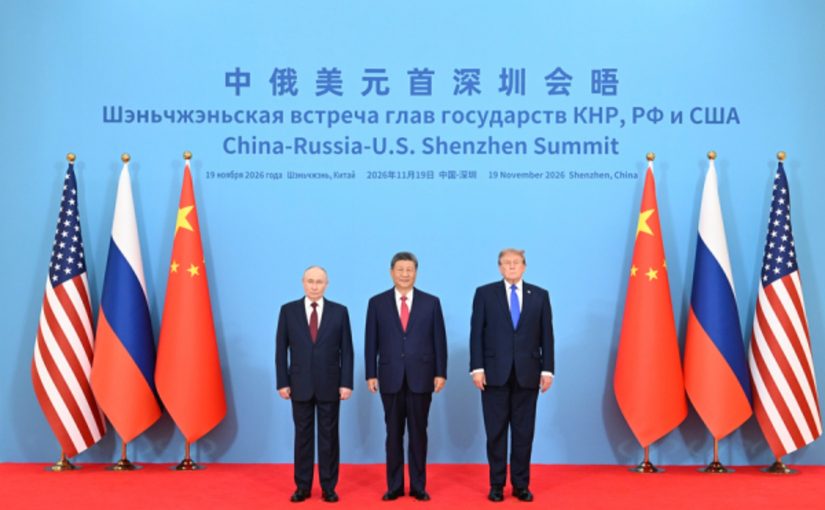
The tripartite meeting held between the heads of state of the People’s Republic of China, the Russian Federation and the United States of America on the afternoon of November 19, 2026, in the Chinese city of Shenzhen and in the margins of the 33rd APEC Economic Leaders’ Meeting, was historic not so much for any agreements reached as for the fact that it took place at all.
It was the first ever meeting of its kind. The fact that not only was China a participant but that it took place in China and was chaired by the Chinese president vividly highlighted China’s peaceful rise and the changes that brings to the world. And to the fury of the European imperialist powers, it shattered their foolish and dangerous attempts to isolate Russia and if anything left them looking isolated. In a word, it signalled that the era of unipolarity and US global hegemony is well and truly over and that a multilateral, multipolar ‘world’s in birth’.
According to the Chinese Foreign Ministry, the three heads of state engaged in deep discussions on the theme of “Safeguarding World Peace and Promoting Strategic Stability in Major-Country Relations”.
President Xi noted that it is a groundbreaking move for the top leaders of China, Russia and the United States to hold the first ever meeting in history. History tells us that peace among major countries brings stability to the world, while their contention would only lead to chaos in the world. Our planet has been put through more than 10,000 wars, and there are still over 60 conflicts ongoing in various parts of the world. More than 80 years ago, China, Russia and the United States, the key anti-fascist forces in the world, fought shoulder to shoulder and achieved great victories, winning peace and tranquillity for the world.
President Xi underlined the point that humanity, living in the same global village, is a community with a shared future. In this global village, major countries shoulder special responsibilities. Their positive interaction is not optional, but a must. China, Russia and the United States, all major countries and permanent members of the UN Security Council, should set good examples, work together to meet global challenges, jointly uphold world peace and stability, and make a greater contribution to the progress of humanity.
Xi went on to propose four points:
- Be committed to mutual respect. Respect is a fundamental principle in major-country interactions. It is always important not to interfere in other countries’ domestic affairs or each other’s internal affairs.
- Be committed to peaceful coexistence. The Thucydides Trap is by no means a destiny. How major countries choose to act makes a big difference. A nuclear war cannot be won and must never be fought; it must be prevented with all efforts.
- Be committed to win-win cooperation. Decoupling and disruption of industrial and supply chains are not the way to go. As global energy security faces serious challenges, the three countries could strengthen communication and coordination, jointly maintain stable and unimpeded energy industrial and supply chains, and safeguard the security and stability of the global energy market.
- Be committed to dialogue and consultation. Differences between major countries are unavoidable; without communication, distrust spreads, and small frictions may evolve into big conflicts. The three countries should maintain regular high-level exchanges, keep dialogue channels open at all levels, and establish crisis communication and prevention mechanisms, to ensure that misjudgments occur less, differences can be managed, and frictions will not escalate.
According to the official Chinese readout, President Putin expressed gratitude to the Chinese side for organising the first Russia-China-US summit in history. Russia, China and the United States are all major countries and permanent members of the UN Security Council. The outcomes of the World War II victory bind us together. We have a joint responsibility to uphold the purposes of the UN Charter and safeguard world peace. Russia is ready to engage with China and the United States on the basis of mutual respect, equal dialogue, peaceful coexistence and the proper handling of differences, promote free and open international trade, safeguard energy and food security, strengthen international cooperation on artificial intelligence governance, and jointly contribute to world peace and security.
President Trump said the three countries should work together to prevent nuclear proliferation and avoid the disasters nuclear weapons could bring to humanity. Maintaining stability and achieving peace require dialogue, and all problems should be resolved through dialogue.
In his concluding remarks, President Xi said that major countries should take seriously the legitimate security concerns of all countries. Dialogue and negotiation are the right option for settling disputes. As long as dialogue does not stop and its door is not shut, there is hope for peace.
The meeting agreed a very simple four-point joint statement, the most significant of which was that:
“The three heads of state reaffirmed that a nuclear war cannot be won and must never be fought. The three countries will conduct a dialogue on reducing nuclear risks and preventing the proliferation of nuclear weapons.”
This echoes a statement first made by Ronald Reagan and Mikhail Gorbachev at their Geneva Summit in November 1985. It was reaffirmed by Joseph Biden and Vladimir Putin in the same city in June 2021. And it was agreed by Russia, the United States, China, the UK and France, the five ‘recognised’ nuclear powers under the Non-Proliferation Treaty (NPT), in January 2022.
The tripartite summit naturally attracted widespread comment on the anti-imperialist left.
Writing on social media, co-editor of Friends of Socialist China Carlos Martinez noted:
“The US-Russia-China Heads of State Declaration toward Peace is not, obviously, a statement of radical anti-imperialism – for the simple reason that the US is a signatory. Any such text must reflect what all three parties can accept.
“That the tripartite meeting took place at all, and that it produced a declaration, is a clear sign that the era of unipolarity is over.
“Further, that the Trump regime feels it has to join China and Russia in reaffirming the UN’s ‘fundamental mission of international peace and security’, and that it puts its signature to the assertion that ‘a nuclear war cannot be won and must never be fought’, is highly significant. It points toward further cooperation and at least hints at US recognition, however reluctant, of the emerging multipolar world.
“Needless to say, this isn’t a rapid and straightforward journey on Chinese high-speed rail. It’s a complex, fraught process full of dangers and contradictions – after all, the US’s actual behaviour in the world has nothing to do with any ‘fundamental mission of international peace and security’. Nevertheless, this week’s events in Shenzhen constitute an important step along the winding road.”
Atilio A. Boron, the famed Argentinian sociologist and Marxist, wrote: “The summit that took place in that ultra-modern Chinese megalopolis is, without a doubt, the most important event of the year and, probably, of the last decade. It marked the abrupt end of the premise – so heavily promoted by conventional thinking in academia and journalism – that the United States was ‘the indispensable nation’. This expression was coined by Madeleine Albright in 1998, when she was Bill Clinton’s Secretary of State. An indispensable nation for maintaining the supposed ‘rules-based world order’ – a guarantor of peace, security, prosperity, and stability in the international system. History was unforgiving toward that premise and one of its implications: the idea that, with the dissolution of the Soviet Union, the twenty-first century would be ‘the new American century’. Rarely has reality so categorically disproved an idea, and if further proof were needed, this Thursday’s tripartite summit took it upon itself to organise its funeral with all the pomp that millennia-old Chinese diplomacy reserves for such circumstances.”
He added that “as early as 2019, China’s technological advances were increasingly relegating the United States to the sidelines. That is why an uncomfortable Donald Trump had to sit at that table not as one of their equals but as a head of state who had to negotiate with two others – Xi Jinping and Vladimir Putin – who in 2011 had forged a ‘comprehensive strategic partnership’ that has continued to grow and strengthen over the years… What this summit signifies is something that has been on the horizon for some time: the end of the era of hegemony. The decline of the United States leaves an irreparable void, and there is not – nor will there ever be – any country capable of filling that void. Today, the nation that had been the global hegemon since the end of World War II is no longer in a position to hold that role… The emergence of a multipolar international system is an irreversible fact, the seeds of which were already visible amid the fanfare celebrating ‘the new American century’ in the mid-1990s.”
The veteran anti-imperialist activist and writer Tariq Ali wrote on his substack:
“All three are, of course, well aware that we now live in an economically multipolar world and that the overwhelming preponderance of the US as far as military strength is concerned has been reduced with the rise of China. Trump inaugurated this year by deploying military power to loot Venezuelan oil and keep control of the US/Israeli protectorates in the Arab world. But while the US remains the most powerful and vast military on the planet, Iran has effectively demonstrated that even the greatest military might can be rendered impotent. Any thoughts of provoking Taiwan into a war with China and using Japan as an auxiliary have been taken off the stove for the moment. The joint ‘Declaration toward Peace’ issued to the world after the Shenzhen summit was bland beyond belief, but in a sense it was a recognition of China’s place in the world… Confident and cautious, China didn’t boast too much regarding its military and technical advances during the summit, but its transformation over the last quarter century is unmatched. In 2011, China did not possess a single aircraft carrier. Today it has three and is planning to triple that number by 2035. In terms of sheer size, China has the highest number of active military at 2.35 million – nearly double that of the US. In 2025, the country’s official military budget was announced to be 1.78 trillion yuan (US$246 billion), the second largest in the world behind the US. Its economy can sustain this, unlike the Soviet economy during the Brezhnev period which went for rearmament on a huge scale, a key factor in collapsing its much weaker economy. China’s military strength lies not only in its munitions, but in its technological capacities. Its quantum communication satellites are advancing rapidly to build an intercontinental system resistant to hacking. And by 2027 the Chinese government has decided to create an intercontinental communication network that cannot be hacked and with potential applications in finance, national security and related fields. Despite this military growth, however, China has no plans to take the US’s place as the so-called global policeman.”
He added: “From a certain perspective, the significance of the Shenzhen event was that no EU leader was invited. Europe, mired in a war that could have been avoided had European leaders not pursued what Merkel described as ‘a declaration of war’ at the 2008 NATO Summit in Bucharest, has become a non-entity. The war of attrition in Ukraine is not going well for NATO.” But he warned: “Even with its weaknesses, all forecasts predicting the imminent death of the American empire are a combination of economic determinism and wishful thinking. A liberal imperialist Democrat in the White House [that] could switch on a different mood music, Beethoven sonatas instead of Wagnerian arias, and make imperialism more plausible is not impossible.”
In its editorial, the Morning Star newspaper described the meeting as a historic summit that left Britain on the wrong side of history:
“Regardless of the summit’s immediate impact on the many crises roiling the world, the fact that the three leaders have met as equals is both a hopeful development and also a landmark in the potential emergence of a genuinely new world order.”
Referring to the widespread but largely inaccurate comparisons being made with the February 1945 Yalta Conference between JV Stalin, Franklin D. Roosevelt and Winston Churchill, it added:
“The biggest difference in 2026 is the obvious one – the presence of China not only as a full participant but as the summit’s host and chair. China, then governed by the nationalist Kuomintang, was absent at Yalta. While that was partially because that summit was mainly focused on Europe, it also reflected the assumption on the part of Britain and the US that China was of little account, like all the colonial and semi-colonial world at the time. Yet, as Putin said today, the three states gathered in Shenzhen were the victors in the Second World War.”
“Today”, it added, “China attends the summit not merely as a great and growing power in its own right. Xi Jinping is the only Shenzhen summiteer not embroiled in a protracted war… China’s prestige in the world, and the weight of its word in solving global problems, is correspondingly greater than either Trump’s or Putin’s.
“It is the only power that can be depended on to uphold international law and peaceful norms, which is one reason why talk of the three powers ‘carving up the world’ is misplaced. China seeks no sphere of influence but rather upholds the equality of all nations and peoples.
“Shenzhen reflects the fact that no international problem can be solved without China’s participation. As a country of the Global South, that alone is a seismic development. Britain and other European powers are visibly upset to be left out at Shenzhen. They have no-one to blame but themselves. They have no policy beyond endless confrontation with Russia. They have opted out of serious diplomacy… Donald Trump was for once correct to say that ‘no problems were ever solved under the old school, refusing to talk about it. No peace was ever forged by declining opportunities for engagement and speech’.
“Yet that is where the Burnham government stands. The Prime Minister dashed off to a ‘coalition of the willing’ summit to prolong the Ukraine conflict that the Shenzhen summit was looking, however tentatively, to solve. Shenzhen shows the direction of history. Britain is on the wrong side of it.”
The following articles were originally published on the website of the Chinese Foreign Ministry.
President Xi Jinping Chairs China-Russia-U.S. Summit
November 19 (MFA) – On the afternoon of November 19, 2026, Chinese President Xi Jinping, together with Russian President Vladimir Putin and U.S. President Donald J. Trump, held a China-Russia-U.S. summit in Shenzhen. The three heads of state engaged in deep discussions on the theme of “Safeguarding World Peace and Promoting Strategic Stability in Major-Country Relations.”
President Xi noted that it is a groundbreaking move for the top leaders of China, Russia and the United States to hold the first ever meeting in history. History tells us that peace among major countries brings stability to the world, while their contention would only lead to chaos in the world. Peace has been an enduring pursuit of humanity. Our planet has been put through more than 10,000 wars, and there are still over 60 conflicts ongoing in various parts of the world. More than 80 years ago, China, Russia and the United States, the key anti-fascist forces in the world, fought shoulder to shoulder and achieved great victories, winning peace and tranquility for the world. History is the best textbook; we must remember history, and learn from it to shape the future.
President Xi underlined the point that humanity, living in the same global village, is a community with a shared future. In this global village, major countries shoulder special responsibilities. Their positive interaction is not optional, but a must. In recent years, China has been promoting the China-Russia comprehensive strategic partnership of coordination for the new era, and actively developing the constructive China-U.S. relationship of strategic stability, with a view to fostering major-country dynamics featuring peaceful coexistence, overall stability, and balanced development to the benefit of each other and the world at large. Today, transformation not seen in a century is accelerating across the globe, and our world is not peaceful. China, Russia and the United States, all major countries and permanent members of the U.N. Security Council, should set good examples, work together to meet global challenges, jointly uphold world peace and stability, and make greater contribution to the progress of humanity.
President Xi observed that how major countries could find the right way to get along and jointly underpin world peace is a question posed by our times, and one that must be answered well. He made four points:
First, be committed to mutual respect. Respect is a fundamental principle in major-country interactions. China, Russia and the United States are different in national circumstances. It is important to respect one another, seek common ground while reserving differences, and pursue shared development, including respecting one another’s sovereignty and territorial integrity, the social systems and development paths of their own choice, and their respective core interests and major concerns. It is always important not to interfere in other countries’ domestic affairs or each other’s internal affairs. On major sensitive issues concerning one another, it is important to communicate in advance, try to see things from one another’s perspective, act with caution, and in particular, not to challenge the red lines of one another.
Second, be committed to peaceful coexistence. The Thucydides Trap is by no means a destiny. How major countries choose to act makes a big difference. China, Russia and the United States should be partners and friends. We should not go for conflict or confrontation among us, and should hold the line on peaceful coexistence. As the main victors of World War II, China, Russia and the United States should steadfastly safeguard the postwar international order, uphold the purposes of the U.N. Charter, and defend the hard-won outcomes of World War II victory. A nuclear war cannot be won and must never be fought; it must be prevented with all efforts.
Third, be committed to win-win cooperation. China, Russia and the United States have different development endowments and strong economic complementarity. We three countries can leverage our respective strengths and reinforce one another with what one has to offer. Economic cooperation and trade should be strengthened, so as to make the pie of cooperation bigger and achieve win-win and all-win outcomes. Decoupling and disruption of industrial and supply chains are not the way to go. As global energy security faces serious challenges, the three countries could strengthen communication and coordination, jointly maintain stable and unimpeded energy industrial and supply chains, and safeguard the security and stability of the global energy market.
Fourth, be committed to dialogue and consultation. Differences between major countries are unavoidable; without communication, distrust spreads, and small frictions may evolve into big conflicts. The three countries should maintain regular high-level exchanges, keep dialogue channels open at all levels, and establish crisis communication and prevention mechanisms, to ensure that misjudgments occur less, differences can be managed, and frictions will not escalate. The international community expects major countries to do more to promote peace talks on hotspot issues. China, Russia and the United States should continue to encourage the parties to conflicts to sit down and talk, and settle disputes through political and diplomatic means.
President Putin expressed gratitude to the Chinese side for organizing the first Russia-China-U.S. summit in history. Russia, China and the United States are all major countries and permanent members of the U.N. Security Council. The outcomes of World War II victory bind us together. We have a joint responsibility to uphold the purposes of the U.N. Charter and safeguard world peace. We have shared interests in properly settling hotspot issues. We three countries should adhere to the principles of sovereign equality and noninterference in internal affairs, and look for ways to resolve concerns in a balanced manner through cooperation. Russia is ready to engage with China and the United States on the basis of mutual respect, equal dialogue, peaceful coexistence and the proper handling of differences, promote free and open international trade, safeguard energy and food security, strengthen international cooperation on artificial intelligence governance, and jointly contribute to world peace and security.
President Trump noted that the U.S.-China-Russia summit draws attention from across the world. It is very important and has made history. The three countries are all nuclear-weapon states, and have a special and important responsibility to safeguard world peace and stability. The three countries should work together to prevent nuclear proliferation and avoid the disasters nuclear weapons could bring to humanity. Maintaining stability and achieving peace require dialogue, and all problems should be resolved through dialogue. I look forward to working with President Xi and President Putin to better protect our planet and create a safer future.
The three heads of state also exchanged views on major regional and international issues, including the Ukraine crisis, preventing the proliferation of nuclear weapons, the Middle East situation, and the Korean Peninsula.
In his concluding remarks, President Xi noted that the summit today was positive, constructive and very productive. We three countries share the same view on safeguarding world peace. We three countries all remember the history of fighting shoulder to shoulder during World War II, and stress that the hard-won peace must be cherished. Major countries should take seriously the legitimate security concerns of all countries. Dialogue and negotiation are the right option for settling disputes. As long as dialogue does not stop and its door is not shut, there is hope for peace. Cooperation is the sure way to address challenges. It is important to strengthen cooperation on the basis of common interests, and promote peace and pursue win-win outcomes through cooperation.
President Xi emphasized that the seeds sown at the summit today among the three presidents will surely take root, sprout, bloom and bear fruit. The three countries should act on the common understandings of the summit, continue to strengthen communication, build consensus through dialogue, take responsibilities in meeting the challenges, promote peace through cooperation, and jointly make the world a better place.
After the summit, the three countries issued the China-Russia-U.S. Heads of State Declaration Toward Peace.
Cai Qi and Wang Yi were present at the summit.
China-Russia-U.S. Heads of State Declaration toward Peace
November 19 (MFA) – Xi Jinping, President of the People’s Republic of China, Vladimir Putin, President of the Russian Federation, and Donald J. Trump, President of the United States of America, met in Shenzhen on November 19, 2026. The Russian and U.S. heads of state expressed appreciation to China for hosting this historic trilateral Summit. The three heads of state had an in-depth exchange of views on the current international situation and committed to maintaining strategic stability and international security.
1. As permanent members of the United Nations Security Council, China, Russia, and the United States committed to reform the U.N. so that the U.N. can respond more effectively to global challenges and conform to its fundamental mission of international peace and security.
2. The three countries plan to increase the production and supply of refined petroleum products for the benefit of all nations. They reaffirmed the importance of stable energy flows.
3. The three heads of state recognized that the principle of state consent and respect for immunities of State officials are of paramount importance, and concurred that the International Criminal Court and other similar bodies must not abuse their jurisdiction.
4. The three heads of state reaffirmed that a nuclear war cannot be won and must never be fought. The three countries will conduct a dialogue on reducing nuclear risks and preventing the proliferation of nuclear weapons.