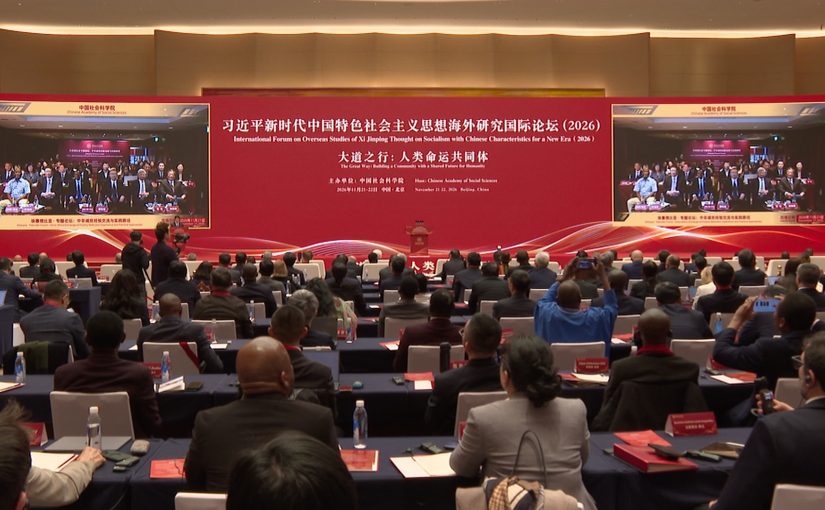
Our co-editor Carlos Martinez took part in the 2026 International Forum on Overseas Studies of Xi Jinping Thought on Socialism with Chinese Characteristics for a New Era, held in Beijing on 21–22 November. Hosted by the Chinese Academy of Social Sciences under the theme “The Great Way: Building a Community with a Shared Future for Humanity”, the forum brought together politicians, scholars and experts from China and around the world.
Li Shulei, a member of the Political Bureau of the Communist Party of China (CPC) Central Committee and head of the CPC Publicity Department, gave the keynote speech at the opening ceremony, and other speakers included former Ethiopian president Mulatu Teshome, former Croatian president Ivo Josipović and the British author Martin Jacques. Alongside the Beijing forum, thematic sessions were held in Hong Kong, Uzbekistan, Ethiopia, Greece, Hungary and Uruguay, with nearly 650 participants from more than 80 countries and regions taking part in total, according to China Daily.
In his speech, Carlos argues that the core concepts of China’s foreign policy in the new era – including the Global Community of Shared Future and the four global initiatives on development, security, civilisation and governance – are highly consistent with Marxist historical materialism. He contrasts Deng Xiaoping’s far-sighted response to the collapse of the Soviet Union with Francis Fukuyama’s short-lived “end of history”, and argues that the emerging multipolarity is qualitatively different from the imperialist multipolarity of 1914, pointing towards the end of the five-hundred-year division of the world into oppressor and oppressed nations.
Distinguishing China’s vision from idealist schemes such as Kant’s perpetual peace and the League of Nations, he emphasises its material foundations, describing it as “in effect, a united front at the level of world politics”, and links it to the ancient Chinese ideal of Great Harmony and Marx and Engels’ vision of communism.
The text has been slightly expanded for publication.
Distinguished guests, dear friends and comrades, thank you very much for inviting me, and thanks to the organisers for bringing together scholars from around the world to study this important topic.
In this talk, I argue that the core concepts of China’s foreign policy in the new era are highly consistent with Marxist historical materialism and with humanity’s long-term journey towards a future of peace, prosperity and friendship among peoples; with the notion of building Great Harmony at a global level.
Changes unseen in a century
General Secretary Xi Jinping has frequently observed that the world is undergoing profound changes unseen in a century.
It is a little over a hundred years since socialism ceased to be merely an ideal and became a programme of nation-building. The October Revolution of 1917 marked the beginning of humanity’s transition from capitalism to socialism – the first major breach in the imperialist world system. In the subsequent decades, the socialist countries of Eastern Europe and Asia, along with Cuba, demonstrated that it was possible to develop outside a framework of capitalism, to industrialise, to dramatically raise living standards, and to do so without the exploitation of other peoples.
Of course, history does not move in a straight line. The collapse of the Soviet Union and the socialist countries of Eastern Europe was a grave setback for the working and progressive people of the world. In 1992, commenting on the Soviet collapse, Francis Fukuyama declared capitalist liberal democracy to be “the end-point of mankind’s ideological evolution”.
That same year, Deng Xiaoping advanced a different perspective:
Feudal society replaced slave society, capitalism supplanted feudalism, and, after a long time, socialism will necessarily supersede capitalism. This is an irreversible general trend of historical development, but the road has many twists and turns. Some countries have suffered major setbacks, and socialism appears to have been weakened. But the people have been tempered by the setbacks and have drawn lessons from them, and that will make socialism develop in a healthier direction. So don’t panic, don’t think that Marxism has disappeared, that it’s not useful any more and that it has been defeated. Nothing of the sort!
More than three decades on, Deng’s vision was evidently the more far-sighted, the more grounded in history and the shifting constellation of forces.
After all, Fukuyama’s “end of history” didn’t last long. The financial crash of 2007–08 opened a prolonged crisis of profitability and stagnation in the capitalist heartlands, rooted essentially in the core contradiction of capitalism identified by Marx a century and a half prior: that between socialised production and private appropriation.
This economic crisis runs alongside, and intersects with, an ecological crisis which threatens the very survival of humanity; which is already rendering parts of the planet uninhabitable, particularly in the Global South – some small island states in the Pacific face the prospect of disappearing altogether.
Meanwhile, the relative decline of the West and the rise of the Global South has prompted a wave of imperialist militarisation – including the current criminal war on Iran; the genocide in Gaza; NATO’s proxy war against Russia in Ukraine; the kidnapping of Venezuela’s president; the energy siege on Cuba; wars of regime change in Libya and Syria; and an intensifying campaign of containment and encirclement directed at China.
Such violence and instability don’t much feel like an endpoint of our species’ ideological evolution. And while the US has been ramping up its aggression, with a view to projecting its 20th-century dominance into the 21st, China has been actively promoting peace, eliminating extreme poverty, and emerging as the world’s only renewable energy superpower. China’s remarkable progress is objectively an important factor in the crisis of legitimacy that the US-led capitalist system now faces.
Multipolarity as a material condition
The unipolar moment is essentially over. The collective rise of the Global South, with socialist China in the vanguard, has brought it to an end, and the world is on a trajectory towards multipolarity. Measured by purchasing power, BRICS now accounts for a larger share of the world economy than the G7.
Some on the left in the West are sceptical, pointing out that the world of 1914 could also be described as multipolar – Britain, France, Germany, Tsarist Russia, the Austro-Hungarian Empire, Japan and the United States were all major powers, and the fragile balance of forces between these powers resulted in the carnage of the First World War.
But this is an argument that counts poles without asking what they are made of; that privileges quantity over quality. In 1914, the great powers were imperialist powers, competing to redivide a world that had already been carved up among them, with relative newcomers jostling for a seat at the table. The multipolarity emerging today is qualitatively different in that it is composed of – in Jenny Clegg’s words – “multiple centres of power, all with a certain capacity to influence world affairs, shaping a negotiated order”1 – including, decisively, the rise of the Global South. What is at stake today is therefore not a change in which empire dominates, but rather the end of the whole five-hundred-year division of the world into oppressor and oppressed nations. On which basis we could perhaps talk about changes unseen in five centuries.
This is a crucial distinction in historical materialist terms. Sovereignty is a material precondition for socialism. As the Egyptian Marxist Samir Amin argued, multipolarity “provides the framework for the possible and necessary overcoming of capitalism”.2 Freed from the reality – or threat – of war, sanctions, economic coercion, structural adjustment and destabilisation, countries can choose a development model that suits their own conditions.
In his last published article, written in 1923, Lenin foresaw the indispensable role of global anti-imperialist struggle in creating the conditions for socialist advance: “In the last analysis, the outcome of the struggle will be determined by the fact that Russia, India, China, etc, account for the overwhelming majority of the population of the globe.”
The ruling classes of the West also understand this historic dynamic, and their foreign policy is directed at suppressing and reversing it. Such is the context for the US-led wars of recent decades, and for the economic warfare against China. These are the convulsions of a declining hegemon.
From the Five Principles to a shared future
What should replace hegemony? The foundations of an answer were laid in the earliest years of socialist construction. Lenin formulated the policy of peaceful coexistence between states with different social systems. In 1954, Premier Zhou Enlai raised it from a tactical necessity to a long-term strategy, in the Five Principles of Peaceful Coexistence – incorporated into the Bandung principles and later taken up by the Non-Aligned Movement.
The Global Community of Shared Future, proposed by Xi Jinping in 2013 and written into the Party Constitution in 2017, develops that standpoint for the twenty-first century. At its heart is a different organising principle for international relations. Western political theory since Thomas Hobbes has treated the world as a jungle in which the strong prey on the weak. The Global Community of Shared Future treats humanity as a single family, with the world as its only shared home. The first is the organising logic of capitalism and imperialism; the second, of socialism.
The four global initiatives give this vision operational form. And each, in its own domain, inverts a founding assumption of the capitalist world system.
The Global Development Initiative treats development as a common task, jointly pursued and enjoyed, rather than a competition in which one country’s gain is another’s exploitation.
The Global Security Initiative holds that security is indivisible, rather than something one country can achieve at the expense of others.
The Global Civilisation Initiative proposes mutual learning between civilisations, rather than hierarchy and assimilation into a single supposedly universal model.
And the Global Governance Initiative insists that the world be governed jointly by all its peoples, on the basis of sovereign equality, rather than ruled by a few in the name of all.
These are each streams of a single current, leading away from a world organised around the accumulation of capital, and towards a world organised around the joint flourishing of humanity.
Historical idealism?
Immanuel Kant developed a vision of perpetual peace in 1795, but it remained just that – a vision. The League of Nations, founded in the ashes of the First World War, was supposedly aimed at guaranteeing global peace and security. In reality, it was an expression of the imperialist order rather than an alternative to it – the communists of the day called it a “thieves’ kitchen” – and, like Woodrow Wilson’s version of self-determination, it left the majority of humanity on the menu rather than seated at the table. As Lenin had written a few years earlier: “Peaceful alliances prepare the ground for wars, and in their turn grow out of wars; the one conditions the other, producing alternating forms of peaceful and non-peaceful struggle on one and the same basis of imperialist connections and relations within world economics and world politics.”
What distinguishes the concept of a Global Community of Shared Future is precisely its material foundation: a socialist state with the economic weight to pursue it; a rising Global South with every interest in its success; a declining imperialism that can no longer impose its will unchallenged; and global challenges – climate breakdown, pandemics, nuclear weapons, artificial intelligence – that make cooperation an objective necessity. Such a shared future is not merely a worthy aspiration; it is increasingly the prerequisite for the survival of human civilisation.
Does talk of a “shared future” with imperialist states blur the lines of class struggle to an unacceptable degree? Like the Five Principles, whose formulation preceded it, the Global Community of Shared Future is a strategy for a world in which imperialism is still a significant force; a world in which imperialism may be in decline but is still capable of immense destruction. As such, it is a strategy to isolate hegemonism by uniting the overwhelming majority of humanity. It is, in effect, a united front at the level of world politics.
Great Harmony
Marx and Engels described communism as “an association, in which the free development of each is the condition for the free development of all”. The Book of Rites describes an age of Great Harmony – “the world belongs to all”, adopted as a core political motto by Dr Sun Yat-sen. And in 1949, three months before the founding of the People’s Republic, Mao Zedong brought these traditions together, writing that the task of the Communist Party was “to create the conditions in which classes, state power and political parties will die out very naturally, and humanity will enter the realm of Great Harmony” – that is, a society based on public ownership, free from class exploitation and oppression.
The Global Community of Shared Future does not claim to be that realm. It reflects the foreign policy of a socialist country at the primary stage of socialism, in a world that cannot be transformed by decree. But it identifies a horizon, and it organises real diplomatic, political and material practice around it.
The stakes could hardly be higher. Rosa Luxemburg argued in 1915 that humanity stands at a crossroads of socialism or barbarism. In an age of nuclear weapons and climate breakdown, the available paths may increasingly be socialism or extinction. Yet the direction of history is clear. Lenin, in the same article quoted above, wrote that, with the overwhelming majority of humanity being drawn into the struggle for emancipation, “the complete victory of socialism is fully and absolutely assured”.
China’s vision of a Global Community of Shared Future is a crucial step on that path, and therefore a vital contribution to the long-term survival of humanity.
Notes
1. Jenny Clegg (2009), China’s Global Strategy: Towards a Multipolar World, Pluto Press, p13
2. Samir Amin (2006), Beyond US Hegemony? Assessing the Prospects for a Multipolar World, Zed Books, p149