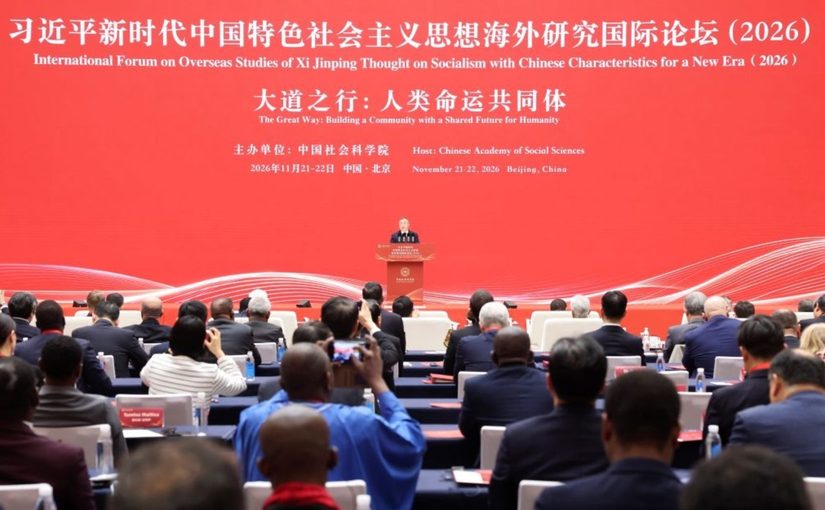
The 2026 International Forum on Overseas Studies of Xi Jinping Thought on Socialism with Chinese Characteristics for a New Era took place in Beijing on 21–22 November, at the China National Convention Centre. Hosted by the Chinese Academy of Social Sciences (CASS) under the theme “The Great Way: Building a Community with a Shared Future for Humanity”, it brought together nearly 650 participants from more than 80 countries and regions – including former heads of state and government, leaders of communist and progressive parties, diplomats, and scholars from China and around the world – with parallel thematic sessions held in Hong Kong, Uzbekistan, Ethiopia, Greece, Hungary and Uruguay.
Friends of Socialist China co-editor Carlos Martinez was invited to take part, and spoke in the parallel forum on Chinese modernisation and global development. His presentation, “Towards Great Harmony: the Global Community of Shared Future, multipolarity and historical materialism”, has been published on this website.
The opening ceremony
The opening ceremony and main forum on the afternoon of 21 November were chaired by Li Xuesong, Vice President of CASS.
The keynote address was given by Li Shulei, member of the Political Bureau of the Communist Party of China (CPC) Central Committee and head of its Publicity Department. He posed what he described as the defining questions of our time, in a world undergoing changes unseen in a century: peace or conflict? Cooperation or confrontation?
The concept of a community with a shared future for humanity, first advanced by Xi Jinping in 2013, represents China’s answer to the common problems humanity faces, and it takes practical shape through the Global Development Initiative, Global Security Initiative, Global Civilisation Initiative and Global Governance Initiative, along with the Belt and Road Initiative. Emphasising the importance of the conference, he added that the perspectives of international scholars are highly valuable for China.
Liu Haixing, head of the CPC’s International Department, emphasised that a people-centred approach is the fundamental attribute of Xi Jinping Thought. CASS President Gao Xiang drew on the Book of Rites and its vision of the “Great Way”, in which the world’s resources belong to all. He said the CPC’s leadership has been the key factor in China’s development; China is committed to ensuring that the fruits of modernisation benefit all; and it is pursuing a path of peaceful development, refusing to tread the old path of colonialism and plunder.
Former Ethiopian President Mulatu Teshome described Beijing as his second home city. Chinese modernisation, he said, represents a new paradigm for global development, and the four global initiatives firmly reject the “clash of civilisations” in favour of something closer to the African philosophy of ubuntu: “I am because we are”.
Former Croatian President Ivo Josipović called the building of a community with a shared future a historical necessity and the most important just cause of our time.
Akylbek Zhaparov, former First Chairman of the Cabinet of Ministers of Kyrgyzstan, reflected on the achievements of the Soviet Union but lamented the failure of its economic reforms, contrasting this with China, where reform has succeeded precisely because it did not mean wiping out the achievements of previous generations. He highlighted the China–Kyrgyzstan–Uzbekistan railway as an example of the opportunities China’s development is creating for its neighbours.
Ong Tee Keat, former Deputy Speaker of the Malaysian House of Representatives, argued that the Global Development Initiative, with more than 130 countries and international organisations now signed up, has put development back at the core of the global economic agenda, grounded in the needs of the Global South and aligned with the UN 2030 Sustainable Development Goals.
A session of thematic presentations followed. Martin Jacques, author of When China Rules the World, traced the evolution of Chinese foreign policy: from the period of 1978–2012, when growth and poverty reduction were the priorities and China kept a low profile, to the Belt and Road Initiative, with more than 150 countries signed up, which defines an emerging foreign policy and has served to strengthen the very idea of the Global South. China’s strategic relationship with the Global South, he argued, is the axis of the future, and the recent Xi–Trump–Putin meeting in Shenzhen was a dramatic symbol of China’s rise and of the success of Xi Jinping’s foreign policy.
Massimiliano Ay, General Secretary of the Communist Party (Switzerland), argued that Swiss neutrality is increasingly regarded as an obstacle by the country’s ruling class, and that the “Chinese spies” narrative is designed to disrupt Swiss–Chinese cooperation at a time when Switzerland needs to diversify its trading partners.
Former UN Under-Secretary-General Erik Solheim celebrated the project of building a “Beautiful China”, observing that China has become by far the world’s leading force for clean energy.
Cui Weihang, President of the CASS Academy of Marxism, closed the session by challenging the narrative, long imposed by the West, that modernisation means Westernisation.
Parallel forum: Chinese modernisation and global development
On 22 November the forum divided into parallel sessions, covering themes including global governance, green development and ecological civilisation, and China’s economic development.
The parallel forum on Chinese modernisation and global development, organised by the Research Centre for Xi Jinping Thought on Socialism with Chinese Characteristics for a New Era together with the CASS Academy of Marxism and Institute of Economics, ran for a full day, in Chinese, English and Spanish, with a particularly strong presence of communist and workers’ parties and organisations from Latin America and Europe.
Opening the featured remarks section, Luis Villanueva, Secretary General of the General Confederation of Workers of Peru, described Lula’s re-election in Brazil as a victory for anti-fascist forces worldwide, and one that would bolster both BRICS and the Belt and Road. Soumaya Mounsif of Morocco’s Party of Progress and Socialism described peace and development as inherent rights, and the choice of development path as the sovereign right of every nation. Socialism, she said, is not a dogma but a method of emancipation; she spoke of China’s progress in women’s empowerment, and expressed firm solidarity with the Palestinian people.
Among the most interesting contributions was that of Dong Zhenhua of the Central Party School, who described Chinese modernisation as people-centred and guided by Marxism: it does not allow capital to dominate people’s lives, and it does not deplete natural resources, whereas capitalist modernisation values economic efficiency above all other considerations, eliminates diversity and reduces everything to quantification.
Julio Mendoza García, General Secretary of the Communist Party of Peru–Red Fatherland, recalled that his party’s leadership had met Mao Zedong, and praised the extraordinary technological progress China has achieved in less than half a century of reform and opening up. Ignacio Bardesio of the Communist Party of Uruguay, a party with 106 years of history, stressed the need to unite all left forces, and noted that the significance of Chinese modernisation transcends China’s borders. Fidel Andía of the Peruvian Communist Party warned of new forms of neocolonialism, in which the Global North brands as “terrorists” those who defend their rights, and recalled José Carlos Mariátegui’s insistence that socialism in Latin America must be “a heroic creation” of its own peoples.
Antonio Segura, Vice President of the Cátedra China Foundation in Spain, argued that China has become the firmest defender of the international legal order built around the UN Charter – an order that the US and its allies are now openly trying to dismantle – while seeking to correct its flaws, such as the undemocratic composition of the Security Council. Underpinning Chinese modernisation, he said, is the principle of serving the people, rooted both in Marxism and in China’s millennia-old cultural traditions: “Modernisation makes no sense unless it serves the people – unless it improves the lives of everyone, not just some.”
Carlos Tapia of Chile’s Alejandro Lipschutz Institute compared local government in China and Chile, highlighting the role of Chinese local government as a motor of wellbeing and development.
Several speakers took up the question of artificial intelligence. John Pang, former Senior Counsel in the Malaysian Prime Minister’s Office, gave a striking presentation drawing on Marx’s Grundrisse and the concept of the “general intellect”. In the hands of a few private companies, he argued, AI encloses human intellect and rents it back to us, compromising the sovereignty of the countries that use it. China’s approach, linking AI to the real economy and to the development of new quality productive forces, offers an alternative – but ultimately, there is no solution that is not a socialist solution.
Herta Manenti of Italy’s Communist Refoundation Party discussed knowledge as a productive force, the continuing relevance of the mass line, and the CPC’s commitment to self-revolution, while Jiri Mäntysalo, Vice Chair of the Communist Party of Finland, contrasted Xi Jinping’s call for AI to be a symphony of international cooperation with the EU’s plans to pour hundreds of billions more into armaments.
Juan Agulló of the Federal University for Latin American Integration, Brazil, talked about the lessons from China’s 15th Five-Year Plan for Latin America, a region that has long been caught in a structural trap: an abundance of natural resources alongside a deficit of the capacities needed to transform them, scale them up and retain their value. Cooperation with China through jointly built value chains, rather than simply more trade in raw materials, could help build concrete communities of shared future.
Gabriel Merino of the National University of La Plata in Argentina described the emerging multipolar world as post-Western, with the current “multipolar disorder” an interregnum in which the US will continue to use force against anything that challenges its hegemony. Gao Liangliang of CASS discussed the historic leap in rural China since 2012, with the number of rural poor reduced from around 100 million to zero, piped water coverage reaching 96 percent, and the urban–rural income gap narrowing.
Karim Lasseb of the Communist Party (Switzerland) noted that China has disproved the old slogan that “socialism doesn’t work”, pointing out that home ownership in China is around 90 percent, compared to 36 percent in Switzerland, and that when it comes to green energy, the West is all talk while China makes unprecedented strides forward. Han Qiang of Beijing Foreign Studies University contrasted the CPC’s discipline and unity with the fragmentation of much of the Western left.
Carlos Martinez’s contribution, “Towards Great Harmony”, argued that the Global Community of Shared Future and the four major global initiatives are grounded in Marxist historical materialism. Today’s multipolarity, unlike the inter-imperialist rivalries of 1914, includes the Global South, and points towards the end of the five-hundred-year division of the world into oppressor and oppressed nations. Tracing the lineage of China’s foreign policy concepts from Lenin to the Five Principles of Peaceful Coexistence, the paper describes the Global Community of Shared Future as, in effect, a united front at the level of world politics, and connects it to the ancient Chinese ideal of datong, or Great Harmony.
The forum was closed by Cui Weihang, who reflected that, when he was a child, the main problem facing Chinese families was food and clothing. China has since achieved in a matter of decades what took the capitalist countries two or three centuries – and Chinese modernisation, he insisted, is socialist modernisation.
He commended the various contributions to the forum, recalling a popular saying: if you have an apple and I have an apple and we exchange them, we each still have one apple; but if we exchange ideas, we each have two.