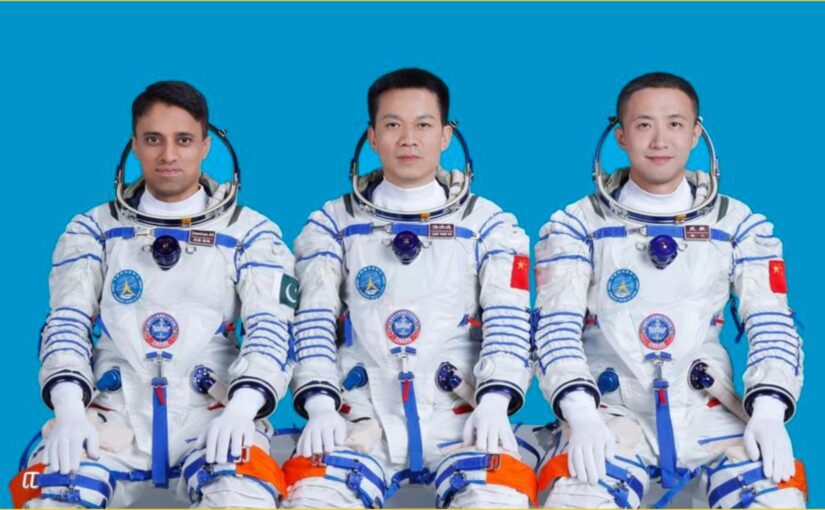
On November 25, the Shenzhou-24 space mission was launched from the Jiuquan Satellite Launch Centre in China’s Inner Mongolia Autonomous Region, carrying mission commander and spacecraft pilot Tang Hongbo, flight engineer Wu Yi, and Pakistani payload specialist Muhammad Zeeshan Ali, marking the first joint flight consisting of Chinese and foreign astronauts in the history of China’s manned space programme.
Zhang Jingbo, spokesperson for the China Manned Space Agency (CMSA), described the joint flight as a landmark achievement in bilateral cooperation as the two countries mark the 75th anniversary of diplomatic relations this year, and an important manifestation of their traditional friendship. China’s manned space programme has consistently adhered to the principle of peaceful utilisation, equality and mutual benefit, and common development, while actively promoting international exchanges and cooperation and the building of a community with a shared future for humanity in outer space, Zhang said at a news conference held the day before the launch.
More than 90 scientific experiments and technology tests are planned for the mission, covering space life sciences, space material science, microgravity fluid physics and combustion science, fundamental physics, space medicine and new space technologies. A number of them have been proposed by the Pakistan side, including one led by the University of Agriculture in Faisalabad, which will expose 32 quinoa seed samples to the space environment outside the station for about one year to investigate their stress tolerance and longevity, with the aim of screening for superior varieties. Describing Pakistan as one of the countries most vulnerable to climate change, Pakistani Federal Minister for Planning, Development and Special Initiatives Ahsan Iqbal said that the country needs smart and climate-resilient agriculture. “The mission gives Pakistani scientists rare access to space laboratories, offering potential breakthroughs to boost productivity and climate resilience,” he told the Xinhua News Agency.
Marking the launch, the Chinese and Pakistani presidents exchanged warm messages.
Chinese President Xi Jinping said that the joint space exploration by astronauts from China and Pakistan is a vivid embodiment of the deep-rooted friendship between the two countries. It marks another important achievement in bilateral cooperation. Xi extended his warm congratulations to the Pakistani government and people, as well as to astronauts and space professionals from both countries on behalf of the Chinese government and people.
Emphasising that China’s space station is an ark of peace, friendship and cooperation, Xi said that China stands ready to work with Pakistan and other countries to advance the peaceful use of outer space, deepen international space cooperation, and improve global governance in outer space, to ensure that outer space exploration delivers greater benefits to humanity.
For his part, Pakistani President Asif Ali Zardari expressed profound appreciation to the Chinese government and the brotherly Chinese people on behalf of the Pakistani government and people. He said that the historic space cooperation between Pakistan and China and the first Pakistani astronaut entering China’s space station come as the two countries commemorate the 75th anniversary of the establishment of diplomatic relations.
Such cooperation demonstrates China’s remarkable progress in space science and technology, its firm commitment to the peaceful use of outer space, and the significance of building a community with a shared future for humanity, Zardari said, adding that it will further strengthen bilateral friendship, and promote the all-weather strategic cooperative partnership between the two countries to a higher level.
Expressing confidence that the mission would inspire Pakistan’s young generation to “pursue knowledge, innovation and scientific discovery with confidence and ambition”, the president cited a verse from national poet Allama Iqbal, Sitaron se aagay jahan aur bhi hain (Beyond the stars there are more worlds still).
Pakistani Prime Minister Shehbaz Sharif congratulated the nation on Ali’s departure for the space mission, saying that “today Pakistan has begun its journey beyond the stars. This is not just one astronaut’s journey, but the journey of 240 million Pakistanis. It is the journey of our younger generation, our scientists and our dreams”. Expressing his gratitude to President Xi, he said that his visionary leadership had taken Pakistan-China friendship to an unprecedented height.
“This historic milestone is a powerful testament to the exceptional trust, mutual respect and enduring brotherhood that bind our two nations and peoples. Pakistan-China friendship is surpassing the heights of the Himalayas, in its journey to outer space.”
Speaking the day before he journeyed into space, Ali, a 40-year-old former Pakistan Air Force pilot, said: “My first flight represents not only myself, but also my country.” He said he had dreamed of flying to space as a child and had even kept newspaper clippings of the space exploration projects at the time in a diary. In June, he joined China’s fourth batch of astronauts for maritime survival training. Yang Liwei, China’s first astronaut in space, made a special trip to cheer on the trainees. As a child, Ali had kept a photo of Yang Liwei among the clippings in his diary. Seeing his idol and receiving his encouragement was a particularly memorable moment for him.
Among the major challenges he had faced in his short and intense training period had been learning the Chinese language. But beyond mastering the language, he had gradually developed a love and appreciation of Chinese culture. He enjoys Chinese poetry, and can recite many lines by famous poets, like Li Bai and Su Shi. At the media briefing, he quoted the lines of Wang Zhihuan, a renowned poet in the Tang Dynasty (618-907): “To enjoy a grander sight, climb to a greater height.”
Ali said he was “deeply grateful” to the Chinese government for helping “us realise our dream of going into space”. He said he arrived at the Astronaut Centre of China a few months ago, carrying with him the hopes of 250 million Pakistani people. He continued, “I have learned the Chinese language and developed a friendship with my Chinese colleagues. Now, I can communicate with my Chinese crewmates in Chinese. We trained side by side, and our friendship embodies the friendship between China and Pakistan: higher than the mountains, deeper than the oceans, sweeter than honey and as vast as outer space.”
He said he had come to deeply appreciate the meaning of President Xi Jinping’s words: “Exploring the vast universe, developing the space industry and building China into a space power is our unremitting pursuit of the space dream.”
“Now, this dream belongs to me and also belongs to Pakistan.” He added that he believed that “what comes after this flight matters more than the flight itself. This mission is not a finish line; it is a launch pad. And I hope the next chapter of China-Pakistan space cooperation will grow from one astronaut, one flight to multiple joint flights, to the Moon, Mars and beyond.
“I now feel the true weight of the words of our Prime Minister Shehbaz Sharif, when he told me that we were about to write a new chapter in Pakistan’s history. I want to assure you that I am not flying for myself. I carry the name of Pakistan on my shoulders, the hopes of 250 million Pakistanis. To every child who is watching while I am in orbit, just look up at the sky and remember that I am up there with your dreams.”
The following articles were originally published by the Xinhua News Agency, Pakistan Today and Dawn.
Xinhua Headlines: China launches Shenzhou-24 spaceship, opening Tiangong space station to first foreign astronaut
JIUQUAN, Nov. 25 (Xinhua) — China launched the Shenzhou-24 crewed spacecraft on Wednesday, sending three astronauts, including a Pakistani astronaut, into the orbiting Tiangong space station.
The Shenzhou-24 mission, carried out by Chinese mission commander and spacecraft pilot Tang Hongbo, flight engineer Wu Yi, and Pakistani payload specialist Muhammad Zeeshan Ali, marks the first joint flight consisting of Chinese and foreign astronauts in the history of China’s manned space program. Ali also became the first foreign astronaut to board Tiangong.
Zhang Jingbo, spokesperson for the China Manned Space Agency (CMSA), described the joint flight as a landmark achievement in bilateral cooperation as the two countries mark the 75th anniversary of diplomatic relations this year, and an important manifestation of their traditional friendship.
China’s manned space program has consistently adhered to the principle of peaceful utilization, equality and mutual benefit, and common development, while actively promoting international exchanges and cooperation and the building of a community with a shared future for mankind in outer space, Zhang said at a news conference on Tuesday.
UN spokesperson Stephane Dujarric said the United Nations welcomed the peaceful use of outer space and the international cooperation this mission represents.
Aboard a Long March-2F carrier rocket, the spaceship blasted off at 8:18 a.m. (Beijing Time) from the Jiuquan Satellite Launch Center in northwest China. About 10 minutes after liftoff, the spaceship separated from the rocket and entered its designated orbit. The CMSA declared the launch “a complete success.”
The spacecraft completed a fast, automated rendezvous and docking with the front port of Tianhe, the station’s core module, in about 3.5 hours. The Shenzhou-23 crew aboard Tiangong opened the hatch at 2:35 p.m. and welcomed the new arrivals.
The two crews then took group pictures marking the ninth space get-together in China’s aerospace history.
After completing a short-term joint flight, Ali will return to Earth aboard the Shenzhou-23 spacecraft alongside two Shenzhou-23 crew members. The other two Shenzhou-24 astronauts will stay in orbit for roughly six months along with Shenzhou-23 astronaut Zhu Yangzhu, who has already spent six months in orbit and will remain aboard Tiangong to complete a year-long stay experiment.
JOINT EXPERIMENTS
More than 90 scientific experiments and technology tests are planned for the Shenzhou-24 mission, covering space life sciences, space material science, microgravity fluid physics and combustion science, fundamental physics, space medicine and new space technologies, according to the CMSA.
Four China-Pakistan cooperative projects in the fields of biotechnology and materials will be conducted during the Shenzhou-24 mission, and Ali will conduct an experiment on photosynthetic cyanobacteria, which was proposed by the Pakistan Space and Upper Atmosphere Research Commission (SUPARCO).
The experiment is expected to provide a biological basis and data support for oxygen regeneration and biomanufacturing at future space stations and deep-space bases, said Chen Mengyun, who is in charge of international cooperation projects at the Technology and Engineering Center for Space Utilization under the Chinese Academy of Sciences.
Another cooperative project, led by the University of Agriculture, Faisalabad in Pakistan, will expose 32 quinoa seed samples to the space environment outside the station for about one year to investigate their stress tolerance and longevity, with the aim of screening for superior varieties.
Describing Pakistan as one of the countries most vulnerable to climate change, Pakistani Federal Minister for Planning, Development and Special Initiatives Ahsan Iqbal said that the country needs smart and climate-resilient agriculture.
“The mission gives Pakistani scientists rare access to space laboratories, offering potential breakthroughs to boost productivity and climate resilience,” he told Xinhua.
The other two experiments will focus on multilayer graphene-based hybrid composites and solar-heated self-healing carbon fiber composites, Chen said.
Pakistani Ambassador to China Syed Ali Asad Gillani said the four experiments in orbit will not only benefit Pakistani researchers, but also help advance the prosperity and development of all humanity.
China-Pakistan space cooperation spans more than three decades. In 1990, Pakistan’s first experimental satellite, Badr-1, was launched aboard a Chinese rocket from the Xichang Satellite Launch Center. More recently, China launched Pakistan’s cube satellite aboard the Chang’e-6 probe in 2024 and placed a Pakistani remote-sensing satellite in orbit via a Long March-6 rocket in April 2026.
COOPERATIVE TEAM
To support the joint flight, the Chinese side prepared bilingual Chinese-English manuals, provided food tailored to Ali’s cultural and dietary habits, and tailored training and ceremonial attire for the Pakistani.
According to Shi Yusheng, an expert with the Astronaut Center of China, the center devised multiple methods to help Ali master Chinese commands and terminology critical for spaceflight. Beyond basic language courses, Ali received intensive training in high-frequency spaceflight vocabulary and commands. Later in the program, he was also taught classical Chinese poetry.
“With tight timelines and heavy tasks, we focused on spacecraft operations, pressure emergency response, fault handling and scientific experiments, and conducted high-frequency joint training to ensure the mission’s success,” Tang, the Shenzhou-24 mission commander, said at Tuesday’s media briefing.
Wu, the mission flight engineer, said Ali had worked diligently to learn Chinese, while the Chinese crew used English as a supplementary communication tool. Through sustained effort, the crew progressed from merely understanding each other to anticipating each other’s actions.
Ali can now communicate with his Chinese counterparts in Chinese. He described mastering flight skills, learning Chinese and forging close bonds with his Chinese crewmates as key gains from his training.
Ali said China and Pakistan have turned a pilot into an astronaut in a remarkably short span of time. “Now it is time to show this great achievement in orbit and send the world a message that we work hand in hand for the peaceful utilization of space,” he said.
In an interview with Xinhua, the Pakistani ambassador to China described the joint flight as taking bilateral relations “from Earth to space,” calling it a dream come true for more than 250 million Pakistanis and “an excellent model for South-South cooperation.”
MULTIPLE TASKS
The Shenzhou-24 mission’s main objectives are to complete an in-orbit crew rotation with the Shenzhou-23 crew, maintain routine station operations, conduct space science and application work, and carry out maintenance, public outreach and payload tests.
One of the highlights is China’s first year-long in-orbit stay experiment. The year-long test will establish a new system for studying the human body in space, conduct interdisciplinary frontier scientific experiments, explore and answer intrinsic mechanisms of human adaptation and remodeling in a spaceflight environment, build a space-human-body research database combining macro and micro perspectives, and produce a batch of original outcomes, said Zhang, the CMSA spokesperson.
In addition, the test will further accumulate practical experience in astronaut support technologies, enrich and improve the major safeguarding systems for in-orbit health, work and daily life, and steadily enhance the astronaut residency support capabilities of China’s space station, he added.
Xi says joint space exploration by Chinese, Pakistani astronauts vivid embodiment of deep-rooted friendship
BEIJING, Nov. 25 (Xinhua) — Chinese President Xi Jinping said on Wednesday that the joint space exploration by astronauts from China and Pakistan is a vivid embodiment of the deep-rooted friendship between the two countries.
It marks another important achievement in bilateral cooperation, Xi said while exchanging congratulations with Pakistani President Asif Ali Zardari on the joint spaceflight mission.
In the message, Xi said that he was glad to learn of a Pakistani astronaut’s successful entry into space aboard a Chinese Shenzhou spaceship for the first time, making him the first foreign astronaut to inhabit China’s space station.
Xi extended his warm congratulations to the Pakistani government and people, as well as to astronauts and space professionals from both countries on behalf of the Chinese government and people.
Xi noted that China and Pakistan are all-weather strategic cooperative partners, saying that the friendship between the two countries has remained rock-solid and unbreakable since diplomatic ties were established 75 years ago.
Emphasizing that China’s space station is an ark of peace, friendship and cooperation, Xi said that China stands ready to work with Pakistan and other countries to advance the peaceful use of outer space, deepen international space cooperation, and improve global governance in outer space, to ensure that outer space exploration delivers greater benefits to the humanity.
For his part, Zardari expressed profound appreciation to the Chinese government and the brotherly Chinese people on behalf of the Pakistani government and people.
He said the historic space cooperation between Pakistan and China and the first Pakistani astronaut entering China’s space station come as the two countries commemorate the 75th anniversary of the establishment of diplomatic relations.
Such cooperation demonstrates China’s remarkable progress in space science and technology, its firm commitment to the peaceful use of outer space, and the significance of building a community with a shared future for humanity, Zardari said, adding that it will further strengthen bilateral friendship, and promote the all-weather strategic cooperative partnership between the two countries to a higher level.
Zardari, Xi exchange letters, hail landmark Pakistan-China space milestone
ISLAMABAD, Nov 25 (Pakistan Today) – President Asif Ali Zardari and Chinese President Xi Jinping on Wednesday exchanged congratulatory letters to mark the historic first spaceflight of a Pakistani astronaut to China’s Tiangong Space Station aboard a Shenzhou spacecraft, making him the first foreign astronaut to enter the orbiting facility.
In his letter to President Xi, President Zardari congratulated the Chinese government and people on the landmark achievement and expressed Pakistan’s profound appreciation for being selected as the first foreign partner in China’s manned space programme.
He acknowledged the support and professionalism of the China Manned Space Agency (CMSA) and the Astronaut Centre of China in making the collaboration possible, saying the milestone reflected China’s remarkable progress in space science and technology and its commitment to the peaceful exploration and use of outer space.
President Zardari said the achievement embodied the vision of building a community with a shared future for mankind through mutual progress, shared opportunities, and collective advancement. He described it as another testament to the enduring friendship, mutual trust, and close cooperation between Pakistan and China.
He noted that collaboration between CMSA and Pakistan’s Space and Upper Atmosphere Research Commission (SUPARCO) had opened new avenues for cooperation in science, technology, and space exploration.
Expressing confidence that the mission would inspire young Pakistanis to pursue scientific research, innovation, and technological advancement, the president said the milestone carried added significance as the two countries marked the 75th anniversary of their diplomatic relations. It would provide fresh impetus to cooperation in space science, research, technological innovation, and capacity building, he added.
In his letter to President Zardari, President Xi congratulated the Pakistani government and people, as well as astronauts and space-industry teams from both countries, on the successful entry of the Pakistani astronaut into China’s Space Station.
He said Pakistan and China, as all-weather strategic cooperative partners, had maintained an unbreakable friendship throughout the 75 years since establishing diplomatic relations.
President Xi described the joint participation of astronauts from the two countries in space exploration as a living testament to their deep-rooted friendship and a significant new outcome of bilateral cooperation.
He said space exploration was boundless and the China Space Station was an “ark of peace, friendship and cooperation.” China, together with Pakistan and other countries, was ready to promote the peaceful use of outer space, deepen international cooperation and improve global space governance to ensure that exploration benefited all humanity, he added.
The exchange of letters underscored the shared pride of the two countries in the achievement and their resolve to expand cooperation in science, technology and the peaceful exploration of space.
Profile: Muhammad Zeeshan Ali, first foreign astronaut aboard China’s space station
JIUQUAN, Nov. 25 (Xinhua) — Pakistani astronaut Muhammad Zeeshan Ali has become the first foreign astronaut to visit China’s Tiangong space station, arriving aboard the Shenzhou-24 spacecraft with two Chinese crewmates.
The spacecraft lifted off from the Jiuquan Satellite Launch Center in northwest China on Wednesday morning, and the crew entered Tiangong that afternoon.
“My first flight represents not only myself, but also my country,” Ali, a 40-year-old former Pakistan Air Force pilot, said at a media briefing on Tuesday, his first public appearance prior to the launch.
He said he had dreamed of flying to space as a child, and had even kept newspaper clippings of the space exploration projects at the time in a diary.
In February 2025, China and Pakistan signed a cooperation agreement that paved the way for a selection program for Pakistani astronauts. Ali initially served as a staff member responsible for the selection process.
Due to the high standards of the program and a very high attrition rate in the selection, additional volunteers were needed.
“I was selected at the very last moment to get in as the last person for this program and I felt very lucky to be part of it,” Ali said.
On April 24, 2026, Ali and another selected candidate arrived at the China Astronaut Research and Training Center, where systematic and rigorous training was arranged for them.
Their training covered professional skills on spacecraft and space station knowledge and specialized operations, with emphasis on experiment operations and emergency response. They also received instruction in crew coordination and Chinese language proficiency, focusing on mission-related commands and technical terminology.
“I was very confident with the operations of the spaceship, and it didn’t feel difficult for me to translate what I’ve already learned in my previous career into this training,” said Ali.
Determined to make the most of the opportunity, Ali repeatedly operated every switch in the simulation devices on the ground, and rehearsed every procedure until the movements became instinctive reactions.
In June, he joined China’s fourth batch of astronauts for maritime survival training. Yang Liwei, China’s first astronaut in space, made a special trip to cheer on the trainees.
As a child, Ali had kept a photo of Yang Liwei among the clippings in his diary. Seeing his idol and receiving his encouragement was a particularly memorable moment for him.
Learning Chinese was his biggest challenge. Inside the Shenzhou spacecraft and the space station, Chinese is used for switches, software, procedures, and voice prompts.
There was very little time available for learning Chinese, and there were plenty of training tasks going on at the same time. But Ali told himself to overcome the language hurdle.
Mission commander Tang Hongbo helped him by compiling over 100 Chinese commands frequently used on the spacecraft. Ali had repeatedly read aloud from the list.
The list helped him quickly master professional terminology for routine operations and emergency handling. Now language is no longer a barrier, as he can fluently communicate with his Chinese crewmates in Chinese.
Beyond mastering the language, he gradually developed a love and appreciation of Chinese culture. He enjoys Chinese poetry, and can recite many lines by famous poets, like Li Bai and Su Shi.
At Tuesday’s media meeting, Ali quoted the lines of Wang Zhihuan in the Tang Dynasty (618-907): “To enjoy a grander sight, climb to a greater height.”
“This is like my daily training — day after day, climbing to a greater height,” he added.
During the mission, Ali will conduct an in-orbit experiment on photosynthetic cyanobacteria. He hopes these tiny organisms can be used in future to support regenerative life support systems. The research could also have applications on Earth, potentially contributing to food security and agricultural production.
“The two great nations of China and Pakistan have turned a pilot into an astronaut in a remarkably short span of time,” Ali said on the eve of the launch. “Now it is time to show this great achievement in orbit and send the world a message that we work hand in hand for the peaceful utilization of space.”
Feature: Pakistanis celebrate launch of China’s Shenzhou-24 spacecraft as Pakistan’s 1st astronaut aboard
ISLAMABAD, Nov. 25 (Xinhua) — In the jam-packed auditorium of Pakistan’s national space agency, the Space and Upper Atmosphere Research Commission (SUPARCO), an enthusiastic crowd erupted into a countdown of “5…4…3…2…1…” as a giant screen displayed the launch of Pakistan’s first astronaut aboard China’s Shenzhou-24 crewed spacecraft.
The auditorium was filled with space enthusiasts, students, scientists and officials who had gathered in the early hours of Wednesday to witness the historic moment of the space journey of Pakistani astronaut Muhammad Zeeshan Ali.
“I was really excited about today. I learned about the event through the news and stayed up all night because I was eager to witness the launch and see how everything unfolded,” Mahnoor Naeem, a software engineer, told Xinhua.
“I was a little nervous, too, hoping that everything would go smoothly, but excitement outweighed the nervousness,” she added.
For many Pakistanis, Ali’s journey represents not only a national milestone but also an opportunity to inspire greater interest in science and space exploration.
Farrukh Shahzad, president of PakAstronomers Islamabad, a group based in the Pakistani capital that organizes public stargazing sessions, lectures, workshops and outreach activities at schools and universities, said Ali was living the dream of millions of Pakistanis, and his journey into space could inspire a new generation of scientists and open up new avenues for scientific and technological development in the country.
“Interest in space and astronomy is growing among Pakistanis, particularly young people. The historic spaceflight would further encourage young people to explore astronomy and space science,” Shahzad told Xinhua.
Holding a poster of Zeeshan Ali along with Pakistani and Chinese flags, Imran Ali, a pre-engineering student, was overcome with emotion as the spacecraft lifted off.
“When the spacecraft blasted off and the crowd began chanting slogans of Pakistan-China friendship, it was an incredibly emotional moment for me because it symbolized not only a historic achievement for Pakistan but also the strength of the enduring friendship between Pakistan and China,” he told Xinhua.
“It was a moment of immense pride to see Pakistan’s dream of sending its astronaut into space becoming a reality with China’s support,” he added.
For Pakistani space scientists and officials at SUPARCO, the successful launch marked the culmination of years of hard work and the beginning of a new phase of space cooperation with China. “Our priority now should be to build on this achievement, strengthen research and explore how space-based experiments can generate tangible benefits for the country,” Zain Bukhari, general manager at SUPARCO, told Xinhua.
Pakistani Prime Minister Shehbaz Sharif congratulated the nation on Zeeshan Ali’s departure for the space mission, saying that “today Pakistan has begun its journey beyond the stars. This is not just one astronaut’s journey, but the journey of 240 million Pakistanis. It is the journey of our younger generation, our scientists and our dreams.”
‘Carrying hopes of 250m people’: Zeeshan Ali to be ‘first’ Pakistani astronaut in space aboard China’s Shenzhou-24
Nov 24 (Dawn) – Zeeshan Ali was named a crew member of China’s Shenzhou-24 space mission on Tuesday, which is scheduled to launch on November 25, with Ali set to become the first Pakistani to undertake an orbital space mission.
Planning Minister Ahsan Iqbal, who is in China, referred to Ali on X as “Pakistan’s first astronaut”.
Ali will also be the first foreign national to board Beijing’s Tiangong space station, the China Manned Space Agency (CMSA) announced.
“Pakistani astronaut Mohammad Zeeshan Ali is the first foreign national to visit Tiangong,” CMSA Spokesperson Zhang Jingbo said during a press conference.
And the Chinese foreign ministry spokesperson said the Pakistani astronaut was also the first international crew member to join China’s manned space programme.
CMSA’s Jingbo said that the Long March-2F rocket that will carry the crew into space will soon be filled with propellant. “The crew is in good condition and the space station is functioning normally, meeting all requirements for the mission,” said Jingbo.
According to the CMSA, the Pakistani astronaut will serve as a payload specialist during the mission and return aboard the Shenzhou-23 spacecraft, which docked with the Tiangong space station in May.
China’s astronaut Tang Hongbo will command the mission, with Wu Yi serving as the mission pilot and Ali taking on the role of payload specialist, according to the CMSA.
The crewed spaceship is scheduled to be launched at 8:18am Beijing time (5:18am Pakistan time) on Wednesday from the Jiuquan Satellite Launch Centre in northwest China.
In a video shared by the Chinese embassy in Pakistan, Ali said the “real challenge” was mastering the Chinese language, rather than centrifuge training.
Ali is expected to spend around a week in space, conducting various experiments alongside the Chinese crew. CMSA said that during the mission, the crew will conduct around 90 experiments.
The Chinese space agency said the mission’s objectives included conducting an orbital rotation with the crew of the earlier Shenzhou-23 mission, carrying out routine operations and maintenance of the Chinese space station, and continuing space science research, including experiments involving space payloads.
The crew currently aboard the Tiangong space station is headed by 40-year-old Zhu Yangzhu, Lai Ka-ying and Zhang Zhiyuan, also 40.
Lai is Hong Kong’s first astronaut and the only woman currently aboard the space station.
After the new crew reaches the space station, Ali will return to Earth alongside Lai and Zhang.
Zhu will remain on board to complete China’s first full-year stay in space — a key test of endurance critical for future lunar and potentially deep-space ambitions.
Zhu will be accompanied for the next six-month Tiangong rotation by 51-year-old space veteran Hongbo and Yi, in his late thirties and making his first voyage to space.
‘We have already made history’
Speaking at a press briefing in Jiayuguan, Ali said he was “deeply grateful” to the Chinese government for helping “us realise our dream of going into space”.
He said he arrived at the Astronaut Centre of China a few months ago, carrying with him the hopes of 250 million Pakistani people.
Detailing his experience in China, he said what he gained had far exceeded his initial expectations.
“First, I have acquired space flight skills. The management, staff and instructors at the Astronaut Centre of China have provided me with comprehensive training […] Day after day, I take another step upward.”
He continued, “I have learned the Chinese language and developed a friendship with my Chinese colleagues. Now, I can communicate with my Chinese crewmates in Chinese.”
“We trained side by side, and our friendship embodies the friendship between China and Pakistan: higher than the mountains, deeper than the oceans, sweeter than honey and as vast as outer space.”
He said he had come to deeply appreciate the meaning of Chinese President Xi Jinping’s words: “Exploring the vast universe, developing the space industry and building China into a space power is our unremitting pursuit of the space dream.”
“Now, this dream belongs to me and also belongs to Pakistan,” he said, adding that it would become a reality through the Shenzhou-24 space mission.
Ali said he believed that “what comes after this flight matters more than the flight itself”.
“This mission is not a finish line; it is a launch pad. And I hope the next chapter of China-Pakistan space cooperation will grow from one astronaut, one flight to multiple joint flights, to the Moon, Mars and beyond.”
Ali noted that 2026 marked the 75th anniversary of China-Pakistan space cooperation, as well as the 75th anniversary of diplomatic relations between the two countries.
“Together with my Chinese crewmates, I will show that this friendship is real — not only on paper, but also in orbit.”
Addressing Pakistanis, he said: “I now feel the true weight of the words of our Prime Minister Shehbaz Sharif, when he told me that we were about to write a new chapter in Pakistan’s history. I want to assure you that I am not flying for myself. I carry the name of Pakistan on my shoulders, the hopes of 250 million Pakistanis.
“To every child who is watching while I am in orbit, just look up at the sky and remember that I am up there with your dreams.”
In his message to his family, he said: “I want to say that I will travel farther from home than ever before. But I promise you one thing: whenever I look back at the Earth for the first time, I will always search for the light of our home before I look at anything else. No matter how far I fly, we will still share the same Moon, and I will still be looking back at the same Earth.”
He then thanked his teammates, those who supported him, his instructors, scientists, engineers, Pakistan’s space agency Suparco and CMSA.
“You are the reason that I am here today, and no matter who flies, we have already made history together,” he said.
Ali said the “two great nations of China and Pakistan have turned a pilot into an astronaut in a remarkably short span of time. Now it is time to show this great achievement, innovation and send the world a message that we work hand in hand for the peaceful utilisation of space”.
Separately, China Daily posted a video of Ali saying that his planned one-year training had been compressed to seven months.
“That was the biggest challenge for me when I came here. But the real challenge, honestly speaking, was mastering the Chinese language. Learning the Chinese language is the key to the hearts of Chinese people,” he added.
Ali said he had read about several astronauts saying that whenever they looked at Earth from outer space, they did not see any borders or “separation between human beings; it is one humanity”.
He said he would be taking handwritten letters from his children and father on his journey “as a great source of inspiration”.
‘A moment that belongs to every Pakistani’
Prime Minister Shehbaz Sharif took to X to wish the crew his best for Wednesday’s liftoff.
“Tomorrow, Pakistan will look to the skies with anticipation, pride and deep gratitude,” he said, adding that as the Shenzhou-24 prepared to carry a Pakistani astronaut to Tiangong Space Station, the nation stood on the “threshold of a historic first”.
“It is a moment that belongs to every Pakistani,” he wrote and paid tribute to Suparco as well as academic institutions, scientists, the armed forces and national institutions whose efforts reflected “Pakistan’s growing capabilities and our determination to reach new frontiers in space exploration and scientific advancement”.
PM Shehbaz expressed gratitude to President Xi, stating that his “visionary” leadership had taken Pakistan-China friendship to an “unprecedented height”.
“This historic milestone is a powerful testament to the exceptional trust, mutual respect and enduring brotherhood that bind our two nations and peoples,” Shehbaz wrote, as he wished the crew his best for a safe and successful mission.
“Pakistan-China friendship is surpassing the heights of the Himalayas, in its journey to outer space.”
President Asif Ali Zardari also congratulated the nation on “historic” participation in the Chinese mission, calling it a “landmark achievement” and a “moment of immense national pride”, according to a statement issued by his office.
He said the mission reflected Pakistan’s “growing commitment to science, research and technological advancement”, lauding the role of Suparco, Pakistani scientists and China’s cooperation.
President Zardari expressed hope that the mission would open new horizons for Pakistan’s space programme and the scientific experiments undertaken during the mission would contribute to advancing research and knowledge.
“Pakistan’s participation in human spaceflight is not only about reaching space but also about harnessing its opportunities for research, learning and innovation.”
Citing a verse from national poet Allama Iqbal — Sitaron se aagay jahan aur bhi hain — he stressed that the mission should inspire Pakistan’s young generation to “pursue knowledge, innovation and scientific discovery with confidence and ambition”.
Planning Minister Iqbal said the joint mission marked “the trust and iron brotherhood between Pakistan and China”.
Sharing a photo of himself from the press briefing in Jiayuguan, Ahsan posted on X: “Filled with immense pride and excitement as I witness history in the making.
“Watching our astronaut, Muhammad Zeeshan Ali, take centre stage is a deeply moving moment. We had dared to dream big and laid the foundational blocks for Pakistan’s space and science ambitions. Today, seeing those dreams take flight and come true right before our eyes reaffirms that no frontier is beyond our reach when a nation commits to knowledge, innovation, and perseverance. The sky is no longer our limit—it is our launching pad.”
Deputy Prime Minister and Foreign Minister Ishaq Dar congratulated the entire nation and Suparco as “Pakistan prepares to make history in space exploration and joint scientific advancement”.
“This landmark moment speaks volumes about the strength of our all-weather strategic cooperative partnership. My sincere wishes go out to all the astronauts on board for a smooth and successful mission. Long live Pakistan-China friendship!” he posted on X.
“This achievement underscores the immense potential of Pakistan’s human talent and the enduring Pakistan-China friendship,” wrote the Foreign Office (FO).
Information Minister Attaullah Tarar highlighted on X that a Pakistani astronaut going into space was a source of joy and pride for the entire nation.
Earlier in April, astronauts Zeeshan Ali and Khurram Daud were chosen from Pakistan to start training in China. Suparco and CMSA signed a cooperation agreement in February 2025, under which two Pakistanis were to train in China, with one joining a mission on the Tiangong space station operated by Beijing.
Eventually, Ali was chosen to join the Chinese mission.
Making the announcement, Iqbal wrote on X that he wanted to “honour both of our astronauts, Muhammad Zeeshan Ali and Khurram Daud, selected for final training. They were chosen from among Pakistan’s finest pilots and scientists. They trained in centrifuges and simulators, in emergency drills and in a new language. Both performed exceptionally well in training. Though Zeeshan Ali will fly tomorrow, both have already made Pakistan proud”.
PM Shehbaz had met the two in April and congratulated them on their selection. He said the space mission was a “matter of pride for the entire nation” and further commended their “round-the-clock efforts” in achieving the milestone.
PM Shehbaz had hoped that the space mission would “add new dimensions to the brotherly relationship between Pakistan and China”.
Beijing has invested heavily in its space programme in recent years — catching up with its main rival the United States — and aims to land astronauts on the moon by 2030.
Pakistan is a natural partner, given the country’s decades-long, “all-weather” friendship. China is Pakistan’s largest trading partner and a major foreign investor.
China has been barred from participating in the International Space Station since 2011, when the US prohibited Nasa from collaborating with Chinese space agencies. Since then, Beijing has sought to build partnerships with other countries — including Pakistan — in its expanding space programme.