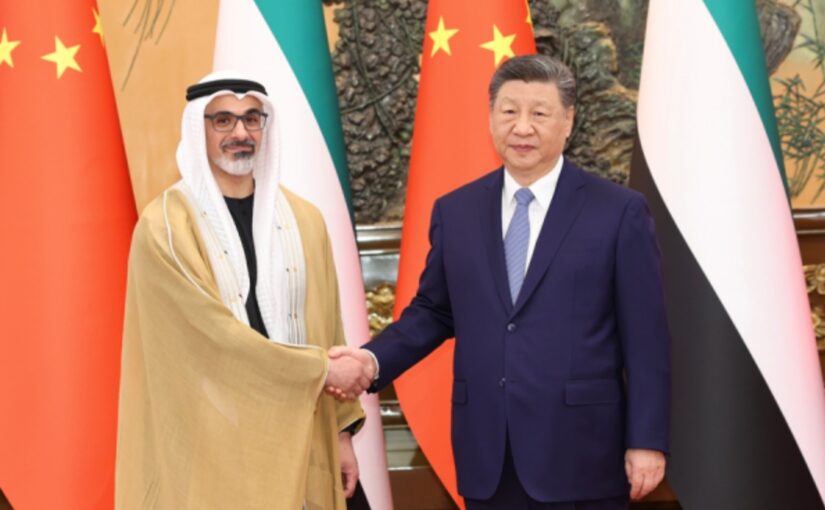
Chinese President Xi Jinping has advanced four propositions aimed at safeguarding and promoting peace and stability in the Middle East.
He outlined these at an April 14 meeting in Beijing with Sheikh Khaled bin Mohamed bin Zayed Al Nahyan, Crown Prince of Abu Dhabi (United Arab Emirates, UAE).
Xi Jinping stressed China’s principled position of promoting peace and facilitating talks and reiterated his country’s readiness to continue playing a constructive role in this regard. His four-point proposition stresses:
- Stay committed to the principle of peaceful coexistence. The Gulf states in the Middle East are close neighbours that cannot move away. It’s important to support the Gulf states in improving their ties, work to build a common, comprehensive, cooperative and sustainable security architecture of the Middle East and the Gulf region, and consolidate the foundation for peaceful coexistence.
- Stay committed to the principle of national sovereignty. Sovereignty serves as a foundation for all countries, especially developing countries, to survive and thrive, and it must not be violated.
- Stay committed to the principle of international rule of law. We should safeguard the authority of international rule of law, reject selective application, and prevent the world from returning to the law of the jungle. It is important to firmly uphold the international system with the United Nations at its core, the international order based on international law, and the basic norms governing international relations underpinned by the purposes and principles of the UN Charter.
- Stay committed to a balanced approach to development and security. Security is a prerequisite for development and development serves as a safeguard of security.
The previous day, Chinese Foreign Minister Wang Yi had met with the Special Envoy of the UAE President to China Khaldoon Khalifa Al Mubarak, who was accompanying Al Nahyan.
Also on April 13, Wang Yi had a phone call with Pakistani Deputy Prime Minister and Foreign Minister Mohammad Ishaq Dar.
Dar gave a comprehensive briefing on Pakistan’s mediation efforts between Iran and the United States and expressed appreciation for China’s endeavours to promote peace. Pakistan stands ready to maintain close communication and coordination with China and jointly play a positive role in realising peace in the region.
Wang reiterated China’s principled position and commended Pakistan for facilitating a temporary ceasefire between the US and Iran and for hosting the Islamabad talks, noting that Pakistan has played a fair and balanced mediating role. He said that the current ceasefire remains highly fragile and the regional situation is at a critical turning point. The pressing priority is to do everything possible to prevent the resumption of hostilities and sustain the hard-won momentum of the ceasefire. The international community should step up efforts to promote peace talks and unequivocally oppose any actions that undermine the ceasefire and escalate confrontation. The Five-Point Initiative of China and Pakistan for Restoring Peace and Stability in the Gulf and Middle East Region reflects the consensus of the international community on promoting peace and can continue to serve as a direction for efforts toward resolving the issue. The Chinese side is pleased to see Pakistan play a greater role and stands ready to work with Pakistan and the rest of the international community to continue making positive contributions to the early restoration of peace and stability in the Middle East.
Then, on April 15, Wang had a phone call with Iranian Foreign Minister Seyed Abbas Araghchi.
Seyed Abbas Araghchi briefed on the latest progress in Iran‑US negotiations and Iran’s next‑step considerations, stating that Iran stands ready to continue seeking a rational and realistic solution through peaceful negotiations. Iran highly appreciates China’s consistent efforts to de‑escalate tensions and hopes China will play an active role in promoting peace and ending the conflict.
Wang Yi stated that China, as always, supports Iran in safeguarding its sovereignty, security and national dignity. China supports sustaining the momentum of ceasefire and negotiations, which serves the fundamental interests of the Iranian people and meets the shared aspiration of regional countries and the international community. The sovereignty, security and legitimate rights and interests of Iran as a country bordering the Strait of Hormuz should be respected and upheld. Guided by the essence of President Xi Jinping’s four propositions, China stands ready to continue to facilitate de‑escalation, promote the improvement of relations among regional countries, and play a constructive role in ultimately achieving enduring peace and stability in the Middle East.
The following articles were originally published on the website of the Chinese Foreign Ministry.
President Xi Jinping Meets With Sheikh Khaled bin Mohamed bin Zayed Al Nahyan, Crown Prince of Abu Dhabi, the UAE
April 14 (MFA) – On the morning of April 14, President Xi Jinping met with Sheikh Khaled bin Mohamed bin Zayed Al Nahyan, Crown Prince of Abu Dhabi, the United Arab Emirates, who is on a visit to China, at the Great Hall of the People in Beijing.
President Xi Jinping noted that the UAE is China’s comprehensive strategic partner, and China always attaches high importance to growing this bilateral relationship. With the concerted efforts of both sides, China and the UAE have maintained sound and stable development of bilateral relations, kept deepening mutual political trust, steadily advanced practical cooperation, and enjoyed vibrant people-to-people exchanges. To cement and elevate China-UAE relations is the firm commitment of both sides and meets the aspiration of both peoples. China stands ready to work with the UAE toward a more solid, resilient and dynamic China-UAE comprehensive strategic partnership. Our two countries should continue to provide mutual support on issues concerning each other’s core interests and major concerns, maintain high-level exchanges and strengthen strategic mutual trust. We should enhance synergy between development strategies, tap into the potential and deepen win-win cooperation in such areas as energy, investment, trade, science and technology. We should strive for greater progress in education, civil aviation and tourism to foster closer people-to-people exchanges and strengthen popular support. We should enhance coordination and cooperation in multilateral platforms such as the U.N. and BRICS, counter international and regional uncertainties with a stable China-UAE relationship, and jointly build a community with a shared future for humanity.
The two sides exchanged views on the current situation in the Middle East and the Gulf region. President Xi Jinping stressed China’s principled position of promoting peace and facilitating talks, and reiterated China’s readiness to continue playing a constructive role in this regard.
President Xi Jinping made four propositions on safeguarding and promoting peace and stability in the Middle East. First, stay committed to the principle of peaceful co-existence. The Gulf states in the Middle East are close neighbors that cannot move away. It’s important to support the Gulf states in improving their ties, work to build a common, comprehensive, cooperative and sustainable security architecture of the Middle East and the Gulf region, and consolidate the foundation for peaceful co-existence. Second, stay committed to the principle of national sovereignty. Sovereignty serves as a foundation for all countries, especially developing countries, to survive and thrive, and it must not be violated. The sovereignty, security and territorial integrity of the Gulf states should be earnestly respected, and the safety of their personnel, facilities and institutions vigorously safeguarded. Third, stay committed to the principle of international rule of law. We should safeguard the authority of international rule of law, reject selective application, and prevent the world from returning to the law of the jungle. It is important to firmly uphold the international system with the U.N. at its core, the international order based on international law, and the basic norms governing international relations underpinned by purposes and principles of the U.N. Charter. Fourth, stay committed to a balanced approach to development and security. Security is a prerequisite for development, and development serves as a safeguard of security. All sides should work to create a sound environment for and bring positive energy to the development of the Gulf states. China stands ready to share with the Gulf countries the opportunities through Chinese modernization, and work with them to nurture a fertile ground for regional development and security.
Crown Prince Sheikh Khaled bin Mohamed bin Zayed Al Nahyan noted that the China-UAE relationship is long-standing and built on deep roots. The two countries have always respected and trusted each other, and shared extensive common interests. The UAE attaches great importance to growing its ties with China, and stands ready to work with China to implement the important common understandings reached between the two heads of state and deepen cooperation in various fields, so as to open up a broader prospect for the bilateral relations and deliver tangible benefits to both peoples. The UAE commends China’s responsible and constructive role in international affairs, and China’s efforts on promoting political settlement of the crisis taking place in the Middle East. The UAE is committed to staying in close communication and coordination with China to facilitate ceasefire between the relevant sides, restore peace and stability in the region as soon as possible, maintain international shipping security, and prevent further impact on the global economy and energy security. The UAE will earnestly protect the safety of Chinese citizens and institutions in its territory.
Wang Yi was present at the meeting.
Wang Yi Has a Phone Call with Pakistani Deputy Prime Minister and Foreign Minister Mohammad Ishaq Dar
April 13 (MFA) – On April 13, 2026, Member of the Political Bureau of the CPC Central Committee and Foreign Minister Wang Yi had a phone call with Pakistani Deputy Prime Minister and Foreign Minister Mohammad Ishaq Dar.
Mohammad Ishaq Dar gave a comprehensive briefing on Pakistan’s mediation efforts between Iran and the United States, and expressed appreciation for China’s endeavors to promote peace. Pakistan stands ready to maintain close communication and coordination with China and jointly play a positive role in realizing peace in the region.
Wang Yi reiterated China’s principled position and commended Pakistan for facilitating a temporary ceasefire between the US and Iran and for hosting the Islamabad talks, noting that Pakistan has played a fair and balanced mediating role. Wang Yi said that the current ceasefire remains highly fragile and the regional situation is at a critical turning point. The pressing priority is to do everything possible to prevent the resumption of hostilities and sustain the hard-won momentum of the ceasefire. The international community should step up efforts to promote peace talks and unequivocally oppose any actions that undermine the ceasefire and escalate confrontation. The Five-Point Initiative of China and Pakistan for Restoring Peace and Stability in the Gulf and Middle East Region reflects the consensus of the international community on promoting peace and can continue to serve as a direction of efforts toward resolving the issue. The Chinese side is pleased to see Pakistan play a greater role and stands ready to work with Pakistan and the rest of the international community to continue making positive contributions to the early restoration of peace and stability in the Middle East.
Wang Yi Has a Phone Call with Iranian Foreign Minister Seyed Abbas Araghchi
April 15 (MFA) – On April 15, 2026, Member of the Political Bureau of the CPC Central Committee and Foreign Minister Wang Yi had a phone call with Iranian Foreign Minister Seyed Abbas Araghchi.
Seyed Abbas Araghchi briefed on the latest progress in Iran‑US negotiations and Iran’s next‑step considerations, stating that Iran stands ready to continue seeking a rational and realistic solution through peaceful negotiations. Iran highly appreciates China’s consistent efforts to de‑escalate tensions and hopes China will play an active role in promoting peace and ending the conflict.
Wang Yi stated that China, as always, supports Iran in safeguarding its sovereignty, security and national dignity. President Xi Jinping solemnly put forward the four propositions on safeguarding and promoting peace and stability in the Middle East, offering a Chinese approach to resolving the crisis. The current situation has reached a critical juncture between war and peace, and a window of opportunity for peace is opening. China supports sustaining the momentum of ceasefire and negotiations, which serves the fundamental interests of the Iranian people and meets the shared aspiration of regional countries and the international community. The sovereignty, security and legitimate rights and interests of Iran as a country bordering the Strait of Hormuz should be respected and upheld. Meanwhile, the freedom and security of navigation in the internationally accessible strait should also be guaranteed, and striving to restore normal navigation in the strait is a shared call of the international community. Guided by the essence of President Xi Jinping’s four propositions, China stands ready to continue to facilitate de‑escalation, promote the improvement of relations among regional countries, and play a constructive role in ultimately achieving enduring peace and stability in the Middle East.






Interesting to see how international politics can affect regional stability. What do you think the actual impact of this plan will be?
It’s interesting to see China taking such a proactive role in this region. Focusing on stability seems like a sensible approach given the complexities involved.