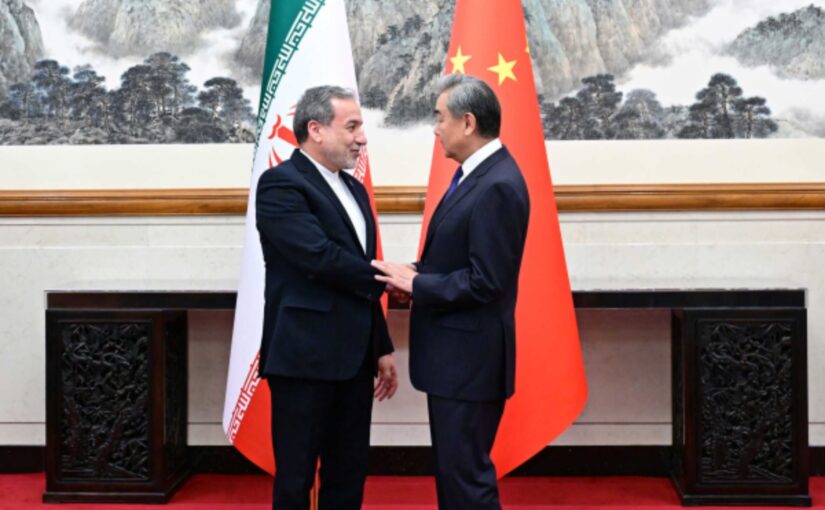
Iranian Foreign Minister Seyyed Abbas Araghchi visited China on May 6 for talks with his Chinese counterpart Wang Yi.
Araghchi briefed Wang on the latest developments in the Iran-US negotiations and Iran’s next steps, stating that facts have proven that political crises cannot be resolved through military means. Iran will resolutely safeguard its national sovereignty and national dignity while continuously building consensus through peaceful negotiations to seek a comprehensive and permanent solution. Currently, the issue of opening the Strait of Hormuz could be promptly addressed. Iran highly appreciates and agrees with the four propositions put forward by President Xi Jinping [during his recent meeting with the Crown Prince of the United Arab Emirates {UAE}] on safeguarding and promoting peace and stability in the region. Iran commends China for always standing on the right side of history and making unremitting efforts with a constructive attitude to prevent the situation from deteriorating and spilling over. Iran trusts China and looks forward to China continuing to play an active role in promoting peace and ending the conflict and supports the establishment of a new post-war regional framework that can coordinate development and security.
The Iranian Foreign Minister added that his country is willing to take the 55th anniversary of the establishment of diplomatic relations between the two countries this year as an opportunity to strengthen exchanges at all levels, tap into cooperation potential, provide firm mutual support, and deepen all-round cooperation. Iran is also willing to strengthen communication and coordination with China in multilateral affairs and continuously deepen the Iran-China comprehensive strategic partnership.
Wang Yi reiterated China’s principled position on the situation in Iran, emphasising that China has been actively promoting peace and facilitating talks since the outbreak of hostilities. President Xi Jinping solemnly put forward four propositions on safeguarding and promoting peace and stability in the Middle East, which has received a positive response from the international community. The current regional situation is at a critical juncture between war and peace. China believes that a comprehensive ceasefire is of utmost urgency, that resuming hostilities is even less acceptable, and that adhering to negotiations is particularly important. China supports Iran in safeguarding its national sovereignty and security and appreciates Iran’s willingness to seek a political solution through diplomatic channels. Regarding the Strait of Hormuz, the international community shares a common concern about restoring normal and safe passage through the strait, and China hopes that the parties involved will promptly respond to the strong call from the international community. [In this regard it should be noted above that Araghchi said that this issue could be promptly addressed, whereas the same day, US President Donald Trump boasted that, “the blockade will remain in full force and effect.” Iran has consistently stressed that the Strait remains open to all but the US aggressors and their allies.]
Regarding the nuclear issue, Wang continued, China appreciates Iran’s commitment not to develop nuclear weapons and, at the same time, believes that Iran has a legitimate right to the peaceful use of nuclear energy. China advocates that countries in the Gulf and Middle East should take their destiny into their own hands, encourages Iran and more Gulf countries to engage in dialogue to achieve good-neighbourliness and friendship, and supports the establishment of a regional peace and security framework by regional countries that ensures joint participation, safeguards common interests, and achieves common development. [As with other recent Chinese statements, the reference to taking “their destiny into their own hands”, in particular, constitutes a subtle but definite call on the Gulf countries to assert their independence and cease acting as stooges of US imperialism.]
Wang Yi further pointed out that China is a trustworthy strategic partner of Iran. China is willing to consolidate and deepen political mutual trust with Iran, maintain and strengthen high-level exchanges, deepen mutually beneficial cooperation in various fields, and continue to advance the China-Iran comprehensive strategic partnership.
Prior to Araghchi’s departure for Beijing, Iran’s Press TV pointed out that the visit formed part of Tehran’s broader diplomatic outreach to key partners, with the foreign minister also having recently visited Russia, Pakistan and Oman. Reporting the meeting with Wang Yi, it said that:
“Araghchi thanked China for its firm stance, particularly its condemnation of Washington and Tel Aviv, describing Beijing as a sincere friend to Tehran. He underscored that cooperation between the two countries will strengthen under current circumstances.
“Araghchi described the ongoing war against Iran as an ‘open aggression and a gross violation of international law.’
“Referring to the diplomatic path forward, he asserted that Tehran would use all its strength in negotiations to protect its legitimate rights and interests, stating that Iran will not be satisfied with anything less than a ‘fair and comprehensive agreement.’”
Press TV added that the visit follows at least three phone calls between Wang and Araghchi since the outbreak of the terrorist war against Iran on February 28. Their last call was on April 15, during which Araghchi commended China and Russia’s responsible stance in opposing a US-backed UN Security Council resolution and said this had helped prevent escalation.
It further noted that Wang praised the Iranian people’s resilience during the recent war and reiterated Beijing’s readiness to support diplomacy and end the conflict.
In a post on X following his meeting with Wang, Araghchi said that China shares Tehran’s view that the US-Israeli war has fundamentally changed Iran’s position in the region and internationally. “Both sides reaffirmed Iran’s right to uphold national sovereignty and national dignity. The Iranian side appreciated China’s four‑point proposal for maintaining and promoting regional peace and stability.”
In an interview with Iranian media, he elaborated on the discussions, noting that China shares Tehran’s view that the war has fundamentally changed Iran’s position in the region.
“Our Chinese friends also believe that Iran after the war is different from Iran before it. Iran has achieved an upgrade in its international standing and has proven its strength and authority. Therefore, a new era of cooperation between Iran and other countries lies ahead.”
For its part, the Mehr News Agency quoted Wang Yi as saying: “China’s principled position is opposition to the use of force and the continuation of this illegal war, whose damaging consequences extend beyond Iran to all nations and peoples of the region and the world.”
The Palestine Chronicle noted: “The Beijing meeting comes just days before Trump’s expected May 14-15 visit to China, which analysts say has added strategic significance to the timing of Araghchi’s trip. According to CNBC, Chinese officials themselves initiated the invitation to the Iranian foreign minister.
“Amir Handjani, board member at the Quincy Institute for Responsible Statecraft [in the United States], told CNBC: ‘Tehran and Beijing are aligning their interests before Trump’s summit with Xi Jinping, and the timing is deliberate.’”
On the same day as his meeting with Wang Yi, Araghchi also had a telephone conversation with the foreign minister of Saudi Arabia Prince Faisal bin Farhan Al Saud.
The South China Morning Post reported that the two ministers discussed regional developments, stressing a need to continue diplomatic efforts and regional cooperation to avoid renewed tensions, according to Iran’s foreign ministry.
It added that the Saudi foreign ministry said in a statement that its foreign minister discussed the latest developments in the Gulf and “efforts made to maintain the security and stability of the region.”
The following articles were originally published on the websites of the Chinese Foreign Ministry and by Press TV, the Mehr News Agency and the Palestine Chronicle.
Wang Yi Holds Talks with Iranian Foreign Minister Seyyed Abbas Araghchi
May 6 (MFA) – On May 6, 2026, Member of the Political Bureau of the CPC Central Committee and Foreign Minister Wang Yi held talks with Iranian Foreign Minister Seyyed Abbas Araghchi in Beijing.
Seyyed Abbas Araghchi briefed on the latest developments in the Iran-US negotiations and Iran’s next steps, stating that facts have proven that political crises cannot be resolved through military means. Iran will resolutely safeguard its national sovereignty and national dignity while continuously building consensus through peaceful negotiations to seek a comprehensive and permanent solution. Currently, the issue of opening the Strait of Hormuz could be promptly addressed. Iran highly appreciates and agrees with the four propositions put forward by President Xi Jinping on safeguarding and promoting peace and stability in the region. Iran commends China for always standing on the right side of history and making unremitting efforts with a constructive attitude to prevent the situation from deteriorating and spilling over. Iran trusts China and looks forward to China continuing to play an active role in promoting peace and ending the conflict, and supports the establishment of a new post-war regional framework that can coordinate development and security.
Seyyed Abbas Araghchi said that China is Iran’s comprehensive strategic partner. Iran has always adhered to the one-China principle, and supports China in safeguarding its core interests. Iran is willing to take the 55th anniversary of the establishment of diplomatic relations between the two countries this year as an opportunity to strengthen exchanges at all levels, tap into cooperation potential, provide firm mutual support, and deepen all-round cooperation. Iran is also willing to strengthen communication and coordination with China in multilateral affairs, and continuously deepen the Iran-China comprehensive strategic partnership.
Wang Yi reiterated China’s principled position on the situation in Iran, emphasizing that China has been actively promoting peace and facilitating talks since the outbreak of hostilities. President Xi Jinping solemnly put forward four propositions on safeguarding and promoting peace and stability in the Middle East, which has received a positive response from the international community. The current regional situation is at a critical juncture between war and peace. China believes that a comprehensive ceasefire is of utmost urgency, that resuming hostilities is even less acceptable, and that adhering to negotiations is particularly important. China supports Iran in safeguarding its national sovereignty and security, and appreciates Iran’s willingness to seek a political solution through diplomatic channels. Regarding the Strait of Hormuz, the international community shares a common concern about restoring normal and safe passage through the strait, and China hopes that the parties involved will promptly respond to the strong call from the international community. Regarding the nuclear issue, China appreciates Iran’s commitment not to develop nuclear weapons and, at the same time, believes that Iran has a legitimate right to the peaceful use of nuclear energy. China advocates that countries in the Gulf and Middle East should take their destiny into their own hands, encourages Iran and more Gulf countries to engage in dialogue to achieve good-neighborliness and friendship, and supports the establishment of a regional peace and security framework by regional countries that ensures joint participation, safeguards common interests, and achieves common development.
Wang Yi said that China is willing to uphold the spirit of President Xi Jinping’s four propositions, aim at supporting countries in the Middle East to build “four shared homelands”, further commit to easing tensions and ending hostilities, continue to provide assistance for initiating peace talks, and play a greater role in restoring peace and tranquility in the Middle East.
Wang Yi pointed out that China is a trustworthy strategic partner of Iran. China is willing to consolidate and deepen political mutual trust with Iran, maintain and strengthen high-level exchanges, deepen mutually beneficial cooperation in various fields, and continue to advance the China-Iran comprehensive strategic partnership.
The two sides also exchanged views on international and regional hotspot issues of common concern.
May 5 (Press TV) – Iranian Foreign Minister Abbas Araghchi will travel to Beijing on Tuesday for high-level talks with his Chinese counterpart on bilateral ties and regional developments.
The visit is part of Tehran’s broader diplomatic outreach to key partners. Araghchi’s agenda includes discussions on mutual cooperation as well as regional and international issues, according to a brief statement by the Iranian Foreign Ministry.
The visit to China comes as Araghchi traveled to Russia last Monday as part of a broader diplomatic tour that also included Pakistan and Oman.
During the Moscow visit, Araghchi held talks with President Vladimir Putin, alongside meetings with his Russian counterpart.
Iran closed the strategic Strait of Hormuz to adversary nations and their allies following the commencement of US-Israeli aggression against Iran on February 28, which resulted in the assassination of the Leader of the Islamic Revolution, Ayatollah Seyyed Ali Khamenei, and several senior military commanders.
On April 8, forty days into the war, a temporary Pakistan-brokered ceasefire came into effect. Negotiations subsequently took place in Islamabad but failed to produce an agreement amid maximalist demands and intransigent positions from the United States.
Meanwhile, the US has imposed a blockade on Iranian ports, which Tehran slams as illegal and in violation of the ceasefire terms. In response, Iran has asserted control over the Strait of Hormuz and is denying passage to vessels belonging to the US and its allies.
Tehran has submitted proposals to Washington aimed at permanently resolving the war, but these have reportedly been rejected by the White House, which has continued to issue military threats against Iran.
FM Araghchi to travel to Beijing for continued diplomatic consultations with key partners
May 5 (Press TV) – Iranian Foreign Minister Abbas Araghchi will travel to Beijing on Tuesday for high-level talks with his Chinese counterpart on bilateral ties and regional developments.
The visit is part of Tehran’s broader diplomatic outreach to key partners. Araghchi’s agenda includes discussions on mutual cooperation as well as regional and international issues, according to a brief statement by the Iranian Foreign Ministry.
The visit to China comes as Araghchi traveled to Russia last Monday as part of a broader diplomatic tour that also included Pakistan and Oman.
During the Moscow visit, Araghchi held talks with President Vladimir Putin, alongside meetings with his Russian counterpart.
Iran closed the strategic Strait of Hormuz to adversary nations and their allies following the commencement of US-Israeli aggression against Iran on February 28, which resulted in the assassination of the Leader of the Islamic Revolution, Ayatollah Seyyed Ali Khamenei, and several senior military commanders.
On April 8, forty days into the war, a temporary Pakistan-brokered ceasefire came into effect. Negotiations subsequently took place in Islamabad but failed to produce an agreement amid maximalist demands and intransigent positions from the United States.
Meanwhile, the US has imposed a blockade on Iranian ports, which Tehran slams as illegal and in violation of the ceasefire terms. In response, Iran has asserted control over the Strait of Hormuz and is denying passage to vessels belonging to the US and its allies.
Tehran has submitted proposals to Washington aimed at permanently resolving the war, but these have reportedly been rejected by the White House, which has continued to issue military threats against Iran.
China blasts ‘illegitimate’ war on Iran as it hosts FM Araghchi
May 6 (Press TV) – China has hosted Iran’s Foreign Minister Abbas Araghchi for talks in Beijing, with Chinese Foreign Minister Wang Yi calling the US-Israeli war on Tehran “illegitimate” and urging a complete ceasefire.
Wang Yi, China’s top diplomat, met Araghchi in Beijing on Wednesday, emphasizing the need to establish a full ceasefire in the West Asia region.
“We believe that a comprehensive ceasefire is urgently needed, that a resumption of hostilities is not acceptable, and that it is particularly important to remain committed to dialogue and negotiations,” Wang said, according to a video of the meeting.
He criticized the military aggressions of the United States and Israel against Iran, adding that “the region is passing through a decisive turning point and direct meetings between the parties are essential.”
Araghchi thanked China for its firm stance, particularly its condemnation of Washington and Tel Aviv, describing Beijing as a sincere friend to Tehran. He underscored that cooperation between the two countries will strengthen under current circumstances.
Araghchi described the ongoing war against Iran as an “open aggression and a gross violation of international law.”
Referring to the diplomatic path forward, he asserted that Tehran would use all its strength in negotiations to protect its legitimate rights and interests, stating that Iran will not be satisfied with anything less than a “fair and comprehensive agreement.”
The Iranian minister arrived in Beijing on Wednesday morning leading a diplomatic delegation and was received by Chinese officials and Iran’s ambassador to China, Abdolreza Rahmani Fazli.
The visit follows at least three phone calls between Wang and Araghchi since the outbreak of the terrorist war against Iran on February 28. Their last call was on April 15, during which Araghchi commended China and Russia’s responsible stance in opposing a US Security Council resolution and said it had helped prevent escalation.
Wang praised the Iranian people’s resilience during the recent war and reiterated Beijing’s readiness to support diplomacy and end the war.
Analysts note that the visit, occurring just days before US President Donald Trump’s scheduled summit in Beijing, is strategically timed.
“Tehran and Beijing are aligning their interests before Trump’s summit with Xi Jinping,” said Amir Handjani, a board member at the Quincy Institute for Responsible Statecraft.
The US and China have been trading blows ahead of the summit. In an unprecedented act of defiance, China last week pushed back against Washington’s sanctions on Chinese refiners buying Iranian crude, invoking a “blocking rule” for the first time, directing companies not to comply with US sanctions.
Last month, China joined Russia to veto a US-backed resolution at the UN Security Council targeting Iran.
On Tuesday, the United States introduced a new resolution after its attempt to open the Strait of Hormuz to US and allied vessels failed. Closed talks on the draft, backed by Bahrain, Saudi Arabia, the UAE, Kuwait, and Qatar, could lead to sanctions or even authorize force if Iran does not comply.
US Secretary of State Marco Rubio called the resolution a test of the UN’s utility and urged China and Russia not to repeat vetoes.
Analysts say the war poses a risk to US-China diplomatic plans. “Even if Trump believes the Chinese are providing diplomatic cover while keeping Iran economically afloat, he is at a disadvantage,” said Danny Russel, a fellow at the Asia Society Policy Institute.
“He needs Beijing to restrain Tehran, not empower it.”
China believes post-war Iran has higher international standing: Araghchi
May 6 (Press TV) – Iranian Foreign Minister Abbas Araghchi held a “constructive meeting” with his Chinese counterpart Wang Yi in Beijing on Wednesday, saying China shares Tehran’s view that the US-Israeli war has fundamentally changed Iran’s position in the region and internationally.
In a post on X after the talks, Araghchi wrote: “Both sides reaffirmed Iran’s right to uphold national sovereignty and national dignity. The Iranian side appreciated China’s four‑point proposal for maintaining and promoting regional peace and stability.”
The minister said that Iran “trusts China and looks forward to its continued active role in promoting peace and ending the conflict in the region, as well as supporting the establishment of a new post‑war regional framework that can balance development and security.”
In an interview with Iranian media, Araghchi elaborated on the discussions, noting that China shares Tehran’s view that the war has fundamentally changed Iran’s position in the region.
“Our Chinese friends also believe that Iran after the war is different from Iran before it,” the top Iranian diplomat said. “Iran has achieved an upgrade in its international standing and has proven its strength and authority. Therefore, a new era of cooperation between Iran and other countries lies ahead.”
Araghchi said the two sides reviewed major issues, including the war and how to end it, the ongoing negotiations, matters related to Iran’s peaceful nuclear program, sanctions, bilateral ties, and the Strait of Hormuz.
“The need to respect Iran’s rights in the Strait of Hormuz was among our serious discussions, and all existing viewpoints were exchanged,” he added.
China calls for ‘comprehensive cessation of hostilities’
Chinese Foreign Ministry spokesman Lin Jian said in a post on X that upholding the commitment to negotiation between Iran and America is of paramount importance.
“The current regional situation is at a critical stage of whether the conflict could end,” Lin wrote. “A comprehensive cessation of hostilities brooks no delay, restarting the conflict would be even more ill‑advised, and upholding the commitment to negotiation is of paramount importance.”
He reiterated China’s support for Iran in safeguarding its national sovereignty and security, and expressed appreciation for Tehran’s “readiness to seek political solutions through diplomatic means.”
China stands ready to “further step up its efforts to de‑escalate the situation and end the fighting, continue to facilitate the launch of peace talks, and play a greater role in restoring peace and tranquility in the Middle East,” Lin added.
Araghchi arrived in Beijing early Wednesday, heading a diplomatic delegation.
The visit is part of a broader Iranian diplomatic offensive following the US‑Israeli war of aggression that began on February 28.
That unprovoked war of aggression included the assassination of Iran’s late Leader, Ayatollah Seyyed Ali Khamenei, and strikes on schools, hospitals, and nuclear facilities.
Iran’s armed forces responded with 100 waves of retaliatory strikes under Operation True Promise 4, firing hundreds of ballistic and hypersonic missiles at American bases across West Asia and Israeli positions.
A fragile ceasefire brokered by Pakistan has been in place since early April, but a US naval blockade of Iranian ports remains in effect, and Tehran has repeatedly warned that any new aggression will be met with a crushing response.
China condemns ‘illegal war’ on Iran, backs peace push
May 6 (Mehr News Agency) – The two foreign ministers discussed a range of bilateral issues, including economic and trade cooperation and progress on implementing existing agreements, before turning to the regional situation.
Araghchi described China as a close friend and strategic partner, expressing Iran’s firm commitment to deepening the comprehensive strategic partnership based on mutual respect and trust. “Our strategic cooperation will continue stronger than before in the new circumstances,” he was quoted as saying.
The Iranian minister briefed Wang on the crimes committed by the United States and Israel against the Iranian people during the 40-day war and their gross violations of humanitarian law. He thanked Beijing for its principled stance condemning violations of the UN Charter and for its responsible approach against the US abuse of the Security Council.
With China assuming the rotating presidency of the Security Council, Araghchi voiced hope that Beijing’s continued effective role would lead to constructive steps to prevent further lawlessness and breaches of international peace and security.
On diplomacy, Araghchi updated Wang on the ongoing process, including Iran-US talks mediated by Pakistan, stressing that while Iran remains fully prepared to defend itself, it is equally serious and steadfast on the diplomatic track.
Wang Yi praised the Iranian people’s resistance and Iran’s good faith and responsible approach, particularly Araghchi’s diplomatic efforts to prevent escalation. He reaffirmed China’s support for Iran’s territorial integrity, sovereignty, and national security.
“China’s principled position is opposition to the use of force and the continuation of this illegal war, whose damaging consequences extend beyond Iran to all nations and peoples of the region and the world,” Wang said.
He cited a four-point plan proposed by China’s president for an immediate and definitive end to the war and the establishment of lasting peace, and underscored Beijing’s firm support for diplomacy and dialogue.
The two sides also reviewed progress on economic and commercial agreements and agreed to continue high-level meetings and consultations.
‘Aligning Interests’: Beijing Hosts Araghchi as Trump Visit Nears
May 6 (Palestine Chronicle) – Chinese Foreign Minister Wang Yi met Iranian Foreign Minister Abbas Araghchi in Beijing on Wednesday, as China positioned itself at the center of regional diplomacy ahead of US President Donald Trump’s planned visit to China later this month.
Beijing Backs Ceasefire Efforts
During the meeting, Wang Yi described the US-Israeli war against Iran as “illegitimate” and stressed that “a complete ceasefire is indispensable.”
The Chinese foreign minister added that Beijing was prepared to continue efforts aimed at reducing tensions in the region.
The talks took place as diplomatic efforts continue following the ceasefire that ended weeks of confrontation involving Iran, the United States, and Israel.
Iran Praises China’s Position
Iranian Foreign Minister Abbas Araghchi thanked China for what he described as Beijing’s principled stance toward the war against Iran.
Araghchi said China remained a “friend of Iran” and stressed that bilateral cooperation would deepen under the current circumstances.
He also described the war against Iran as “blatant aggression and a flagrant violation of international law,” while insisting Tehran would only accept a “fair and comprehensive” agreement in ongoing negotiations.
Trump Visit Looms over Talks
The Beijing meeting comes just days before Trump’s expected May 14-15 visit to China, which analysts say has added strategic significance to the timing of Araghchi’s trip.
According to CNBC, Chinese officials themselves initiated the invitation to the Iranian foreign minister.
Amir Handjani, board member at the Quincy Institute for Responsible Statecraft, told CNBC: “Tehran and Beijing are aligning their interests before Trump’s summit with Xi Jinping, and the timing is deliberate.”
Handjani added that China’s main concern remains preserving regional stability and uninterrupted trade flows.
“Chinese leadership wants tankers moving and trade flowing out of the Persian Gulf into Asian markets,” he said.






It’s good to see this kind of diplomatic engagement happening. The emphasis on national sovereignty is really important in this context.
No war on Iran!