Friendly Ireland-China relations reinforced with visit by Tánaiste Micheál Martin

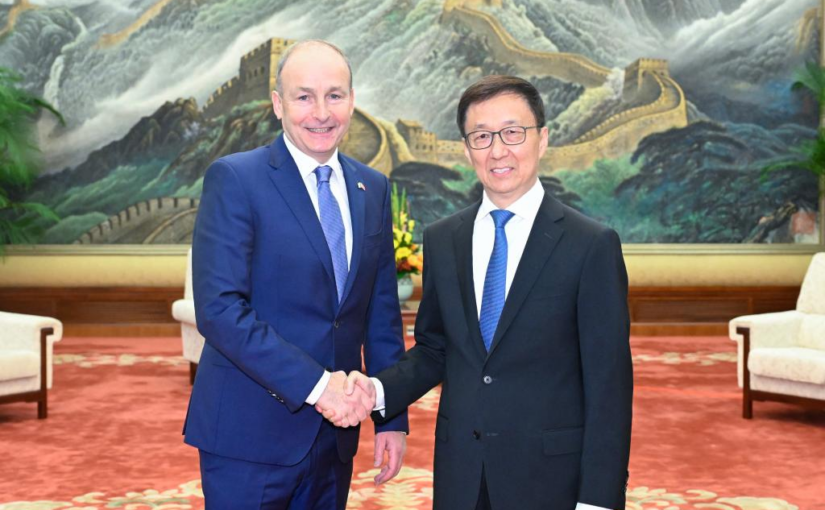
Friendly relations between Ireland and China have been reinforced with a visit by Micheál Martin, Ireland’s Tánaiste (Deputy Prime Minister), Minister for Foreign Affairs, and Minister for Defence. Martin is also the leader of the Fianna Fáil party, one of the three parties in Ireland’s coalition government.

Martin met with Chinese Vice President Han Zheng on November 6, who said that, under the strategic guidance and promotion of the leaders of the two countries, China and Ireland have become a good example of friendly coexistence and win-win cooperation between countries with different histories, cultures, and political systems. Han added that to develop China-Ireland relations, the foundation is solid and the conditions are sound.

Next year marks the 45th anniversary of the establishment of diplomatic ties between China and Ireland. The two sides should consolidate political mutual trust, tap the potential of practical cooperation, strengthen public support for friendship, and work together to push for new achievements in China-Ireland mutually beneficial strategic partnerships.

For his part, Martin said that Ireland and China enjoy profound friendship, and cooperation in various fields has expanded in recent years. Ireland is willing to take next year’s 45th anniversary of diplomatic ties between Ireland and China as an opportunity to strengthen exchanges with China in various fields.

The following day, at the request of the Irish side, Martin, who also met with Foreign Minister Wang Yi during his stay, met with Liu Jianchao, Minister of the International Department of the Communist Party of China (CPC) International Department (IDCPC). 

Martin said, Ireland-China friendship has a long history. The Irish side attaches importance to developing relations with China, regards China as an important partner, and hopes to strengthen exchanges and cooperation between the two countries in economy, trade, people-to-people exchanges, agriculture and other fields. As an EU member state, the Irish side is committed to developing robust EU-China relations, adheres to free and open economic policies, opposes “decoupling” from China, and hopes to promote closer cooperation between the EU and China in areas such as climate change and sustainable development. 

Liu said that the CPC attaches importance to maintaining various forms of exchanges with major political parties such as the Fianna Fáil and is willing to enhance understanding and mutual trust and promote the further development of China-Ireland strategic partnership for mutually beneficial cooperation. 

In a fascinating article by its China correspondent Denis Staunton, published on November 8, the Irish Times, Ireland’s most prestigious daily newspaper, reported on the Tánaiste’s visit to the Beijing Foreign Studies University (BFSU), home to an Irish Studies Centre, which is China’s comprehensive, multi-disciplinary institute in this field.

Reflecting China’s great interest in Ireland and Irish studies, and the country’s great respect for small nations and the great diversity of human civilisations, BFSU, which is one of China’s most prestigious universities, teaches 101 languages and has educated generations of the country’s diplomats, including three former ambassadors to Ireland. The Irish Studies Centre’s programmes cover Irish language, literature, culture, history, politics, and international relations and one of its senior figures, Wang Zhanpeng, is an expert on Brexit.

Staunton reported Zhang Junhan, one of the centres’s lecturers in the Irish language as saying: “Some of the students [who had turned out to greet Martin] are postgraduates from the Irish Studies Centre and the Gaeilge [the Irish language] is one of the modules they must take because we think it’s a source for them to understand Irish culture and society more deeply. There’s another bunch of graduate students from all over the university, from the law school, the business school, other language faculties. They study Irish as an optional module only because they are interested in this language and this country.”

Staunton’s report added: “Last December, Wang [Zhanpeng] and the centre’s director Chen Li went to Dublin to receive the Presidential Distinguished Service Award. Chen has done more to promote Irish writing in China than any other individual, introducing writers such as Anne Enright and Colin Barrett who are now translated into Chinese, alongside many others including John Banville, Colm Tóibín and Sally Rooney.”

He also noted that Martin had been greeted with the performance on the whistle, flute and bodhrán of a number of famous Irish songs and musical pieces. They included The Foggy Dew, one of Ireland’s most famous rebel songs. It can be seen here performed by The Wolfe Tones, the legendary Irish rebel group who this year celebrate their 60th anniversary.

The following reports were originally published by the Xinhua News Agency and on the IDCPC website.

Chinese VP meets Irish deputy PM

BEIJING, Nov. 6 (Xinhua) — Chinese Vice President Han Zheng met with Micheal Martin, Deputy Prime Minister and Minister for Foreign Affairs of Ireland, in Beijing on Monday.

Under the strategic guidance and promotion of the leaders of the two countries, China and Ireland have become a good example of friendly coexistence and win-win cooperation between countries with different histories, cultures, and political systems, Han said, adding that to develop China-Ireland relations, the foundation is solid and conditions sound.

Next year marks the 45th anniversary of the establishment of diplomatic ties between China and Ireland. The two sides should consolidate political mutual trust, tap the potential of practical cooperation, strengthen public support for friendship, and work together to push for new achievements in China-Ireland mutually beneficial strategic partnerships, said Han.

Continue reading Friendly Ireland-China relations reinforced with visit by Tánaiste Micheál Martin
Clare Daly: ‘derisking’ from China would be suicidal for European industry

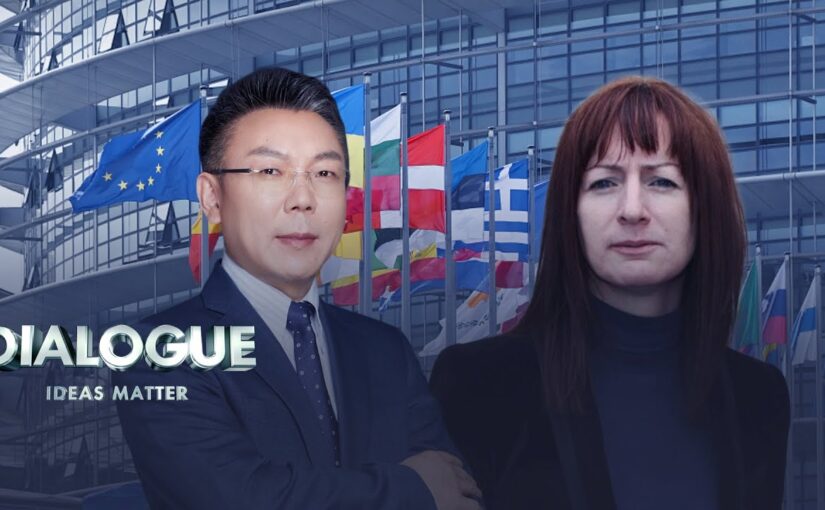
In this episode of the CGTN program Dialogue, Xu Qinduo interviews Clare Daly, the outspoken, anti-imperialist member of the European Parliament (MEP) from Ireland on the EU’s attitude towards the conflicts in Gaza and Ukraine, as well as on China.

Clare notes that the recent resolution on Gaza adopted by the European parliament, which she and her colleague Mick Wallace voted against, did not address the root causes of the conflict or the crimes, including ethnic cleansing and genocide, perpetrated by the Israeli apartheid state. The EU and the United States, she notes, are complicit in Israeli genocide and that makes them equally culpable in international law.

On Ukraine, she is not presently hopeful of prospects for peace. Rather she fears that working class Ukrainian men will continue to be killed in the interests of western arms companies who seek to perpetuate the conflict. 

Asked about the moves to expand NATO to Asia, possibly starting with the establishment of an office in Tokyo, Clare responds that she has said before that the last bite of a dying snake is the most dangerous. US hegemony is in decline and there is no going back on this. But in its lashing out in desperation it is very dangerous. In this regard, she cites President Biden’s recent demand for US$100 bn for not only Israel and Ukraine but Taiwan as well. She feels that the US managed to provoke Russia and now seeks to do the same to China over Taiwan. However, she believes that Chinese diplomacy is more measured and the country will not walk into a similar trap.

Asked what impressed her most on her recent visit to China, she says there is not enough time to recount all the amazing things she saw. China, she notes, has built whole cities, but in Dublin it has not been possible to build even one metro station in 30 years. Ireland does not have a single high-speed train and neither does the US. Unfortunately, the EU has been following the US in seeking to restrict relations with China under the guise of ‘derisking’ and similar terms. Such a policy, she notes, if followed through, would be suicidal for European industry. In the face of these provocations, Clare advises China to continue with its diplomatic overtures and says she can think of nothing that China should be doing differently.

Within this situation, Clare asserts that Ireland has a special role to play. The EU is largely made up of former colonising powers or former socialist countries. Ireland, however, was colonised. It knows what it is like to be oppressed. Therefore, Ireland can be a voice for neutrality, non-alignment, multilateral cooperation and international solidarity.

The full interview with Clare Daly MEP is embedded below.

Ireland’s neutrality is at stake

In this article, originally published by Socialist Voice, Jimmy Corcoran, who is the General Secretary of the Communist Party of Ireland (CPI), takes up the new and increasing danger to what remains of Irish neutrality.

Neutrality is enshrined in the Irish constitution, but has been considerably undermined over recent years. That process has been further expedited with both the conflict in Ukraine and the new cold war against China, despite the principled position in defence of neutrality put forward by Irish President Michael D Higgins.

So far, Higgins’ public stance has prevented a formal application for NATO membership, but Micheál Martin, leader of the Fianna Fáil party and Tánaiste (Deputy Prime Minister), Minister for Foreign Affairs, and Minister for Defence in the Irish government, is now seeking to weaken the constraints on the deployment of Irish troops overseas as a thin end of the wedge. Hitherto, Irish troops have essentially been confined to United Nations peacekeeping duties overseas.

Corcoran notes that: “In the event of Sinn Féin becoming the major party in the next 26-County government [as is currently highly likely] they will be faced with this pro-imperialist bias [on the part of the Irish ruling class].”

The possibility of a revision or modification in Sinn Féin’s historically strong position on neutrality is currently a matter of public debate both within and outside the party. The CPI General Secretary poses the questions: “How will they react? Will they remain true to their anti-colonial and anti-imperialist tradition, or will they don the Atlanticist clothing of official Ireland?”

His article continues:

“They need to look beyond the world of US, EU and British imperialism towards the developing world. The Chinese share of the world economy is growing, while that of the United States is in relative decline. China is the main trading partner of more than 150 countries. Unlike Ireland, when China embarked on its path of modernising its economy the state remained in control, and it lifted 800 million people out of absolute poverty.”

Making an important call to Sinn Féin, Corcoran concludes:

“One doesn’t have to accept China’s self-designation as a socialist society to recognise that its development strategy has produced far better results than that pursued by the Irish ruling class since the late 1950s. If a Sinn Féin-led government is to develop Irish political and economic sovereignty and tilt the balance of forces towards the working class, it will need to counter the arguments of the Atlanticists. It could start by sending a high-level delegation to the People’s Republic of China to look at its path to modernisation and see what can be adapted to Irish conditions.”

The threat to completely abandon what remains of Irish neutrality is a continuing and increasing one. The recent intervention of President Higgins may have slowed down Micheál Martin’s march to NATO, but the threat remains.

Rather than applying for NATO membership immediately, the ruling class have set their sights as an interim step on removing the “triple lock” on the deployment of Irish troops. The capitalist parties and media claim that the triple lock is no longer tenable, because both Russia and China have a veto in the Security Council, which they can use to stop military aggression by the United States and its satellites. This ignores the fact that three NATO members—the United States, Britain, and France—also have a veto, which they use to protect imperialist aggression. The United States uses its veto against any condemnation of apartheid Israel’s continued colonisation in Palestine.

The report of the Commission on the Defence Forces demonstrates the continuing EU threat to Irish neutrality and sovereignty. It cites the EU Commission’s position that the rise of China must be seen as a threat to EU security.¹ This is reinforced regularly in the “news” media, to the extent that one would imagine that the Chinese military lie just over the horizon. The real political situation in Ireland consists of British (NATO) forces in the Six Counties and a US (NATO) base in Shannon Airport.

The Atlanticist ideology is deeply ingrained in the political class, the media, the higher echelons of the civil service, and the officer corps of the Defence Forces. Irish politicians and “journalists” ape the NATO line that China, Russia, Cuba, North Korea, Nicaragua and Venezuela are a threat to the “rules-based order” upon which “our” economic, political and military security is based.

But exactly what are these rules, who drafted them, and who approved them? Despite what many people may believe, the aforementioned rules are not the UN Charter or the various international agreements drafted under the aegis of the United Nations, or regional bodies such as the Council of Europe (not to be confused with the EU’s European Council) and then agreed by individual member-states: the “rules-based order” amounts to no more than the United States assuming the right to determine the economic and political path of all countries.

Any country that seeks to break with imperialism is automatically held to be in breach of the rules; and the United States reserves the right to punish them by economic or military intervention, or both.

In the event of Sinn Féin becoming the major party in the next 26-County government they will be faced with this pro-imperialist bias. How will they react? Will they remain true to their anti-colonial and anti-imperialist tradition, or will they don the Atlanticist clothing of official Ireland? The realpolitik gurus within the party will no doubt urge them to accept the Atlanticist position (they already have a welcome in the White House), as they will need the tax from American corporations to implement their social policies.

However, they need to look beyond the world of US, EU and British imperialism towards the developing world. The Chinese share of the world economy is growing, while that of the United States is in relative decline. China is the main trading partner of more than 150 countries. Unlike Ireland, when China embarked on its path of modernising its economy the state remained in control, and it lifted 800 million people out of absolute poverty.² It has an internal economy of 1.4 billion people, and government policies are concentrated on increasing the purchasing power of the poorest sections over the next decade. China spends far less on its military than the United States does; and China has not been at war for more than forty years.

One doesn’t have to accept China’s self-designation as a socialist society to recognise that its development strategy has produced far better results than that pursued by the Irish ruling class since the late 1950s. If a Sinn Féin-led government is to develop Irish political and economic sovereignty and tilt the balance of forces towards the working class, it will need to counter the arguments of the Atlanticists. It could start by sending a high-level delegation to the People’s Republic of China to look at its path to modernisation and see what can be adapted to Irish conditions. They would also see that China has no material benefit to gain from war, but that on the contrary a war could set its development back decades.

  1. Report of the Commission on the Defence Forces (2022), p. 6.
  2. World Bank press statement, 1 April 2022.