In the following article, Friends of Socialist China co-editor Carlos Martinez responds to a recent Jacobin book review which presents China’s economic rise as a simple story of “brutal exploitation” indistinguishable from the horrors of Britain’s industrial revolution.
While not doubting the hardships described in the book under review, Carlos argues that Jacobin’s framing is ahistorical and idealist. China’s growth has not merely enriched a class of capitalists but transformed the lives of the majority, lifting hundreds of millions out of poverty and improving working class wages and conditions at an extraordinary pace.
The book review essentially compares China with an imagined socialist utopia, rather than comparing China with other destinations of outsourced production – where wages are lower, repression harsher, and no comparable rise in living standards is on offer.
Drawing on Friedrich Engels, Deng Xiaoping, Michael Parenti and John Smith, the article shows how China’s socialist land ownership system has protected living standards for hundreds of millions, and how the state is working to expand protections for workers in the “gig economy”. The article concludes:
At a moment when China is the largest and most developed socialist country on earth; when it is the leading proponent of a multipolar world order; and when it is the target of a systematic propaganda war designed to manufacture consent for a New Cold War (and ultimately hot war), for self-described socialists and anti-imperialists to offer this kind of context-free condemnation is, to say the least, deeply unhelpful.
Jacobin has published a review by Daniel Cheng of Adrift in the South, the memoir of the Chinese worker-poet Xiao Hai, detailing the harsh conditions he faced as a migrant worker in the megacities of southern China.
The book itself sounds interesting and worthwhile, and there is no reason to doubt the harshness of the conditions Xiao Hai describes. But the frame the review wraps around his story – that China’s economic miracle was “made possible by the brutal exploitation of millions of workers”, and that China’s development and the dark satanic mills of Britain’s industrialisation can be comfortably placed together in a category of “the universal suffering of capitalism” – is ahistorical, idealist, and, in the present geopolitical conjuncture, actively unhelpful.
Exploitation has to be contextualised
The first thing to say is that China’s growth has not simply enriched a class of capitalists. It has transformed the lives of the great majority. Over the past half-century, China has lifted an estimated 800 million people out of extreme poverty – by the World Bank’s own reckoning, more than three-quarters of the entire reduction in global poverty over the same period. Chinese workers and farmers today live longer, eat better, are far better educated and enjoy a level of material security their grandparents could barely have imagined.
Manufacturing wages roughly trebled between 2005 and 2016, and real wages have continued to climb at an impressive clip. The rate of exploitation of Chinese labour has been falling, not rising.
That is the context in which “brutal exploitation” must be understood. The phrase conjures a process whereby the many are ground down so that the few may prosper. What actually happened is closer to the opposite: vast numbers of people worked very hard, in difficult conditions, in a process that has lifted the whole of society. Daniel Cheng himself half-concedes the point when he writes that “workers face exploitative conditions all over the Global South in countries that have not enjoyed China’s miraculous levels of growth”. Quite so. The exploitation is not the distinguishing feature; the shared and rising prosperity is.
Indeed, the most extreme exploitation in the world economy is concentrated precisely in the countries that have not followed China’s path. In Imperialism in the Twenty-First Century, John Smith describes how the good health of global capitalism “rests on extreme rates of exploitation of workers in the low-wage countries where production of consumer goods and intermediate inputs has been relocated”. His central example is Bangladesh – the lowest factory wages of any major exporter, garment workers whose union activists are “routinely blacklisted, beaten up, and subject to arbitrary arrest”, and an industry in which no employer “has ever been convicted of an infringement of health and safety laws”.
That is the comparison the review needs and never makes: not between China and an imagined socialist utopia, but between China and the other destinations of outsourced production, where wages are lower, repression is harsher, and no commensurate rise in living standards is on offer.
Meanwhile, workers’ pay and conditions in China are improving continuously, and that improvement is driven by, and enforced at, every level of government, precisely because the Chinese state is not an instrument of capital; which is to say, because China is not a capitalist country.
A tale of two urbanisations
“In the cities”, Cheng writes, migrant workers “searched for an escape from rural poverty but encountered the horrors of industrial capitalism”.
Consider for a moment what they did not encounter. Across the rest of the Global South, large-scale urbanisation has invariably meant the explosion of slums: Mumbai, Lagos, Dhaka, São Paulo and Manila are ringed by vast informal settlements, and slum growth has outpaced urbanisation across the developing world since the 1970s. More than 600 million Chinese people have moved from countryside to city over the last half-century, and yet China has avoided this fate. Walk through Beijing or Shanghai, each home to more than twenty million people, and the pervasive slums and street homelessness of comparably sized cities elsewhere are conspicuously absent.
This is not a matter of accident or good fortune; it is the product of conscious planning, and above all of a land system that was never privatised. Because rural land remains collectively owned, with use rights allocated to households, China’s migrant workers never lost their stake in the village. This is the decisive difference between a Chinese migrant worker and his or her counterpart in South Asia. The Chinese worker is not trapped in debt bondage and is not one missed wage from destitution, because there is always a home and a plot of land to return to. When the 2008 crisis cost more than 20 million migrants their jobs, they were not cast onto the streets; they went home.
Friedrich Engels grasped why this matters. The proletarian, he observed in The Condition of the Working Class in England, is more exposed than even the bondsman of earlier epochs: “The slave is assured of a bare livelihood by the self-interest of his master, the serf has at least a scrap of land on which to live … but the proletarian must depend upon himself alone”.
By refusing to privatise rural land, China ensured that its migrant workers, unlike the dispossessed proletarians of early industrial Britain, never lost that “scrap of land”. China’s home-ownership rate exceeds 90 percent – a figure barely conceivable in the advanced capitalist countries of the West, never mind in the slum-ringed metropolises of the Global South.
So while the relative poverty Cheng describes is real, it is markedly less than that endured by workers elsewhere in the developing world, and that difference is structural and socialist in origin.
What the review leaves out
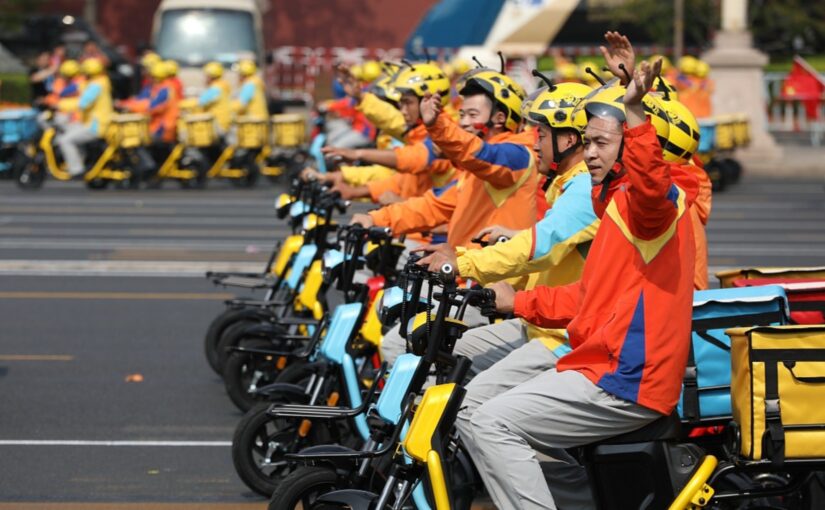
Xiao Hai’s hardest passages concern gig work – the delivery rider fined for a late package, uninsured, paying off a motorist in cash to avoid the police. It is striking, then, that the review makes no mention of the policies now being directed at exactly this layer of workers.
In 2026 China’s highest bodies, the CPC Central Committee and the State Council, issued new guidelines mandating standardised contracts, minimum pay, maximum hours, social insurance and algorithmic transparency for more than two hundred million workers in the platform economy. Food delivery platforms are being required to guarantee riders an income above the minimum wage, to provide insurance, and to relax the punishing delivery deadlines.
The recent hukou reform extends social insurance to migrant workers in the cities where they actually work. The trajectory is the precise opposite of the one in Britain and the United States, where companies such as Uber and Deliveroo have spent fortunes in the courts to deny their workers the status of employees at all.
To review a book about Chinese gig workers and omit the fact that the Chinese state is moving to protect them is to leave out the most important part of the story.
The difference between Shenzhen and Manchester
The review’s emotional centre is the comparison with the industrial revolution: the phosphorus of Manchester’s match factories and the toxins of Shenzhen’s screen printers “both poisoned their workers”, and Marx’s Capital and Xiao Hai’s memoir describe the same labour alienation. But the comparison collapses on contact with the historical record.
The workers of Engels’ Manchester did not see their lives improve rapidly over a few decades. They died young – Edwin Chadwick’s 1842 sanitary report put the average age at death of labourers and mechanics in Manchester at just 17, against 38 for the local gentry and professional classes – and they had no public healthcare, no guaranteed housing, no universal education. More than 57 percent of working-class children in Manchester, Engels recorded, died before their fifth birthday.
Engels refused to treat this as the neutral price of progress, naming it instead “social murder” – the condition in which society “deprives thousands of the necessaries of life, places them under conditions in which they cannot live … knows that these thousands of victims must perish, and yet permits these conditions to remain”.
The Chinese worker who slices a finger has access to a public health system; everyone in China today has guaranteed food, housing, clothing, education, healthcare, clean water and modern energy. That is not a quantitative difference in degree of suffering. It is a qualitative difference in the nature of the society: the difference between a state oriented towards the pursuit of private profit at all costs and one oriented – however imperfectly – towards common prosperity.
There is a second point Jacobin’s comparison erases. Britain was the world’s foremost colonial power, and the riches of its industrial revolution were inseparable from the plunder of India, the Atlantic slave trade and the looting of half the globe. Insofar as the British working class eventually won better conditions, this was to a significant extent facilitated by crumbs from the imperial table – the super-exploitation of the colonies. China’s rise has involved no colonies and no empire. It has lifted itself by its own efforts, against the grain of an imperialist world system, not by feeding off the subjugation of others.
Why China?
“Under capitalism, our cultures are increasingly similar”, the review concludes. If that were the whole story – if China were just another capitalist society passing through a phase Britain passed through two centuries ago – we would have to explain a series of awkward facts.
Why is it China, and not the dozens of other developing countries integrated into global capitalism on far harsher terms, that has eliminated extreme poverty? That has all but abolished homelessness? That has become the world’s only green-energy superpower, with more installed wind and solar capacity than the rest of the world combined and three-quarters of all the large-scale wind and solar under construction anywhere on earth? That has climbed to the summit of science and technology – and done so outside the framework of the imperialist world order?
These are not the achievements of a society indistinguishable from any other capitalist one. They are the achievements of a country where the state is not subordinated to capital, where the economy is planned and directed, where the fruits of growth are shared, and where the development of productive forces is consciously pursued as a national project. In short, they are the achievements of socialism.
Pure socialism is pure idealism
What the review offers, in the end, is an example of what Michael Parenti called “pure socialism”: measuring actually existing socialist construction not against the real alternatives available to a poor, encircled, formerly colonised or semi-colonised country, but against an imagined frictionless utopia.
As Parenti put it in Blackshirts and Reds, this “pure socialism” view “is ahistorical and nonfalsifiable; it cannot be tested against the actualities of history. It compares an ideal against an imperfect reality, and the reality comes off a poor second”. Its adherents, he observed, “support every revolution except the ones that succeed”.
Held to an impossible standard, every actual socialist project is found wanting. But this is idealism, not materialism. It abstracts away from imperialist encirclement, from the level of development of the productive forces, from the actual balance of class forces – the very things a Marxist analysis is supposed to address.
“There can be no communism with pauperism”, Deng Xiaoping told the American journalist Mike Wallace in 1986, “or socialism with pauperism … We permit some people and some regions to become prosperous first, for the purpose of achieving common prosperity faster”. The current common prosperity drive, and the new protections for the lowest-paid and most precarious workers, represent that principle being applied in earnest – the second half of Deng’s formula beginning to operate, as those who got rich first have a responsibility to help the rest catch up.
None of this means Xiao Hai’s pain should be waved away, or that China is without contradictions and injustices; that would be another form of idealism. It is rather to insist that China’s problems be understood in their historical and political context.
At a moment when China is the largest and most developed socialist country on earth; when it is the leading proponent of a multipolar world order; and when it is the target of a systematic propaganda war designed to manufacture consent for a New Cold War (and ultimately hot war), for self-described socialists and anti-imperialists to offer this kind of context-free condemnation is, to say the least, deeply unhelpful.






I hope Jacobin will read this excellent article.
Great debunking of Jacobin. The question remains why not calling out Jacobin and saying what it is – pseudo progressive fake socialist and a liberal bourgeois outlet.
True, these are people who call themselves socialists, criticize capitalism, but don’t want it overthrown.
Criticism can be varied, from constructive to ulterior motives.
I’m curious how today’s People’s Republic of China would react to the socialist revolution in the United States (I know it sounds improbable, but then again, history isn’t over yet).
As a boy, I recall reading in LOOK Magazine (we still had LOOK back then) a story about development in rural China. The most astounding photo for me showed an endless line of peasants loaded with straw baskets full of dirt trudging up to dump their loads and make a dam. Of course, a few bulldozers would have done the job right away (I have watched them do so), but China did not have those bulldozers.
I also read about China’s industrial development since 1949 when I was in university. Workers struggled in poor conditions to make goods for exports—but not only did they receive capital in exchange, they also earned the rights of the technology the foreign factories used, so they could replicate it for themselves.
In short, China sacrificed generations to bring to fruit the China we now see and admire.