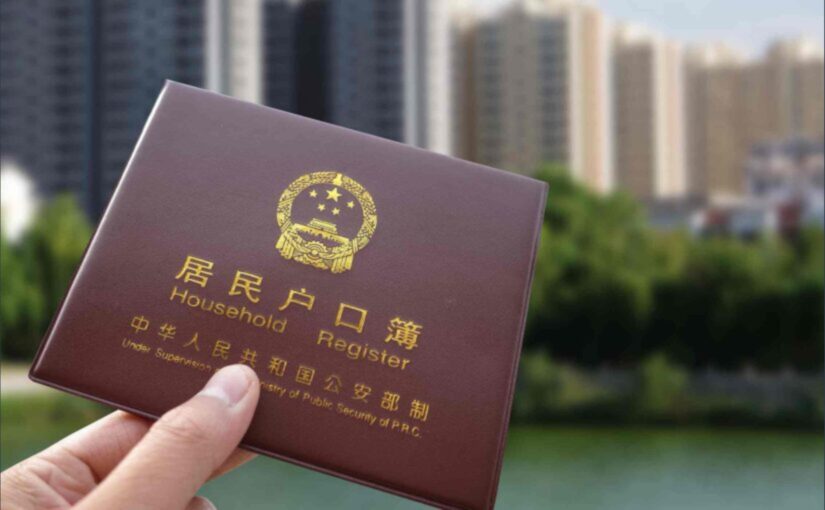
On Friday 22 May, China’s State Council announced a significant reform to the country’s social insurance system: migrant workers will now be able to enrol in social insurance in the cities where they work, regardless of where their household is officially registered. It is the latest step in the gradual reform of the hukou household registration system – and it extends coverage to hundreds of millions of internal migrants, including the growing ranks of gig-economy workers.
The hukou system is widely misunderstood in the West, where it is typically presented as a simple instrument of repression. In the following article, our co-editor Carlos Martinez explains what the hukou system is, traces the decade-long process of reform of which the latest announcement is part, and explains the system’s historical function: combined with collective land ownership, it allowed China to urbanise on a staggering scale, moving over 600 million people from countryside to city, without producing the vast slums that have ringed the hypercities of the capitalist Global South.
Carlos then sets out why reform has now become both possible and necessary, and draws a pointed contrast with the West, where the gig-economy giants are fighting to strip their workers of basic protections even as China moves to extend them. The dismantling of hukou barriers, he argues, ultimately reflects a system oriented towards human welfare rather than private profit.
On Friday 22 May, China’s State Council announced a significant reform to the country’s social insurance system: migrant workers will now be able to enrol in social insurance programs in the cities where they are employed, regardless of where their household is officially registered.
The new measures also commit the authorities to refining the mechanisms for transferring and continuing social insurance entitlements as workers move between regions – a long-standing headache for one of the most mobile workforces on earth. According to census data released the same day, China’s migrant population has now surpassed 357 million.
For decades, the household registration (hukou) system tied access to public services to a person’s place of registration, restricting the provision of healthcare, schooling and social insurance in the cities where migrant workers resided. The new policy severs that link for social insurance, extending coverage to the hundreds of millions of internal migrants – including the ranks of gig-economy workers: ride-hailing drivers, delivery couriers, and other platform-based workers.
Part of a longer process
This is not a sudden break but the latest step in a process of gradual reform of the hukou system stretching back more than a decade.
In 2014, the Central Leading Group for Comprehensively Deepening Reform set a target of resettling 100 million rural migrants in urban areas by 2020. Since then, at least 18 provinces have relaxed their registration restrictions.
The National Development and Reform Commission has progressively removed hukou limits in cities with populations under three million, eased registration in cities of three to five million, and optimised the points-based systems that govern access in the megacities.
The current reform directly advances commitments made at the July 2024 third plenum of the 20th Central Committee, and a joint Party–State Council document last year explicitly called for the “full removal of hukou restrictions on participation in social insurance at the place of employment”. Friday’s announcement delivers on that promise.
What is the hukou system?
The household registration system in its modern form was introduced in 1958, albeit China has had some form of migration regulation in place for over two thousand years. Every citizen is assigned an urban or rural registration status, which historically determined their access to a bundle of social welfare provisions – subsidised housing, education, healthcare, pensions and unemployment insurance – in their place of registration.
Crucially, those entitlements did not travel with the worker. A rural-registered migrant working in Shanghai or Shenzhen could spend decades contributing to the urban economy while remaining formally entitled to services only in a home village hundreds of miles away.
How the hukou system prevented chaos and slums
It is impossible to understand the hukou system without understanding what it prevented. When Reform and Opening Up began in the late 1970s, 83 percent of China’s population lived in the countryside. Over the following four decades, more than 600 million people moved from rural areas to the cities, such that the urbanisation rate has now hit 68 percent.
In almost every other developing country, migration on this scale has produced vast slums: the hypercities of the Global South – Mumbai, Nairobi, Lagos, São Paulo, Dhaka, Cairo, Mexico City – are ringed by sprawling informal settlements, and across the Global South slum growth has consistently outpaced urbanisation since the 1970s.
China has managed to avoid this. Walk through Shanghai or Beijing – each with over 20 million inhabitants – and the pervasive slums and homelessness common to comparably-sized cities elsewhere are conspicuously absent. The hukou system was central to this achievement: by regulating the pace and direction of migration, it prevented a chaotic flood into a handful of megacities whose services and housing could not have coped.
Equally important was land reform. Because the socialist land system was never privatised – rural land remains collectively owned, with use rights allocated to households – rural migrants never lost their entitlement to land and housing in their home villages. This created an immensely important structural buffer. When the 2008 financial crisis cost some 30 million migrant workers their jobs practically overnight, they were not cast into urban destitution; they returned to their home villages where they had land and housing.
China today has a home-ownership rate exceeding 90 percent – a figure inconceivable in the slum-ringed cities of capitalist development.
Why reform is necessary
If the hukou system was well adapted to an era of scarcity and rapid industrialisation, the conditions that made it expedient are now changing, and a system that once aided China’s development risks becoming a brake on it.
First, there is the obvious question of equality and fairness. Nearly 70 percent of China’s population now lives in cities, but only some 45 percent hold urban hukou, representing a gap of over 100 million people. The system has reinforced a two-tier urban society and produced painful social costs, most visibly the millions of “left-behind children” raised by grandparents while their parents work in distant cities. For a socialist country committed to common prosperity, this has long been a contradiction that the government has been working to resolve.
Second, there is an important economic factor. Migrant workers denied access to urban services have held back on consumption, saving heavily against the risk of illness or unemployment. As China attempts to stimulate greater domestic consumption, freeing up that suppressed spending power is a strategic priority. Extending social insurance to where people actually work directly serves the goal of expanding the middle income group and boosting domestic demand.
Third, there are the demographic and developmental imperatives. China’s future depends on a highly educated workforce, which means universal access to quality schooling regardless of registration. And as the country confronts a falling birth rate, lifting the burdens of education and healthcare costs from young working families is one lever available to encourage them to have children.
Finally, the reform serves the construction of a unified national market – removing barriers to the free flow of labour and talent across the country.
The hukou system performed a real historical function: it allowed China to urbanise on an unprecedented scale without the slums, destitution and social breakdown that have accompanied capitalist development across the Global South. That it is now being progressively dismantled is not a repudiation of that achievement but a recognition that China has entered a new stage of development, one in which the equalisation of social provision, rather than the regulation of scarcity, is the order of the day.
Diverging paths
The contrast with the trajectory of the Western capitalism is stark. While China is moving to extend social insurance to – and improve pay and conditions for – its couriers, drivers and other platform workers, the dominant trend in the West runs in precisely the opposite direction.
In Britain and the US, the gig-economy giants have waged a sustained legal and political campaign to deny their workers the status of employees altogether – the better to avoid paying for sick leave, pensions, holiday pay or even the minimum wage.
Uber fought all the way to the UK Supreme Court in 2021 in an unsuccessful attempt to classify its drivers as self-employed; Deliveroo riders were denied collective bargaining rights by the same court in 2023; and in California, the gig companies spent over $200 million on a 2020 ballot measure, Proposition 22 – the most expensive in the state’s history – specifically to exempt themselves from treating their drivers as employees.
Where the logic of a socialist system, even amid the complexities of a vast developing economy, pushes over time towards the extension of social protection to all working people, the logic of capital pushes relentlessly in the other direction: towards the erosion of those protections in the name of profit.
The steady dismantling of hukou barriers is, in the final analysis, a reflection of a system oriented towards human welfare rather than private accumulation.






This is a really positive development. It’s about time the hukou system started to address these inequalities for migrant workers.