With the patient mediation of Pakistan, Iran and the United States of America agreed a Memorandum of Understanding (MoU) on June 14-15. This represents a significant victory for the government and people of Iran in their courageous struggle against US imperialism and its various proxies, including the Israeli Zionist regime, not only since the launch of the unprovoked war of aggression on February 28, 2026, but also since the victory of the Islamic Revolution in January 1978 and for decades before that.
Key points of the MoU include:
- The United States of America and the Islamic Republic of Iran and their allies in the current war by signing this MoU, declare the immediate and permanent termination of military operations on all fronts, including in Lebanon, and undertake from now on not to initiate any war or any military operation against each other, and to refrain from the threat or use of force against each other, and ensuring the territorial integrity and sovereignty of Lebanon.
- The United States of America and the Islamic Republic of Iran undertake to respect each other’s sovereignty and territorial integrity and to refrain from interfering in each other’s internal affairs.
- The United States of America further undertakes to remove its forces from the proximity of the Islamic Republic of Iran within 30 days after the final deal.
- Upon the signing of this MoU, the Islamic Republic of Iran will make arrangements using its best efforts for the safe passage of commercial vessels with no charge for 60 days only from the Persian Gulf to the Sea of Oman and vice versa… The Islamic Republic of Iran will conduct dialogue with the Sultanate of Oman to define the future administration and maritime services in the Strait of Hormuz in discussion with other Persian Gulf littoral states in line with the applicable international law and the sovereign rights of coastal states of the Strait of Hormuz.
- The United States of America undertakes with regional partners to develop a definitive, mutually agreed plan with at least $300 billion for the reconstruction and economic development of the Islamic Republic of Iran.
- The United States of America undertakes to terminate all types of sanctions against the Islamic Republic of Iran, including the United Nations Security Council resolutions, i.e. IAEA Board of Governors resolutions and all unilateral US sanctions, primary and secondary, in an agreed-upon schedule as part of the final deal.
- Pending the final deal, the United States of America and the Islamic Republic of Iran agree to maintain the status quo. The Islamic Republic of Iran will maintain the current status quo of its nuclear program, and the United States of America will not impose any new sanctions and will not deploy additional forces in the region.
- The United States of America undertakes that immediately upon the signing of this MoU until the termination of sanctions, the US Department of Treasury will issue waivers for the export of Iranian crude oil, petroleum products and derivatives, and all associated services, including banking transactions, insurances, transportation, etc.
- The United States of America undertakes to make fully available for use the frozen or restricted funds and assets of the Islamic Republic of Iran upon the implementation of this MoU.
- The final deal will be endorsed by a binding UN Security Council resolution.
- The United States of America and the Islamic Republic of Iran undertake to respect each other’s sovereignty and territorial integrity and to refrain from interfering in each other’s internal affairs.
- The United States of America further undertakes to remove its forces from the proximity of the Islamic Republic of Iran within 30 days after the final deal.
- Upon the signing of this MoU, the Islamic Republic of Iran will make arrangements using its best efforts for the safe passage of commercial vessels with no charge for 60 days only from the Persian Gulf to the Sea of Oman and vice versa… The Islamic Republic of Iran will conduct dialogue with the Sultanate of Oman to define the future administration and maritime services in the Strait of Hormuz in discussion with other Persian Gulf littoral states in line with the applicable international law and the sovereign rights of coastal states of the Strait of Hormuz.
- The United States of America undertakes with regional partners to develop a definitive, mutually agreed plan with at least $300 billion for the reconstruction and economic development of the Islamic Republic of Iran.
- The United States of America undertakes to terminate all types of sanctions against the Islamic Republic of Iran, including the United Nations Security Council resolutions, i.e. IAEA Board of Governors resolutions and all unilateral US sanctions, primary and secondary, in an agreed-upon schedule as part of the final deal.
- Pending the final deal, the United States of America and the Islamic Republic of Iran agree to maintain the status quo. The Islamic Republic of Iran will maintain the current status quo of its nuclear program, and the United States of America will not impose any new sanctions and will not deploy additional forces in the region.
- The United States of America undertakes that immediately upon the signing of this MoU until the termination of sanctions, the US Department of Treasury will issue waivers for the export of Iranian crude oil, petroleum products and derivatives, and all associated services, including banking transactions, insurances, transportation, etc.
- The United States of America undertakes to make fully available for use the frozen or restricted funds and assets of the Islamic Republic of Iran upon the implementation of this MoU.
- The final deal will be endorsed by a binding UN Security Council resolution.
(Emphases added by us – Eds.)
As the New York Times observed:
“It was less than 15 weeks ago when President Trump, at the height of his bravado about how the war with Iran would end, declared ‘there will be no deal with Iran except UNCONDITIONAL SURRENDER.’
“When the text of the deal intended to wind down the conflict was finally released on Wednesday, read aloud paragraph by paragraph by a senior administration official who stopped to defend each section, it read nothing like a surrender document. Instead, the Iranians emerged from a confrontation with the world’s most powerful military having not only survived, but with much to celebrate.”
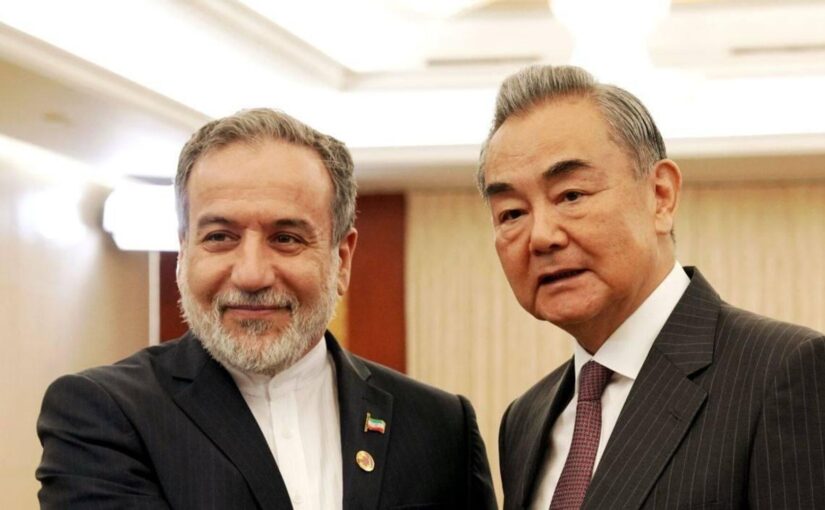
Following the agreement, on June 17, Member of the Political Bureau of the CPC Central Committee and Foreign Minister Wang Yi had a phone call with Iranian Foreign Minister Seyyed Abbas Araghchi.
Seyyed Abbas Araghchi briefed Wang Yi on the first-phase memorandum of understanding (MoU) reached between Iran and the United States and expressed sincere gratitude to China for its positive role in advancing the negotiations and concluding the agreement. He stated that the MoU should be implemented practically, including Israel’s halt to military operations against Lebanon. Iran consistently views its relations with China from a strategic perspective and looks forward to deepening mutual trust, expanding cooperation across all sectors, and jointly advancing the comprehensive strategic partnership between the two countries.
Wang Yi said China welcomes the conclusion of the first-phase MoU between Iran and the United States. Facts have proven that force and power politics cannot resolve disputes, and dialogue and negotiation represent the right path forward. As comprehensive strategic partners, China has always stood by Iran’s reasonable and legitimate propositions, supported Iran in safeguarding its sovereignty and security, backed mediation efforts by Pakistan and the international community, and consistently worked in China’s own way to end hostilities and promote peace. The dawn of peace has emerged. The priority going forward is for all parties to deliver earnestly on their commitments and fend off disturbances from all sides. China supports Iran’s efforts to improve relations with regional countries and explore the joint development of a regional security architecture.
Meanwhile, in Tehran, Iranian Parliament Speaker Mohammad Baqer Qalibaf stressed that Tehran is a “full-fledged” partner of China, emphasising the pivotal role the two countries would play in any emerging regional bloc.
Qalibaf, who also serves as Iran’s special representative for China affairs, made the remarks during a meeting with the Iranian Chamber of Commerce, highlighting the Islamic Republic’s significant potential to expand economic cooperation across the region and beyond.
“China is a unique country for us. We must, through our actions and approach, create the belief on the Chinese side (and they will believe) that Iran is not just a customer, but a full-fledged, reliable, and long-term partner for China,” Qalibaf said.
Iran’s Press TV noted: “Iran and China signed a landmark 25-year comprehensive strategic partnership agreement in March 2022, despite unilateral sanctions imposed on both countries by the United States.
“The agreement formally outlines long-term cooperation between Tehran and Beijing across political, cultural, security, defence, regional and international spheres, while reinforcing the Iran-China Comprehensive Strategic Partnership.”
On the evening of June 16, Wang Yi had held a telephone call with Pakistani Deputy Prime Minister and Foreign Minister Mohammad Ishaq Dar.
Mohammad Ishaq Dar briefed Wang Yi on the first-phase memorandum of understanding reached between Iran and the United States, and thanked China for maintaining close communication with Pakistan over the past few months and for its valuable support for Pakistan’s mediation efforts. Pakistan looks forward to continuing communication and coordination with China, sustaining the current momentum of peace talks, and jointly playing an active role in achieving lasting peace and stability in the region.
Wang Yi congratulated Pakistan on facilitating the first-phase MoU between Iran and the United States and stressed that working for peace is the international responsibility of all countries, including China and Pakistan. As long as there is hope for peace, it is worth the effort.
Wang Yi noted that the last leg of a journey marks the halfway point. The current consensus is far from an endpoint; it is a new starting point. Lasting peace in the Middle East and Gulf region still requires unremitting efforts from all parties. It is foreseeable that the second-phase negotiations will be even more difficult than the first phase. However, China believes that there should be no turning back, still less a resort to force again. The international community should provide further impetus to the Iran-US negotiations, and multilateral institutions such as the UN Security Council should also play a greater role. The Middle East has suffered greatly from the scourge of war, and its people deserve peace. China is ready to work with Pakistan to tirelessly promote peace and facilitate talks, and to make sustained efforts for the early restoration of peace, stability and development in the Middle East.
For his part, Special Envoy Zhai Jun of the Chinese Government on the Middle East Issue has begun a tour of regional countries to further the drive for peace.
From June 13-14, he visited Oman where he held separate meetings with Omani Foreign Minister Sayyid Badr bin Hamad bin Hamood Albusaidi and Undersecretary for Political Affairs of the Omani Foreign Ministry Sheikh Khalifa Alharthy and exchanged views on China-Oman bilateral relations and the current situation in the Middle East.
Zhai said that following the outbreak of the military conflict among the United States, Israel and Iran, China has maintained close communication with Oman and other Gulf countries in the Middle East to promote de-escalation and end hostilities. Guided by the spirit of the four-point proposal put forward by President Xi Jinping for safeguarding and promoting peace and stability in the Middle East, China aims to support regional countries in building a community of good-neighbourliness, development, security and cooperation.
He then visited Qatar, June 15-16.
During a meeting with Mohammed bin Abdulaziz Al-Khulaifi, the minister of state at Qatar’s Ministry of Foreign Affairs, Zhai said China welcomed the United States and Iran reaching agreement on a first-stage memorandum of understanding and praised Qatar and other countries for their efforts to end hostilities and seek peace. He called on all parties to adhere to the path of peace and resolve disputes through dialogue and negotiations.
Al-Khulaifi praised China’s efforts to ease regional tensions and said Qatar was ready to work with Beijing to safeguard security and stability in the Gulf region.
The following articles were originally published by CGTN, the website of the Chinese Foreign Ministry and Press TV.
Read the full text of the 14-point MoU between US and Iran
June 18 (CGTN) – Pakistani Prime Minister Shehbaz Sharif said on Thursday that a memorandum of understanding (MoU) between the United States and Iran has been electronically signed by the leaders of both countries and has entered into force with immediate effect.
Here is the full text of the 14-point MoU published by media outlets including Iran’s official news agency IRNA, CNN and Time Magazine:
- The United States of America and the Islamic Republic of Iran and their allies in the current war by signing this MoU, declare the immediate and permanent termination of military operations on all fronts, including in Lebanon, and undertake from now on not to initiate any war or any military operation against each other, and to refrain from the threat or use of force against each other, and ensuring the territorial integrity and sovereignty of Lebanon. Final deal will confirm the permanent termination of the war on all fronts, including in Lebanon, and other provisions of this paragraph.
- The United States of America and the Islamic Republic of Iran undertake to respect each other’s sovereignty and territorial integrity and to refrain from interfering in each other’s internal affairs.
- The United States of America and the Islamic Republic of Iran commit to negotiating and achieving the final deal in maximum 60 days, extendable with mutual consent.
- Immediately upon the signing of this MoU, the United States of America will begin the removal of its naval blockade and any disturbances or impediments against the Islamic Republic of Iran, and will fully end the naval blockade within 30 days. During this period, the traffic of vessels will be in proportion to the numbers of pre-war traffic being restored by the Islamic Republic of Iran. The United States of America further undertakes to remove its forces from the proximity of the Islamic Republic of Iran within 30 days after the final deal.
- Upon the signing of this MoU, the Islamic Republic of Iran will make arrangements using its best efforts for the safe passage of commercial vessels with no charge for 60 days only from the Persian Gulf to the Sea of Oman and vice versa. The traffic of commercial vessels will immediately start, and considering the need for removing the technical and military obstacles and demining by the Islamic Republic of Iran, will be instated within 30 days. The Islamic Republic of Iran will conduct dialogue with the Sultanate of Oman to define the future administration and maritime services in the Strait of Hormuz in discussion with other Persian Gulf littoral states in line with the applicable international law and the sovereign rights of coastal states of the Strait of Hormuz.
- The United States of America undertakes with regional partners to develop a definitive, mutually agreed plan with at least $300 billion for the reconstruction and economic development of the Islamic Republic of Iran. The mechanism for the implementation of this plan will be finalized as part of a final deal within 60 days. All required licenses, waivers and permissions needed for the relevant financial transactions will be granted by the United States of America.
- The United States of America undertakes to terminate all types of sanctions against the Islamic Republic of Iran, including the United Nations Security Council resolutions, i.e. IAEA Board of Governors resolutions and all unilateral US sanctions, primary and secondary, in an agreed-upon schedule as part of the final deal. The Islamic Republic of Iran and the United States of America acknowledge the critical importance of the sanctions-termination issue abovementioned, and expressed their intentions to immediately address these issues in the negotiations, in order to achieve mutual agreement on them.
- The Islamic Republic of Iran reaffirms that it shall not procure or develop nuclear weapons. The United States of America and the Islamic Republic of Iran have agreed to resolve the disposition of stockpiled enriched material, pursuant to a mechanism that will be mutually agreed upon in accordance with the schedule mentioned in Paragraph Seven, with the minimum methodology to be downblending on site under the supervision of the IAEA. The two parties also agreed to discuss the issue of enrichment and other mutually agreed matters related to the Islamic Republic of Iran’s nuclear needs based on a satisfactory framework being agreed upon in the final deal. The final deal will confirm the provisions of this paragraph. The United States of America and the Islamic Republic of Iran acknowledge the critical importance of the nuclear issues abovementioned and express their intention to immediately address these issues in the negotiations in order to achieve mutual agreement on them.
- Pending the final deal, the United States of America and the Islamic Republic of Iran agree to maintain the status quo. The Islamic Republic of Iran will maintain the current status quo of its nuclear program, and the United States of America will not impose any new sanctions and will not deploy additional forces in the region.
- The United States of America undertakes that immediately upon the signing of this MoU until the termination of sanctions, the US Department of Treasury will issue waivers for the export of Iranian crude oil, petroleum products and derivatives, and all associated services, including banking transactions, insurances, transportation, etc.
- The United States of America undertakes to make fully available for use the frozen or restricted funds and assets of the Islamic Republic of Iran upon the implementation of this MoU. The United States of America and the Islamic Republic of Iran will mutually agree on the procedures related to the release of these funds during the negotiations. Such funds, either retained in the original account or transferred, shall be made fully usable for payment to any ultimate beneficiary designated by the Central Bank of the Islamic Republic of Iran. The United States of America undertakes to issue all necessary licenses and authorizations accordingly.
- The United States of America and the Islamic Republic of Iran agree that an executive mechanism will be established to monitor the successful implementation of this MoU and the future compliance of the final deal.
- After signing this MoU and subject to the beginning of the implementation of Paragraphs 1, 4, 5, 10 and 11 of this MoU and the continuing implementation of these measures, the United States of America and the Islamic Republic of Iran will start negotiations regarding the final deal exclusively on the other paragraphs.
- The final deal will be endorsed by a binding UN Security Council resolution.
Wang Yi Has a Phone Call with Iranian Foreign Minister Seyyed Abbas Araghchi
June 17 (MFA) – On June 17, 2026, Member of the Political Bureau of the CPC Central Committee and Foreign Minister Wang Yi had a phone call with Iranian Foreign Minister Seyyed Abbas Araghchi upon request.
Seyyed Abbas Araghchi briefed Wang Yi on the first-phase memorandum of understanding (MoU) reached between Iran and the United States, and expressed sincere gratitude to China for its positive role in advancing the negotiations and concluding the agreement. He stated that the MoU should be implemented practically, including Israel’s halt to military operations against Lebanon. Iran consistently views its relations with China from a strategic perspective and looks forward to deepening mutual trust, expanding cooperation across all sectors, and jointly advancing the comprehensive strategic partnership between the two countries.
Wang Yi said China welcomes the conclusion of the first-phase MoU between Iran and the United States. Facts have proven that force and power politics cannot resolve disputes, and dialogue and negotiation represent the right path forward. As comprehensive strategic partners, China has always stood by Iran’s reasonable and legitimate propositions, supported Iran in safeguarding its sovereignty and security, backed mediation efforts by Pakistan and the international community, and consistently worked in China’s own way to end hostilities and promote peace. The dawn of peace has emerged. The priority going forward is for all parties to deliver earnestly on their commitments and fend off disturbances from all sides. The issue of navigation through the Strait of Hormuz needs to be properly addressed to respond appropriately to the widespread concerns of the international community. China supports Iran’s efforts to improve relations with regional countries and explore the joint development of a regional security architecture. China stands ready to strengthen communication and coordination with Iran, consolidate and deepen China-Iran relations, and continue contributing to safeguarding and advancing peace and stability in the region.
Iran, China will be at heart of any emerging regional bloc: Qalibaf
June 17 (Press TV) – Iranian Parliament Speaker Mohammad Baqer Qalibaf has stressed that Tehran is a “full-fledged” partner of China, emphasizing the pivotal role the two countries would play in any emerging regional bloc.
Qalibaf, who also serves as Iran’s special representative for China affairs, made the remarks during a meeting with the Iranian Chamber of Commerce, highlighting the Islamic Republic’s significant potential to expand economic cooperation across the region and beyond.
“China is a unique country for us. We must, through our actions and approach, create the belief on the Chinese side (and they will believe) that Iran is not just a customer, but a full-fledged, reliable, and long-term partner for China,” Qalibaf said.
Referring to the necessity of forming new international alliances and blocs, the parliament speaker stated: “We need blocs; I am making it clear that these blocs must be formed and have been formed to some extent.”
Qalibaf stated that China and Iran would be indispensable members of any future bloc.
“In any bloc that emerges, there are two definitive and irreplaceable countries in all areas: China and Iran,” he said.
Qalibaf vowed to “take steps in this direction… in all technological, economic and political dimensions,” adding, “We must advance this path while maintaining dignity and authority, but away from tension and based on logic. This opportunity is available to you and me.”
After the meeting, Qalibaf wrote in a post on his X account that Iran’s commitment to “win-win cooperation underpinned by comprehensive strategic partnership with China is resolute.”
“In my meeting with the Iran Chamber of Commerce, I emphasized: We are determined to translate our strategic consensus under the GDI into pragmatic outcomes,” he added.
Iran and China signed a landmark 25-year comprehensive strategic partnership agreement in March 2022, despite unilateral sanctions imposed on both countries by the United States.
The agreement formally outlines long-term cooperation between Tehran and Beijing across political, cultural, security, defense, regional and international spheres, while reinforcing the Iran-China Comprehensive Strategic Partnership.
Wang Yi Has a Phone Call with Pakistani Deputy Prime Minister and Foreign Minister Mohammad Ishaq Dar
June 16 (MFA) – On the evening of June 16, 2026, Member of the Political Bureau of the CPC Central Committee and Foreign Minister Wang Yi had a phone call with Pakistani Deputy Prime Minister and Foreign Minister Mohammad Ishaq Dar.
Mohammad Ishaq Dar briefed Wang Yi on the first-phase memorandum of understanding (MoU) reached between Iran and the United States, and thanked China for maintaining close communication with Pakistan over the past few months and for its valuable support for Pakistan’s mediation efforts. Pakistan looks forward to continuing communication and coordination with China, sustaining the current momentum of peace talks, and jointly playing an active role in achieving lasting peace and stability in the region.
Wang Yi congratulated Pakistan on facilitating the first-phase MoU between Iran and the United States, and stressed that working for peace is the international responsibility of all countries, including China and Pakistan. As long as there is hope for peace, it is worth the effort. Since the outbreak of hostilities, China has engaged with various parties and actively worked to stop the fighting and promote peace. From the very beginning, China has firmly supported Pakistan, stressing to all parties that Pakistan is a trustworthy mediator, and has also engaged Iran and the United States respectively in its own way.
Wang Yi noted that the last leg of a journey marks the halfway point. The current consensus is far from an endpoint; it is a new starting point. Lasting peace in the Middle East and Gulf region still requires unremitting efforts from all parties. It is foreseeable that the second-phase negotiations will be even more difficult than the first phase. However, China believes that there should be no turning back, still less a resort to force again. The international community should provide further impetus to the Iran-U.S. negotiations, and multilateral institutions such as the UN Security Council should also play a greater role. China has always maintained that regional countries should take their future and destiny into their own hands, and hopes to explore, through dialogue and consultation, a peace and security architecture with the participation of all countries in the region. Since the door to peace has been opened, it should not be closed again. The Middle East has suffered greatly from the scourge of war, and its people deserve peace. China is ready to work with Pakistan to tirelessly promote peace and facilitate talks, and to make sustained efforts for the early restoration of peace, stability and development in the Middle East.
Special Envoy Zhai Jun of the Chinese Government on the Middle East Issue Visits Oman
June 15 (MFA) – From June 13 to 14, 2026, Special Envoy Zhai Jun of the Chinese Government on the Middle East Issue paid a visit to Oman. He held separate meetings with Omani Foreign Minister Sayyid Badr bin Hamad bin Hamood Albusaidi and Undersecretary for Political Affairs of the Omani Foreign Ministry Sheikh Khalifa Alharthy, and exchanged views on China-Oman bilateral relations and the current situation in the Middle East.
Zhai Jun said that China and Oman enjoy profound traditional friendship. In recent years, the China-Oman strategic partnership has continued to make fresh progress under the guidance of the two heads of state. China attaches great importance to its relations with Oman and stands ready to work with the Omani side to elevate bilateral relations to new heights. Following the outbreak of the military conflict among the United States, Israel and Iran, China has maintained close communication with Oman and other Gulf countries in the Middle East to promote de-escalation and end hostilities. Guided by the spirit of the four-point proposal put forward by President Xi Jinping for safeguarding and promoting peace and stability in the Middle East, China aims to support regional countries in building a community of good-neighborliness, development, security and cooperation. China will work with Oman and all other relevant parties to contribute to the early restoration of peace and tranquility in the region.
Sayyid Badr bin Hamad bin Hamood Albusaidi noted that Oman cherishes its strategic partnership with China, and is ready to work with China to deliver more fruitful outcomes from practical cooperation across all fields. Oman highly appreciates China’s efforts to ease tensions in the Middle East. It will stay in communication and coordination with China on international and regional hot spot issues, and work together to play a constructive role in safeguarding peace and stability across the world and the region.
China to boost dialogue with Qatar, regional states to advance peace: envoy
June 17 (CGTN) – China will strengthen communication and coordination with Qatar and other regional countries to help restore peace and stability in the Gulf region as soon as possible, Zhai Jun, special envoy of the Chinese government on the Middle East issue, said during a visit to Qatar on June 15-16.
During a meeting with Mohammed bin Abdulaziz Al-Khulaifi, the minister of state at Qatar’s Ministry of Foreign Affairs, Zhai said China welcomed the United States and Iran reaching agreement on a first-stage memorandum of understanding and praised Qatar and other countries for their efforts to end hostilities and seek peace.
He called on all parties to adhere to the path of peace and resolve disputes through dialogue and negotiations.
Zhai also said China viewed its ties with Qatar from a strategic and long-term perspective and was ready to work with Doha to implement the important consensus reached by the two heads of state and deepen bilateral relations.
Al-Khulaifi said Qatar attached great importance to developing friendly ties with China and was willing to deepen political mutual trust and maintain communication on major international and regional issues.
He said Qatar would continue mediation efforts and work to maintain the momentum in negotiations based on the first-stage memorandum of understanding between the parties involved.
Al-Khulaifi also praised China’s efforts to ease regional tensions and said Qatar was ready to work with Beijing to safeguard security and stability in the Gulf region.






Thank you, Iran!