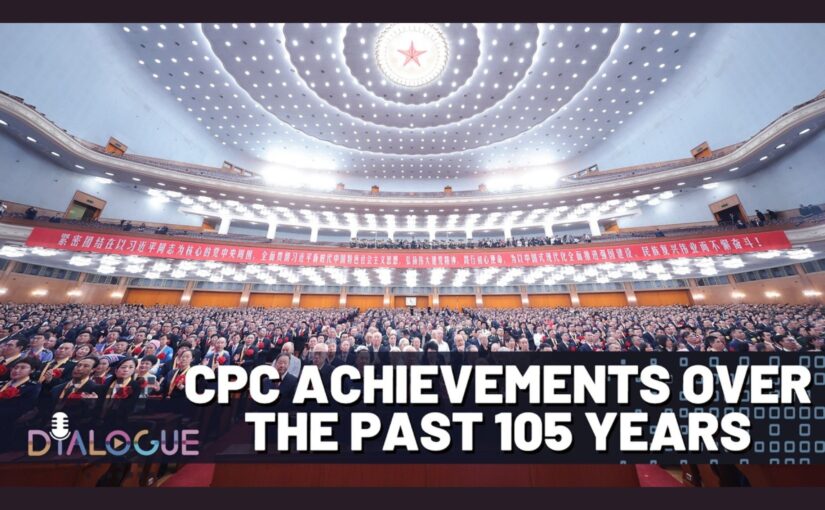
The following is a discussion from CGTN’s Dialogue programme marking the 105th anniversary of the founding of the Communist Party of China. Broadcast in the wake of Xi Jinping’s anniversary speech – in which he hailed the Party’s 105-year history as the “most magnificent epic” of the Chinese nation – it brings together Xia Lu, associate professor at the School of CPC History and Party Building at Renmin University of China; Carlos Martinez, co-editor of Friends of Socialist China; and Radhika Desai, convenor of the International Manifesto Group.
The panel discusses how to evaluate the CPC’s achievements and governing logic; the role of Marxism – seeking truth from facts, the mass line, and the Party’s capacity for self-renewal – in explaining its longevity and legitimacy; and the distinctiveness of Chinese modernisation. Radhika Desai argues that the Chinese revolution, following the Bolshevik revolution, set humanity on a path to socialism, and that amid a declining capitalism China has become an “ocean of stability”. Carlos Martinez stresses that China’s is a modernisation achieved without colonialism, slavery or war – shattering the Eurocentric assumption that to modernise is to Westernise. Xia Lu reads the Party’s six outstanding qualities through the lens of dialectical and historical materialism, and emphasises the mass line and the Party’s vigilance against detachment from the people.
This discussion was originally broadcast by CGTN’s Dialogue. The video and a transcript follow.
Transcript
Host: Hello and welcome to Dialogue. Addressing a gathering marking the 105th anniversary of the Communist Party of China, General Secretary of the CPC Central Committee Xi Jinping hailed the 105-year history of the Party as the “most magnificent epic” of the Chinese nation. He urged the Party to press ahead to build China into a modern socialist country on schedule. So how should we evaluate the Party’s achievements and governing logic over the past 105 years? What does the speech tell us about the Party’s discipline and capacity for self-renewal? And as China moves toward its long-term modernisation goals, what challenges lie ahead? Joining me today from Beijing are Xia Lu, associate professor from the School of CPC History and Party Building at Renmin University of China; Carlos Martinez, author of The East is Still Red: Chinese Socialism in the 21st Century and co-editor of Friends of Socialist China; and also Radhika Desai, convenor of the International Manifesto Group. Welcome to the show. Radhika, I’ll start with you: I’m sure you followed the speech, so I wonder what were your major takeaways?
Radhika Desai: Well, first of all, President Xi’s speech really grasps the fundamentals of the achievements of the Party. I would say that for this party to be more than a century old – 105 years old – while retaining its legitimacy among a billion-strong population, and having essentially transformed the people of China not only into an agent of their own history, giving the destiny of the people into the hands of the people of China, but into an agent of world history – that is a tremendous achievement. The second major event setting the world on a path to socialism after the Bolshevik revolution was the Chinese revolution. And the Bolshevik revolution is no longer; the Chinese revolution is still going. So it set humanity on a path to socialism, and it continues there – at this particular time in history when circumstances have become extremely dangerous, thanks to the decline of that very capitalism. In its decline, capitalism is unleashing chaos, destruction and economic disruption all over the world. In this context, the CPC not only holds great legitimacy among the people of China, but shows the way forward to the rest of the world, and has become a beacon, an oasis of stability, and a visionary path to the future.
Host: Carlos, President Xi said the Party’s endeavours over the past 105 years have fundamentally transformed the future of the Chinese people – as Radhika said, blazed the right path toward the rejuvenation of the Chinese nation, demonstrated the strong vitality of Marxism, had a profound influence on the course of world history, and made the CPC a powerful communist party. What do you make of such a statement?
Carlos Martinez: I think it’s a very powerful reiteration of the CPC’s line, and a very consistent line over the course of more than a century. Marxism is obviously intimately connected with this project of the great rejuvenation of the Chinese nation. Xi Jinping often says that only socialism can save China, and only socialism with Chinese characteristics can develop China. China tried a kind of capitalist, Western-style liberal democracy for a few decades from 1912, and that project was a failure – in terms of dismantling feudalism, ending warlordism, uniting the country, modernising, and defeating imperialist intervention. To achieve those things, China required, and continues to require, Marxism; it required, and continues to require, the leadership of the working class and the peasantry, and not ceding the leadership of the country to a capitalist class that would focus on its own private interests. So Marxism and the Communist Party’s leadership have enabled China to achieve something unprecedented in human history, and I think that’s very strongly reasserted in President Xi’s speech.
Host: Xia Lu, people often say that if you want to understand China you need to understand the Party – that shows how important the Party’s leadership is. President Xi mentioned in his speech the six outstanding characteristics of the CPC: seeking truth, always adhering to the right direction, being deeply rooted in the people, rising to its historic mission, always maintaining the strategic initiative, and so on. What do you make of that summary of who the Party is, and what makes it stand out?
Xia Lu: This is a very good question. I was in the studio yesterday listening to the President’s speech, and I was thinking about the internal logic of the six outstanding characteristics. I would like to use Marxist principles to explain that logic – historical materialism and dialectical materialism. One of the Marxist principles is that we should use systematic thinking, rather than seeing things separately from one another. Economic affairs, political affairs, social governance and even ecological management are connected with each other; you can’t just think of overcoming one obstacle while leaving another unattended. The second principle is process thinking: everything is changing, everything is dynamic, and the CPC is very good at using a dynamic way of thinking to see, understand and solve problems. And, last but not least, is the principle of contradiction – dialectical thinking. Everything has two sides: a positive side and, definitely, a negative side. The CPC never simply gets rid of the negative things; it admits that during the process of modernisation there must be some contradictions, and that these are questions waiting to be tackled. So in my opinion the six outstanding features of the CPC fit the principles of Marxist dialectical and historical materialism.
Host: Radhika – I’m not sure whether you agree with Xia Lu or not – but what do you think are the factors contributing to the success of the CPC?
Radhika Desai: I think the factors that contribute to the success of the CPC are its commitment to the emancipation of the people of China, but within a larger understanding of the world’s road to socialism, of which China is a part. Professor Xia Lu rightly mentioned that a key aspect of Marxism is dialectical, process and historical thinking. History is a process, but history is not just something that happens outside you – you are part of history. What the party has done is transform the Chinese people into an agent of history, and it has maintained this connection, in large part by committing itself to the material emancipation of the Chinese people, to cultural development and so on – by always offering the Chinese people a better future. Even today, when you might think that after all these achievements there is little more China could offer its people, it’s still forging ahead – talking about developing new productive forces, a new civilisation, ecological civilisation, sustainability. The party is constantly able to see further into the future. I’d also mention one other thing: I don’t think Gramsci is very fashionable in China, but this Italian Marxist of the 1920s and 30s made a very interesting point. In Machiavelli’s time, that great political thinker talked about princes doing politics and history; Gramsci said that in modern times the modern prince is the party. The party is the political actor, because in mass politics individuals can’t do anything – you have to forge a mass political force, and that is what the party does, and the CPC has excelled at it to an astonishing degree. How many parties can retain, after 105 years of existence and more than 80 years of revolution, such a large membership and remain a legitimate political force, retaining the consent and support of the people? It is an astonishing feat – constantly moving with the times, adapting its strategy to what is needed.
Host: Exactly – that’s a key point, Carlos. The party is 105 years old and has run through different stages of national development. In 1921 there were about 50-odd members, and the country was weak, basically semi-colonised; today there are more than 100 million members and the country is the second-largest economy. So how does the party stay true to its original aspiration – seeking happiness for the people and rejuvenation of the nation – despite all the challenges along the way?
Carlos Martinez: It’s a very complicated and difficult question that the party itself grapples with constantly. There are a couple of very important elements, and the party has been quite consistent in them over time. We’ve been talking about Marxism and how it relates to the party’s trajectory. Marxism is something that changes over time – it’s not a static dogma, it’s not a religious belief, it’s a social science. And China, as the longest-running and largest socialist project and revolutionary process, has itself impacted Marxism; so modern Marxism includes Xi Jinping Thought, and it includes Mao Zedong Thought. Some of the key elements of that are the idea of seeking truth from facts, and the notion that the sole criterion of truth is the revolutionary practice of millions of people. These ideas have continued through the party’s history – through the first decades of socialist construction, through reform and opening up, and into the new era. So sticking to those core scientific ideas of seeking truth from facts has been crucial. The other thing is being deeply rooted in the people, always maintaining this mission of serving the people – remaining true to what was called, back in the 1930s, 40s and 50s, the mass line: going to the masses, taking their ideas, consolidating, concentrating and synthesising them, and then going back to the masses to propagate and explain those ideas until the masses embrace them. This concept of the mass line, and retaining a very close connection with ordinary people – with the working class, the peasantry, intellectuals, teachers, doctors, nurses and so on – is an absolutely crucial element in sustaining the party, so that it continues to represent the interests of the people and push China towards national rejuvenation.
Host: That’s an interesting point. Xia Lu, now you have 100 million members – many people would wonder how the party disciplines and manages such a large party. It enables the party to stay in touch with the people, because members come from different fields and different parts of society. But in what way do the members stay united, stay in touch with the people, and stay in line with the direction and policy of the party?
Xia Lu: This is a very important theoretical and practical question, addressed by President Xi in his Thought on Party Building, revealed just half a month ago. There are two dimensions to it. The first is how the party stays united – a unique difficulty for a large party like the CPC, because with more than 100 million members it is larger than most countries in the world; there are only 16 countries with a population larger than 100 million, if I remember correctly. So how do you keep such a party united in terms of thinking, mindset and action, and in terms of the project – how to proceed with poverty alleviation, with Chinese modernisation, even with scientific innovation and the new quality productive forces? All these things should be connected and coordinated. That is why the Communist Party, as a Marxist-Leninist party, focuses on thinking together and acting together in accordance with the Central Committee – which is why the Central Committee’s authority is emphasised. That’s the first dimension. The second dimension is how the party stays closely connected with the people. Carlos just mentioned one of the characteristics – the mass line. The mass line is not only a slogan, and not only useful in revolutionary history; it is still useful today, in the new era. It means respecting the people first, staying close to the people, thinking as the people think, caring for the people, protecting the people and serving the people – and using this as the direction, the way to improve the people’s livelihood. In my opinion, in the Communist Party, not only the leading officials but also the rank-and-file always think about how to improve the people’s livelihood and do their job better, in order to earn more and more constant support from the people. That is why President Xi always talks about having a mindset of danger – and that danger is not only outside China, but also inside: the danger of detaching from the people, of not staying close to the people. That, too, is a danger for China.
Host: Stay vigilant. China is also in the middle of the path to full modernisation. President Xi mentioned that the Chinese path to modernisation has created a new form of human civilisation and expanded the choices available to developing countries as they pursue modernisation. Xia Lu, share your understanding of this statement.
Xia Lu: Thank you. This question is also very important. First, I’d like to say something about the new form of human civilisation, and how we should understand and define civilisation. We have many university lectures and courses on civilisation, and most of them start with history – the history of arts and philosophy and other liberal-arts subjects. I agree with that. But I think another important pillar of civilisation is governance – the governing style, the way in which a society stays together and is coordinated. That is why the Chinese path to modernisation is going to provide a new form of human civilisation: it is not necessarily an alternative to Western civilisation, but rather a composite – putting together the whole picture of human civilisation. There shouldn’t be just one standardised type of governing style; there could be another kind, like what we are doing now: staying close to the people, putting people together, using collective thinking to overcome more and more difficulties. That is my understanding of this new form of civilisation.
Host: Radhika, China’s successful modernisation obviously offers at least food for thought, and different choices, for other developing countries in their pursuit of modernisation.
Radhika Desai: Yes. While I agree that China represents a very distinctive path of modernisation, I’d also like to stress something: while I understand the desire not to necessarily oppose the West as such, Chinese modernisation represents a radically new way of modernisation. Until now, modernisation has been a term connected with the Western capitalist way of thinking. What China represents is something radically new – in at least four different ways. Until socialism arrived on the stage of world history, with the Bolshevik revolution and then the Chinese revolution a few decades later, all development had taken place in the imperialist countries. The new type of development represented by socialist countries today, with China in the forefront, is radically new. Number one, this development is taking place without the privilege of imperialism – they are not exploiting other countries to develop themselves. Number two, they are developing from a starting point to which they had been lowered by imperialism, which interfered in their histories, disrupted them and impoverished them – the century of humiliation and so on – so China had to emerge from that lower starting point. Number three, it had to do so while imperialism was resisting it: for the first several decades of China’s existence, the most powerful country in the world did not even recognise its existence, and its rightful place in the United Nations was given to a tiny island, so nearly a sixth of humanity was deprived of representation; China also suffered the threat of nuclear war for decades. And, finally, it had to do so without the luxury of exporting excess populations to allegedly empty continents. So in all these ways, the kind of development and modernisation China represents is radically new. And the fact that it has made such a thumping success of it is really something to be proud of – and it is engineered by the party. It is not something that happened spontaneously; it was done by the party, and that is why the party is to be congratulated.
Host: Carlos, what are your thoughts? China would say its modernisation is a peaceful process – China did not start a war to take its fortune into its own hands, but simply worked hard, made plans, and worked domestically as well as externally. And now here we are, with China at the frontier even in some advanced technologies.
Carlos Martinez: I agree with what Radhika stated – we’re talking about a modernisation that is historically very unique, because it’s being achieved without colonialism, without slavery, without war. If you look at the history of modernisation in the advanced capitalist countries – essentially in Western Europe, North America and Japan – that’s a process that relied heavily on plunder, pillage and conquest. One can look at the Industrial Revolution in Britain, where I am today and where Radhika is too. Going back to the development of the steam engine, it’s well documented – including in a famous book by Eric Williams, a radical Trinidadian student in London who went on to become the leader of Trinidad, called Capitalism and Slavery – that the steam engine relied on capital and investment that came directly from the slave trade in the Caribbean. So we’re talking about a process of modernisation and industrialisation that required the extraction of wealth from the colonies, from the labour of enslaved people. China’s modernisation instead relies on the creativity and hard work of the Chinese people and the leadership of the Communist Party of China. Xi Jinping has talked about this a number of times: there are four important features to China’s modernisation. First, it is the modernisation of a huge country, with a huge population. Second, it is the modernisation of common prosperity for all – and this is very important, because here in Western Europe and North America these are modernised countries, but the fruits of modernisation are not shared. You can step outside my apartment in London and very quickly see a surprising and alarming number of homeless people. There is massive inequality, and millions of people who don’t meaningfully benefit from the wealth that modernisation has provided. Thirdly, Chinese modernisation has to be the modernisation of harmony between humanity and nature – the process of industrialisation in the West has taken us to the brink of potentially catastrophic climate breakdown, and if the rest of the world wants to modernise, it has to modernise on a new path of ecological civilisation. And fourthly, it is a modernisation of peaceful development – inverting this Western pathology of modernisation through conquest and war. And very importantly – this is a world-historic factor – China’s modernisation is shattering an essentially Eurocentric, or racist, idea that modernisation means Westernisation: that to modernise you must follow the path of Western Europe and North America. In doing so, it expands the modernisation path for the whole of the Global South. It provides proof that a developing country can modernise on its own terms, outside of the US-led imperialist system.
Host: It has also served as an inspiration to many developing countries. Radhika, President Xi also said that socialist China led by the party is recognised as a builder of world peace, a contributor to global development and a defender of the international order. This is about the relationship between the party, the nation and the world – so what is the message to the international community?
Radhika Desai: It’s very important to understand that there’s a lot of talk right now about how we are entering a new age of great-power conflict. I’m always at pains to distinguish between what was happening on the eve of the First World War and what is happening now – they are two totally different things. On the eve of the First World War, great capitalist powers were indeed entering into conflict with one another. Today the reality is completely different: all the war, the aggression, the sanctions and other forms of aggression are emanating from a declining capitalist world. Meanwhile, in this context, China is essentially acting as a kind of ocean of stability, an ocean of predictability, a spreader of peace, trying to promote agreement where there is war and conflict. So the message is that the Chinese people represent a new civilisation whose difficult birth is taking place today because the old capitalist world is trying to fight its decline. But it is declining, and China has to keep the world stable, on an even keel, while this extremely violent and destabilising process continues. I think China is doing a great job of it, and it has put the Chinese people in the forefront of this process, as few other peoples are. This is a great historic mission that they are carrying out.
Host: With that we come to the end of today’s show. Many thanks to our guests. You can also find us on the CGTN app and on YouTube. Thanks for being with us – see you next time.






Excellent discussion!