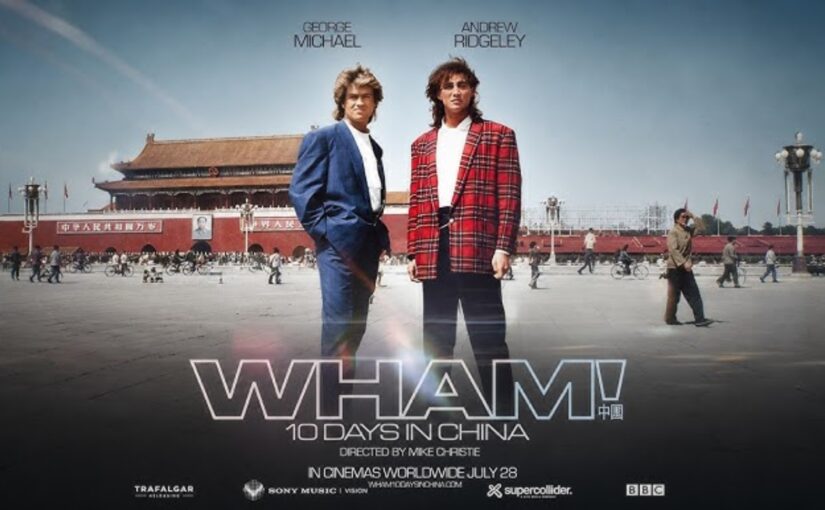
Keith Bennett finds a new documentary film on the first western pop group to perform in the People’s Republic to be a warm, touching and entertaining depiction of a moment in history.
Wham! 10 Days in China, a documentary film with much contemporary footage which went on general release in the UK on July 28, records the extraordinary story of the duo’s 1985 visit, when they became the first western pop group to perform in China, with concerts in Beijing and Guangzhou.
For some of us, the film is a vivid reminder of how China looked at that time. George Michael, then 21, and Andrew Ridgeley, then 22, were true icebreakers. China was still in the relatively early stage of reform and opening up and was very much, in Deng Xiaoping’s words, “crossing the river by feeling the stones”. Although living standards were rising, we were still some way away from the subsequent Chinese economic miracle. However, people’s expectations were definitely rising and with it their eagerness to embrace the outside world (and not without a whole range of misconceptions and naïve expectations) and to experience new things. As others have already noted, in reviews of the film and of course elsewhere, China was a country and a society on the cusp of great change – a change that has in turn profoundly altered the whole course of global development in the twenty-first century in ways that could not reasonably have been envisaged 40 years ago. It is actually extraordinary that these two young men played a modest but very real part in making this happen – in icebreaking and in inventing the future.
According to the film, becoming the first western pop group ever to be invited to perform in the People’s Republic was conceived as just a smart way of making it in the United States. That’s as maybe, but they still had to be prepared to make that leap and take that chance – something that might be seen as a rare moment of real insight on the part of the band’s cynical and manipulative manager. It also necessitated patient and protracted negotiations, something that would be all too familiar to anyone involved in similar work at the time. The art curator James Birch provides a vivid account of what it took to secure the first British contemporary art exhibition in Beijing and Shanghai a few years later in his Gilbert and George and the Communists.
Using China as the gateway to the USA might appear to have been counterintuitive but it showed that there was great interest in and fascination with China in the country at that time, albeit for very different reasons on the part of different sections of the population. As we have previously noted, today’s is not the first iteration of ‘Chinamaxxing’.
As for George and Andrew, they were very unprepared for the minefield they were walking into, characterised by the games of their manager; the hideous behaviour and intrusiveness of the British press; the almost comically empire anachronistic attitudes and disdainful behaviour of British diplomats, especially to the Chinese but also to the lads themselves; another form of patrician disdain on the part of film director Lindsay Anderson, a wildly inappropriate pick, his very real talents notwithstanding, who soon came to dislike both Wham! and China and confided to his diary that he’d only taken the gig for the money; and the requirements, along with a degree of understandable nervousness, on the part of at least some Chinese officialdom. There were also moments of real crisis, as when back up trumpet player Raul D’Oliveira experienced a mental health crisis on a flight to Guangzhou and stabbed himself, forcing the plane to turn back and make an emergency landing in Beijing.
Through it all, these two young men generally come across as nice, polite, patient, willing and respectful, at least to the people who actually mattered – the people of China. Although George did find the public attention in one shop too overwhelming for someone who, stage persona aside, was actually a rather shy and private person.
Some press attention has been given to their jocular banter during a car journey as they discussed what they would say when called upon to deliver a speech at a banquet hosted by the All-China Youth Federation, something that obviously neither of them had ever done before. But it was entirely good natured, and the end result was fine – better than one would have probably got from a British diplomat.
The role played by the British press was particularly disgusting. For anyone who has had the misfortune of being on the receiving end of their attentions, what is most notable is how little they’ve changed. Wham! had already experienced it back home – the blood sport of entrapping, ridiculing and attempting to humiliate celebrities, a process proudly recalled by an obnoxious hack from the Daily Star and something that was to dog George Michael for much of his tragically short life. But in China this was compounded by cold war anti-communism and more than a hint of racism – and with attempts to trick or force the band into making inappropriate political comments. A particular focus was on one alleged incident when Wham! performed at the then Workers’ Stadium in Beijing, where apparently one over-excited fan was ejected by overzealous security after he had stood on a chair to dance. Whatever the truth or otherwise, the rights and wrongs of the incident, it’s probably the case that a solitary fan being ejected from a concert in England in similar circumstances would probably not make the front page. The lads stood their ground, insisting they had not seen or been aware of the incident and had heard different accounts of it.
Finally, the press played their trump, or at any rate last card, asking the duo how they felt about being hosted by the Communist Youth League. Answer: “It’s a communist country.” Well said!
And while it remains the case that little could have prepared them for their experiences in China, one salient fact that should be mentioned is that George’s father was a member of AKEL, the Cypriot communist party, and George himself had joined the Young Communist League. He retained his progressive political and social views, and generous and often anonymous support for them, for the rest of his life.
This actually provides the overlooked context for George’s criticism, made to an intrusive journalist, somewhat bizarrely while he was having his buttocks massaged, where he expressed a degree of disappointment, compared to his expectations, on visiting a socialist country for the first time. This was quite understandable. He and Andrew had been swept up into a veritable maelstrom in which they were being buffeted from every conceivable direction. Moreover, China was still a very poor country, and their officials had never had to tackle anything quite like their visit. It’s a shame that he never made it back to see China’s subsequent development for himself.
One thing that was constantly stressed in the film – with much help from recent interviews – was just how inspiring and formative the visit and concerts were for those who went on to become China’s first generation of rock stars and celebrity DJs, like Cheng Fangyuan, Wang Di, DJ Paul and Cui Jian.
It was also fascinating to get the retrospective insights of Ling Ling Coe as a China-based organiser of the tour. Ling Ling is the younger daughter of Frank and Ruth Coe, legendary friends of China and of Chairman Mao himself.
While, as noted, George Michael never made it back to China, the film closes with Andrew Ridgeley back on the Great Wall, saying that had he done so, he thought George would have been most touched by finding out how much his visit had actually helped change the lives of so many people. It’s a perceptive and kind observation from a loyal friend, all the more so considering their subsequent divergent career trajectories.
The film is of course not all perfect. Some of the footage used from Anderson’s film, which George insisted never be shown, at times depicted Chinese people as objects of orientalist curiosity, which to an extent reminded this reviewer of Italian director Michelangelo Antonioni’s 1972 film ‘China’, albeit the criticisms of that production were exaggerated by the ultra-leftist Gang of Four for their own factional purposes.
But overall, this is a warm, touching and entertaining depiction of a moment in history that deserves to be known and enjoyed.
Wham! 10 Days in China is currently showing at cinemas in the UK and is due to be shown on BBC2 and be available on BBC iPlayer in the autumn.