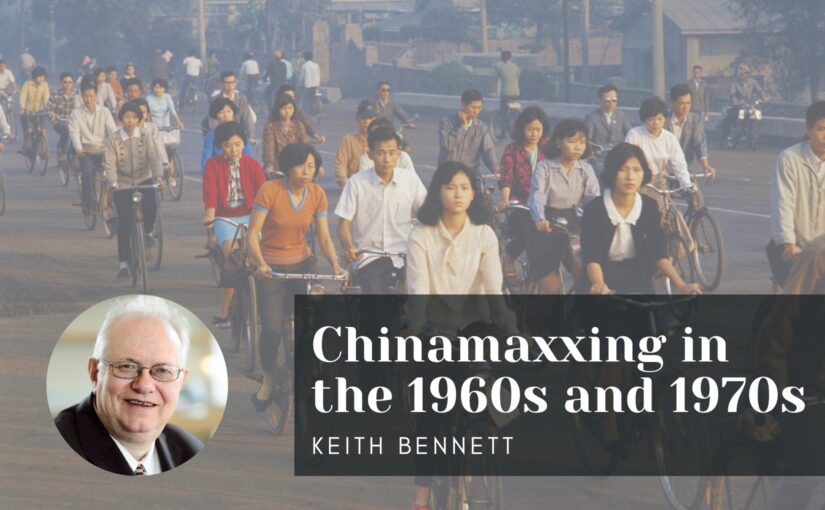
The following is the full text of the presentation prepared by our co-editor Keith Bennett for our April 12 webinar on the subject of ‘Socialist Chinamaxxing: How China’s achievements are a product of socialism’. Due to time constraints, Keith previously delivered an abbreviated version of his remarks. The livestream of the webinar and videos of all the speeches as delivered can be viewed here. The video of Keith’s speech is embedded below the text.
We’ve heard some excellent speakers on the present trend of Chinamaxxing.
For my part, I’m going to attempt to give a certain historical and comparative perspective. Going back to the 1960s and 70s. And therefore, if you like, making a case that what we see today is at least Chinamaxxing 2.0, even if the term itself didn’t previously exist.
My focus here is on the cultural and intellectual rather than the party political. Although the background and context are inevitably political.
The late 1960s and 70s were a time of great change in China. Political life was still in tumult, but the mass mobilisations of the Cultural Revolution abated and were curtailed. A stridently revolutionary foreign policy gave way to handshakes between Chairman Mao and President Nixon. And a procession of other western political leaders generally from the right of the political spectrum, such as Britain’s Edward Heath.
But what remained at the time was a sense that China was a remote and somewhat mysterious place. Literally a world away from the West. Few people went there. Besides political considerations on both sides there were also objective factors. Social media and mobile telephony simply did not exist. As late as the mid-1980s, the London-Beijing flight with BA was London-Rome-Bahrain-Hong Kong-Beijing.
Yet the fascination for China in important sectors of western societies belied and overcame the physical and mental remoteness.
The political seeped into the cultural and each impacted on the other.
Barely two months after France had been shaken by the events of May 1968, and four months after demonstrators protesting the American war in Vietnam had clashed with police outside the US embassy in London, the Beatles recorded a track entitled Revolution, composed by John Lennon. Initially released as the B side to the single Hey Jude, it includes the lines:
But if you go carryin’ pictures of Chairman Mao
You ain’t gonna make it with anyone anyhow
Apparently, this was a late addition to the words, being added in the studio, but Lennon said in a promotional clip that he regarded them as the song’s most important lyrics.
They may have been meant to express disapproval, but he had certainly noticed the phenomenon. Moreover, they encountered a backlash.
New Left Review dismissed the song as “a lamentable petty bourgeois cry of fear.” But by January 1971, in a conversation with Tariq Ali, Lennon said of the song: “I made a mistake, you know. The mistake was that it was anti-revolution.” The following year, he remarked: “I should have never said that about Chairman Mao.”
The partial opening of China that was perhaps first indicated by ‘ping pong diplomacy’ [1]– the surprise invitation to the US table tennis team to proceed from the 1971 world championships in Nagoya, Japan to China; a country in which barely a handful of US citizens had set foot in more than three decades – also triggered musical responses in Britain.
In 1972, Matching Mole, a progressive rock band formed by Robert Wyatt after he left Soft Machine, released their second album, ‘Matching Mole’s Little Red Record’. Obviously inspired by Chairman Mao’s Little Red Book, as it was generally known, the cover was a pastiche of a famous Chinese revolutionary poster of the time, that carried the then popular slogan, “We are determined to liberate Taiwan!”
In 1974, Brian Eno, hitherto of Roxy Music, and today the president of the Stop the War Coalition, released his second solo album. ‘Taking Tiger Mountain by Strategy’ was named after one of the seven model revolutionary operas of the Cultural Revolution.
But if there was, inter alia, an element of parody in these artistic expressions, Cornelius Cardew was an example of someone who went all the way.
Considered Britain’s most outstanding experimental musician, Cardew began his career as an assistant to Karlheinz Stockhausen. His first expression of interest in Chinese culture was his ‘The Great Learning’, a work in seven parts or ‘Paragraphs,’ based on translations of Confucius by Ezra Pound. A few years later, he joined the Marxist-Leninist movement, subsequently becoming a founding and leading member of the Revolutionary Communist Party of Britain (Marxist-Leninist), and repudiated his previous work.
He formed the band, People’s Liberation Music, doubtless with a nod to the People’s Liberation Army, whose performances from the back of a lorry became ubiquitous at trade union, anti-fascist and anti-racist, and anti-imperialist demonstrations. His works of that period included ‘Revolution is the Main Trend’, which set to music the words of Chairman Mao’s May 20, 1970 statement, calling on the “people of the world to unite to defeat the US aggressors and all their running dogs”; and arrangements, for violin and piano and violin respectively, of the two most popular Chinese revolutionary songs of the time, ‘The East is Red’ and ‘Sailing the seas depends on the helmsman’.
Guy Brett, or to be exact, the Honorable Guy Brett, as he was the son of the 4th Viscount Esher, was the art critic of the Times, from 1964-75. In 1974, Brett went to Huxian County in China to meet artists, in connection with an exhibition, ‘Peasant Painters of Hu County’. He was then employed by the Arts Council to write the English text and a catalogue for the show. From this, he started to take an interest in the art produced by liberation movements, not least in Guinea Bissau, and was promptly sacked by the Times. Together with the Filipino artist David Medalla and others, he formed Artists for Democracy, whose first major initiative was a 1974 exhibition in solidarity with the Chilean resistance following the coup the previous year.
Norway was a country where a significant number of the leading cultural personalities took the Cardew route of ‘walking the walk’ in fully immersing themselves in the revolutionary movement, in their case through membership of the Workers’ Communist Party (Marxist-Leninist) (AKPML).
One example is the award-winning novelist Per Petterson. His 2008 novel, ‘I curse the river of time’, draws in part from his years in the party and its title is taken from the first line of Chairman Mao’s 1959 poem ‘Shaoshan Revisited’, regarding his return to his birthplace after an absence of 32 years, albeit the official English translation renders it, as “I curse the long-fled past”.
The novel recalls the response in Oslo to Mao’s death in September 1976. It was referenced as follows in a November 2013 article by Tariq Ali in the Guardian:
“Scandinavia was awash with Maoism in the 70s. Sweden had Maoist groups with a combined membership and periphery of several thousand members[2], but it was Norway where Maoism became a genuine popular force and hegemonic in the culture. The daily paper Klassekampen still exists, now as an independent daily with a very fine crop of gifted journalists (mainly women) and a growing circulation. October is a leading fiction publishing house and May was a successful record company. Per Petterson, one of the country’s most popular novelists, describes in a recent book how, when Mao died, 100,000 people in a population of five million marched with torches to a surprised Chinese embassy to offer collective condolences.”
France was another country where the Chinese revolution had a huge impact on intellectual and cultural life at the time.
When ‘La Cause du peuple’, the newspaper of the organisation Gauche Prolétarienne, whose masthead featured a bust of Mao along with a hammer and sickle, was banned by the French state in 1970, Jean-Paul Sartre, Simone de Beauvoir, Claude Lanzmann, Jean-Luc Godard and François Truffaut were among the leading philosophers and film directors who sold it on the streets. Sartre accepted the directorship of the paper after the two previous directors had been arrested. In June 1970, he and de Beauvoir were themselves arrested while distributing the paper on the streets of Paris.
In 1967, Jean-Luc Godard had written and directed ‘La Chinoise’, a film about a group of young Maoist activists in Paris and a loose adaptation of Dostoyevsky’s 1872 novel Demons. This heralded a subsequent move by Goddard to more explicitly political and collective filmmaking, not least with the 1969 formation of the Dziga Vertov Group, named after a Soviet film director of the 1920s-30s.
The Wind from the East is the title of a not particularly sympathetic book about this aspect of French history. Its promotional material states:
“Michel Foucault, Jean-Paul Sartre, Julia Kristeva, Phillipe Sollers, and Jean-Luc Godard. During the 1960s, a who’s who of French thinkers, writers, and artists, spurred by China’s Cultural Revolution, were seized with a fascination for Maoism. Richard Wolin shows how French students and intellectuals, inspired by their perceptions of the Cultural Revolution, and motivated by utopian hopes, incited grassroots social movements and reinvigorated French civic and cultural life. The Wind from the East illustrates how the Maoist phenomenon unexpectedly sparked a democratic political sea change in France.”
Clearly the world of the late 1960s and the first half of the 1970s is a very different one from that of today and one should be careful of over generalization and direct comparison. But whilst the forms taken by what we might call Chinamaxxing 1.0 and Chinamaxxing 2.0, might be very different the underlying essence presents a more nuanced picture.
By the late 1960s the post war boom was starting to open up higher education beyond the elite. France had experienced the Algerian war of independence. The Vietnamese people’s war of liberation divided American society from top to bottom. The civil rights movement became the struggle for black power and went from pacifism to armed self-defence and urban insurrection. Likewise in Ireland, the brutal suppression of the peaceful civil rights struggle gave rise to a fully-fledged armed struggle. A series of audacious hijackings brought the struggle of the Palestinian people to the attention of the world. The struggles against racism and imperialism infused, inspired and imparted militancy to the movements for women’s liberation and gay liberation.
Today, we see the ever increasing and ever more visible inability of social democracy to represent working class interests in even a partial or degenerated way; decaying infrastructure, rising poverty and an increasingly vicious assault on democratic rights[3]; an utterly discredited, corrupt and venal ruling class, now aptly called the Epstein class, with its tentacles reaching from the White House to the royal family to the Labour Party; a looming climate catastrophe; the promised peace dividend with the end of Cold War I has become the ‘forever wars’ and Cold War II, and the nuclear clock ticks ominously closer to midnight.
While an earlier generation of young people was moved to tears and roused to action by the pictures of a little Vietnamese girl running screaming down the road, her body aflame with napalm, today’s generation is similarly moved and roused by the genocide in Gaza and increasingly elsewhere in the West Asian region that is livestreamed 24/7 on their phones.
Whether in the 1960s and 70s or today, young people in particular, in looking for explanations and alternatives, saw, and are increasingly starting to see, that China presents a different option. That a better world is not only necessary but possible. That it actually exists and is being built. Not without difficulties, mistakes and setbacks – the inevitable fellow travellers of all human endeavours – but in very real and concrete ways nevertheless.
Whether in the 1960s and 70s or today, ‘Chinamaxxing’, looking to China as a reference point and inspiration, and for answers to some of the greatest and most existential questions facing humanity, was not wrong then. And it is not wrong now.
[1] On April 10, two days before the webinar, an event was held in Beijing to mark the 55th anniversary of ‘ping pong diplomacy’. Chinese Vice President Han Zheng attended and read a congratulatory letter sent by President Xi Jinping, who described it as an example of “the little ball being able to move the big ball,” in terms of its historical impact on China-US relations.
[2] Mention could also be made here of the Swedish novelist Henning Mankell (1948-2015). The creator of Inspector Kurt Wallander (played by Kenneth Branagh in one of the television adaptations), Mankell was, for a number of years closely associated with the Communist Party of Sweden (SKP – previously the Communist League Marxist-Leninist, KFML) as well as Norway’s AKPML, both of which had fraternal ties with the Communist Party of China. His 2008 novel, ‘The man from Beijing’, whilst a work of fiction, displays considerable insight into Chinese history, politics and society and is also an excellent read. In 2010, he took part in a flotilla aimed at breaking the siege of Gaza and was detained and forcibly deported from Israel. He also had a passionate commitment to African liberation and divided his time between Sweden and southern Africa, principally Mozambique.
[3] The day before the webinar, London’s Metropolitan Police arrested 523 people under anti-terrorism legislation for the ‘crime’ of peacefully holding placards expressing their opposition to the genocide of the Palestinian people. They included Robert Del Naja from the trip hop group Massive Attack.






great my friend Keith