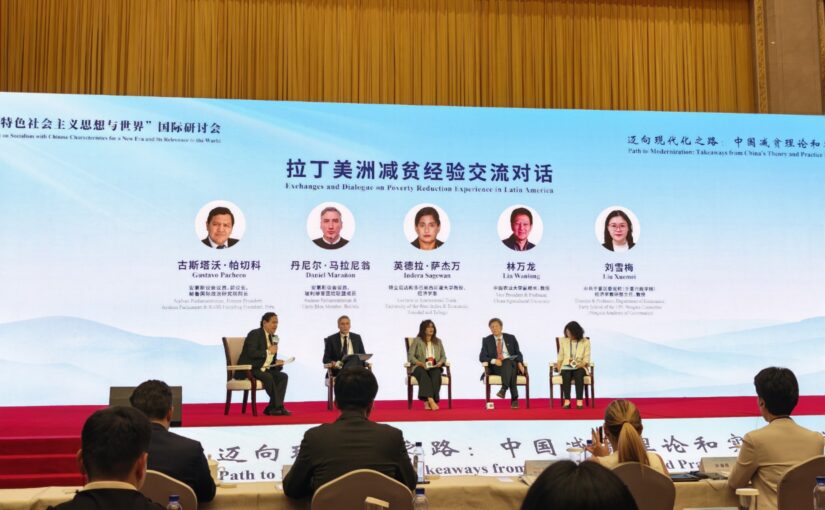
Concluding his series of articles on his recent visit to China at the invitation of the International Department of the Communist Party of China (IDCPC), David Peat, Secretary of Friends of Socialist China Britain Committee, was requested to write a paper on the topic of China’s poverty reduction, and its impact globally, including any possible application to the writer’s home country and local conditions, in connection with the ‘Path to Modernisation: Takeaways from China’s Theory and Practice of Poverty Alleviation’ conference which took place in Yinchuan, capital of the Ningxia Hui Autonomous Region, in July 2026.
In his paper, David charts the world-historic achievement of China’s poverty alleviation and notes how Global South countries in particular are paying close attention and applying what lessons they deem appropriate for their national conditions from China’s experiences. The paper goes on to contrast this achievement to the resurgent and under-reported levels of poverty in the “developed” western countries. He emphasises that the primary global obstacle to achieving sustainable poverty alleviation in any country (Global South or North) remains US-led imperialism, and even the best-intentioned and best practice examples can be undermined or even reversed by US economic and military action. As such, Global South nations seeking lessons from China’s experience should also recognise that the foundation of its success has been built fundamentally on the basis of its own hard-won political and economic sovereignty. Though China was able to achieve this sovereignty through its successful revolution, that is not necessarily the only path for other countries to do likewise, and newly emerging forms of alternative global development infrastructure, such as the Belt and Road Initiative (BRI), BRICS+, and others, can be successfully utilised, in collaboration with the demands of their own citizens, to forge new development paths, not dependent on (or subjugated by) the imperialist-dominated system.
The earlier articles in the series reported from Gansu, where poverty alleviation was examined in theory and practice, and from Ningxia, where the Global South gathered to study China’s ‘Long March’ to abolish absolute poverty.
The full text of David’s paper is printed below.
Since the success of the Chinese revolution and the founding of the People’s Republic of China (PRC), the efforts of the masses of the Chinese people, led by the Communist Party of China (CPC), have resulted in world-historic achievements in poverty reduction that shine as a beacon of possibility towards which Global South nations are increasingly looking. Likewise, in the Global North, even publications and outlets usually quick to denigrate, misrepresent and/or ignore the PRC’s achievements, have been compelled by the scale of the undertaking to credit this achievement. The World Bank issued a report which stated:
Over the past 40 years, the number of people in China with incomes below US$1.90 per day has fallen by close to 800 million, accounting for close to three-quarters of global poverty reduction since 1980. At China’s current poverty standards, the number of poor people in China fell by 770 million. By any measure, the speed and scale of China’s poverty reduction is historically unprecedented.[1]
A commentator at the British Guardian newspaper, following the above analysis, noticed an opposite tendency in relation to the United States, in that, for the same time period, it is “breathtaking how its lopsided distribution of income keeps getting worse.”[2]
The purpose of this paper is to review the course of progress of China’s journey of poverty alleviation, contrast this with the persistent, and resurgent, poverty in the “developed” countries of the Global North (GN), and to also review the global impact China’s example has given to other Global South (GS) countries. I will go on to argue that despite the many lessons that could be learned by other GS countries by reviewing China’s path to modernisation, Xi Jinping Thought, and practical policy experiences, the primary obstacle and danger to current poverty alleviation successes, as well as future possibilities in this area, is that of US-led imperialism. In recent years, the imperialist assaults—from Palestine to Cuba, Caracas to Tehran—and many more locations, have clearly shown imperialism’s multiple techniques for the deliberate destruction of people, their ways of living, and their economic and political sovereignty. Such attacks are not random and are targeted above all against countries attempting to build independent paths to modernisation. Since these countries are attempting to assert their own self-determination, and as a result to be less subjugated to exogenous interests, the imperialist world-system will inevitably always target them. This paper will further argue that China’s success has been fundamentally built on its ability to determine its path to modernisation, including its many successes of development, perhaps preeminent of which is its poverty alleviation programme.
As such, when considering the prospects for poverty alleviation in the wider world, this key concept of sovereignty must not be ignored. It is not necessarily the case that each country need have its own revolution along the lines of the Chinese revolution, however, wider multilateral frameworks and institutions—alternatives to those dominated by imperialist countries—will be required to allow the “breathing space” for GS countries and their populations to pursue their own paths to modernisation and poverty alleviation, separate to the toxic and counterproductive Western developmentalist paradigms. Through win-win cooperation in diplomatic, trade, finance, ecological, and other fields, as well as the establishment of various global institutions and initiatives, China and many other countries are working together to build this kind of non-coercive international environment, which is conducive to successful development (including programmes of global poverty alleviation).
China’s ‘Long March’ to the Eradication of Absolute Poverty
In 2020, marking nearly 100 years since the founding of the CPC, the Chinese government announced that it had succeeded in its First Centenary Goal of achieving a “moderately prosperous society in all respects.” Part of this goal was raising the living standards of the last 100 million who had still been living in ‘absolute poverty’.
It’s important to note that various authorities measure absolute poverty differently, with for example the World Bank defining the line at 1.90 USD per capita per day. The Chinese government defines poverty in a more holistic way, with its “two assurances and three guarantees” methodology. The assurances relate to the presence of sufficient food and clothing, and the guarantees relate to adequate housing (including drinking water and electricity), access to medical services, and a minimum of nine years of free education. Only after these assurances and guarantees are met, alongside income measurements, will China’s poverty alleviation programme allow a person or family to be removed from the list of those in ‘absolute poverty’.
In addition to these policies, the system of land ownership in rural China, where the remaining pockets of absolute poverty were concentrated, entails rent-free access to land and housing. Particular measures were also taken to ensure tailored support for women, children, those with disabilities and the elderly. As such, it should be noted that these more stringent and comprehensive measures mean that the living conditions of those raised out of ‘absolute poverty’ in China are in many ways a step above what is considered by an income only definition. This heightens the enormous achievements made, which are considered as “the largest-scale poverty reduction [programme] in the world, significantly narrowing the world’s poverty map, and contributing more than 70% to the global poverty reduction [in the period].”[3]
The achievement of the First Centenary Goal marked the end of one stage of a long process that had begun even prior to the founding of the People’s Republic, with steps towards poverty alleviation undertaken in the Jiangxi-Fujian Soviets in the early 1930s. Following the success of the revolution, wide-scale land reforms and industrialisation programmes continued to generally raise living standards, alongside more targeted measures. One way the successes of the Mao era can be seen on a macro level, is by the extraordinary increases in life expectancy, from thirty-six years to sixty-seven, in the thirty years following liberation.
The transition to new leadership under Deng Xiaoping, and the modifications to economic and other policies under Reform and Opening Up, continued the progress of eradicating poverty, including specifically absolute poverty, not least through recognising that “[s]olving the problem of rural poverty was … the starting point for the reform process, which emphasised productivity, science and technology as means of generating social wealth.”[4] Indeed, Deng Xiaoping himself stressed in 1987 that “to uphold socialism, a socialism that is superior to capitalism, it is imperative first and foremost to eliminate poverty.”[5] These policies generated enormous growth in incomes, albeit not necessarily equitably across Chinese society at large. However, as Egyptian economist Samir Amin noted, “growing inequality has been accompanied by the reduction of poverty”, which is not often found in other examples across the Global South, where instead “growth – and in some cases significant[ly] high growth – has benefitted only a minority.”[6] Further to this, the Italian philosopher and historian Domenico Losurdo noted that Chinese socialism has addressed the fundamental problem of the “absolute inequality that exists between life and death” and these policies have been successful in “eliminating once and for all the absolute qualitative inequality inherent in starvation and the risk of starvation.”[7]
The final stage of abolishing absolute poverty was accomplished with the policy of “targeted poverty alleviation 精准扶贫”, which was embarked upon in 2014, under the leadership of President Xi Jinping. This aimed to exhaustively identify and improve the living conditions of the very last people living in absolute poverty within the country. President Xi had direct personal experience of rural poverty in his early years and has remarked that this experience “was the starting point for a movement of young intellectuals who were dedicated to rural reform,” and which also motivated his centering of the policy of poverty alleviation as a key part of his leadership.[8] This enormous campaign involved huge amounts of public spending, and the work of more than 800,000 CPC cadres, alongside other community workers, who collectively undertook the work to “visit and survey every household across the country, identifying 89.62 million poor people in 29.48 million households and 128,000 villages.”[9] In each case, local conditions were considered and direct democratic processes were deployed at the family and community level to determine the best way to raise the living conditions to an adequate level, cooperatively, with cadres and villagers working together. Through this extensive and exhaustive process, the number of those counted under China’s broader definition of absolute poverty fell from around 100 million to zero.
Throughout the last 100 years or so, with many challenges (not least of which was the war against Japanese aggression, and successive revolutionary wars), continual efforts have been made to improve the living conditions of the broad masses of the Chinese people, with particular focus on the most deprived. Xi Jinping noted: “thanks to the sustained efforts of the Chinese people from generation to generation, those who once lived in poverty no longer have to worry about food or clothing or access to education, housing and medical insurance.”[10] Indeed, scholars such as Li Xiaoyun and Yang Chengxue argue that the scale of mass engagement, coupled with the driving force and direction of the CPC, mark “a return of sorts to [China’s] historic revolutionary agenda.”[11]
What must be noted, and stands in stark contrast to the imperialist countries discussed in the next section, is that China has been able to achieve this poverty reduction, without resorting to aggressive imperialism abroad, neo-colonial trade arrangements, or other exogenous techniques that would fill its coffers at the expense of other people around the world. China remains a developing country, and political economists argue that it is still, on balance, exploited by the world-system of trade, in the sense that it contributes more labour hours to the global economy than it receives. Despite this, the leadership of the country has prioritised and achieved, over its more than 100 year history, an unprecedented result in the abolition of absolute poverty for its citizens.
Persistent and Resurgent Poverty in the Imperial Countries
The inverse of the obfuscatory and ignorant depictions in Western media of China’s achievements of poverty alleviation, are the rose-tinted representations of Western nations as bastions of “freedom”, “opportunity” and “safety”. The reality is that huge and increasing numbers of those living in Western countries live very precarious existences. Despite living in countries which have some of the largest economies, the most profitable corporations, the richest people, and as well as still retaining their historic ill-gotten riches of colonialism, these countries are unable or unwilling to look after their own citizens.
In Western countries, definitions of absolute poverty are typically based on income thresholds, and don’t take into account other aspects of living conditions such as access to housing, education, medical facilities and so on. As such, while self-defined figures may list significant but smaller numbers of those living in absolute poverty, the reality of everyday life is very different. Moreover, the holistic and society-wide system of poverty alleviation practiced in China is completely alien to Western approaches, which mostly see poverty as “an individual failure rather than a structural problem.”[12] Thereby, the system can absolve itself of responsibility.
In Britain, according to the government’s own statistics, those living in ‘absolute low income’ circumstances—which means “people living in households with income below 60% of median income in a base year… adjusted for inflation”—is at around 20% of the population, when housing costs are considered, and this figure is a higher proportion for children, at 27%.[13] This means over 13 million people, four million of whom are children, are living in very poor conditions, in a country with the 10th largest economy in the world, measured by GDP PPP. An NGO, the Joseph Rowntree Foundation’s Grassroots Poverty Action Group, compiled a report to describe the realities of the state of poverty in Britain over the last 20 years and summarised it with just six words: “Nothing’s changed? Everything’s changed — it’s worse.” The summary of their report finds the following manifestations of this poverty in Britain:
- “One million more people are now unable to afford enough nutritious and varied food since 2021/22.”
- Those living with disabilities, or those caring for family members with them, face “impossible choice[s] of whether to charge our mobility scooter or switch on the washing machine.”[14]
- Ethnic minorities are disproportionately represented in poverty figures.
- “In 2023/24, 6.8 million people — or almost half of those in poverty — were in very deep poverty, with an income far below the standard poverty line, meaning their incomes are at most two thirds of the poverty line. This is both the highest absolute number of people, and the highest proportion, on record, going back to 1994/95.”
These forms of acute poverty, as well as the general impoverishment of all but a few members of the wider population in western countries is a political and economic choice on the part of its ruling classes. Since the 1980s the policies of neoliberal economics have consistently and progressively diminished systems of social support, people’s wages and savings have been eroded through inflation, successive economic crises have reduced employment figures, and the erosion of collective organising of workers through trade unions has resulted in worse working conditions overall for the population. The cumulative effect has resulted in current generations having vastly fewer opportunities for a secure life, with the majority being unable to afford their own home (and state-housing being all but impossible to secure).
Chinese netizens have become increasingly cognisant of the realities of poverty in western countries in recent years, with discussions of a “kill line”—the margin of survival at which many tread water, only one emergency away from sinking into mountains of debt, homelessness, or even worse. This is most extreme in countries with more limited forms of welfare support, such as the United States, but comparable dangers can be found in Britain, with severe rises in homelessness being observed in recent years. Shelter, a charity supporting those homeless or in precarious housing situations, reported that in 2025 “at least 382,000 are homeless in England… [which] has risen by a shocking 8% in one year.” This figure includes those in temporary housing and other insecure arrangements, but the most severe forms are also showing similar trends “[with] at least 4,667 people… sleeping rough on any given night – a 20% increase in one year.”[15] It is an everyday reality for those living in urban areas to witness the severity of the poverty of those living on the streets, often suffering from mental health problems and addiction.
Further evidence of this lack of commitment to looking after their own populations can be seen in contrasting the differing approaches taken towards public health during the COVID-19 pandemic’s acute phases. Whereas China’s approaches repeatedly managed to contain outbreaks, limiting mortality/infection rates and sparing their population repeated and comprehensive country-wide lockdowns, the western countries combined both poorly-managed overall lockdowns and uncontrolled infection-dispersing periods, with the result that more than one million deaths in the US were attributable to the disease, and likewise Britain had woeful per-capita infection and mortality rates, as well as massive economic losses as a result of the lockdowns. Academics studying comparative approaches to public health have observed that commitment to private profits have outweighed prioritising the health of citizens in many countries around the world. “Governments like those of Brazil and the United States chose to protect the financial interests of conglomerates, leading to an inequitably experienced health disaster that could have been avoided.”[16]
The fact that imperial core countries cannot look after their own citizens, despite their extraordinary wealth (which is fundamentally founded on enormous and ongoing colonial and neo-colonial plunder), shows that type of economy constitutively depends on reproducing poverty, both at home and in other countries, as will be further discussed in the ‘Obstacles’ section below.
The Global Impact of China’s Poverty Reduction
Countries around the world, and particularly those in the Global South, are increasingly looking towards China’s successes in poverty alleviation and attempting to apply them, in their own national contexts. Noticing the effect of “accurate precision targeting, customised programs, and efficient resource allocation,” countries such as Ghana have studied China’s methodologies.[17] Elsewhere in Africa, Zeno Mutimura, a Rwandan diplomat commented that his country had lifted one million people out of poverty through ‘people-centred’ practices similar to those of China.[18] Other countries and regions such as Uzbekistan,[19] the ASEAN bloc,[20] and more, have all sought a greater understanding of how China was able to achieve its poverty reduction goals.
Former President of Brazil, and president of the Shanghai-based and BRICS+-linked New Development Bank, Dilma Rousseff had her own “challenging” experience heading an administration that raised 36 million Brazilians out of absolute poverty. In an interview she described China’s achievements as “historic in human development,” which required “tremendous efforts” and moreover, that “this experience must be shared and promoted.” She suggested multilateral organisations such as BRICS+ could be a useful conduit for conveying the “best practices of others”, adding that “every country can develop its own model.”[21]
Countries in the Global South are more than aware that the practices for development recommended by the Western prescriptions have not served their countries and been detrimental to their capacity to alleviate poverty. Popular explanations for the lack of progress in these countries rest on determinist, ethnicist, or culturalist arguments, and routinely downplay the historic and ongoing effects of western intervention in their countries.[22]
Not all countries will come to a poverty reduction programme through a revolution similar to China’s or Cuba’s, but all countries aiming at independent, sovereign development for their populaces will have to recognise the fact that they are under threat from the hegemonic world-system, and they will have to cooperate with countries around the world such as China which are working on alternative fiscal, economic, diplomatic, etc. systems in order for their progress to be defended and sustainable.
The Obstacles and Threats to Poverty Alleviation
Despite taking great inspiration from the poverty alleviation successes of China, many countries in the Global South (and even those in the Global North to a lesser degree) are unable to implement analogous programmes in their regions due to the nature and mechanisms of the capitalist world-system, particularly in its post-1945 US-led incarnation.
In the decades following the end of the Second World War, there were waves of revolutionary decolonisation, with the peoples of many countries, in the face of brutal resistance of the colonial powers, achieving formal independence. Many of these revolutionaries, whether socialist, national-capitalist, non-aligned, etc., dreamed of initiating development programmes incorporating poverty reduction. However, in many cases, those countries which were poorest in the mid-twentieth-century remain the poorest today and languish in what orthodox economists refer to as a “poverty trap”.
Kwame Nkrumah, the revolutionary pan-Africanist and first prime minister of an independent Ghana, identified and described the reality of this situation facing newly-independent nations in 1965: “The general objective has been mentioned: to achieve colonialism in fact while preaching independence.” What Nkrumah described as “neo-colonialism” was the result of multiple mechanisms, including militarism, debt, trade, ‘aid’ and “even the cinema stories of fabulous Hollywood”.[23] All of these aspects play a part to undermine actual sovereign development and ensure underdevelopment and dependence for the newly liberated nations (and these mechanisms more or less persist to the present day even if in somewhat modified forms). This suite of policies, instantiated by the US-led global financial, economic, and political institutions allow the former colonial nations to retain their colonial riches, and moreover continue the drain of resources, labour, and value from the Global South, to such a degree that these nations are unable to develop their economies in any ways not dictated by the needs of global capital.[24]
In the present period, theorists such as Dr. Ali Kadri have gone further, arguing that the deliberate destruction of people, society, and nature is integral to capitalism’s value-capturing mechanisms, and this factor takes on an increasingly dominant role over time. “Destruction becomes the principal commodity produced by capital. Militarism will lead accumulation, which will theoretically demolish any limit to capital.”[25]
As such, any poverty alleviation programme in the Global South must reckon with the reality of being able to determine its economic and political sovereignty. To ensure its hard-won successes and programmes of modernisation, including poverty alleviation, are not undermined (as we are seeing at present in Venezuela and Cuba), or destroyed outright (as we have seen in the case of Gaza), determining ways to strengthen the Global South’s individual and collective sovereignty must be a priority. The ecologist Max Ajl notes such forms of sovereignty-building projects
… requires complementary and interlacing South-North struggles to open political space for and prevent reprisals against southern states which nationalise their productive plant, emplace humane wages, widen the scope of national control over productive forces, and ensure popular classes within the nation are the ones that exercise that control… Sovereignty must be strengthened because states are necessary vehicles for popular interests at the current historical moment.[26]
As President Xi has noted “There cannot be sustainable development in the world when some countries are getting richer and richer while others languish in prolonged poverty and backwardness.”[27]
A primary reason China was able to determine its own development, with freedom of movement not found in many other Global South contexts, is as a result of its successful revolution, which allowed it to remove the comprador class from power and, under the leadership of the CPC, follow planned economic policies which foregrounded sovereign development. Domenico Losurdo, writing after a visit to China in 2010, recognised the fact, that the country was “extending the conquest of political independence to reach economic and technological independence.”[28] As a result of its revolution China was, for a considerable period, excluded from the global economy at large by the “developed nations”—essentially the same as the former colonial powers. This obliged China to pursue a form of endogenous development, which prefigured Samir Amin’s concept of development through delinking—that is, “the refusal to submit national-development strategy to the imperatives of ‘globalisation.’”[29] This foundational sovereign development allowed China to retain control of the most important aspects of governance as it opened up the wider economy in the years following.
Each country and region’s own development path will have its own specificities and will not be able to replicate China’s path to development without amending it to its own national context. Regardless, however, it will still face the same overall major obstacle to furthering the sovereign development of its economic and political systems—that of US-led imperialism, in its military-economic instantiation, what Cheng Enfu and Lu Baolin have called “NATO and the International Monopoly-Capitalist Military and Political Alliance.”[30]
The report to the twentieth National Congress of the CPC (October 2022) recognised that western models of development relied upon “the old path of war, colonisation, and plunder… That brutal and blood-stained path of enrichment at the expense of others [which] caused great suffering for the people of developing countries;” affirming instead that China “will stand firmly on the right side of history and on the side of human progress. Dedicated to peace, development, cooperation, and mutual benefit, we will strive to safeguard world peace and development as we pursue our own development, and we will make greater contributions to world peace and development through our own development.”[31]
Possible Global Paths to Escape Underdevelopment
Any serious project of poverty alleviation will come into conflict with the demands of the imperialist world-system, representatives of whom will be found within the national context, as well as at the supra-national level. It will require a range of approaches, from revolutions to elections, and the development of new ways of conducting trade, finance, diplomacy, and international cooperation. Marco Fernandes argues “it is necessary to strengthen national popular projects with broad participation from progressive social sectors, especially the working classes, otherwise the results of any development are unlikely to be reaped by those who need them the most.”[32] Echoing this, Torkil Lauesen argues that “the struggle against imperialism must be fought at the state level and at the level of the popular movements in combination.”[33]
Without robust domestic and international support, the imperialist world-system will seek to undermine development paths not under its purview. Attempts of this sort can even be seen in recent years with relation to China. Despite its status as the world’s largest economy, at least in terms of GDP as measured by Purchasing Power Parity (PPP),[34] it is still subject to increasingly coercive economic and political measures from the US administration (such as in the so-called “Trade War”, “Chip War” etc.), its corporate entities, and the international, ostensibly multilateral—but in reality, US-dominated—institutions. This is resulting in China repositioning itself in the global economy and prioritising a ‘dual circulation’ model, with “a greater focus on the domestic market, or internal circulation,… [to adapt] to an increasingly unstable and hostile outside world.”[35] It is important to remember that, as Samir Amin stated, delinking is “not at all a synonym for autarky.”[36] Given China’s position as the largest trading partner for over 120 countries globally, autarky would neither be desirable nor seemingly possible. However, the proper meaning of “refusal to submit” to externally imposed models of development is key, and operative in China’s engagement in various multilateral institutions not dominated by the former colonial nations, such as BRICS+, the Group of Friends in Defence of the Charter of the United Nations, and others. Further to this, China has developed alternative global fiscal, defence, diplomatic, developmentalist and other platforms (the Belt and Road Initiative [BRI], Regional Comprehensive Economic Partnership [RCEP], Shanghai Cooperation Organisation [SCO], and the four Global Initiatives[37] to name just a few).
As a key player in or founder of these institutions, China sees in these projects the capacity for cooperative ‘win-win’ forms of global organisation, which are conducive to its own path of development as well as, and because of its conduciveness, to wider development of the Global South. Alongside other nations, China is building the infrastructure of a burgeoning multipolar world. Collectively, these nations are in the process of building a foundation upon which global sovereign development can occur outside of the control of the formerly dominant powers. Chinese diplomatic policy has reflected this reality, with President Xi noting that “a new model of international exchange and cooperation with win-win results is an important guarantee for [poverty alleviation].”[38] A few examples below of how this can work:
- Greater diversity of currencies used in financing and bilateral trading, as well as greater use of currency swap arrangements, negotiated through these alternative organisations or bilaterally, reduces the global primacy of the dollar, and makes the US’ use of unilateral sanctions less effective.
- Strengthening of the UN system could lead to more effective, truly multilateral arenas for diplomacy and conflict resolution.
- Greater investment in infrastructure projects which support endogenous development (under programmes such as the BRI).
Fundamentally, this alternative institutional network aims to build a developmental environment in which alternative paths to development can be tested and applied, without interference from coercive powers.
Torkil Lauesen sees enormous potential in this burgeoning system, arguing that “the development of a multipolar world-system has unleashed the development of the productive forces from the constraints of US-led monopoly and finance capital” which can support the development of poverty alleviation projects and even “socialist transition in the longer run.” In fact, argues Lauesen, despite the strength the subjective forces—the ‘revolutionary spirit’—for global transformation had in the 1960s, the objective forces—the continuing development of global productive forces, nurtured the multipolar system—and this places the chances for qualitative change “in a much better position.”[39]
Conclusion
Global South nations can learn important lessons from China’s historic success in poverty alleviation programmes: that is, it is essential to pay proper attention to the micro and macro contexts of poverty. This means direct, democratic engagement at the local level where poverty is found, to determine the best course of action for lasting success, while at the same time recognising the macro context—that of national and supra-national political and economic sovereignty, only upon which meaningful and non-revocable development can be built. Understanding the dialectical relationship between these factors will be necessary for a sustained improvement in many aspects of global governance, including ecological issues, and their fundamental absence for the majority of countries over the last few decades plays some part in explaining the near-total lack of improvement in absolute poverty levels (excluding China), CO2 emission reductions, and other measures of development.
China’s ability to direct its own history, as a result of the sovereignty gained through its successful revolution, has allowed it to abolish absolute poverty in its country, and upon which it continues to build, aiming at achieving a “great modern socialist country that is prosperous, strong, democratic, culturally advanced, harmonious, and beautiful”, its Second Centenary Goal, by 2050. However, China recognises that its own success also rests on the development of the rest of the world. In October 1984, Deng Xiaoping stated: “There are two major problems in the world that are very prominent. One is the issue of peace and the other is the North-South issue. There are many other issues, which are not of the same underlying importance or global and strategic significance as these two.”[40] As such, China is playing a key part in the formation of an alternative global system which is not antagonistic towards other countries’ paths to development. However, we must be aware that the road to this positive development “can be smooth as the Global South gradually delinks from imperialism and [creates development] with different national characteristics… Or, the transformation can be traumatic, resulting in global wars.”[41]
The path to avoiding wars, and to sustainable and lasting global poverty alleviation will rely on forms of international cooperation similar to those described above, as well as the enormous efforts of working people in all countries of the world. As discussed, even the majority of those living in richer countries have an interest in the creation of a fairer, more equitable and more sustainable global system, one which doesn’t prohibit sovereign development and with it poverty alleviation. As such, the working masses of the world can take great inspiration from Socialist China’s ability to eradicate absolute poverty, and we need to all work together to abolish absolute poverty from the rest of the world, Global North and Global South.
If we examine the current situation on the basis of the international forces of justice and the development of the twists and turns of the international class struggle, the twenty-first century is a new era in which the world working class and the masses can carry out great revolutions and safeguard world peace; in which the socialist countries can carry out great feats of construction and promote ecological civilisation; and in which progressive nations can work together to build a community with a shared future for humankind, a world in which neoimperialism and international capitalism gradually make way for global socialism.
Notes
- Report accessible at World Bank, worldbank.org ↩
- Porter, Eduardo, ‘China has brought millions out of poverty. The US has not – by choice’, The Guardian ↩
- ‘Chinese Ambassador to Sri Lanka Qi Zhenhong: China’s Poverty Reduction Story: a Magnificent Chapter in Global Development’, Ministry of Foreign Affairs of the People’s Republic of China ↩
- Martinez, Carlos, 2023, The East is Still Red, (London: Praxis Press), 94. ↩
- Deng, Xiaoping, 1987, ‘To Uphold Socialism We Must Eliminate Poverty’ ↩
- Amin, Samir, 2018, ‘Interview: There is a Structural Crisis of Capitalism’, Monthly Review Online ↩
- Losurdo, Domenico, 2017, ‘Has China Turned to Capitalism – Reflections on the Transition from Capitalism to Socialism’, International Critical Thought, 7:1, 15-31, doi.org/10.1080/21598282.2017.1287585 ↩
- Xi, Jinping, 2016, Up and Out of Poverty: Selected Speeches in Fujian, (Beijing: Foreign Language Press), 46. ↩
- ‘Serve the People: The Eradication of Extreme Poverty in China’, 2021, Tricontinental Institute ↩
- Xi, Jinping, 2022, ‘2022 New Year Address by President Xi Jinping’, Ministry of Foreign Affairs of the People’s Republic of China. ↩
- Li Xiaoyun and Yang Chengxue, 2020, ‘The Battle Against Poverty: An Alternative Practice in China’s Post-Revolutionary Era’, Wenhua Zongheng Issue 3 (June 2020). ↩
- Russell, Megan, 2026, ‘Ignoring China’s Poverty Alleviation Success Is Costing Us All’, CodePink. ↩
- House of Commons Library, commonslibrary.parliament.uk ↩
- Grassroots Poverty Action Group, 2026, ‘The lives behind the numbers — unacceptably tough, and getting harder’. ↩
- Shelter, 2025, ‘At least 382,000 people are homeless in England today’ ↩
- Turshen, Meredeth & Thébaud-Mony, Annie, 2020, ‘The COVID-19 Pandemic Exposes Fatal Health Inequities’, Monthly Review, DOI: doi.org/10.14452/MR-072-06-2020-10_3. It should be noted that as regards Brazil, this referred to the policies under the Bolsonaro administration, which subsequent Brazilian President Lula da Silva described as leading the country’s residents “to the slaughterhouse.” ↩
- Darkwa, Dr. Samuel Kofi, ‘Adopting China’s targeted poverty alleviation model: Lessons for Ghana and Africa’, BFTonline ↩
- Xinhua (2023), ‘Lessons from China’s poverty alleviation valuable for Africa — experts’ ↩
- Gazeta (2023), ‘Uzbekistan to implement China’s model of poverty reduction in 14 districts’ ↩
- Malindog-Uy, Anna, (2021), ‘Learning From China’s Poverty Alleviation Program’, The ASEAN Post ↩
- CGTN, 2023, ‘Exclusive with the president of the New Development Bank’ ↩
- Zhou Jinyan, 2019, ‘Africa’s Path to Industrialisation: How Can China Contribute to the Continent’s Economic Development?’, Wenhua Zongheng Issue 1 (February 2019). ↩
- Nkrumah, Kwame, 1965, Neo-Colonialism, the Last Stage of Imperialism, (London: Thomas Nelson & Sons, Ltd.), 187. ↩
- Political economic explanations of the various mechanisms whereby this is achieved can be found in books such as Emmanuel, Arghiri, (2025) Unequal Exchange (New York: Monthly Review Press), Smith, John, Imperialism in the Twenty-first Century, (New York: Monthly Review Press), Ness, Immanuel, (2023) Migration as Economic Imperialism (Cambridge: Polity Books). ↩
- Kadri, Ali, 2023, The Accumulation of Waste, (Leiden: Brill), 149. ↩
- Ajl, Max, 2022, A People’s Green New Deal, (London: Zero Books), 158. ↩
- Xi, Jinping, ‘Follow the Trend of the Times and Promote Global Peace and Development’ (March 23, 2013), Chinese Ministry of Foreign Affairs. ↩
- Losurdo, Domenico, 2026, ‘An Educational Trip to China: Reflections of a Philosopher’, International Critical Thought. ↩
- Amin, Samir, 1987, ‘A note on the Concept of Delinking’, Review (Fernand Braudel Center) Vol. 10, No. 3 (Winter, 1987), 435. This form of ‘globalisation’, despite its name, in reality meant primarily subjugation to the dominant neoliberal economic tenets, and differs in meaning from the “universally beneficial, inclusive economic globalisation” outlined by Xi Jinping, for example in this 2024 speech. ↩
- Cheng, Enfu & Lu, Baolin, 2021, ‘Five Characteristics of Neoimperialism: Building on Lenin’s Theory of Imperialism in the Twenty-First Century’, Monthly Review, DOI: doi.org/10.14452/MR-073-01-2021-05_2 ↩
- Full text of the report to the 20th National Congress of the Communist Party of China ↩
- Fernandes, Marco, 2023, ‘Editorial: How to break the vicious cycle of underdevelopment in the Global South’, Wenhua Zongheng Vol. 1, No. 4, 9. ↩
- Lauesen, Torkil, 2025, Unequal Exchange: Past, Present, and Future (New York: Iskra Books), 243. ↩
- According to IMF figures, in 2026, China’s PPP (excluding Hong Kong, Macao, and Taiwan) was around 1.4 times the size of the United States’ figure. ↩
- South China Morning Post, ‘What is China’s dual circulation economic strategy and why is it important?’ ↩
- Amin, Samir, 1987, ‘A note on the Concept of Delinking’, Review (Fernand Braudel Center) Vol. 10, No. 3 (Winter, 1987), 435-436. ↩
- These are, namely, the Global Development Initiative (GDI), the Global Security Initiative (GSI), the Global Civilisation Initiative (GCI), and Global Governance Initiative (GGI). ↩
- Xi, Jinping, ‘Work Together to Eradicate Poverty and Promote Common Development’ (October 16, 2015), keynote speech delivered at the 2015 Global Poverty Reduction and Development Forum in Beijing. ↩
- Lauesen, Torkil, 2025, Unequal Exchange: Past, Present, and Future (New York: Iskra Books), 243-244. ↩
- Deng, Xiaoping, Collected Works of Deng Xiaoping, vol. 3 [in Chinese] (Beijing: People’s Publishing House, 1993), 96. ↩
- Lauesen, Torkil, 2024, The Long Transition Towards Socialism and the End of Capitalism, (New York: Iskra Books), 12. ↩