A team at Nanjing University’s Centre for Asia-Pacific Development Studies has published what appears to be the most comprehensive statistical test yet attempted of the “debt trap diplomacy” thesis – examining 197 countries and regions over 2000 to 2023, including the 146 that have signed Belt and Road cooperation agreements. It found no evidence that participation raised financial vulnerability. Indeed, it found the opposite: the more Belt and Road infrastructure a country actually built, the further its debt burden fell.
The following article by Carlos Martinez sets out the study’s findings and the mechanism behind them – productive assets generating returns, widening the tax base and reducing the need to borrow simply to service previous borrowing – along with the associated gains the researchers identify in political stability, government effectiveness and the reduction of corruption. It notes that these conclusions are consistent with what Chatham House, Deborah Bräutigam of Johns Hopkins and the campaign group Debt Justice have found whenever they have examined the evidence.
For a decade, anyone following Western coverage of the China-initiated Belt and Road Initiative (BRI) has been fed the same story: that Beijing lends recklessly to poor countries, waits for them to default, and then seizes their assets. This notion of “debt trap diplomacy” has been repeated so often as to acquire the status of established fact.
A team from Nanjing University’s Centre for Asia-Pacific Development Studies, led by Professor Mao Weizhun, has now published in the peer-reviewed Quarterly Journal of International Politics what appears to be the most comprehensive statistical test of the thesis yet attempted. Reported by the South China Morning Post, the study examined data from 197 countries and regions over the period 2000 to 2023, covering the 146 countries that have signed Belt and Road cooperation agreements and the 135 where projects have actually been launched or completed.
The headline finding is unambiguous. Testing whether participation in the BRI raised debt risk – using indicators including government debt and fiscal capacity – the researchers found no evidence whatsoever that taking part in the initiative increased financial vulnerability. Indeed, they found the opposite.
The research team tracked countries across three distinct stages: signing up to BRI projects, beginning construction, and bringing completed projects into operation. At the first stage the effect on debt was slightly negative but statistically insignificant. Once construction was under way it became significant, and once the infrastructure was operating it was stronger still. In other words, the more Belt and Road infrastructure a country actually built, the further its debt burden fell. Mao Weizhun writes that “this parallel trend test on debt levels shows the fallacy of the ‘debt trap’ argument”.
How does the BRI reduce debt?
The mechanism is not particularly mysterious. The investment gives rise to productive assets – ports, railways, power networks, communications systems, industrial estates – and productive assets generate returns. Better logistics and energy supply raise industrial output, which in turn widens the tax base, allowing the debt to be serviced.
The study’s authors write that “large-scale infrastructure construction not only brings direct economic benefits to the countries taking part but also optimises their economic structures and strengthens their independent development capacity”. As that capacity grows, participating states “can make better use of domestic resources rather than relying on external borrowing to repay debts”.
Borrowing simply to service existing loans is precisely the pattern that has historically undermined developing economies. Borrowing to build a railway is not the same act as borrowing to service previous borrowing – and the latter is what a great deal of Global South sovereign debt actually finances.
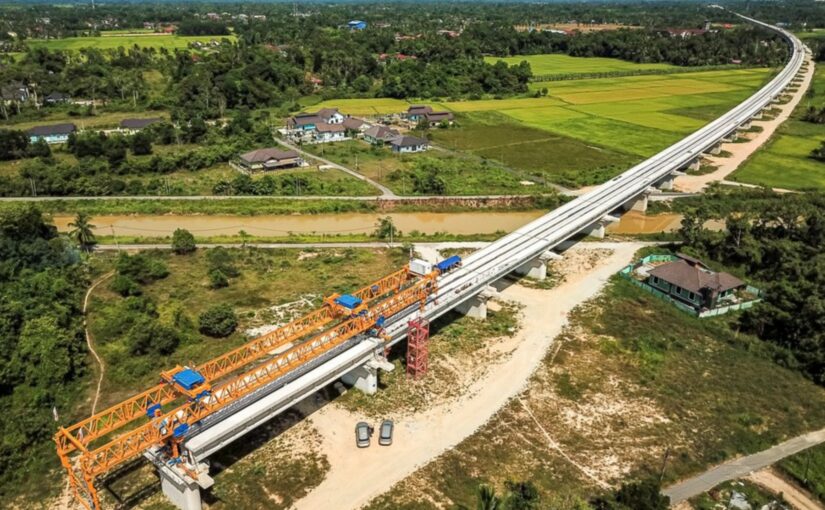
The study also found a number of associated gains: improvements in political stability, in government effectiveness, and in reducing corruption. Public infrastructure, the researchers argue, goes beyond steel and concrete; it strengthens a state’s capacity to allocate resources, deliver public services and integrate remote regions. They describe the result as a “development-infrastructure-security” cycle, citing the China–Laos Railway, the Jakarta–Bandung high-speed line and the China–Pakistan Economic Corridor.
The researchers cite estimates that participating countries’ combined GDP rose by 39.6 percent in the five years after joining, with over half of that growth attributable to infrastructure improvements. The World Bank has estimated that Belt and Road infrastructure could deliver annual benefits worth 1.3 percent of global GDP – some $1.6 trillion – by 2030, with around 90 percent of the gains accruing to participating countries.
Consistent findings
Critics will point out that this is a study by Chinese academics in a Chinese journal. This is true. But its conclusions are entirely consistent with what Western researchers have found whenever they have troubled to examine the evidence.
Chatham House dismantled the thesis as long ago as 2020, noting that the BRI “is not geared towards advancing coherent geopolitical aims” and that “recipient countries (such as Sri Lanka and Malaysia) are not hapless victims, but actively shape outcomes within China’s development financing system”. Deborah Bräutigam of Johns Hopkins University, who runs a detailed empirical research programme on Chinese lending, has spent years documenting that the “debt trap” narrative does not survive contact with the data. Chinese lending to Africa is overwhelmingly infrastructure finance: some 40 percent has gone to power generation and transmission, and around 30 percent to transport, on a continent where more than 600 million people still have no reliable electricity.
Who is actually responsible for debt distress in the Global South? According to World Bank figures, Western multilateral institutions and commercial creditors between them hold close to three-quarters of Africa’s external debt. Research by the British campaign group Debt Justice found that African governments owe just 12 percent of their external debt to Chinese lenders, against 35 percent to Western private lenders – and that the private loans carry an average interest rate of 5 percent, compared with 2.7 percent on Chinese lending.
“Western leaders blame China for debt crises in Africa”, Debt Justice’s Tim Jones has said, “but this is a distraction. The truth is their own banks, asset managers and oil traders are far more responsible, but the G7 are letting them off the hook”. When the G20 established its debt service suspension initiative during the pandemic, China took part, deferring roughly $5.7 billion in debt service payments, representing 63 percent of total bilateral suspensions. Western private creditors did not participate.
The debt trap does exist. It has been laid over decades by Western banks, bondholders and the international financial institutions that discipline debtors on their behalf, and it works by lending at punitive rates for consumption and refinancing rather than for production – often accompanied by conditions of structural adjustment: privatisation, deregulation, liberalisation, and the sale of public assets.
The Belt and Road is something else entirely: a programme of South–South cooperation that builds the productive capacity by which countries might eventually escape that trap altogether. That, rather than genuine concern for the financial wellbeing of Zambia or Sri Lanka, is why it attracts such sustained hostility from the mainstream media.