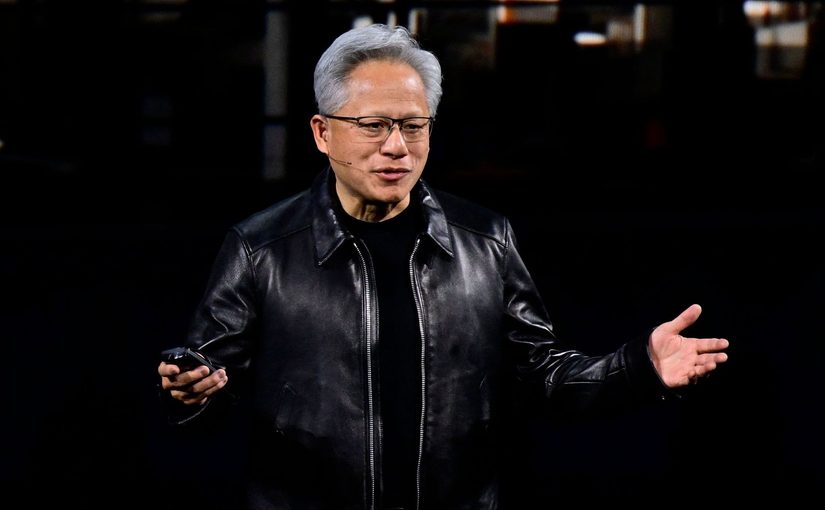
In the following article, Sara Flounders – a long-standing anti-war activist, co-director of the International Action Center and a contributing editor of Workers World – argues that the media’s coverage of Jensen Huang’s fall as Nvidia’s chief executive, presented as a soap opera of sex and espionage, obscures what is really going on.
Sara points out two “inconvenient facts”. First, even the US government doesn’t claim the spy story is proven: Attorney General Todd Blanche has admitted that the Justice Department has reached no conclusion about Alice Huang. Second, China doesn’t actually want Nvidia’s chips: some 600,000 H200 chips are piling up in Hong Kong warehouses because Beijing is withholding import approval, as China builds its own AI future on domestic processors and open-source models.
So what was Huang’s real offence? Sara argues that he was the most prominent corporate champion of open-weight AI in the US, and that he was selling chips across Asia to help countries build their own “sovereign AI” capacity – undermining both the closed, rent-seeking business model of the US tech giants and Washington’s attempt to build an exclusive semiconductor bloc. “The question is not who he had an affair with,” she writes. “It is who profits from AI staying closed, locked and under tight US corporate control.”
This article first appeared in Workers World.
The media has covered the fall of Jensen Huang as a scandal — a soap opera with a billionaire CEO, an extramarital affair, a Chinese spy with national security in peril. The New York Times broke the story of his relationship with Alice Huang (no relation to Jensen), an executive at the Singaporean data-center firm Megaspeed, whom U.S. intelligence officials — citing unnamed sources — claim was recruited by Chinese intelligence.
Two weeks of headlines later, Huang resigned as CEO of Nvidia on Nov. 12, company stock fell 14%, CFO Colette Kress was installed as interim chief and Congress summoned Huang to testify. Senator Elizabeth Warren declared that his resignation “does not absolve him … of responsibility for putting our national security at risk.” (The Hill, Nov. 12)
Nvidia is the engine of artificial intelligence (AI) in the U.S., engineering the most advanced chips, systems and software. It is a Silicon Valley multinational technology company that is among the most valuable publicly traded technology companies in the world, supplying hardware for major cloud and tech providers such as Microsoft, Google, Amazon and Meta.
But strip away the melodrama and two inconvenient facts remain. First, even the U.S. government doesn’t claim the spy story is proven: Attorney General Todd Blanche told reporters the Justice Department has reached no conclusion about who Alice Huang “is or is not” and has not determined whether Megaspeed was smuggling chips to China. (Bloomberg News, Nov. 12)
China has rejected the espionage claims outright, calling them “pure fabrication out of thin air.” (New York Times, Nov. 9)
Second, and far more damning for the entire narrative: China doesn’t want Nvidia’s chips. The scandal presumes a China desperate to get its hands on restricted Nvidia hardware, willing to run espionage operations to obtain it. But that is not what is happening.
According to a Reuters report on Nov. 5, roughly 600,000 of Nvidia’s advanced H200 chips are sitting in warehouses in Hong Kong, piled up awaiting shipment to the mainland — because Beijing is withholding import approval. Nvidia’s own licensed export channel, opened under the Trump administration as a concession in trade negotiations, is being refused at the Chinese end.
U.S. chips a liability
Why are the chips piling up in Hong Kong? Because Beijing has decided, for reasons of security and sovereignty, that it will not build its AI future on U.S.-made chips. Chinese authorities have directed domestic firms toward homegrown processors. Huawei, Moore Threads, Enflame and Alibaba’s T-Head. Alibaba, ByteDance, DeepSeek and Tencent are all developing their own silicon. As CNBC’s China newsletter put it: China is learning “to build without Nvidia.” (June 1)
Billions of dollars have been directed into state-backed computing infrastructure, aiming for high domestic chip integration and consolidating fragmented data centers into unified national networks.
China’s commitment is to open-source AI — globally accessible models at a fraction of the cost of the closed U.S. “frontier” systems that can only be rented in tiny, expensive blocks. For that project, a stockpile of U.S. chips is not a prize, it is a liability.
So the spy story collapses under its own premise. What kind of espionage operation targets a technology the target country is actively blocking? This raises the real question the media circus is designed to crowd out: What was Jensen Huang’s actual offense — not against China but against the U.S. tech establishment?
Open-weight AI costs far less
The record is clear. Huang was the most prominent corporate champion of open-weight AI in the U.S. He promoted Nvidia’s own open Nemotron models, drove the acquisition of Hugging Face — the platform used by more than 18 million developers to share open models — and invested in open ecosystem projects. Huang argued, publicly and repeatedly, that open models accelerate innovation, strengthen safety, prevent vendor lock-in and enable technological sovereignty. (CNBC, Aug. 12)
TechCrunch Report explained that Jensen Huang’s exit puts all of Nvidia’s support for open source in question, and AI researchers like Nathan Lambert, a prominent voice in open-source AI, expect the funding Huang championed to now dry up. (Nov. 12)
Silencing the loudest voice for openness
The U.S. based AI economy is built on enclosure. OpenAI, Google, Anthropic, Microsoft, Amazon and Google fight furiously among themselves for control of closed “frontier” models whose profits depend on rationing data access at enormous margins. They consolidate AI computing inside their own data centers to maximize recurring cloud rental revenue. Vendor lock-in is not a side effect of this system — it is the system. Open-weight models that anyone can download, customize and run on their own hardware are a death threat to all of it.
Huang, the capitalist, had his own reasons for his actions: selling chips to everyone — major enterprises, nation-states, startups — beats selling them to a handful of feudal lord-like companies. He pitched “sovereign AI” across Asia, helping Japan, South Korea, Indonesia and Taiwan build domestic supercomputers instead of renting piecemeal from U.S. cloud giants. He supplied chips to Southeast Asian “neocloud” startups, creating regional competitors that undercut the pricing power of U.S. providers. Singapore, his second-largest billing center, was the hub for this regional distribution. (New York Times, Nov. 13)
And there lies the geopolitical offense. Last December, Washington launched “Project Pax Silica” — a State Department coalition, spanning Japan, South Korea, Singapore, the Netherlands, Britain, Israel, the UAE and Australia, organized around semiconductors, minerals and AI supply chains.
Its roster mirrors the containment blocs of earlier imperialist eras. The whole U.S. strategy is to create a bloc built on exclusion, chaining the world’s infrastructure and its AI to U.S.-owned, closed, rental-based systems. Huang was selling chips to precisely the Asian countries Washington was trying to enlist — and selling to them an open alternative, not a subscription to Silicon Valley.
A CEO who armed the global open-source movement against the U.S. enclosure system was not serving the project. The U.S. senators demanding answers are not primarily worried about Alice Huang’s loyalties. They are worried that the leading vendor of the AI era was loosening the grip of U.S. monopoly capital on the technologies that will run the world.
There is far more than a scandal behind the takedown of Jensen Huang. The question is not who he had an affair with. It is who profits from AI staying closed, locked and under tight U.S. corporate control — and who wanted the loudest voice for openness silenced.
The whole AI bubble can only be sustained if AI is tightly restricted in a few private, for-profit hands. U.S. allies are being forced into prohibitively expensive use of for-profit frontier AI technology, where they pay dearly for every use of data.
But technology can’t be constrained. Like every other form of new technology, AI will break through the old walls.
Jensen Huang is a capitalist who did business by selling chips everywhere.
“The capitalists will sell us the rope with which we will hang them,” is an apocryphal quote but valid sentiment most often attributed to Vladimir Lenin.
Taking down Jensen Huang and reconfiguring Nvidia will only make the billions of Chinese chips coming on line more attractive.