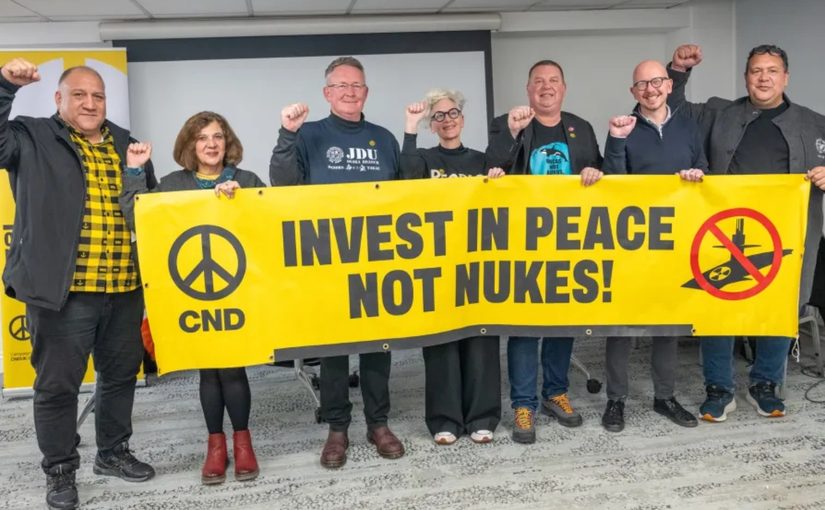
The Campaign for Nuclear Disarmament (CND) organised an international meeting of trade unionists in London on November 16 to mobilise opposition to the AUKUS nuclear submarine pact between Australia, the UK and the US, which threatens China and constitutes a breach of the nuclear Non-Proliferation Treaty (NPT).
As CND General Secretary Sophie Bolt explained in an article in the Morning Star:
“Now in its fifth year, this highly controversial treaty – signed between the US, Britain and Australia – ties Australia into spending $AUS368 billion (£188.8bn) over the lifetime of the nuclear-powered submarines, plus at least another $AUS180bn (£92bn) in costs to store the radioactive nuclear waste.
“The treaty effectively ties Australia even closer into a military alliance with the US, totally at the expense of the Australian population – who are put on the front line in any military confrontation, whilst paying the price through cuts to public services.”
An independent public inquiry in Australia into AUKUS has just published its findings. Sophie notes: “Its principal findings don’t hold back: ‘AUKUS is the worst, most costly and riskiest defence decision ever made by Australian governments, and without adequate public scrutiny.’ It argues that AUKUS jeopardises national security and undermines national sovereignty.”
She adds: “It is critical that we get behind this powerful campaign being waged in Australia. It is absolutely clear that this treaty is against the interests of us all – Australian, British and US populations alike. It puts us all on the front line of any war led by the US, we pay for it through cuts to public services. We all need to be working together to halt the global war drive and growing nuclear dangers.”
Reporting the meeting, Morning Star editor Ben Chacko writes:
“‘Workers have no interest in war with China – or any other country.’ Warren Smith, deputy national secretary of the Maritime Union of Australia (MUA), set out a compelling case against the AUKUS nuclear submarine pact between Australia, Britain and the United States at a CND public meeting in London on Monday night…
“Australians have bitter experience of their land being used by overseas powers in a nuclear arms race – and ‘the plans for nuclear waste dumps and military bases under AUKUS will fall hardest on Aboriginal communities, as they did when Britain tested atomic bombs at Maralinga and Emu Field,’ Smith warned.”
The MUA, Ben notes, has been at the forefront of organising to scrap AUKUS, and it draws on a great tradition of working-class internationalism and anti-imperialist solidarity: Smith recalled the Port Kembla wharfies who refused to load pig iron on ships bound for Japan in 1938 in support of the Chinese people’s war of resistance against Japanese aggression.
“Peace is union business,” Smith stressed. “It’s as fundamental a right of workers to fight for peace as it is to fight for a wage rise. Workers die in wars… Like the wharfies of 1938 who refused to load the pig iron, our job is to refuse to let our ports, our jobs, our communities become part of US imperialism’s war drive.”
Among other speakers, Labour MP Brian Leishman decried the “universal passion for militarism” at Westminster drowning out any rational discussion on the subject. And former president of the RMT transport workers union Alex Gordon savaged a British elite posturing as a “19th century gunboat power sending its aircraft carriers around the South China Sea”.
Meanwhile, China Daily published an editorial calling on Australia to withdraw from AUKUS:
“Though the project was sold to the Australian people as a generational strategic necessity, the inquiry has concluded that it actually jeopardises Australia’s national sovereignty, ties the country to the US military bandwagon and endangers rather than enhances its security…
“It would be ‘madness’ for Australia to take on a major country such as China, (former Australian Defence Force chief Chris) Barrie said. ‘It may serve the interests of the United States, but it would not serve ours.’”
China Daily adds: “The hegemony-driven arrangement contravenes the spirit and principles of the South Pacific Nuclear Free Zone Treaty and the Southeast Asia Nuclear Weapon-Free Zone. It also risks triggering a regional arms race, casting a shadow of confrontation over the waters of the Asia-Pacific.
“It is encouraging that opposition to the AUKUS plan has been increasing in Australia. More and more Australian people are recognising the significant risks associated with the project. The latest report reflects a concentrated voice of rational forces within Australian society.
“Facts suggest that blindly following an extraterritorial power in pursuit of enhanced military capability cannot deliver genuine security for Australia, and dependent military arrangements will only compromise Australia’s strategic autonomy and increase the country’s security risks.
“The Chinese government firmly opposes the AUKUS nuclear submarine programme, calling it a ‘textbook case of nuclear proliferation’, which risks sparking bloc confrontation in the region… Withdrawing from the AUKUS programme is the correct path for Australia to protect its own interests and help maintain regional peace.”
The following articles were originally published by the Morning Star and China Daily. Additionally, videos of all the speeches at the London meeting are available on CND’s YouTube channel.
Trade unionists push for international opposition to Aukus militarisation
November 14 (Morning Star) – THIS Monday, CND is delighted to be hosting trade unionists from Australia, Japan and New Zealand and here in Britain to co-ordinate and build opposition to the Aukus Treaty. The deal is driving nuclear proliferation and risks increasing tensions across the Asia Pacific. It is also an outrageous transfer of wealth from the Australian population to fund the British and US nuclear industry.
Now in its fifth year, this highly controversial treaty – signed between the US, Britain and Australia – ties Australia into spending $AUS368 billion (£188.8bn) over the lifetime of the nuclear-powered submarines, plus at least another $AUS180bn (£92bn) in costs to store the radioactive nuclear waste.
The treaty effectively ties Australia even closer into a military alliance with the US, totally at the expense of the Australian population – who are put on the front line in any military confrontation, whilst paying the price through cuts to public services.
In September, the British government confirmed that “while the UK’s Aukus submarines will be constructed in Barrow, Australia will build its submarines at Osborne Naval Shipyard in South Australia.”
So, not only is Australia building its own submarines, it is also paying half of all the design, development and research costs for the British ones too, including the expansion at Rolls Royce in Derby. This is the site where the nuclear reactors are built for both Britain’s nuclear-armed Vanguard (and the new generation of Dreadnought) submarines, and the nuclear-powered Astute submarines. The company also has the contract to build the nuclear reactors for Australia’s Aukus submarines.
Yet Rolls Royce is way behind schedule with the construction of these reactors. In fact, the government’s own spending watchdog has repeatedly issued warnings that the programme is “unachievable.”
The Aukus deal will also see a huge development around Port Kembla in eastern Australia to accommodate a nuclear submarine base. Secret government documents have said that this “could be a target for Australian military adversaries.”
Not surprisingly, there is a huge amount of opposition in Australia against the treaty, particularly from the trade union movement, where the Australian Maritime Union has been taking a leading role.
An independent public inquiry set up into the treaty has now completed its consultation and published its findings and recommendations. It has the backing of former prime ministers, retired military and naval officers, leading strategists and academics, human rights lawyers and union leaders.
In his submission, former Australian prime minister Malcolm Turnball states: “The UK’s submarine industrial base is in absolute disarray and the delivery of SSN-Aukus has been acknowledged by the House of Commons as “a lengthy and complex undertaking” the delivery of which is attendant with very great risk. The arrival of the SSN-Aukus boats in the early 2040s seems highly optimistic.” He goes onto say: “We’re writing the cheques. We’re taking the most risk.”
Key objectives of the inquiry are to assess if the Aukus nuclear-powered attack submarines will keep Australians more secure and the implications for peace and security in the region.
Sovereignty threat
Its principal findings don’t hold back: “Aukus is the worst, most costly and riskiest defence decision ever made by Australian governments, and without adequate public scrutiny.” It argues that Aukus jeopardises national security and undermines national sovereignty.
The key recommendation of the inquiry is for the termination of Pillar 1 of the treaty – that is to cancel the nuclear submarines programme.
It is critical that we get behind this powerful campaign being waged in Australia. It is absolutely clear that this treaty is against the interests of us all – Australian, British and US populations alike. It puts us all on the front line of any war led by the US, we pay for it through cuts to public services. We all need to be working together to halt the global war drive and growing nuclear dangers.
It is very significant that we are seeing such strong leadership from the trade union movement on challenging the wrong priorities of our governments – which seem intent on dragging us into wars that could go nuclear, whilst failing to tackle the serious threats from climate breakdown and broken public services.
This public meeting on Monday is a critical part of our work to build international co-operation and solidarity across the trade union movement.
Speakers include Warren Smith, the Maritime Union of Australia’s deputy national secretary, who has been playing a critical role in building opposition to Aukus. Here in Britain, UCU have been leading the campaign for Wages not Weapons, and to reframe the debate on real security. UCU president Maria Chondrogianni will be joining the panel, along with Brian Leishman MP and RMT’s Alex Gordon. We will also be hearing delegates from the International Transport Workers Federation’s Dockworkers sections of Japan and possibly New Zealand.
Sophie Bolt is general secretary of CND.
‘Peace is union business’ – the case against Aukus
November 18 (Morning Star) – “WORKERS have no interest in war with China — or any other country.”
Warren Smith, deputy national secretary of the Maritime Union of Australia, set out a compelling case against the Aukus nuclear submarine pact between Australia, Britain and the United States at a CND public meeting in London on Monday night.
Australia’s Aukus Public Inquiry — an independent civil society review, bringing together unions, lawyers and retired politicians and military officers — concluded in its report published this month that Aukus was “the worst, riskiest and most costly defence decision ever made by an Australian government.”
The commissioners titled their report Surrendering Australia, and Smith stressed the pact’s role in a wider strategy to turn Australia into an Asia-Pacific forward base for US aggression, and ensure Britain and Australia are dragged into any Pacific war Washington launches.
Australians have bitter experience of their land being used by overseas powers in a nuclear arms race — and “the plans for nuclear waste dumps and military bases under Aukus will fall hardest on Aboriginal communities, as they did when Britain tested atomic bombs at Maralinga and Emu Field,” Smith warned.
One of the inquiry commissioners is Karina Lester, a First Nations woman whose father went blind from radioactive fallout from British nuclear tests in South Australia in the 1950s.
But the commissioners came from widely divergent backgrounds: they included former Western Australia premier Carmen Lawrence, the first woman to head an Australian state government; Admiral Chris Barrie, a former chief of the Australian Defence Force (commanding the entire Australian military from 1998-2002); Australia Institute co-CEO Leanne Minshull and lead commissioner and former environment minister Peter Garrett.
It received over 1,000 public submissions and held public forums in which two former Australian prime ministers added to the damnation of a hugely costly and dangerous agreement — “the worst deal in all history,” according to ex-Labor PM Paul Keating.
The huge expansion of the HMAS Stirling naval base in Western Australia to accommodate rotating US and British nuclear-powered submarines “gives Washington and London a forward base in the Indian Ocean, funded substantially by Australian taxpayers, crewed and commanded by personnel under foreign chains of command,” was the judgement of former Liberal PM Malcolm Turnbull.
Aukus is, as CND general secretary Sophie Bolt explained, “a deal about transferring nuclear technology to a non-nuclear weapons state, Australia, to build nuclear-powered submarines… for war fighting. It’s a total breach of the Nuclear Non-Proliferation Treaty and it’s increasing tensions across the Asia-Pacific.”
Even disregarding its sinister purpose, Aukus is a terrible bargain for Australia. It “leaves Australia spending billions and billions [368 billion Australian dollars or about £190bn over 40 years by official figures, which critics believe is a significant underestimate] on facilities for US and British nuclear submarines, while the promised Australian fleet may never materialise; the submarines operating from our shores remain under foreign command.” Washington also reserves the right to refuse to sell the submarines it is supposedly building for Australia if it decides it wants them itself.
The government pitches it as a job-creating programme, but the 20,000 jobs it is supposed to create over three decades works out at $19 million a job, Smith pointed out, money that could generate far more employment in other sectors; and “locked into highly specialised defence supply chains concentrated in a few sites tied to US and UK strategic priorities.”
Submarine Rotational Force West will operate from HMAS Stirling with maintenance from Henderson Defence Precinct south of Perth; “and up to 2,300 US personnel and families will be housed there. This is a US base despite denials of such. And already Australia hosts military facilities that support the US capacity to wage war.”
As with British bases like RAF Lakenheath, many so-called Australian bases “are for all intents and purposes US bases… Australian territory and infrastructure are becoming more deeply integrated into the machinery through which the United States can fight its — often illegal — wars.”
As with Iran’s retaliation against US bases in the Middle East used to attack it, a US war on China would now put Australia in the firing line for retaliation, without Australians even being informed whether their bases are housing US nuclear weapons, and “no plans to defend against [the risk of nuclear attack], no evacuation or civil defence plans for a nuclear accident…”
Not only is this familiar from the secretive uses to which British bases are put, Britain is very much threatened by its own involvement in Aukus.
“It’s a British problem too. UK shipyards and reactor plants are tied in. The UK government signed a 50-year treaty with Australia that will lock both our countries into US war plans in the Pacific.”
Australian historian Christoper Clark entitled his history of European powers’ slide into World War I “Sleepwalkers.” The British and Australian peoples too are being drawn ever closer to the brink without governments disclosing the truth about their agreements, and without a public debate on the risks.
Labour MP Brian Leishman, addressing the meeting, decried the “universal passion for militarism” at Westminster drowning out any rational discussion on the subject. Former RMT president and Communist Party general secretary Alex Gordon savaged a British elite posturing as a “19th century gunboat power sending its aircraft carriers around the South China Sea.”
But they can be stopped. Already Australia has had to pause selection of an east coast equivalent to HMAS Stirling because of mass popular mobilisations against it, union-led, in the favoured site of Port Kembla.
Those mobilisations have much in common with the mass protests against conscription and militarism across Europe described by UCU past president Dr Maria Chondrogianni, who also detailed the work that went into overturning the TUC’s position in favour of higher military spending in 2025 and again in 2026.
The Maritime Union of Australia has been at the forefront of organising to scrap Aukus, and it draws on a heroic tradition in that vein: Smith remembered the Port Kembla wharfies who refused to load pig iron on ships bound for Japan in 1938; the Australian, Indonesian, Chinese and Indian seafarers whose waterfront strikes blocked the “Black Armada” of Dutch merchant and military vessels planning to set sail from Australia to force newly independent Indonesia back under Dutch colonial rule.
“Peace is union business,” Smith stressed. “It’s as fundamental a right of workers to fight for peace as it is to fight for a wage rise. Workers die in wars.
“Peace and good jobs are not opposites. Scrap Aukus. No to nuclear submarines, no to US bases — spend the money on housing, on health, on renewable energy, on industry, on shipping — on anything but war!
“No-one can do it alone. We want to work with the British labour movement, with CND — this pact binds both our countries and only working people can break it.
“Like the wharfies of 1938 who refused to load the pig iron, our job is to refuse to let our ports, our jobs, our communities become part of US imperialism’s war drive.”
Australia should withdraw from AUKUS: China Daily editorial
November 5 (China Daily) – A five-month-long independent public inquiry into Australia’s A$368 billion ($239 billion) AUKUS nuclear submarine program — led by former Labor minister Peter Garrett and former Australian defense force chief Chris Barrie — has delivered a Commissioner’s Report, which judges the plan to be “the worst, riskiest and most costly defense decision ever made by an Australian government”.
The report, which was released on Wednesday, calls for the trilateral security agreement to be scrapped immediately, and a special commission to be established to investigate how Australia got into “this mess”.
In September 2021, Australia, the United Kingdom and the United States established the AUKUS “security” pact, which includes Australia’s acquisition of technology for eight nuclear-powered submarines and aims to deepen cooperation on advanced military technologies such as cyber capabilities and quantum technologies. It was a deal to counter what the three nations perceived to be China’s growing “assertiveness” in the “Indo-Pacific”.
Though the project was sold to the Australian people as a generational strategic necessity, the inquiry has concluded that it actually jeopardizes Australia’s national sovereignty, ties the country to the US military bandwagon and endangers rather than enhances its security. “We should never allow an acquisition program like AUKUS to define our national security,” Barrie noted.
The so-called “security partnership” runs counter to Australia’s national interests. Its staggering costs divert resources away from essential public needs, and it unnecessarily entangles Australia in geopolitical competition.
It would be “madness” for Australia to take on a major country such as China, Barrie said. “It may serve the interests of the United States, but it would not serve ours.”
Indeed, AUKUS is by no means a mere “defense cooperation” initiative as claimed. Instead, it serves as an instrument for the US to advance bloc confrontation and fuel geopolitical rivalry across the Asia-Pacific. Through nuclear submarine cooperation, the US seeks to anchor Australia to its military planning, and beef up military deployments in the South Pacific and Southeast Asian waters. These moves threaten regional peace and stability.
Australia is a non-nuclear-weapon state, and the AUKUS plan to transfer weapons-grade highly enriched uranium to power nuclear submarines raises high proliferation risks and presents grave hidden dangers for global nuclear governance. Such a move undermines the foundation of the Treaty on the Non-Proliferation of Nuclear Weapons and sets a dangerous precedent for other nations.
Thus, the hegemony-driven arrangement contravenes the spirit and principles of the South Pacific Nuclear Free Zone Treaty and the Southeast Asia Nuclear Weapon-Free Zone. It also risks triggering a regional arms race, casting a shadow of confrontation over the waters of the Asia-Pacific.
It is encouraging that opposition to the AUKUS plan has been increasing in Australia. More and more Australian people are recognizing the significant risks associated with the project. The latest report reflects a concentrated voice of rational forces within Australian society.
Facts suggest that blindly following an extraterritorial power in pursuit of enhanced military capability cannot deliver genuine security for Australia, and dependent military arrangements will only compromise Australia’s strategic autonomy and increase the country’s security risks.
The Chinese government firmly opposes the AUKUS nuclear submarine program, calling it a “textbook case of nuclear proliferation”, which risks sparking bloc confrontation in the region.
While some neo-militarists in Japan increasingly long for US nuclear submarines to accelerate Japan’s remilitarization, Australia has every reason to make the right choice. Withdrawing from the AUKUS program is the correct path for Australia to protect its own interests and help maintain regional peace.