Although China failed to qualify for the 2026 football World Cup, the country’s millions of football fans have been finding many ways to engage with the contest.
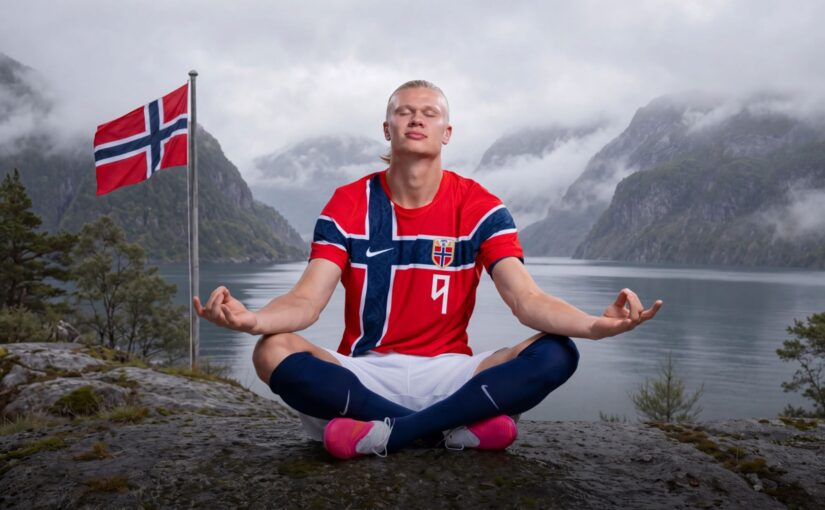
One such has been the virtual adoption of Erling Haaland. The Norwegian soccer forward and striker for Manchester City, considered to be his country’s greatest ever footballer, and currently one of the best in the world, has become an online sensation. Fresh from scoring 16 goals to help Norway reach its first World Cup since 1998, Chinese fans have been turning his goals, exaggerated facial expressions, and off-pitch antics into a nonstop stream of viral content.
The Shanghai-based website Sixth Tone reports: “With the tournament underway, hashtags related to Haaland have attracted more than 490 million views on microblogging platform Weibo, where he launched an official account earlier this month, as well as on Douyin, China’s version of TikTok, attracting 194,000 followers within days.
“Standing nearly two metres tall with a powerful physique, Haaland is often portrayed online as a ‘robot striker’ or ‘Nordic cyborg’, a nod to his seemingly machine-like scoring ability.”
That imposing image is balanced by his approachable side. Haaland has been spotted signing autographs while casually eating a carrot in a car or smiling during heated on-pitch confrontations. He has also joined a trending meme beside the Liziba monorail station in the southwestern megacity of Chongqing, mimicking tourists who pretend to “eat” the passing train. Fans have filled the comment sections with edits of Viking-themed artwork released by the Norway team.
Sixth Tone adds that the striker’s popularity has also attracted commercial interest in the country. He has been announced as an ambassador for the Chinese herbal tea brand Wanglaoji and represents the Norwegian Seafood Council in promoting Norwegian salmon and other seafood exports.
Exports of Norwegian salmon to China have been growing exponentially. They jumped 188% in April 2025 compared to the same month the previous year, making China the third-largest market globally for Norwegian salmon, according to the country’s export statistics. This pushed Norway’s market share in China to 62%, exceeding the 50% threshold for the first time in over a decade of gradual market expansion.
Haaland is also set to make his feature film voice acting debut, playing a Viking also named Haaland in the animated film ViQueens. The movie is scheduled for release at Christmas 2026. It is directed and co-written by Harald Zwart, who also directed The Karate Kid (2010).
The following article was originally published by Sixth Tone.
Robot, Giant, Ha Baby: China’s Many Versions of Erling Haaland
June 15 (Sixth Tone) – A man who eats passing trains, a giant with ball-crushing strength, a robot striker with the occasional human smile. On Chinese social media, they are all versions of Erling Haaland, the Norwegian soccer forward.
Fresh from scoring 16 goals to help Norway reach its first World Cup since 1998, the Manchester City striker has become an online obsession, with Chinese fans turning his goals, exaggerated facial expressions, and off-pitch antics into a nonstop stream of viral content.
One widely circulated clip shows the 26-year-old unleashing a shot that crashes into a defender’s face with such force that the ball visibly buckles on impact. Users quickly gave Haaland a new nickname: “ball quality inspector.”
With the tournament underway, hashtags related to Haaland have attracted more than 490 million views on microblogging platform Weibo, where he launched an official account earlier this month, as well as on Douyin, China’s version of TikTok, attracting 194,000 followers within days.
Standing nearly two meters tall with a powerful physique, Haaland is often portrayed online as a “robot striker” or “Nordic cyborg,” a nod to his seemingly machine-like scoring ability.
His exaggerated facial expressions during matches and goal celebrations, often replayed in slow motion, have only added to his appeal. Among young Chinese netizens, he has become a symbol of “abstract” energy — a term used to describe something surreal, baffling, or difficult to explain.
That imposing image is balanced by his approachable side. Haaland has been spotted signing autographs while casually eating a carrot in a car, or smiling during heated on-pitch confrontations. Fans have embraced the contrast with the nickname “Habao,” or “Ha Baby.” A catchy Chinese remix dedicated to him has also gone viral, often accompanying videos of his goals.
On his Douyin account, Haaland answers fan questions, including which foods he would like to try if he were to visit the country. Asked whether he is a robot, he replies with a simple: “Maybe I am, sometimes.”
He has also joined a trending meme beside the Liziba monorail station in the southwestern megacity of Chongqing, mimicking tourists who pretend to “eat” the passing train. Fans have filled the comment sections with edits of Viking-themed artwork released by the Norway team, as well as screenshots of Haaland’s more unusual expressions.
The striker’s popularity has also attracted commercial interest in the country. He has been announced as an ambassador for the Chinese herbal tea brand Wanglaoji and represents the Norwegian Seafood Council in promoting Norwegian salmon and other seafood exports.
In China, the World Cup has a long history of producing internet folklore. During the 2022 tournament, Lionel Messi’s now-famous “Qué mirás, bobo?” outburst was endlessly remixed online. Chinese fans even created a playful phonetic adaptation, roughly rendered as “give you two steamed cornbread,” which spread as a viral catchphrase.