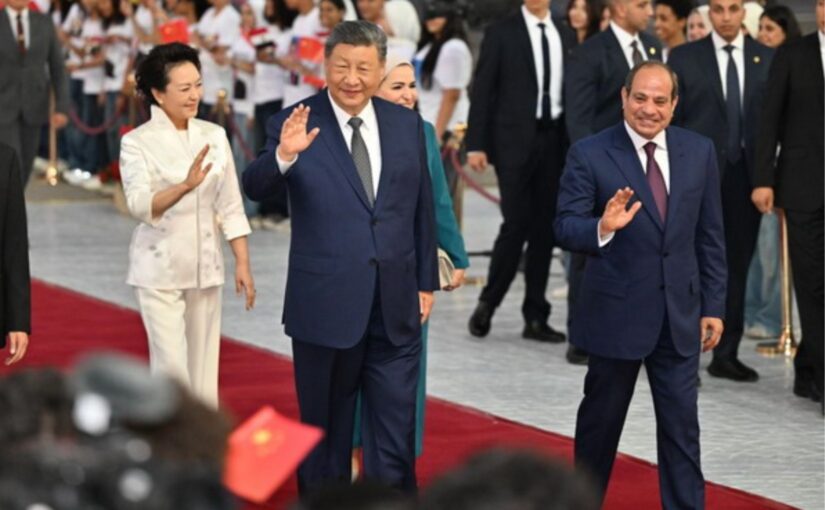
Following his state visit to Kyrgyzstan and attendance at the Shanghai Cooperation Organisation (SCO) Summit 2026, Chinese President Xi Jinping paid a state visit to Egypt, arriving in Cairo on the evening of September 1.
On that day, Xi published a signed article in Egypt’s three main newspapers, writing that he was, “Setting foot for the second time on this land nourished by the Nile. Just as an Egyptian proverb reads, ‘Once you drink from the Nile, you are destined to return’… Known for their age-old civilisations, China and Egypt have each contributed an invaluable intellectual legacy and splendid cultural heritage to the progress of humanity. The Yangtze River and the Yellow River gave birth to the Chinese civilisation, and the Nile was the cradle of the ancient Egyptian civilisation.”
Against this background: “Seventy years ago, China and Egypt officially established diplomatic relations, marking the start of New China’s friendly cooperation with Arab and African countries. For seven decades, the China-Egypt relationship has braved wind and rain and withstood the test of the changing international landscape. It has stayed on the right course, remained robust as ever, and sustained a strong momentum. It is a fine example for China’s cooperation with Arab states and Africa as a whole, and for friendship, solidarity and collaboration between developing countries.
“China and Egypt have always been close brothers standing by each other. In the struggle for national independence and against imperialism and colonialism, the people of our two countries forged profound friendship. China firmly supported Egypt’s sovereignty over the Suez Canal, and Egypt, alongside the majority of Asian, African, and Latin American and Caribbean countries, voted unequivocally in favour of the restoration of the lawful seat of the People’s Republic of China in the United Nations.”
Now, “Egypt is China’s major trading and investment partner in the Arab world and Africa, and one of the first countries to participate in Belt and Road cooperation. As early as ten years ago, President El-Sisi and I jointly unveiled the China-Egypt Suez Economic and Trade Cooperation Zone.”
Xi pointed out that: “China and Egypt have always been sincere friends committed to equality and mutual trust. At the Bandung Conference in 1955, our two countries actively supported the anti-imperial and anti-colonial struggle, and jointly advanced Asian-African solidarity. Today, China and Egypt have shared goals and a common aspiration in upholding international order, championing fairness and justice, and practicing multilateralism. Both sides firmly support the just cause of the Palestinian people in restoring their legitimate national rights, and both are committed to facilitating the political settlement of hotspot issues and realising peace and stability in the region. This demonstrates our commitment, as Global South countries, to seeking strength through unity and upholding fairness and justice…
“We need to enhance mutual trust and serve as a model in carrying forward friendship. The friendship between our two countries was forged by the elder generations of our leaders. It is our honour and responsibility to carry forward, develop and promote this friendship. Our two sides should continue supporting each other on core interests and major concerns and deepen exchanges and cooperation at various levels and across all sectors to ensure that the baton of friendship is passed on from generation to generation.”
The article concludes: “We need to join hands to lead the way in China-Arab and China-Africa cooperation. As a major country in both the Arab world and Africa, Egypt plays an important role in promoting the collective cooperation between China and Arab states, and between China and African countries. The Chinese side is ready to work with the Egyptian side to enhance the demonstration effect of our well-established cooperation, leverage Egypt’s unique location in linking the Arab world and reaching across the African continent, further implement the proposal on building ‘five cooperation frameworks’ between China and Arab states and follow up on the ten partnership actions for modernisation between China and Africa. This will ensure that China-Arab and China-Africa cooperation keep pace with the times, makes steady progress and go a long way.
“For 70 years, China and Egypt have stood by each other rain or shine. Now our two countries are embarking on a new journey with enterprise and fortitude. The Chinese side is ready to work with the Egyptian side to stay true to the shared aspiration of our two countries, build on our past achievements, support each other and forge ahead on the path toward prosperity and rejuvenation, and strive for a better tomorrow in both our respective national development and our bilateral relations.”
A commentary published by the Xinhua News Agency also previewed the visit, noting: “The seven-decade journey of China-Egypt relations is a powerful testament to what solidarity and cooperation can achieve. Over the years, the two countries have steadily strengthened their ties despite shifts in the regional and global landscape, maintained close coordination on international affairs, supported each other on issues of mutual interest, and expanded practical cooperation, making their partnership a model of amity, solidarity and cooperation among developing countries.
“That spirit of solidarity was evident from the very beginning of their diplomatic ties. In the early years of the People’s Republic of China, Beijing supported Egypt’s efforts to reclaim sovereignty over the Suez Canal. In 1971, Cairo voted in favor of restoring the People’s Republic of China’s lawful seat at the United Nations. The two peoples also stood together in the struggle against colonialism and hegemonism, laying a solid foundation for a friendship that has endured for seven decades.”
More recently: “In 2014, the two countries elevated their relationship to a comprehensive strategic partnership. During Xi’s 2016 state visit to Egypt, the two sides agreed to align the Belt and Road Initiative with Egypt’s development strategies. In 2024, Egypt became the first Arab country to include the goal of building a community with a shared future in a bilateral joint statement.
“Cooperation has also extended beyond economics. Joint archaeological excavations in Luxor and exhibitions of Egyptian civilisation in China have brought the histories and cultures of the two ancient civilisations closer to their peoples. Such exchanges have given the bilateral relationship a deeper human foundation.”
The commentary added that: “At a time of profound global change — with economic recovery still fragile, unilateralism and hegemonism on the rise, and regional conflicts continuing to escalate — it is more urgent than ever for Global South countries to stand together and pursue common progress.”
In a written statement delivered on his arrival at Cairo International Airport, President Xi noted that, “China and Egypt are both ancient civilisations, with a traditional friendship that has endured and grown stronger over millennia. Over the 70 years since the establishment of diplomatic relations, the two countries have always stood together and cooperated for mutual benefit, regardless of changes in the international and regional landscape… The two countries enjoy solid political mutual trust, fruitful mutually beneficial cooperation, and close and robust multilateral coordination, setting an example of friendship and solidarity among developing countries.”
President Abdel Fattah El-Sisi of Egypt held talks with President Xi Jinping at the Al-Ittihadiya Palace in Cairo on the morning of September 2.
Xi Jinping noted that Egypt established diplomatic relations with the People’s Republic of China in 1956, becoming the first Arab and African country to do so. The older generation of leaders of the two countries led the two peoples in fighting side by side to achieve national independence and oppose imperialism and colonialism. A bond of unbreakable, deep friendship was forged. The past seven decades of shared journey through wind and rain has fostered and witnessed the salient features of China-Egypt relations: equality and mutual trust, friendship and mutual learning, solidarity and mutual support, and cooperation for win-win outcomes.
He emphasised that the two sides should do the following:
- First, firmly support each other, maintain the momentum of high-level exchanges, intensify exchanges and cooperation across different areas and levels, and strengthen the exchange and mutual learning of governance experience
- Second, advance mutually beneficial cooperation, enhance synergy between development strategies, unleash cooperation potential in traditional areas such as infrastructure building, electricity, agriculture, and communication technology, and foster new cooperation highlights in green energy, electric vehicle, aerospace, the digital economy, modern agricultural technology, etc.
- Third, promote people-to-people exchanges by expanding exchanges and cooperation across the board in areas including culture, education, science and technology, health, and sports, and increasing the flow of personnel, in order to boost connectivity between the peoples of the two countries
- Fourth, strengthen security cooperation by jointly combating transnational crime, deepening international cooperation against corruption, and firmly supporting each other’s counterterrorism efforts, so as to safeguard the two countries’ common security
- Fifth, enhance international and multilateral collaboration by coordinating and cooperating more closely on multilateral platforms such as the United Nations and BRICS, and jointly advancing the building of the China-Arab States Cooperation Forum and the Forum on China-Africa Cooperation, to oppose unilateralism and bullying acts together, and promote a more just and equitable global governance system.
The two presidents had an in-depth discussion on the situation in the Middle East. President Xi Jinping noted that the Chinese side supports regional countries in developing good-neighbourly and friendly relations, upholding the vision of common, comprehensive, cooperative, and sustainable security, and building a new security architecture for the Middle East.
To this end, Xi made four proposals:
- Unleash the internal momentum of regional common security. The people in the Middle East should be the masters of their own affairs. Interference by external forces should be opposed. Regional countries should be supported in strengthening dialogue on peace and security, discussing the reshaping of the security architecture in the region, and holding their future in their own hands.
- Advance the comprehensive governance of regional common security. The many highly interrelated hotspot issues in the Middle East require comprehensive solutions. The Palestinian question remains at the core of the Middle East issue and should not be neglected or marginalised at any time.
- Cement the development foundation of regional common security. Lasting stability and security in the Middle East relies fundamentally on development. The Chinese side stands ready to work with all regional countries to safeguard the security of international shipping lanes, advance development cooperation, promote the convergence of interests of regional countries, and gradually enhance mutual trust and eliminate the breeding ground for conflict.
- Enhance international coordination on regional common security. The UN Charter and international law serve as the basic guidelines for handling Middle East affairs. The international community, especially major countries outside the region, should reject double standards, respect the sovereignty and territorial integrity of regional countries, and safeguard the security and stability of the region. The UN should be supported in playing a tangible role in regional affairs.
After the talks, the two presidents jointly witnessed the signing of multiple cooperation documents in areas including Belt and Road cooperation, artificial intelligence, economy and trade, and industrial and supply chain cooperation. The two sides issued the Joint Statement Between the People’s Republic of China and the Arab Republic of Egypt on Deepening the China-Egypt Comprehensive Strategic Partnership. During the visit, the two sides also signed more than 20 cooperation documents in areas such as the digital economy, science and technology, education, and transport.
In the afternoon of September 2, President Xi Jinping and his wife Madame Peng Liyuan visited the Grand Egyptian Museum accompanied by President of Egypt Abdel Fattah El-Sisi and First Lady Mrs. Entissar El-Sisi.
Inside the museum, the two couples posed for a group photo in front of the statue of Ramesses II and listened to a briefing on the museum and the ancient Egyptian history. Taking the escalator up, they admired with keen interest the exquisite and monumental stone statues, inscribed stone columns, and pyramidion from a temple, before stopping at the viewing area to take in the distant view of the pyramids from the window. Then the two presidents entered the Tutankhamun Galleries where they appreciated prize collections such as the golden throne of the Pharaoh, the golden mask, and the royal chariot.
President Xi Jinping noted that China and Egypt each has a time-honored civilisation and are both home to a great deal of world heritage. The two great civilisations have long engaged and connected with each other across time and space, and the friendship between the two peoples have continued from generation to generation. The two sides should carry forward the vision of equality, mutual learning, dialogue, and inclusiveness between civilisations, put into practice the Global Civilisation Initiative, jointly promote inclusiveness, coexistence, exchanges and mutual learning between different civilisations, and pool greater strength of diverse civilisations for building a community with a shared future for humanity.
Among the key points in the two countries’ joint statement:
The two sides reiterated their unwavering mutual support on issues concerning each other’s core interests and primary concerns. The Chinese side reaffirmed its understanding of the vital importance of the Nile River as Egypt’s primary lifeline, recognising Egypt’s legitimate right to protect its water and food security and its developmental interests. In this regard, both sides called upon all Nile Basin states to adhere to international law, including the obligation not to cause harm. The Egyptian side emphasised its rejection of interference in China’s internal affairs and its steadfast commitment to the One-China principle, recognising Taiwan as an inalienable part of the territory of the People’s Republic of China, supporting the Chinese position on issues pertinent to China’s sovereignty and territorial integrity, and supporting the achievement of China’s national reunification.
The two Presidents expressed their appreciation for the existing financial cooperation between the two sides, including the issuance of Chinese “Panda” bonds, the expansion of local currency swap arrangements, and encouraging financial institutions in both countries to support industrial and development investments, infrastructure projects, and the green and digital transitions. In this regard, the two Presidents welcomed the renewal of the currency swap agreement between the two countries and the increase of its value.
They agreed to promote the use of local currencies in trade and investment, and to encourage greater settlement of commercial and investment transactions in local currencies. In this regard, the Egyptian side commended the Chinese measures to exempt African countries from customs duties. The two Presidents agreed to achieve greater balance in the trade volume and to encourage the entry of more Egyptian products into the Chinese market.
The two Presidents reaffirmed that the Palestinian issue is the core issue in the Middle East and stressed the importance of reaching a just and lasting settlement based on the two-state solution, which guarantees the establishment of an independent and sovereign Palestinian state along the June 4, 1967 borders with East Jerusalem as its capital. They renewed their categorical rejection of any plans to displace the Palestinian people from their lands under any pretexts or names. The two sides called for the need to underpin the ceasefire in the Gaza Strip, facilitate the flow of humanitarian aid without restrictions, and the return of the Palestinian Authority to the Strip at the soonest time. They expressed their concern about the dangerous Israeli escalation in the West Bank and East Jerusalem, including the increased pace of settler violence, land confiscation, and the construction of settlements. They stressed the importance of preserving the unity of the Palestinian territories, supporting the role of the United Nations Relief and Works Agency for Palestine Refugees in the Near East, and the need not to compromise its mandate.
The two Presidents affirmed that consolidating stability in the Horn of Africa requires respect for the sovereignty and territorial integrity of its states. [This may refer to the issue of Somali unity with the secessionist territory of Somaliland having been recognised by Israel as well as recent threats by Ethiopia to overcome its landlocked status by seizing a port in Eritrea. This latter issue has drawn particular attention from Egypt, which is presently locked in its own dispute regarding the use of waters from the Nile, which rises in Ethiopia and as referenced above.]
Both parties emphasised the need to respect the unity and sovereignty of the Sudanese territory, preserve its national institutions, and refrain from interfering in its internal affairs. They affirmed their determination to work together to stop the war in Sudan and launch a comprehensive, Sudanese-owned political process. [This would represent an important new initiative by China, further details of which will doubtless be released in due course.]
The two Presidents emphasised the importance of amplifying the voice of the Global South, supporting the right of developing countries to fair and balanced participation in international economic and political decision-making, and working to strengthen the role of emerging markets and developing countries in the international order. They also agreed that the comprehensive strategic partnership between the Arab Republic of Egypt and the People’s Republic of China represents a model of cooperation among major developing countries based on mutual respect, non-interference in internal affairs, mutual benefit, shared development, and solidarity among countries of the Global South, thereby driving the international order toward a more just and equitable direction.
The joint statement drew the attention of the Palestine Chronicle, which noted: “Chinese President Xi Jinping and Egyptian President Abdel Fattah el-Sisi on Wednesday rejected the displacement of Palestinians and reaffirmed support for an independent Palestinian state, placing Palestine prominently on the agenda of talks in Cairo.”
It added: “The two countries called for the consolidation of the ceasefire in the Gaza Strip and the unrestricted delivery of humanitarian assistance… The joint statement expressed concern over Israeli actions in the occupied West Bank and East Jerusalem, specifically citing growing settler violence, land confiscation and settlement construction…
“During the talks, Xi also addressed the wider regional situation, saying China supported Middle Eastern countries in building a new regional security architecture. According to China’s Xinhua news agency, Xi said the peoples of the Middle East should remain ‘masters of their own affairs’ and reject external interference.
“The Chinese president called on outside powers to abandon what he described as double standards in dealing with regional issues and called for an effective UN role in Middle Eastern affairs. Xi separately said China and Egypt should jointly oppose ‘unilateralism and acts of bullying’ and ‘work together for a more just and equitable global governance system’.”
President Xi and his party returned to Beijing on the morning of September 3.
The following articles were originally published on the website of the Chinese Foreign Ministry, by the Xinhua News Agency, on the website of the State Information Service of Egypt and by Palestine Chronicle.
Celebrating 70 Years of Solidarity, China and Egypt Embark on a New Journey
September 1 (MFA) – H.E. Xi Jinping
President of the People’s Republic of China
For Al-Ahram, Al-Akhbar, and Al-Gomhuria
At the invitation of His Excellency President Abdel Fattah El-Sisi, I will be paying a state visit to Egypt and, as President of the People’s Republic of China, setting foot for the second time on this land nourished by the Nile. Just as an Egyptian proverb reads, “Once you drink from the Nile, you are destined to return.” During my last visit ten years ago, I was deeply impressed by the time-honored, profound civilization of this country, together with its booming vitality and upward momentum. This time, I look forward to renewing the friendship and working together with President El-Sisi to explore ways of cooperation and map out a new blueprint for deepening the China-Egypt comprehensive strategic partnership.
As a Chinese saying goes, “A partnership forged with the right approach defies distance.” Known for their age-old civilizations, China and Egypt have each contributed an invaluable intellectual legacy and splendid cultural heritage to the progress of humanity. The Yangtze River and the Yellow River gave birth to the Chinese civilization, and the Nile was the cradle of the ancient Egyptian civilization. With porcelain and silk sailing the seas and traversing the deserts, the vast geographical distance never kept our two civilizations from appreciating each other, and friendly exchanges along the millennium-old ancient Silk Road never stopped. Chinese silk, porcelain, and paper-making, smelting and casting techniques made their way westward, while Egyptian aromatics, glassware and calendrical knowledge journeyed over thousands of miles eastward. The Chinese artifacts unearthed in Fustat attest to the close bonds and deep friendship that have existed between our peoples since ancient times.
Seventy years ago, China and Egypt officially established diplomatic relations, marking the start of New China’s friendly cooperation with Arab and African countries. For seven decades, the China-Egypt relationship has braved wind and rain, and withstood the test of the changing international landscape. It has stayed on the right course, remained robust as ever, and sustained a strong momentum. It is a fine example for China’s cooperation with Arab states and Africa on the whole, and for friendship, solidarity and collaboration between developing countries.
—China and Egypt have always been close brothers standing by each other. In the struggle for national independence and against imperialism and colonialism, the people of our two countries forged profound friendship. China firmly supported Egypt’s sovereignty over the Suez Canal, and Egypt, alongside the majority of Asian, African, and Latin American and Caribbean countries, voted unequivocally in favor of the restoration of the lawful seat of the People’s Republic of China in the United Nations. Currently, our two sides firmly support each other in pursuing development paths suited to our respective national conditions, and firmly support each other on core interests and major concerns. All this has laid a solid foundation for the China-Egypt comprehensive strategic partnership.
—China and Egypt have always been reliable partners in win-win cooperation. Egypt is China’s major trading and investment partner in the Arab world and Africa, and one of the first countries to participate in Belt and Road cooperation. As early as ten years ago, President El-Sisi and I jointly unveiled the China-Egypt Suez Economic and Trade Cooperation Zone. The project has drawn substantial investment, created a large number of local jobs, and helped in Egypt’s endeavor to expedite its modernization. In other fields, fruits of mutually beneficial cooperation—from Africa’s tallest building and first intercity electric light rail built in Egypt by Chinese enterprises, to fresh Egyptian oranges heading for the Chinese market as the first African produce to capitalize on China’s zero-tariff policy for the African countries having diplomatic relations with it—are shared by countless households in both countries.
—China and Egypt have always been the role models of friendship and mutual learning. Egypt is the first among both Arab nations and African countries to sign an agreement on cultural cooperation with New China, and our people-to-people exchanges have been diverse and vibrant. The Grand Egyptian Museum is a must-visit for Chinese tourists, so much so that the exhibition “The Civilization of Ancient Egypt” in Shanghai Museum saw tickets sell out in seconds. In Egypt, the Chinese language is taught in more than 40 middle schools, and cooperation with China on vocational education has benefited numerous Egyptians. Across time and space, the two civilizations have been reaching out to each other, adding new chapters of everlasting friendship between the two peoples.
—China and Egypt have always been sincere friends committed to equality and mutual trust. At the Bandung Conference in 1955, our two countries actively supported the anti-imperial and anti-colonial struggle, and jointly advanced Asian-African solidarity. Today, China and Egypt have shared goals and common aspiration in upholding international order, championing fairness and justice, and practicing multilateralism. Both sides firmly support the just cause of the Palestinian people in restoring their legitimate national rights, and both are committed to facilitating the political settlement of hotspot issues and realizing peace and stability in the region. This demonstrates our commitment, as Global South countries, to seeking strength through unity and upholding fairness and justice.
Our two countries are each at a critical stage of development and national revitalization. China saw its 15th Five-Year Plan for economic and social development getting off to a good start, and is striving to open up new ground in Chinese modernization. Egypt is making vigorous efforts in building the New Republic and forging ahead toward its Vision 2030. The Chinese side is ready to work with the Egyptian side to deepen the comprehensive strategic partnership, advance the building of a community with a shared future between the two countries, and join hands in realizing modernization.
We need to enhance mutual trust and serve as a model in carrying forward friendship. The friendship between our two countries was forged by the elder generations of our leaders. It is our honor and responsibility to carry forward, develop and promote this friendship. Our two sides should continue supporting each other on core interests and major concerns, and deepen exchanges and cooperation at various levels and across all sectors to ensure that the baton of friendship is passed on from generation to generation.
We need to pursue mutual benefit and win-win cooperation and set a benchmark for joint development. China has the world’s largest and most complete industrial system, and is strong in capital, technology and equipment. Egypt has a large population, abundant resources and a vast market. Our two sides should forge greater synergy in development strategies, engage in high-quality Belt and Road cooperation, proactively tap the potential and expand the scope of pragmatic collaboration in a bid to provide sustained impetus to the mutually beneficial cooperation.
We need to take pride in who we are while setting an example for exchanges and mutual learning. As two great civilizations, China and Egypt should champion equality, mutual learning, dialogue and inclusiveness among civilizations, implement the Global Civilization Initiative, actively protect humanity’s cultural heritage, and jointly promote the harmonious coexistence of various civilizations. Our two sides should deepen exchanges and cooperation in areas such as education, tourism, science and technology, health, sports and archaeology, forge a stronger bond of mutual understanding and affinity between our two peoples, with a view to injecting new momentum into the China-Egypt comprehensive strategic partnership, and harnessing the strengths of diverse civilizations to promote the building of a community with a shared future for humanity.
We need to press ahead side by side and be pioneers in upholding fairness and justice. Profound changes unseen in a century are unfolding at a faster pace, amid a volatile international landscape. As both major developing countries and important Global South nations, China and Egypt should vigorously uphold world peace and stability, and international fairness and justice by practicing true multilateralism, enhancing multilateral coordination, and working together to deliver on the four global initiatives on development, security, civilization and governance.
We need to join hands to lead the way in China-Arab and China-Africa cooperation. As a major country in both the Arab world and Africa, Egypt plays an important role in promoting the collective cooperation between China and Arab states, and between China and African countries. The Chinese side is ready to work with the Egyptian side to enhance the demonstration effect of our well-established cooperation, leverage Egypt’s unique location in linking the Arab world and reaching across the African continent, further implement the proposal on building “five cooperation frameworks” between China and Arab states and follow up on the ten partnership actions for modernization between China and Africa. This will ensure that China-Arab and China-Africa cooperation keeps pace with the times, makes steady progress and goes a long way.
For 70 years, China and Egypt have stood by each other rain or shine. Now our two countries are embarking on a new journey with enterprise and fortitude. The Chinese side is ready to work with the Egyptian side to stay true to the shared aspiration of our two countries, build on our past achievements, support each other and forge ahead on the path toward prosperity and rejuvenation, and strive for a better tomorrow in both our respective national development and our bilateral relations.
Xinhua Commentary: Forging ahead toward China-Egypt community with shared future in new era
CAIRO, Sept. 1 (Xinhua) — As China and Egypt mark the 70th anniversary of diplomatic ties, Chinese President Xi Jinping’s state visit to Egypt is set to inject fresh impetus into bilateral relations and further advance the building of a China-Egypt community with a shared future in the new era.
The seven-decade journey of China-Egypt relations is a powerful testament to what solidarity and cooperation can achieve. Over the years, the two countries have steadily strengthened their ties despite shifts in the regional and global landscape, maintained close coordination on international affairs, supported each other on issues of mutual interest, and expanded practical cooperation, making their partnership a model of amity, solidarity and cooperation among developing countries.
That spirit of solidarity was evident from the very beginning of their diplomatic ties. In the early years of the People’s Republic of China, Beijing supported Egypt’s efforts to reclaim sovereignty over the Suez Canal. In 1971, Cairo voted in favor of restoring the People’s Republic of China’s lawful seat at the United Nations. The two peoples also stood together in the struggle against colonialism and hegemonism, laying a solid foundation for a friendship that has endured for seven decades.
In recent years, China-Egypt relations have been deepening under the guidance of the two heads of state and are now at their best in history. For over a decade, Xi and Egyptian President Abdel Fattah al-Sisi have met more than 10 times, providing strategic guidance for the continued expansion of bilateral cooperation.
In 2014, the two countries elevated their relationship to a comprehensive strategic partnership. During Xi’s 2016 state visit to Egypt, the two sides agreed to align the Belt and Road Initiative with Egypt’s development strategies. In 2024, Egypt became the first Arab country to include the goal of building a community with a shared future in a bilateral joint statement.
Anchored in the leaders’ shared vision, China-Egypt cooperation has flourished across a range of fields including trade, investment, industry, energy, science and technology, and cultural exchange, delivering tangible benefits to people in both countries.
China has been Egypt’s largest trading partner for over a decade, while landmark projects such as the China-Egypt TEDA Suez Economic and Trade Cooperation Zone, the Benban Solar Park, the remote sensing MisrSat-2 satellite and the Government Data and Cloud Computing Center illustrate how bilateral cooperation has expanded into areas ranging from renewable energy and space technology to digital governance.
Cooperation has also extended beyond economics. Joint archaeological excavations in Luxor and exhibitions of Egyptian civilization in China have brought the histories and cultures of the two ancient civilizations closer to their peoples. Such exchanges have given the bilateral relationship a deeper human foundation.
The significance of China-Egypt ties also extends beyond the two countries. Egypt was the first Arab country to establish diplomatic relations with Beijing, making the China-Egypt relationship a starting point for China’s ties with the Arab world. Over the years, the momentum of China-Arab cooperation has continued to grow, with Belt and Road projects creating new opportunities for development and improving livelihoods across the region.
China and Egypt have also worked closely in multilateral institutions, including the United Nations, the Group of 20, BRICS and the Shanghai Cooperation Organization. By coordinating their positions and speaking up on issues of common concern, the two countries have contributed to a stronger voice for the Global South.
At a time of profound global change — with economic recovery still fragile, unilateralism and hegemonism on the rise, and regional conflicts continuing to escalate — it is more urgent than ever for Global South countries to stand together and pursue common progress.
For the Global South, China-Egypt cooperation carries a broader message. By pooling their strengths, expanding practical cooperation and supporting each other’s development paths, Global South countries can create more opportunities for themselves and make a greater contribution to the world’s shared development.
The upcoming visit by Xi will provide a new opportunity to carry this spirit forward. China will continue to work with Egypt and other partners across the Arab world to deepen mutually beneficial cooperation, uphold multilateralism, amplify the voice of developing countries and promote a more just and equitable international order.
Xi Jinping Arrives in Cairo for State Visit to Egypt
September 2 (MFA) – On the evening of September 1, 2026 local time, President Xi Jinping arrived in Cairo by special plane for a state visit to Egypt at the invitation of Egyptian President Abdel Fattah El-Sisi.
Upon Xi Jinping and his wife Peng Liyuan’s arrival at Cairo International Airport, President Abdel Fattah El-Sisi and his wife were present to warmly greet them. Honor guards stood in formation along both sides of the red carpet in salute, while Egyptian youths waved the national flags of China and Egypt to welcome Xi Jinping and his wife.
Xi Jinping delivered a written statement extending sincere greetings and best wishes, on behalf of the Chinese government and people, to the Egyptian government and people.
Xi Jinping noted that China and Egypt are both ancient civilizations, with a traditional friendship that has endured and grown stronger over millennia. Over the 70 years since the establishment of diplomatic relations, the two countries have always stood together and cooperated for mutual benefit, regardless of changes in the international and regional landscape. In recent years, together with President Abdel Fattah El-Sisi, I have guided the China-Egypt comprehensive strategic partnership to achieve leapfrog development. The two countries enjoy solid political mutual trust, fruitful mutually beneficial cooperation, and close and robust multilateral coordination, setting an example of friendship and solidarity among developing countries. During this visit, I will have an in-depth exchange of views with President Abdel Fattah El-Sisi on China-Egypt relations, all-round bilateral cooperation, and international and regional issues of mutual concern, jointly charting the course for the development of the China-Egypt comprehensive strategic partnership and opening a new chapter in the history of China-Egypt friendship.
Cai Qi, Wang Yi and other accompanying officials arrived on the same plane.
Chinese Ambassador to Egypt Liao Liqiang also went to the airport to welcome the delegation.
President Xi Jinping Holds Talks with President Abdel Fattah El-Sisi of Egypt
September 2 (MFA) – On the morning of September 2 local time, President Abdel Fattah El-Sisi of Egypt held talks with President Xi Jinping at the Al-Ittihadiya Palace in Cairo.
Under the clear, sunny skies of Cairo, President Xi Jinping and his wife Madame Peng Liyuan arrived at the Al-Ittihadiya Palace by limousine. Mounted cavalry and honor guards lined up in salutation, the military band played welcoming music, and a 21-gun salute was performed. The couple was warmly welcomed by President Abdel Fattah El-Sisi and First Lady Mrs. Entissar El-Sisi.
President Abdel Fattah El-Sisi held a welcome ceremony for President Xi Jinping. The two presidents stepped onto the reviewing stand together, and the military band played the national anthems of China and Egypt. The two presidents shook hands with each other’s accompanying officials. Then the two couples walked into the hall of the Al-Ittihadiya Palace and posed for photos in front of the two countries’ national flags.
The two presidents held talks following the welcome ceremony.
President Xi Jinping noted that Egypt established diplomatic relations with the People’s Republic of China in 1956, becoming the first Arab and African country to do so. The older generation of leaders of the two countries led the two peoples in fighting side by side to achieve national independence and oppose imperialism and colonialism. A bond of unbreakable, deep friendship was forged. The past seven decades of shared journey through wind and rain has fostered and witnessed the salient features of China-Egypt relations: equality and mutual trust, friendship and mutual learning, solidarity and mutual support, and cooperation for win-win outcomes. In recent years, under our joint guidance, the China-Egypt comprehensive strategic partnership has realized leapfrog development. The two sides share similar visions and converging strategies in the cause of achieving development and revitalization, enhancing people’s well-being, and defending international fairness and justice. Faced with the changing and turbulent international and regional situation, the two countries should support each other, deepen cooperation, and continue to build a China-Egypt community with a shared future.
President Xi Jinping emphasized that the two sides should do the following: First, firmly support each other, maintain the momentum of high-level exchanges, intensify exchanges and cooperation across different areas and levels, and strengthen the exchange and mutual learning of governance experience; second, advance mutually beneficial cooperation, enhance synergy between development strategies, unleash cooperation potential in traditional areas such as infrastructure building, electricity, agriculture, and communication technology, and foster new cooperation highlights in green energy, electric vehicle, aerospace, the digital economy, modern agricultural technology, etc; third, promote people-to-people exchanges by expanding exchanges and cooperation across the board in areas including culture, education, science and technology, health, and sports, and increasing the flow of personnel, in order to boost connectivity between the peoples of the two countries; fourth, strengthen security cooperation by jointly combating transnational crime, deepening international cooperation against corruption, and firmly supporting each other’s counterterrorism efforts, so as to safeguard the two countries’ common security; fifth, enhance international and multilateral collaboration by coordinating and cooperating more closely at multilateral platforms such as the United Nations and BRICS, and jointly advancing the building of the China-Arab States Cooperation Forum and the Forum on China-Africa Cooperation, to oppose unilateralism and bullying acts together, and promote a more just and equitable global governance system.
President Abdel Fattah El-Sisi warmly welcomed President Xi Jinping to Egypt for a historic state visit as the two countries mark the 70th anniversary of diplomatic relations. Since the establishment of diplomatic ties, the bilateral relations have maintained sound and steady development, and the cooperation in various areas have produced fruitful outcomes. The Egyptian side firmly adheres to the one-China principle and is committed to promoting greater development of the two countries’ comprehensive strategic partnership. The Egyptian side stands ready to work with the Chinese side to deepen cooperation in such areas as trade and investment, manufacturing, infrastructure building, finance, science and technology, and new energy, strengthen military and security exchanges, and enhance the flow of personnel, to deliver benefits to the two peoples and contribute to regional development and prosperity. As a permanent member of the U.N. Security Council, China plays an important, constructive role in international affairs. The Egyptian side is prepared to strengthen coordination and cooperation with the Chinese side at multilateral platforms to jointly tackle global challenges and safeguard international fairness and justice.
The two presidents had an in-depth discussion on the situation in the Middle East. President Xi Jinping noted that the Chinese side supports regional countries in developing good-neighborly and friendly relations, upholding the vision of common, comprehensive, cooperative, and sustainable security, and building a new security architecture for the Middle East. To this end, President Xi Jinping made four proposals. First, unleash the internal momentum of regional common security. The people in the Middle East should be the masters of their own affairs. Interference by external forces should be opposed. Regional countries should be supported in strengthening dialogue on peace and security, discussing the reshaping of the security architecture in the region, and holding their future in their own hands. Second, advance the comprehensive governance of regional common security. The many highly interrelated hotspot issues in the Middle East require comprehensive solutions. The Palestinian question remains at the core of the Middle East issue, and should not be neglected or marginalized at any time. Third, cement the development foundation of regional common security. Lasting stability and security in the Middle East relies fundamentally on development. The Chinese side stands ready to work with all regional countries to safeguard the security of international shipping lanes, advance development cooperation, promote the convergence of interests of regional countries, and gradually enhance mutual trust and eliminate the breeding ground for conflict. Fourth, enhance international coordination on regional common security. The U.N. Charter and international law serve as the basic guidelines for handling Middle East affairs. The international community, especially major countries outside the region, should reject double standards, respect the sovereignty and territorial integrity of regional countries, and safeguard the security and stability of the region. The U.N. should be supported in playing a tangible role in regional affairs.
President Abdel Fattah El-Sisi said that the Egyptian side highly commends the Chinese side for all along taking an objective and impartial position on the Middle East issue. The Egyptian side is committed to promoting deescalation of the situation, resolving disagreements and conflicts through political means, and achieving security and development in the region. Egypt is ready to continue to strengthen coordination with China to ease the situation and safeguard stability in the Middle East and explore a security architecture for the region.
After the talks, the two presidents jointly witnessed the signing of multiple cooperation documents in areas including Belt and Road cooperation, artificial intelligence, economy and trade, and industrial and supply chain cooperation. The two sides issued the Joint Statement Between the People’s Republic of China and the Arab Republic of Egypt on Deepening the China-Egypt Comprehensive Strategic Partnership. During the visit, the two sides also signed more than 20 cooperation documents in areas such as the digital economy, science and technology, education, and transport.
At noon, President Abdel Fattah El-Sisi and Mrs. Entissar El-Sisi held a welcome banquet for President Xi Jinping and Madame Peng Liyuan at the Al-Ittihadiya Palace.
Cai Qi and Wang Yi, among others, were present at the above events.
President Xi Jinping and Madame Peng Liyuan Visit the Grand Egyptian Museum Together with President of Egypt Abdel Fattah El-Sisi and His Wife
September 3 (MFA) – On the afternoon of September 2 local time, President Xi Jinping and his wife Madame Peng Liyuan visited the Grand Egyptian Museum accompanied by President of Egypt Abdel Fattah El-Sisi and First Lady Mrs. Entissar El-Sisi.
The magnificent museum stands a short distance away from the millennia-old pyramids on the Giza Plateau.
Upon arrival, President Xi Jinping and Madame Peng Liyuan were warmly greeted by President Abdel Fattah El-Sisi and his wife. Inside the museum, the two couples posed for a group photo in front of the statue of Ramesses II and listened to a briefing on the museum and the ancient Egyptian history. Taking the escalator up, they admired with keen interest the exquisite and monumental stone statues, inscribed stone columns, and pyramidion from a temple, before stopping at the viewing area to take in the distant view of the pyramids from the window. Then the two presidents entered the Tutankhamun Galleries where they appreciated prize collections such as the golden throne of the Pharaoh, the golden mask, and the royal chariot.
President Xi Jinping noted that China and Egypt each has a time-honored civilization and are both home to a great deal of world heritage. The two great civilizations have long engaged and connected with each other across time and space, and the friendship between the two peoples have continued from generation to generation. The two sides should carry forward the vision of equality, mutual learning, dialogue, and inclusiveness between civilizations, put to practice the Global Civilization Initiative, jointly promote inclusiveness, coexistence, exchanges and mutual learning between different civilizations, and pool greater strength of diverse civilizations for building a community with a shared future for humanity.
President Abdel Fattah El-Sisi thanked President Xi Jinping for his congratulatory letter on the opening of the Grand Egyptian Museum last year. He noted that the characteristics of inclusiveness and harmony in diversity shared by the ancient Egyptian civilization and the Chinese civilization are highly aligned with the vision of the Global Civilization Initiative President Xi Jinping has proposed. Egypt stands ready to pursue closer people-to-people exchanges with China, and promote mutual learning between civilizations, to make the world a more harmonious and inclusive place.
Cai Qi and Wang Yi, among others, were present at the visit.
Egypt-China Joint Communiqué on the further deepening of their comprehensive strategic partnership
September 2 (SIS) – At the invitation of His Excellency President Abdel Fattah El-Sisi, President of the Arab Republic of Egypt, His Excellency President Xi Jinping, President of the People’s Republic of China, paid a State visit to the Arab Republic of Egypt on September 1 and 2, 2026.
The visit coincided with the commemoration of the 70th anniversary of the establishment of diplomatic relations between the two countries, noting that Egypt was the first Arab and African state to recognize the People’s Republic of China and establish diplomatic relations with it in 1956.
Over the past seven decades, the cooperative and friendly relations between the two nations have witnessed remarkable development, maintaining a sound and stable course as a hallmark of Egyptian-Chinese friendship, characterized by equality, mutual trust, mutual benefit, solidarity, support, andwin-win outcomes. Egyptian-Chinese relations have thus served as a driving force in advancing the spirit of friendship and cooperation between China and Arab and African nations.
The two Presidents held official talks addressing the overall scope of bilateral relations between the two countries. They reviewed the remarkable progress and landmark advancement these relations have witnessed since the inauguration of the Comprehensive Strategic Partnership between the two countries in 2014. The two Presidents also exchanged views on international and regional issues of mutual interest and reached a broad consensus.
First: Bilateral Relations:
1- The two Presidents agreed to deepen the Comprehensive Strategic Partnership based on the following pillars:
(a) Continuing to maintain high-level exchanges, effectively leveraging the Strategic Dialogue between the Foreign Ministers of the two countries alongside other bilateral mechanisms, and continuing to enhance strategic coordination.
(b) Consolidating mutually beneficial cooperation between the two countries across all fields.
(c) Expanding coordination on issues of global governance, as well as defending the interests of developing nations and the Global South.
2- The two sides expressed their aspiration to build upon the progress achieved in bilateral relations in recent years to work towards fostering the Egyptian-Chinese community with a shared future. The Chinese side commended the principle of strategic balance established by Egypt, recognizing its role in supporting international multilateralism.
3- The two sides reiterated their unwavering mutual support on issues concerning each other’s core interests and primary concerns. The Chinese side reaffirmed its understanding of the vital importance of the Nile River as Egypt’s primary lifeline, recognizing Egypt’s legitimate right to protect its water and food security and its developmental interests.
In this regard, both sides called upon all Nile Basin states to adhere to international law, including the obligation not to cause harm. The Egyptian side emphasized its rejection of interference in China’s internal affairs and its steadfast commitment to the One-China principle, recognizing Taiwan as an inalienable part of the territory of the People’s Republic of China, supporting the Chinese position on issues pertinent to China’s sovereignty and territorial integrity, and supporting the achievement of China’s national reunification.
4- The Egyptian side commended the historic developmental achievements attained by China under the leadership of President Xi Jinping, affirming its support for China in advancing the comprehensive building of a strong nation and the rejuvenation of the nation. For its part, the Chinese side expressed its appreciation for the achievements realized by Egypt in state-building and development under the leadership ofPresident Abdel Fattah El-Sisi within the framework of the “New Republic.”
5- The two Presidents lauded the continued success of cooperation in major projects across the fields of infrastructure, transport, energy, manufacturing, space, and technology. This includes the ongoing implementation of the joint cooperation plan for the Belt and Road Initiative, mutual support for the development of the Suez Canal Economic Zone, and encouraging enterprises from both sides to engage in joint projects pertaining to renewable energy, Artificial Intelligence, digital transformation, and localized manufacturing.
6- The two sides agreed to work toward achieving deeper alignment between Egypt’s Vision 2030 and the joint Belt and Road Cooperation Initiative, thereby contributing to transforming Egypt into a regional hub for industry, logistics, clean energy, and digital economy connecting Asia, Africa, and Europe. This shall be realized through enhancing joint Egyptian-Chinese partnerships, encouraging Chinese enterprises to leverage the competitive advantages offered by Egypt, and actively exploring avenues of cooperation in localizing manufacturing, including electric vehicles, shipbuilding, and renewable energy equipment such as solar panels and wind turbine towers. Cooperation will also encompass seawater desalination, as well as expanding collaboration in advanced technology, including cloud computing, data centers, the data-driven economy, semiconductors, cybersecurity, space applications and remote sensing, critical mineral supply chains, agriculture, and automotive manufacturing. The two sides also agreed to enhance human capacity building and the exchange of expertise and technologies in these domains, thereby supporting digital transformation and sustainable development in Egypt.
7- The two Presidents expressed their appreciation for the existing financial cooperation between the two sides, including the issuance of Chinese “Panda” bonds, the expansion of local currency swap arrangements, and encouraging financial institutions in both countries to support industrial and development investments, infrastructure projects, and the green and digital transitions. In this regard, the two Presidents welcomed the renewal of the currency swap agreement between the two countries and the increase of its value.
8- The two sides also agreed to expand and strengthen bilateral cooperation in the field of tourism, with the Chinese side expressing satisfaction at the growing numbers of Chinese tourists visiting Egypt, alongside supporting cooperation in hotel construction and resort management, and enhancing collaboration across media, culture, higher education, scientific research, and youth exchange.
9- The two Presidents lauded the implementation of the Executive Program for the Comprehensive Strategic Partnership for the years (2024–2028). They agreed to promote the use of local currencies in trade and investment, and to encourage greater settlement of commercial and investment transactions in local currencies. In this regard, the Egyptian side commended the Chinese measures to exempt African countries from customs duties. The two Presidents agreed to achieve greater balance in the trade volume and to encourage the entry of more Egyptian products into the Chinese market in accordance with Chinese standards. In this context, both sides agreed to continue consultations regarding an “Early Harvest” agreement.
10- The two Presidents instructed the relevant authorities in both countries to enhance communication to implement what has been agreed upon, including convening the meeting of the Joint Intergovernmental Commission at the earliest possible date.
11- On the occasion of the 70th anniversary of the establishment of diplomatic relations between the two countries, the two Presidents praised the depth of the historical friendship uniting the two ancient Egyptian and Chinese civilizations. They welcomed the organization of a series of joint celebratory events and activities on this occasion, as well as the “China-Africa Year of People-to-People and Cultural Exchanges 2026.”
12- The two sides agreed to continue strengthening cooperation in the fields of law enforcement and security, exerting joint efforts to combat transnational organized crime, accelerating the pace of consultations toward signing an extradition treaty, and enhancing communication and cooperation in the field of counterterrorism, while providing steadfast support for each other’s counterterrorism efforts. Both sides expressed their categorical rejection of terrorism in all its forms and manifestations, rejecting the association of terrorism with any specific country, race, or religion, and rejecting the application of “double standards” in counterterrorism. They also rejected the harboring or supporting of terrorist forces under any pretext, underscoring their commitment to exerting joint efforts in combating all terrorist organizations.
13- The Chinese side lauded the developmental efforts exerted by Egypt, particularly the “Decent Life” (Hayah Karimah) initiative, as a developmental model aimed at elevating the living standards of citizens and achieving comprehensive development. In this framework, the Egyptian side commended the “Global Development Initiative” launched by President Xi Jinping as one of the global initiatives contributing to accelerating the achievement of the Sustainable Development Goals in accordance with the United Nations 2030 Agenda, in which Egypt will continue to actively participate across all fields. Egypt also expressed its appreciation for the “Global Civilization Initiative,” particularly as Egypt shares with China the principles based on respecting human cultures and civilizations on an equal footing, noting that Egypt and China are two ancient civilizations deeply rooted in history with major contributions to human history. Egypt also praised the “Global Security Initiative” and the “Global Governance Initiative” put forward by the Chinese side, both of which contribute to addressing global challenges and fostering peace, development, and shared prosperity worldwide.
Second: Regional and International Issues:
14- The two Presidents affirmed their commitment to strengthening political and security coordination between their countries on regional and international issues of common interest. They also stressed their keenness to continue close coordination to support peace, stability, and development at both the regional and international levels. They also affirmed their countries’ commitment to the principles and purposes of the UN Charter and the principles of international law, rejecting double standards and unilateral actions. They stressed the need to reform the international order and international financial institutions to be more equitable, representative of developing countries, and more effective in responding to global challenges. The two presidents agreed that Egypt and China would continue to enhance coordination and cooperation at international fora, including the United Nations, the BRICS group, the Shanghai Cooperation Organization, and the G20, on issues such as climate change, food security, energy, and the digital economy. In this context, the Egyptian side affirmed its support for China’s presidency of the BRICS group in 2027 and the organization of the 19th BRICS Leaders’ Summit. The Egyptian side also commended China’s initiatives to launch the International Organization for Mediation and the World Artificial Intelligence Cooperation Organization.
15- The two Presidents reaffirmed that the Palestinian issue is the core issue in the Middle East, and stressed the importance of reaching a just and lasting settlement based on the two-state solution, which guarantees the establishment of an independent and sovereign Palestinian state along the June 4, 1967 borders with East Jerusalem as its capital. They renewed their categorical rejection of any plans to displace the Palestinian people from their lands under any pretexts or names. The two sides called for the need to underpin the ceasefire in the Gaza Strip, facilitate the flow of humanitarian aid without restrictions, and the return of the Palestinian Authority to the Strip at the soonest time. They expressed their concern about the dangerous Israeli escalation in the West Bank and East Jerusalem, including the increased pace of settler violence, land confiscation, and the construction of settlements. They stressed the importance of preserving the unity of the Palestinian territories, supporting the role of the United Nations Relief and Works Agency for Palestine Refugees in the Near East, and the need not to compromise its mandate.
16- The two Presidents affirmed that consolidating stability in the Horn of Africa requires respect for the sovereignty and territorial integrity of its states. They stressed that the governance and security of the Red Sea are primarily the responsibility of the littoral states and that their will must be fully respected, while enhancing regional cooperation among these states to address common challenges and ensure freedom of navigation and international trade.
17- Both parties emphasized the need to respect the unity and sovereignty of the Sudanese territory, preserve its national institutions, and refrain from interfering in its internal affairs. They affirmed their determination to work together to stop the war in Sudan and launch a comprehensive, Sudanese-owned political process.
18- The Chinese side commended Egypt’s pivotal role in supporting regional security and stability, its continuous efforts to reach comprehensive political settlements to the geopolitical crises in the Middle East, and its commitment to upholding the principles of good neighborliness, respect for state sovereignty, and non-interference in their internal affairs. The Egyptian side expressed its appreciation for the vision of His Excellency the President of China Xi Jinping regarding the preservation and promotion of peace and stability in the Middle East. Both sides welcomed regional and international efforts aimed at reducing tensions, enhancing dialogue, and reaching political understandings that address the concerns of all parties and contribute to consolidating security and stability in the Gulf region and the Middle East.
19- The two Presidents commended the fruitful cooperation within the China-Arab States Cooperation Forum and the Forum on China-Africa Cooperation (FOCAC) and affirmed their determination to continue implementing their outcomes and enhancing practical cooperation within their frameworks.
20- The two Presidents emphasized the importance of amplifying the voice of the Global South, supporting the right of developing countries to fair and balanced participation in international economic and political decision-making, and working to strengthen the role of emerging markets and developing countries in the international order. They also agreed that the comprehensive strategic partnership between the Arab Republic of Egypt and the People’s Republic of China represents a model of cooperation among major developing countries based on mutual respect, non-interference in internal affairs, mutual benefit, shared development, and solidarity among countries of the Global South, thereby driving the international order toward a more just and equitable direction.
21-Both sides valued the fruitful outcomes achieved during the visit of His Excellency President Xi Jinping, which is considered a significant milestone in the development of Egyptian-Chinese relations. His Excellency President Xi Jinping expressed his deep gratitude to His Excellency President Abdel Fattah El-Sisi for the warm reception and generous hospitality, and extended an invitation to His Excellency President Abdel Fattah El-Sisi to visit China. President El-Sisi accepted the invitation and promised to fulfill it at a mutually convenient time.
The Presidency
China, Egypt Reject Palestinian Displacement, Call for Independent State
China and Egypt rejected Palestinian displacement and called for an independent state as Xi Jinping and Abdel Fattah el-Sisi held talks in Cairo.
September 2 (Palestine Chronicle) – Chinese President Xi Jinping and Egyptian President Abdel Fattah el-Sisi on Wednesday rejected the displacement of Palestinians and reaffirmed support for an independent Palestinian state, placing Palestine prominently on the agenda of talks in Cairo.
In a joint statement following their meeting, the two leaders described the Palestinian cause as the “central cause” in the Middle East and called for a just and lasting settlement based on the two-state solution.
The statement said such a settlement should guarantee the establishment of an independent and sovereign Palestinian state along the June 4, 1967 borders, with East Jerusalem as its capital.
Xi and Sisi also “categorically rejected” any attempt to displace Palestinians from their land “under any pretext or designation.”
The two countries called for the consolidation of the ceasefire in the Gaza Strip and the unrestricted delivery of humanitarian assistance.
They also backed the return of the Palestinian Authority to Gaza as soon as possible.
The joint statement expressed concern over Israeli actions in the occupied West Bank and East Jerusalem, specifically citing growing settler violence, land confiscation and settlement construction.
China and Egypt stressed the need to preserve the unity of the Palestinian territories and expressed support for the role of the United Nations Relief and Works Agency for Palestine Refugees (UNRWA) and the preservation of its mandate.
During the talks, Xi also addressed the wider regional situation, saying China supported Middle Eastern countries in building a new regional security architecture.
According to China’s Xinhua news agency, Xi said the peoples of the Middle East should remain “masters of their own affairs” and reject external interference.
The Chinese president called on outside powers to abandon what he described as double standards in dealing with regional issues and called for an effective UN role in Middle Eastern affairs.
Xi separately said China and Egypt should jointly oppose “unilateralism and acts of bullying” and “work together for a more just and equitable global governance system,” according to Xinhua.
Xi arrived in Cairo on Tuesday for his first visit to Egypt in approximately a decade and his first trip to the Middle East since visiting Saudi Arabia in 2022.
The visit coincides with the 70th anniversary of diplomatic relations between China and Egypt. Sisi has made several visits to China in recent years, while the two countries have expanded political and economic cooperation.
The Egyptian presidency said the visit was focused on strengthening bilateral political, economic and development relations and reviewing the implementation of the Comprehensive Strategic Partnership agreement signed by the two countries in 2014.
China has invested more than $10 billion in Egypt, including infrastructure and transportation projects, while annual trade between the two countries is estimated at approximately $20 billion, according to government figures cited by the Associated Press.
Xi arrived in Egypt after attending the Shanghai Cooperation Organization summit in Bishkek, Kyrgyzstan, alongside leaders from Russia, Iran, India, Pakistan and other member states.
China has sought a larger diplomatic role in the Middle East in recent years. Beijing brokered the 2023 agreement that restored diplomatic relations between Iran and Saudi Arabia and has repeatedly expressed support for a two-state solution to the Palestinian question.
Egypt and China have also expanded their security relationship. In August, the two countries held a multiday air exercise at several Egyptian bases involving Chinese J-16 and Egyptian Rafale fighter aircraft.