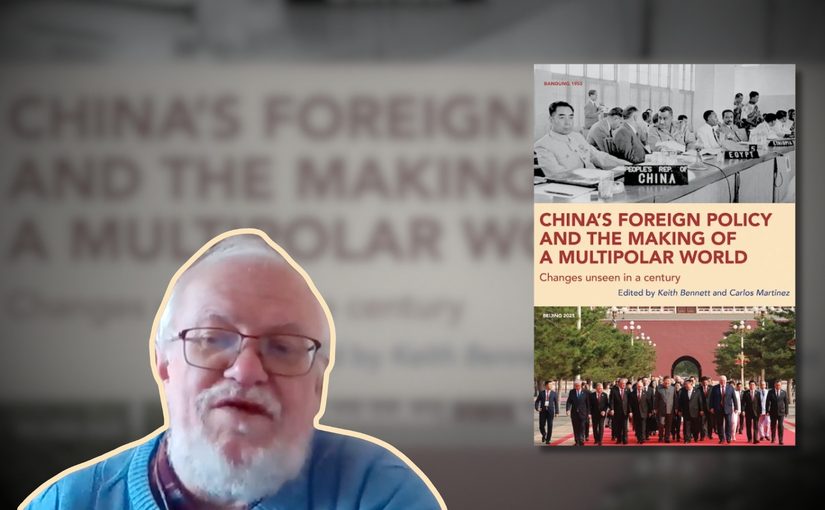
The following is the full text of the remarks prepared by Keith Bennett for the 20 September online launch of China’s Foreign Policy and the Making of a Multipolar World: Changes Unseen in a Century, which he edited along with Carlos Martinez. (His speech as delivered was abbreviated due to time constraints.)
Taking up the concept of changes unseen in a century, advanced by Xi Jinping and incorporated into the book’s title, Keith notes that: “One key manifestation of this in our part of the world can be summed up in three words: Gaza changes everything.”
He adds that: “It is above all this new generation coming to anti-imperialist politics that we hope our book can reach.”
The book is available from socialistbooks.com. The discount code CHINA35 gives 35 percent off all titles from the publishers Praxis Press until the end of the year.
In his testimonial for the book that we’ve been launching online today, George Galloway, as most if not all of you will know currently a parliamentary candidate for the constituency recently held by the prime minister of the United Kingdom, writes:
“Only the light-hearted care naught for where China goes next. The future of China will shape yours.”
One might disagree with George on many things, but on this at least reasonable people should surely not differ.
Yet, as China, to paraphrase Xi Jinping, steadily advances to the centre of the world stage, in our part of the world there is still a dearth of serious scholarship and a serious lack of understanding of what is actually happening, how the country and its leadership actually thinks and acts, and how that is changing the face not only of China but of the world as a whole.
There is not a shortage of copy per se. If you pick up a comic like the Telegraph, the Mail or the Murdoch Times, you can, on a daily basis, read entertaining fiction, suggesting for example that China is bugging tractors in order to harvest the kind of prosaic information readily available on a government website. Slightly more sophisticated versions of the same are offered by the chronically anachronistic voice of classical liberalism, The Economist, and even the venerable pink paper, the Financial Times.
There are a few, but still far too few, books offering excellent Marxist analysis of China, including from Carlos Martinez, Jenny Clegg, and the late and always much missed Jude Woodward. And from John Ross, Ken Hammond and Roland Boer. There are also the rightly popular work of Martin Jacques and the phenomenal scholarship of Peter Nolan.
Yet if you go into a branch of Waterstones, for example, with the possible exception of Martin Jacques’ key work, thanks in large part to its brilliantly provocative title, you’re highly unlikely to find any of these authors.
What you’re likely to find is the scribblings of the renegade Jung Chang, who serves up a diet of political pornography thinly disguised as biography; of the charlatan Gordon Chang, who informed us in 2001 that China was certain to collapse by 2011, yet is still, presumably as a kind of therapy, periodically paraded in public as some kind of China expert; or of Frank Dikötter, whose dubious scholarship would have us believe that the greatest revolution in human history is little more than one great, century-long criminal conspiracy.
What this all reflects is that the battle on the ideological front, and the battle for public opinion, are key parts of the cold war against socialism and human progress; and are key fronts in the class struggle.
Chairman Mao observed that to make a revolution it is always necessary first of all to create public opinion. And the same goes for counter-revolution.
It was precisely in order to take up that battle for public opinion, as a key front in the class struggle, the struggle for peace and against war, the struggle for socialism and against barbarism, that, in May 2021, Carlos, Danny Haiphong and myself, took the initiative to establish Friends of Socialist China. And why Carlos and myself embarked on this book project.
As they have demonstrated again in their contributions today, the authors represent some of the finest activist scholars working in the China field today. We are indebted to them for giving so generously of their time and their wisdom.
I use the designation activist scholars advisedly. This is exactly what we are aiming for. As Stalin well put it in his celebrated work, Foundations of Leninism:
“Of course, theory becomes purposeless if it is not connected with revolutionary practice, just as practice gropes in the dark if its path is not illumined by revolutionary theory. But theory can become a tremendous force in the working-class movement if it is built up in indissoluble connection with revolutionary practice.”
This is exactly where we want to situate this work. Not least, primarily even, because there is also much confusion on the left with regard to both China’s internal and external policies. This is hardly surprising given the imperialist intellectual and cultural hegemony that I’ve alluded to above.
In a country like Britain, anti-China leftism has powerful roots and comes from various directions:
From social democracy, which to the extent that it still stands and fights for progressive reforms favourable to working people, something which is both a developing situation and a topic for legitimate debate, does so on the basis of their somehow existing an identity of interests between the working class and the capitalist class – a Faustian pact that can only ultimately exist at the expense of the oppressed nations and peoples and be sustained by imperialist super profits.
From many who call themselves Trotskyists and who might for our purposes here be described as the far left of social democracy.
To them, one might add those comrades who seem determined to keep fighting the Sino-Soviet dispute, from whatever side of those barricades, apparently oblivious to the fact that the Soviet Union tragically ceased to exist 35 years ago. And those whose disdain for contemporary China is rooted in hopelessly one-sided, idealistic and unrealistic views of the China of the 1960s and 1970s or the Soviet Union of the 1930s and 1940s.
Whatever direction this anti-China leftism comes from, and irrespective of, but not negating, the doubtless good intentions and sincere hard work and contributions to numerous progressive struggles, of many of the comrades concerned, this represents at root the tenacious influence of imperialist ideas in the working class and people’s movements.
This is particularly the case in countries where it is simply difficult to accept that the cutting edge of human progress and liberation is not to be found in the working-class movement of the Global North, but rather to its east and south.
That the vanguard of world revolution, the most advanced theory and practice, is to be found in the hitherto oppressed and downtrodden nations.
Faced with the betrayal of China at the Versailles Peace Conference of 1919, Mao Zedong reflected that progressive Chinese had long looked to the west for enlightenment but could not understand why the master was always beating the student.
The history of revolution in the twentieth and twenty-first century is one of that master/student relationship being reversed.
This became material reality through the Chinese revolution and the other great Asian revolutions in Korea, Vietnam and Laos; through the revolutions in the Western hemisphere in Cuba and Nicaragua; and in Algeria, Zimbabwe, Eritrea and Burkina Faso, in north, south, east and west Africa.
It was summed up by Lenin when he wrote in ‘Better Fewer, But Better’:
“In the last analysis, the outcome of the struggle will be determined by the fact that Russia, India, China, etc., account for the overwhelming majority of the population of the globe. And during the past few years it is this majority that has been drawn into the struggle for emancipation with extraordinary rapidity, so that in this respect there cannot be the slightest doubt what the final outcome of the world struggle will be. In this sense, the complete victory of socialism is fully and absolutely assured.”
It is in this context that Carlos’s chapter on, ‘Is China imperialist?’ and Danny’s on ‘Is China’s foreign policy “good enough?”’ acquire a central place in the book’s standpoint and argumentation.
But are we just bashing our heads against a brick wall? Even if that were apparently the case, I’d still prefer the outlook expressed by Mao Zedong in 1945, when he told the closing session of the Communist Party of China’s Seventh National Congress:
“The Foolish Old Man replied, ‘When I die, my sons will carry on; when they die, there will be my grandsons, and then their sons and grandsons, and so on to infinity. High as they are, the mountains cannot grow any higher and with every bit we dig, they will be that much lower. Why can’t we clear them away?’”
But beyond this, as Xi Jinping often says, and as we have incorporated into the book’s title, we are living through a period of changes unseen in a century. One key manifestation of this in our part of the world can be summed up in three words: Gaza changes everything.
Gaza is not the first genocide, the first holocaust, in history. But it is the first that people can see livestreamed on their phones. And it is probably the first where its perpetrators publicly engage in such shameless and obscene boasting.
In standing against this genocide, in an unprecedented campaign of sustained, mass anti-imperialist mobilisation, a new generation, joined by not a few veterans and many previously uninvolved in any form of political activity, are increasingly questioning not only the blatant lies they are told about Palestine, Lebanon and Iran. With that comes, for some at least, a dawning realisation that if we are lied to so mendaciously on this issue, how can anything at all that they tell us be trusted.
A few years ago, refuting the wholly invented tale of a supposed genocide in Xinjiang could seem like an uphill struggle. Today, the difference between an actual and a fictional genocide is there for all with eyes to see.
It is above all this new generation coming to anti-imperialist politics that we hope our book can reach.
The book inevitably refers to such current and recent events and to specific issues. But overall it has a more general theoretical and historical framework. A projected second volume will aim to provide case studies to show how these are applied to China’s foreign policies and practices, with regard to, for example, the United States, Russia and the former Soviet Union, the European Union, Japan, the Korean peninsula, the South Asian subcontinent, West Asia, Africa and Latin America.
But in addressing this theoretical framework, we aimed to highlight continuity amidst change and development, something highlighted specifically in Ken Hammond’s chapter.
This goes to the very nature of the Chinese revolution itself as one for both national and class liberation. Naturally, this reality finds its expression also in China’s world view and practice.
This is the key context for Michael Dunford’s chapter on ‘Why Chinese and Western visions of world order differ; why the difference matters’, which wonderfully explains and utilises Xi Jinping’s concept of the ‘two integrations’, specifically that of Marxism and fine traditional Chinese culture; for Torkil Lauesen’s chapter on ‘The principal contradiction in the world and China’s pursuit of socialism’, which applies Mao’s key philosophical work to changes at the global level and therefore to China’s practice; and for Jenny’s chapter on taking the five principles of peaceful coexistence, first formulated by Zhou Enlai in 1953 and representing a creative application and development of Lenin’s policy to a new and developing situation, as a guide.
This theme of continuity amidst change and development also inspired the book’s cover, featuring as it does Zhou Enlai with Egypt’s Gamal Abdul Nasser at the 1955 Asian-African Conference at Bandung; and 70 years later, Xi Jinping, flanked by Vladimir Putin and Kim Jong Un, and joined by two dozen leaders from the Global South, at Beijing’s 2025 celebration of the 80th anniversary of victory in the war of resistance against Japanese aggression and the world anti-fascist war.
We have aimed to make this a book of partisan but rigorous scholarship. And I think this is reflected in the 25 testimonials it received before publication and which are printed in the opening pages. Of course they include ones from our close comrades, but they also include ones from friends, like long-time China specialist and Guardian journalist John Gittings and former Labour member of the European parliament Glyn Ford, who certainly would not agree with all its contents, but nevertheless recognise its seriousness and its valid contribution to important debates. To all of them, we express our thanks.
Above all, we would like this book to make a contribution to the struggle against imperialism and for socialism. And for that to happen, we need your help.
Naturally, we would like you to buy it. But you can also ask your local bookshop – especially if you’re lucky enough to have a decent, independent one – to stock it or ask your library to order it. Please use it in your work and if you can promote it on social media or even write a review.
Finally, I must thank our publisher Praxis Press and the indefatigable Kenny Coyle for such professional, warm and comradely collaboration at all times. As well as the International Manifesto Group for their co-organisation and constant support.