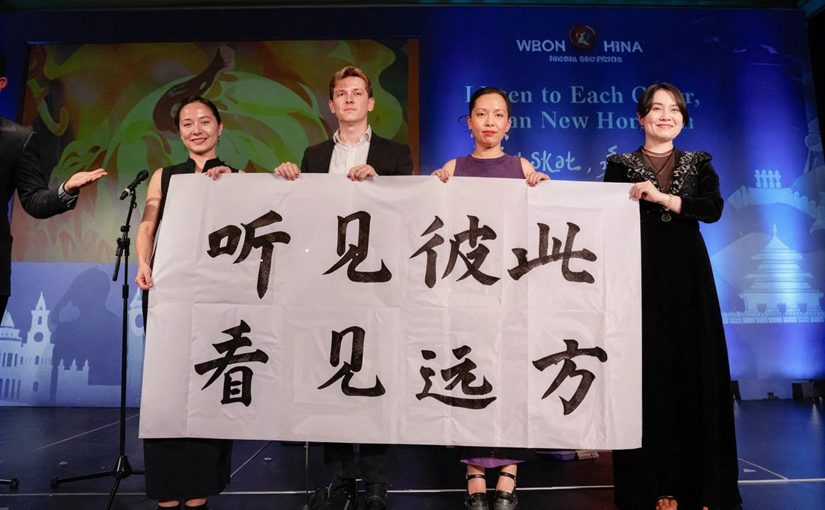
Intended to showcase vibrant and vivid examples of people-to-people links, China Daily organised a ‘Vision China’ event, held at the global headquarters of the Institution of Civil Engineers in central London, on September 17, with the theme, ‘Listen to Each Other, Open New Horizons’.
With opening addresses by Qu Yingpu, publisher and editor-in-chief of China Daily, and Zhao Fei, chargé d’affaires ad interim of the Chinese Embassy in London, the event also heard from renowned British Sinologist Frances Wood, who is also a vice president of the Society for Anglo-Chinese Understanding (SACU). For Frances, mutual learning was not just a ‘good-to-have’, but also central to her nearly 35 years of work at the British Library, which involved the conservation and digitisation of some 7,000 complete manuscripts and 6,000 fragments of ancient scrolls from Dunhuang, in northwest China’s Gansu province, dating from the third to the 10th century CE.
Michael Spence, president and provost of University College London (UCL), noted the contributions of the college’s 15,000 Chinese students and its many more Chinese alumni, as well as its role in promoting Chinese language learning in schools across the country. Listing some daunting global challenges – from fighting climate change to governing artificial intelligence – Spence said he does not see any “reasons for pessimism”, because what British and Chinese students, scholars and researchers have already achieved through collaboration is “proof of what is possible”.
Other speakers included Chen Junyan, winner of the second prize at the Leeds International Piano Competition in 2024, Mike Longhurst, a fellow of the Royal Photographic Society, and Richard Trainor, provost of the Rhodes Trust at the University of Oxford.
Also addressing the event was Ondřej Dostál, a member of the European Parliament from Czechia (Czech Republic), who began by noting with reference to his country’s socialist period: “I was born in Czechoslovakia, which was never a colonial power, but always helped the developing countries across the world with technologies and education.”
Referring to how times are changing, he continued: “When I was eight, we had elections and I remember seeing posters: ‘With the Soviet Union. Forever and never otherwise.’ When I was eleven, the Soviet Union was no more.”
Disillusioning experiences followed with the United States and the European Union, however: “I first visited China in 2008 to attend a conference on health law.
“After I was elected to the European Parliament, I decided to visit China again. I had the honour of being the only Member of the European Parliament present at China’s Victory Day parade commemorating the 80th anniversary of the victory over fascism. [On September 3, 2025.] And, just over a month ago, on 15 August, I laid flowers at Chairman Mao’s statue in Shaoshan, and saw, not only in the museum, but also in real life, what China has achieved over a mere three generations.
“I saw the incredible development of China in cities such as Shanghai, Hangzhou, Changsha and Ningbo. I saw how China has become the world’s leader in innovation, patents and high-quality productive forces and in technologies that will shape our future.”
But there is still “an enormous gap between the real China and perceptions of China in the West”.
Dostál thinks there are two reasons for that:
- The speed of China’s growth has been extraordinary. For many people in the West, their perceptions have simply failed to keep pace with reality.
- But there is also “the purposeful smearing of China in parts of our political discourse and media, designed to prevent our friendship and mutually profitable engagement. And to contain China’s rise. It is the narrative of a ‘China as a threat’.”
He argues: “We need to understand China as it actually is. Its achievements and its contradictions. Its history and its aspirations. Its government and its people.
“Only when we see China as it actually is, can Europe formulate a China policy based on reality rather than projection.”
We reprint below the text of Mr Dostál’s speech, which has been lightly edited by us. It is preceded by China Daily’s report of the event, written by its journalists Xing Yi and Wang Huazhong.
Cultivating deeper cultural bonds encouraged at event
Sep 19 (China Daily) – Engagement with China fosters a deeper understanding of the country and encourages more people from abroad to visit China, meet its people and experience its culture, said experts in education, art and music on Thursday.
They made the remarks during a Vision China event held at the global headquarters of the Institution of Civil Engineers in central London, the United Kingdom. The event, themed “Listen to Each Other, Open New Horizons”, aimed to inspire its audiences to engineer a cultural bridge to overcome boundaries with an inclusive mindset.
The London edition of Vision China followed a recent phone conversation between President Xi Jinping and British Prime Minister Andy Burnham. It underscored their consensus on the importance of communication and exchanges in developing bilateral relations.
During the phone call, Xi urged China and the UK to seek common ground while reserving differences and make their mutually beneficial cooperation even stronger. Burnham expressed the UK’s readiness to advance bilateral cooperation across all fields and strengthen people-to-people exchanges.
Qu Yingpu, publisher and editor-in-chief of China Daily, which hosted Thursday’s event, said via video call that “by heeding this shared vision, China and the UK can also encourage the wider international community to bridge differences and work together”.
Even though advancements in technology have made communication quicker and easier, “we still need closer exchanges to break preconceptions that often shape how we see one another”, Qu said.
He called on everyone to see, meet and listen, in order to build better understanding through empathy and carry forward friendly relations. “We need to open new horizons for international cooperation and development, and make greater contributions to building a community with a shared future for humanity,” Qu added.
Zhao Fei, charge d’affaires ad interim of the Chinese embassy in the UK, also gave a speech.
Ondrej Dostal, a member of the European Parliament representing Czechia, said that he has traveled to China several times and has seen how the nation has effectively become the world’s most significant innovator and producer, which is more than mere technological prowess.
For many people in the West, “perceptions have simply failed to keep pace with reality” and there is an “enormous gap between the real China and perceptions of China”, he said, referring to the intentional smearing of China in Western political discourse and media, which is designed to prevent engagement with the country and contain its rise.
“Therefore, a great deal of work is ahead of us in explaining China’s vision to Europe and to the world,” Dostal said, noting that Europe and China face “too many common challenges to allow misunderstandings to define our relationship”.
“Only when we see China as it actually is can Europe formulate a China policy based on reality, rather than projection. Only then can we move beyond outdated stereotypes and manufactured threat narratives. Only then can we move beyond rivalry and finally embrace partnership — and, I hope, friendship,” he added.
For renowned British Sinologist Frances Wood, mutual learning is not just a good-to-have, but also central to her 30 years of work at the British Library, which involves the conservation and digitization of some 7,000 complete manuscripts and 6,000 fragments of ancient scrolls from Dunhuang, Northwest China’s Gansu province, dating from the third century to the 10th century.
She recalled how British and Chinese conservators worked together to repair the fragments, forging friendships and a family-like bond along the way.
“After decades of hard work, we had a lot to show for it — over 7,000 ‘new’ manuscripts transformed from ‘debris’, and the publishing of a series of academic books,” Wood said.
For Chen Junyan, winner of the second prize at the Leeds International Piano Competition in 2024, listening is not a metaphor. “It is what we do,” she said, adding that music education in Shanghai and London taught her that listening helps broaden one’s horizons.
She noted that one of her primary reasons for being a pianist is being able to play chamber music with instrumentalists from different countries.
“When I play … I listen. They respond. I change. They change. Eventually, we create something that none of us on stage could have created alone,” Chen said. “Meaningful cultural exchanges work very much in the same way. It is about being curious enough to listen, and being confident enough to allow what we hear to change us.”
Mike Longhurst, a fellow of UK’s Royal Photographic Society, said that he saw China through different lenses — as a photographer, a businessman, a tourist and a sustainability consultant — during his visits to different Chinese cities.
He captured on camera the Pudong skyline from the Bund in Shanghai; the majestic Great Wall in Beijing; the ancient Terracotta Warriors in Xi’an, Shaanxi province; the giant pandas in Chengdu, Sichuan province; and the karst landscapes in Guilin, Guangxi Zhuang autonomous region.
“But what I loved most is seeing the people. It is the people and their values that determine how all things are created, maintained and presented. … I see a togetherness that is missing in many cultures,” Longhurst said.
“China is so vast that whatever I have seen can only be a very small part. I hope to go back again and see more,” he added.
As China extended its visa-free policy to many European countries, including ordinary British passport holders in February, more people from the UK and Europe are traveling to China to see the country with their own eyes. Meanwhile, China remains one of the UK’s most important sources of visa applicants.
The growth in people-to-people exchanges is even more pronounced in the field of education. Around 100,000 Chinese students visit the UK for higher studies each year.
Richard Trainor, provost of Rhodes Trust at the University of Oxford, said the 44 Chinese Rhodes scholars to date have become central to its scholar community, which encompasses continents and disciplines. “Chinese Rhodes scholars show that empathy, collaboration and courage are key attributes for 21st century leadership,” said Trainor.
Michael Spence, president and provost of University College London, noted the contributions of UCL’s 15,000 Chinese students and 30,000 Chinese alums, as well as the university’s role in promoting Chinese language learning in public schools across England.
“Shared language is, of course, only one route to building trust among many. Yet for me, it most clearly underlines the values needed for trust and cooperation,” Spence said, recalling his own Chinese language studies.
Listing some daunting global challenges — from fighting climate change to governing artificial intelligence — Spence said he does not see any “reasons for pessimism”, because what British and Chinese students, scholars and researchers have already achieved through collaboration is “proof of what is possible”.
The Vision China event also included a dialogue session, in which six young panelists from China, the UK and France exchanged views on economic and trade cooperation, people-to-people exchanges and cultural interactions.
Through candid sharing of ideas, they explored their experiences and perspectives across borders, contributing to greater understanding and common ground and highlighting the role that young people play in shaping the future of China-UK and China-Europe relations.
Speech by Ondřej Dostál MEP
Thank you very much for inviting me to the conference, “China Through My Eyes”. The timing could hardly be better. I come from Strasbourg, where Ursula von der Leyen just delivered her State of the Union Address. I promise to be shorter. And not so depressing.
My name is Ondřej Dostál, and I am a member of the European Parliament and of its Health and Environment Committees, and a member of Delegations to ASEAN, the Arabian Peninsula, Russia – and China.
I was born in Czechoslovakia, which was never a colonial power, but always helped the developing countries across the world with technologies and education. The friendship remained, which is good, because who has no friends, has no cards.
Times are changing. When I was eight, we had elections and I remember seeing posters: “With the Soviet Union. Forever and never otherwise.”
When I was eleven, the Soviet Union was no more.
Then, we began to say: With the United States, forever and never otherwise. Even in 2024, it was still like that. But now, our leaders don’t say it anymore and rather decided yesterday to embrace and kiss Canada. Literally.
And finally, the European Union was perceived by many as the be-all and end-all for the Czech Republic. Yesterday, Mrs Von der Leyen, as the Monty Python shopkeeper, tried to persuade us that the European Blue is not dead, it has not yet ceased to be, it has not yet, joined the choir invisible, that it is not an EX Union. That it is just daydreaming. And pining for the fjords. After being rejected by Iceland.
What I want to say is: things change, and perceptions change. As President Xi Jinping has analysed, we are witnessing today “changes unseen in a century”. And in order to bring our citizens peace and prosperity, we must observe, learn and adapt.
I first visited China in 2008 to attend a conference on health law.
After I was elected to the European Parliament, I decided to visit China again. I had the honour of being the only Member of the European Parliament present at China’s Victory Day parade commemorating the 80th anniversary of the victory over fascism. And just over a month ago, on 15 August, I laid flowers at Chairman Mao’s statue in Shaoshan, and saw, not only in the museum, but also in real life, what China has achieved over a mere three generations.
I saw the incredible development of China in cities such as Shanghai, Hangzhou, Changsha and Ningbo. I saw how China has become the world’s leader in innovation, patents and high-quality productive forces and in technologies that will shape our future.
But I also saw the pride of Chinese people in what their country has achieved, while at the same time remaining curious about the world, eager to learn and exchange ideas. And all that without provoking a single war of aggression over half of a century. Which other superpower can claim that?
What all of this inevitably reveals is the enormous gap between the real China and perceptions of China in the West.
In my view, there are two reasons for that.
The first is: The speed of China’s growth has been extraordinary. For many people in the West, their perceptions have simply failed to keep pace with reality.
It is not so surprising, that many still hold an image of China that is years, if not decades, out of date: a China that follows but does not innovate; a China still plagued by pollution; a China with a small middle class; a China that produces cheap goods but cannot lead in advanced technology.
But there is second, much worse, source of misunderstanding. It is the purposeful smearing of China in parts of our political discourse and media, designed to prevent our friendship and mutually profitable engagement. And to contain China’s rise. It is the narrative of a “China as a threat”.
We are told that China is not simply a partner and competitor, but a “systemic rival” even by the European Commission.
So, it is difficult for many Westerners to have an accurate picture of China because the country is growing so fast. But it is also difficult, because vast efforts are being undertaken to prevent Westerners from forming an accurate picture in the first place.
And this is precisely why today’s discussion matters. I saw an inscription on a stone in front of the Renmin University in Beijing: “To see truth from facts.” It is a duty of academicians, and I would say, also of us politicians.
China must learn to tell its story well, and also we in Europe must learn to tell our story – and, more importantly, listen to the others, as well.
And we should not merely listen. We should actively contribute to a more accurate mutual understanding.
China is already doing a great deal in this regard. And let me take this opportunity to congratulate China Daily on the important work it is doing.
China’s visa-free policy has also been a major gamechanger. It has boosted tourism and allowed countless Westerners to travel to China, experience the country for themselves, speak to its people and see a reality that often bears remarkably little resemblance to the image presented in our media. Unfortunately, we Czechs remain one of the few Europeans who still have a visa requirement. Perhaps under our new government, a much more reasonable one I can say, things will change for better.
I have tried to do my part.
I am proud to say that my office is the only office in the European Parliament that not only has a Chinese intern but also maintains a presence on Chinese social media. I am also happy to regularly contribute articles and short comments to China Daily.
And together with the Chinese Mission to the European Union, I am organising an event on China’s Global Governance Initiative on 14 October in the European Parliament—and you are, of course, all warmly invited.
Because ultimately, Europeans need neither an idealised China nor a demonised China.
We need to understand China as it actually is.
Its achievements and its contradictions.
Its history and its aspirations. Its government and its people.
Only when we see China as it actually is, can Europe formulate a China policy based on reality rather than projection.
Only then can we move beyond outdated stereotypes and manufactured threat narratives.
Only then can we move beyond rivalry and finally embrace partnership—and, I hope, friendship.
And that is how we can work together to build a better future.
Thank you.