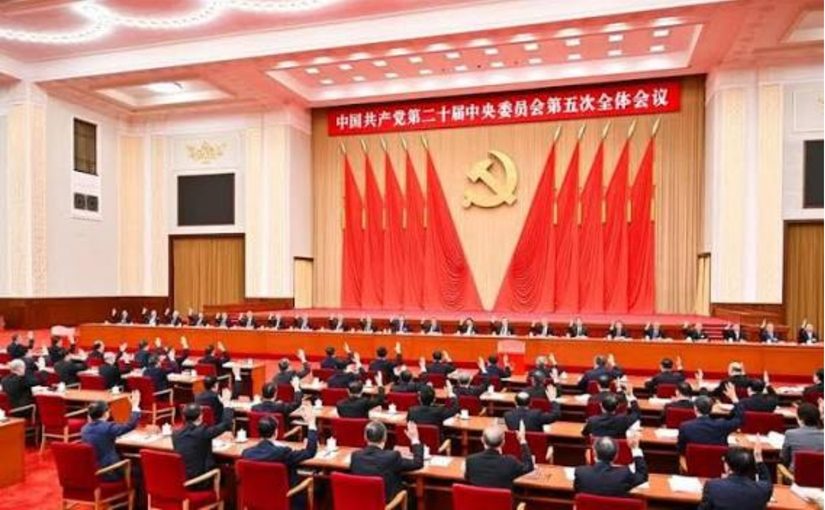
The following article by Javier Vadell – Associate Professor in the Department of International Relations at the Pontifical Catholic University of Minas Gerais (PUC Minas) in Brazil and a researcher at the National Council for Scientific and Technological Development (CNPq) – offers a thoughtful Marxist reading of the fifth plenary session of the 20th Central Committee of the Communist Party of China (CPC), which met in Beijing from 26 to 29 October and adopted a resolution on persevering with full and rigorous Party self-governance.
Drawing on Antonio Gramsci’s conception of the party as the “modern Prince” – a collective intellectual capable of forging a collective will and leading the intellectual and moral reform of society – Javier argues that the plenum reaffirms the CPC’s self-understanding as a “collective ethical intellectual”, one that must continually educate, discipline and renew itself as the condition for its long-term capacity to govern.
He examines the concept of self-reform as the Party’s answer to the “historical cycle of rise and fall”, and analyses the anti-corruption formula of the “three nots” – ensuring that officials do not dare, are not able and do not want to be corrupt – as an articulation of coercion, institutions and consensus. Of these, he notes, the third is the most ambitious: punishing and regulating are tasks of the state, but ensuring that a cadre does not want to be corrupt is the task of a collective intellectual seeking to shape consciences.
This article first appeared on Javier Vadell’s Substack.
The Party as the “Collective Intellectual” of China’s Governance
Between October 26 and 29, 2026, the 20th Central Committee of the Communist Party of China (CPC) convened in Beijing for its fifth plenary session. The meeting approved the Decision of the Central Committee of the Communist Party of China on Some Major Issues Concerning Perseveringly Advancing Full and Rigorous Party Self-Governance. Unlike plenums focused on the economy or five-year planning, this session was centered on the Party itself.
Antonio Gramsci wrote that the modern party should be the “modern Prince”—that is, a collective organism capable of shaping a collective will and leading an intellectual and moral reform of society. In this view, the party is a collective intellectual that organizes consensus, educates its cadres, and provides ethical direction to society as a whole.
In this regard, the Fifth Plenum reaffirms the CPC’s self-conception as a collective ethical intellectual that must constantly nourish itself with ethical commitments in its governance role. It is a subject that claims for itself the task of educating, disciplining, and renewing itself as a condition for sustaining its capacity to govern in the long term.
Self-Reform as an Ethical Project
The plenum’s communique maintains that the CPC found two answers to break the “historical cycle of rise and fall” of dynasties and regimes: “placing the government under the scrutiny of the people” and “self-reform.” The second is presented as the Party’s own creation and as a contribution to the Marxist theory of political parties. The document also acknowledges, with unusual candor, that there was a period of “weakening, ineffectiveness, and laxity” in Party leadership prior to 2012.
The Decision enshrines Xi Jinping Thought on Party Building as a synthesis that integrates Marxism with the Chinese context and traditional culture. Faced with the “four tests” and the “four risks,” the text defines strengthening commitment to the Party as a fundamental task. This commitment involves ideals and convictions, loyalty, a sense of service to the people, seeking truth from facts, and cultivating moral integrity.
It is here that the ethical dimension becomes explicit. The Party presents itself not merely as a manager of the State, but as a builder of character: it educates its more than 100 million members, selects cadres based on “political conviction” and an “exemplary work style,” and ties the Confucian ethics of the virtuous public servant to Leninist discipline. In Marx’s formulation in the Theses on Feuerbach, the educator must also be educated—and the plenum turns this requirement into institutional policy.
Coercion, Institutions, and Consensus: The “Three Nots”
The core of the anti-corruption strategy is the formula of the “three nots” (不敢腐, 不能腐, 不想腐): creating an environment in which no one dares, can, or wants to be corrupt. The plenum defines it as a fundamental directive for winning the fight against corruption, stating that the Party and corruption are incompatible “like water and fire.”
The formula reproduces the articulation between coercion and consensus:
- “Not daring” corresponds to deterrence: high pressure on finance, state-owned enterprises, energy, and education, targeting both high-level “tigers” and grassroots “flies.”
- “Not being able to” corresponds to institutions: the National Supervisory Commission, the Supervision Law, and the “Eight Rules” against the “four winds” (formalism, bureaucracy, hedonism, and extravagance).
- “Not wanting to” corresponds to hegemony proper: the internalization of integrity values through ideological and moral education.
The numbers indicate the scale of the undertaking. According to official data released in October 2026, since 2012 disciplinary inspection organs have filed 8.105 million cases and punished 7.922 million people, including 963 cadres under the management of the Central Committee. In 2025 alone, 115 officials at the ministerial level or higher were investigated.
The third “not” is the most ambitious. Punishing and regulating are tasks of the State; ensuring that a cadre does not want to be corrupt is the task of a collective intellectual intending to shape consciences.
Depuration and Renewal of the Leadership
The plenum was also an act of large-scale self-cleansing. A total of 279 members attended—162 full members and 117 alternate members—compared to the 376 elected in 2022 (205 full and 171 alternate).
Investigation reports on 34 officials were approved: 18 by the Central Commission for Discipline Inspection and 16 by the Central Military Commission. The plenum confirmed the expulsion of 33 of them and removed Li Yunze from his Party posts.
At the same time, the plenum renewed its ranks. Ten alternate members were promoted to full membership, and Zhang Shengmin was elected to the Political Bureau. The official framing views this move as the Party’s “self-transcendence”; external analysts also see it as the consolidation of power by central leadership and a realignment of loyalties, particularly within the Armed Forces. The two interpretations are not mutually exclusive: ethical discipline is also an instrument of power.
Toward the 21st National Congress: Final Remarks
The plenum scheduled the 21st National Congress for the second half of 2027 in Beijing. The communique describes it as a congress of “paramount importance,” taking place as the Party strives to essentially achieve socialist modernization.
The Fifth Plenum demonstrates the CPC acting as a collective ethical intellectual in the full sense: it produces theory, establishes ethical criteria for its cadres, institutionalizes oversight, and punishes in an exemplary manner. It does not separate ethics, organization, and power; on the contrary, it makes ethics the declared foundation of its legitimacy for long-term governance.
The third “not”—not wanting to be corrupt—remains the horizon, not the final destination. This will be the decisive test inherited by the 21st Congress.