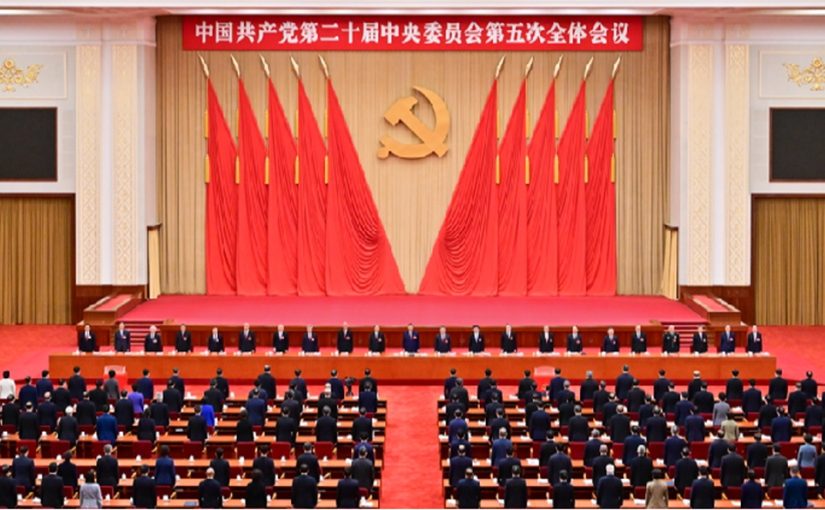
We are pleased to publish the following article by Oliver Vargas, a British-Bolivian journalist with CGTN. It offers an accessible explanation of some of the key concepts behind the fifth plenary session of the 20th Central Committee of the Communist Party of China (CPC), which met in Beijing from 26 to 29 October and adopted a resolution on persevering with full and rigorous Party self-governance.
Oliver explains what “full and rigorous Party self-governance” means – strict rules, oversight, anti-corruption work and internal discipline, combined with constant self-renewal – and why the CPC regards it as essential at this stage of China’s drive for socialist modernisation.
He goes on to discuss how these principles translate into practice at the grassroots, visiting an administrative service centre in Haikou (capital of Hainan province), where a new “One-Form” system has cut repetitive paperwork and helped identify elderly residents who were entitled to social security subsidies but had never claimed them.
Readers may also be interested in the full text of the plenum’s resolution and of Xi Jinping’s explanation of it, both of which we have published.
The following article is published here in English for the first time.
As the cold autumn of Beijing sets in, I set sail for the tropical island province of Hainan. Nestled among the towering palm trees are the local government offices that people need for everyday tasks like registering business licenses or signing up for social security. The stacks of paperwork and photocopies are now a thing of the past as new technologies are implemented to relieve everyone from the arduous administrative work that eats up people’s time. It might seem like a small local story, but it zooms in on something much bigger: how the Communist Party of China (CPC) works to identify and solve everyday problems facing the people. Around the world, many are asking how socialist governance can work in practice, and specifically how it operates in China. This is a window into understanding it.
The Fifth Plenary Session of the 20th CPC Central Committee wrapped up in Beijing on Thursday, October 29. Over four days, the Party’s central leadership gathered to tackle major institutional questions.
The session boiled down to two key tasks: the Political Bureau accounting for its recent work, and the Central Committee examining what full and rigorous self-governance means in practice.
What is “full and rigorous Party self-governance”?
Observers outside China may not be familiar with this term, but it is essential to understanding the Party’s operational priorities. Essentially, it means holding the Party to account through strict rules, oversight, anti-corruption drives, and internal discipline—paired with constant self-renewal. Under General Secretary Xi Jinping’s leadership, the Central Committee has focused heavily on how a long-ruling Marxist party can build and adapt in the new era. Under “Xi Jinping Thought on Party Building,” this translates into several interconnected principles:
- Continuous self-correction: Targeting corruption, bureaucracy, formalism, and anything that creates distance between the Party and the public.
- Placing authority in an “institutional cage”: Enforcing rules and structural accountability rather than relying solely on an individual official’s ethics.
- Maintaining organizational capacity: Preventing a political party with over 100 million members from becoming fragmented or sluggish.
- Linking Party reform to national development: Treating internal cleanup as a direct driver of broader modernization.
- Staying close to the people: Building operational mechanisms to consistently identify and address public needs as they arise.
Why now?
The Party is focused on its overarching goal of achieving basic socialist modernization. In practice, that means driving industrial upgrading, green energy transitions, bridging urban-rural divides, and market opening. Navigating these modern challenges requires a disciplined cadre of party officials. So to steer this forward, the plenum set out seven guiding principles for self-governance:
“Serving the Party’s missions and tasks; taking strengthening the Party politically as the overarching principle; exercising rigorous governance across the board; adopting a problem-oriented approach; upholding fundamental principles and breaking new ground; adhering to a top-down approach; and running the Party according to regulations.“
Through political conviction, professional skills, strong work ethic, and iron discipline, Party organizations at every level are expected to strengthen their leadership and organizational capacity. Addressing the ongoing anti-corruption campaign, the official communiqué noted that “taking integrated steps to ensure that officials do not have the audacity, opportunity, or desire to commit corruption is both an important strategy for full and rigorous Party self-governance and a fundamental guideline for our fight against corruption.“
The Central Committee emphasized that this internal discipline is critical at a time when global and domestic conditions are shifting rapidly. The job of protecting China’s sovereignty, security, and development interests – while keeping the Party clean and effective – remains a mammoth task. Favorable conditions exist, but so do complex new circumstances and challenges.
On the ground
Big goals and high-level directives will dominate the headlines, but implementation happens on the ground – where the international news won’t be tracking the day-to-day local impact. So, to observe this firsthand, I traveled from Beijing to the southern tropical province of Hainan, a region that has served as a pioneer of innovative policies since becoming China’s largest Special Economic Zone, and more recently, a Free Trade Port.
In Haikou, the provincial capital, we visited an administrative service center where officials explained their new “One-Form” system. This uses new technologies to automate repetitive paperwork that people used to have to submit – a problem that the Party explicitly identified as a burden for citizens trying to register small businesses or apply for social security. Left unaddressed, these administrative headaches are the kind of things that lead to a detachment between officials and the people.
Wang Dujuan, an official at the Haikou office, explained: “In the past, our reports had to be submitted multiple times. Screening personnel was time-consuming and labor-intensive, taking up time that should have been used to serve the public. After ‘One-Form’ was launched, the system took over that screening automatically.”
These administrative fixes may not seem glamorous, but they can change people’s lives. For instance, the automated system in Wang’s office flagged numerous elderly residents in the area who qualified for social security subsidies, but had never signed up for them. They are now receiving that support directly. This is what running the Party according to regulations looks like when translated into frontline service delivery.
Next steps
Steering an organization of over 101 million members and 5.4 million primary-level Party branches is a massive logistical effort. Translating the plenum’s guiding principles into practical outcomes now stands as a primary mandate for the Party leadership.
After the communiqué was published, the Central Committee held a press conference in Beijing and talked over how the session had gone. Tang Fangyu, deputy director of the Policy Research Office of the CPC Central Committee, told media:
“The major accomplishments over the past year have been achieved amid accelerated transformation never seen in a century globally and rising uncertainties and unpredictable factors facing the country’s development and withstanding great pressure and various risks and challenges. They do not come easily. We owe these achievements to the leadership of the CPC Central Committee with General Secretary Xi Jinping at the core and the sound guidance of Xi Jinping Thought on Socialism with Chinese Characteristics for a new era.
The most important outcome of the session is the adoption of the resolution. Our party has dedicated itself to achieving lasting greatness for the Chinese nation. Party building concerns the future of the party, and the success of the undertakings of the party and country…the session made strategic plans on the self-governance, the development and strengthening of the party. This is very important and necessary.”