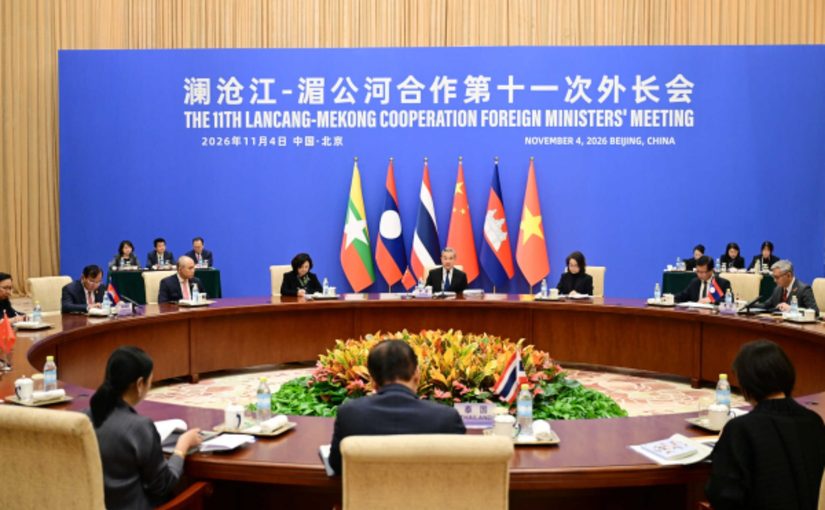
On November 4, 2026, the 11th Lancang-Mekong Cooperation (LMC) Foreign Ministers’ Meeting was held in Beijing. The meeting was co-chaired by Chinese Foreign Minister Wang Yi and Deputy Prime Minister and Minister of Foreign Affairs of Thailand Sihasak Phuangketkeow. The LMC mechanism links China with its five neighbours who jointly share this major Asian river and the meeting was also attended by Cambodian Deputy Prime Minister and Foreign Minister Prak Sokhonn, Lao Deputy Prime Minister and Foreign Minister Thongsavanh Phomvihane, Vietnamese Foreign Minister Le Hoai Trung, and Union Minister for National Planning, Investment and Foreign Economic Relations of Myanmar U Aung Kyaw Hoe.
Addressing the meeting, Wang Yi said that this year marks the 10th anniversary of the first LMC Leaders’ Meeting. Over the past decade, under the strategic guidance of the leaders of the six countries, the LMC has moved from a phase of building, in which the framework was set up and areas of cooperation expanded, to a phase of deep engagement, in which mechanisms are strengthened and practical results are emphasised, becoming the most dynamic and promising “golden example” of regional cooperation.
He put forward a five-point proposal:
- Pool new synergies for solidarity and collective strength. We should conduct regular exchanges between the legislative bodies and political parties of Lancang-Mekong countries, resolve differences and disputes through dialogue and consultation, and enhance security and resilience through development and cooperation.
- Build a new frontier for opening-up and win‑win outcomes. We should effectively implement the Lancang-Mekong Special Cooperation Plan on Poverty Reduction through Science and Technology, advance the building of the information sharing platform for water resources cooperation, and increase the sense of gains of the people in the basin through more exemplary small and beautiful livelihood programmes.
- Foster new impetus for green innovation. We should expand cooperation in emerging areas such as the digital economy, artificial intelligence, smart manufacturing and smart agriculture, and promote the transformation of regional industrial cooperation toward new, smarter and greener development.
- Consolidate new underpinnings for security. We should oppose external interference and intervention, oppose instigating bloc confrontation, resist the building of exclusive “small circles”, and never allow the resurgence of militarism.
- Foster new highlights in disaster management. We should push for the establishment of the Lancang-Mekong cross-border disaster early-warning cooperation mechanism, set up a real-time multi-source data exchange mechanism among Lancang-Mekong countries on hydrology, meteorology, geology and forest fires, and strengthen cooperation in disaster monitoring, early warning and emergency response, create a regional network for meteorological disaster monitoring and early warning, and build a demonstration network of earthquake early warning stations, so as to jointly enhance capabilities of disaster prevention, mitigation and relief.
The meeting participants agreed to strengthen the building of the LMC Economic Development Belt, deepen cooperation in priority areas such as connectivity, water resources and the environment, expand digital transformation and green innovation, and promote people‑to‑people and cultural exchanges. They agreed to strengthen disaster management, maintain close security coordination, combat cross‑border crimes, and safeguard regional tranquillity. They further agreed to promote the alignment and mutual reinforcement between the LMC and other regional mechanisms, uphold multilateralism, jointly address global challenges, and work together to build a Lancang‑Mekong community with a shared future.
Wang Yi also held bilateral meetings with his five counterparts, from Laos, Myanmar and Thailand on November 3, and from Vietnam and Cambodia on November 4.
Meeting with Lao Deputy Prime Minister and Foreign Minister Thongsavanh Phomvihane, Wang Yi stated that China and Laos are friendly socialist neighbours sharing a common future, with shared ideals and convictions, the same social systems and similar development paths. This year marks the 65th anniversary of the establishment of diplomatic relations between China and Laos and the “Year of China-Laos Friendship”. In June, General Secretary of the Communist Party of China (CPC) Central Committee and President Xi Jinping and visiting General Secretary of the Central Committee of the Lao People’s Revolutionary Party (LPRP) and Lao President Thongloun Sisoulith jointly announced the decision to build an all-weather China-Laos community with a shared future in the new era. China and Laos are socialist comrades and brothers. The two sides should maintain strategic resolve and focus on managing their own affairs well. In the next stage, the two sides should make joint preparations for high-level exchanges, make good use of the Joint Committee for China-Laos Economic Corridor Cooperation, and accelerate the development of the China-Laos Railway and cooperation in trade, minerals and other fields. They should jointly organise activities for the “Year of China-Laos Friendship”, vigorously promote people-to-people and cultural exchanges, strengthen solidarity and coordination in multilateral and regional affairs, and deliver more tangible results in building a China-Laos community with a shared future.
Thongsavanh Phomvihane stated that the Lao side warmly congratulated the CPC on the important outcomes of the Fifth Plenary Session of the 20th Central Committee of the party. Laos stands ready to strengthen exchanges with the CPC on its experience in Party and state governance, learn from the CPC’s valuable experience, and advance the development of the LPRP and the state. Taking the 65th anniversary of the establishment of diplomatic relations between Laos and China as an opportunity, Laos is ready to unswervingly advance the building of a Laos-China community with a shared future in accordance with the consensus reached by the top leaders of the two parties and countries.
Meeting with Minister of the Ministry of National Planning, Investment and Foreign Economic Relations of Myanmar U Aung Kyaw Hoe, Wang Yi said that in June this year, President Xi Jinping held an important meeting with President Min Aung Hlaing during his state visit to China. The two sides agreed to accelerate the building of a China-Myanmar community with a shared future. China supports political reconciliation in Myanmar and supports the country’s new government in stabilising the situation, developing the economy, improving people’s livelihoods and revitalising the country.
U Aung Kyaw Hoe stated that Myanmar upholds the Five Principles of Peaceful Coexistence, carries forward the traditional friendship between Myanmar and China, and always adheres to the one-China principle. President Min Aung Hlaing’s successful visit to China recently gave a strong boost to the development of bilateral relations. Myanmar thanked China for its assistance with post-earthquake reconstruction and expressed its readiness to work with China to accelerate the implementation of projects under the Myanmar-China Economic Corridor and continuously enhance the level of mutually beneficial cooperation between the two countries. Myanmar will step up efforts to combat telecom fraud in cooperation with China and other countries in the region.
Meeting with Deputy Prime Minister and Minister of Foreign Affairs of Thailand Sihasak Phuangketkeow, Wang Yi said that the concept of “China-Thailand Family” has become more deeply rooted in the hearts of the two peoples. The two countries have always understood, trusted and supported each other, continuously enriching their traditional friendship with new dimensions suited to the times. China appreciates the new Thai government, led by Prime Minister Anutin Charnvirakul, for its firm commitment to a friendly policy toward China. This serves Thailand’s fundamental and long-term interests and contributes to regional peace and stability. He noted that, amid a turbulent and volatile international landscape, strengthening cooperation among neighbouring countries is of vital importance. Lancang-Mekong Cooperation is one of the most successful subregional cooperation mechanisms in the region. China highly appreciates Thailand’s important contributions to the development of Lancang-Mekong Cooperation and stands ready to work with Thailand, as co-chair countries, to make good preparations for the Fifth Lancang-Mekong Cooperation Leaders’ Meeting.
Meeting with Vietnamese Foreign Minister Le Hoai Trung, Wang Yi said that since the beginning of this year, under the personal guidance of the top leaders of the two Parties and two countries, the building of a China-Vietnam community with a shared future has been deepened and consolidated. The two sides have strengthened strategic communication, deepened economic, trade and investment cooperation and connectivity, carried out more active people-to-people and cultural exchanges, jointly responded to the new challenges of the world’s unprecedented changes in a century, and made new contributions from China and Vietnam to building a community with a shared future for humanity. General Secretary Xi Jinping emphasised that to govern the country, the Party must be governed first, and only when the Party thrives can the country be strong. The just-concluded Fifth Plenary Session of the 20th Central Committee of the CPC made strategic arrangements for persevering with full and rigorous party self-governance, demonstrating the firm determination of the CPC to carry out the great self-reform to the end. We will earnestly and solidly implement the major arrangements of the Fifth Plenary Session, so that the CPC will always maintain its advanced nature and purity, consolidate the flesh-and-blood ties with the people, and continue to be the core force leading the Chinese people in advancing Chinese modernisation. The current global political and economic situation proves that the socialist path and institutional choices adhered to by China and Vietnam are correct. The two parties share common ideals and beliefs as well as common practices in party and state governance. They should strengthen mutual learning and mutual support, continuously enrich the contemporary connotation of the China-Vietnam community with a shared future, promote the modernisation process of their respective countries, and inject new impetus into the revitalisation of the world socialist cause, so that Marxism will radiate vitality in the 21st century.
Le Hoai Trung congratulated the successful convening of the Fifth Plenary Session of the 20th CPC Central Committee, expressing the belief that the important arrangements of the session will push China into a new stage of development. The 14th National Congress of the Communist Party of Vietnam (CPV) also put forward the line and policies for the self-renewal of the CPV and the realisation of the two centenary goals. Under the strategic guidance of the top leaders of the two parties and two countries, Vietnam-China relations have continued to develop, with fruitful cooperation results in various fields.
Meeting with Cambodian Deputy Prime Minister and Foreign Minister Prak Sokhonn, Wang Yi said that China and Cambodia are ironclad friends, and the friendship between the two countries, which has stood the test of time, embodies the painstaking efforts of leaders of successive generations. Facing the intertwined and turbulent international situation, the stability and resilience of China-Cambodia comprehensive strategic cooperation have become increasingly prominent. As Cambodia’s most reliable strategic support, China will continue to firmly support Cambodia in taking a development path that suits its national conditions and is ready to strengthen strategic communication with Cambodia to jointly meet external challenges and better promote the respective modernisation drives of the two countries.
Prak Sokhonn said that China is Cambodia’s most trustworthy partner. The historic mutual visits between the leaders of the two countries have pointed out the direction for developing the all-weather Cambodia-China community with a shared future in the new era. The Cambodian side fully supports all initiatives put forward by President Xi Jinping, congratulates the CPC on the successful convening of the Fifth Plenary Session, thanks China for its long-term support and assistance for Cambodia’s economic and social development, reaffirms its adherence to the one-China principle, supports China’s great cause of peaceful reunification, and opposes all forms of “Taiwan independence”.
Wang Yi also had an informal “tea chat” with his Cambodian and Thai counterparts as part of China’s ‘quiet diplomacy’ aimed at resolving tensions between the two countries centring on their disputed border.
Following the conclusion of the meeting, Wang Yi met the press jointly with Deputy Prime Minister and Minister of Foreign Affairs of Thailand Sihasak Phuangketkeow.
Wang said that since its launch in 2016, under the strategic guidance of the leaders of the six countries, the LMC has maintained strong momentum and built an all-round, multi-level, and wide-ranging cooperation architecture, continuously delivering tangible and inclusive outcomes. The saying that the six LMC countries have not only a shared river but also a shared future has taken even deeper roots among the people, and the LMC can be called the most dynamic stellar example of regional cooperation.
The six foreign ministers agreed that more in-depth and substantive progress has been made in building communities with a shared future between China and the five Mekong countries, and noted that the annual trade between the two sides now surpassed US$500 billion, an increase of 150 percent over a decade ago and accounting for about half of the trade volume between China and ASEAN (Association of South East Asian Nations). Wang Yi added that a river surges on ceaselessly, linking us with a shared future. China will work with Mekong countries to act not as “talk shops” but as “bulldozers,” stay problem-oriented, deliver more real benefits, put people’s livelihoods first, take action as the priority, and adopt more robust measures to advance common modernisation, so as to keep the LMC at the forefront of regional cooperation, set a benchmark for the solidarity and collective strength of the Global South, and jointly inject the positive energy of the LMC into today’s turbulent and complex world.
The following articles were originally published on the website of the Chinese Foreign Ministry.
The 11th LMC Foreign Ministers’ Meeting Held in Beijing
November 4 (MFA) – On November 4, 2026, the 11th Lancang-Mekong Cooperation (LMC) Foreign Ministers’ Meeting was held in Beijing. The meeting was co-chaired by Member of the Political Bureau of the CPC Central Committee and Foreign Minister Wang Yi and Deputy Prime Minister and Minister of Foreign Affairs of Thailand Sihasak Phuangketkeow. Cambodian Deputy Prime Minister and Foreign Minister Prak Sokhonn, Lao Deputy Prime Minister and Foreign Minister Thongsavanh Phomvihane, Vietnamese Foreign Minister Le Hoai Trung, and Union Minister for National Planning, Investment and Foreign Economic Relations of Myanmar U Aung Kyaw Hoe attended the meeting.
Wang Yi said that this year marks the 10th anniversary of the first LMC Leaders’ Meeting. Over the past decade, under the strategic guidance of the leaders of the six countries, the LMC has moved from a phase of building, in which the framework was set up and areas of cooperation expanded, to a phase of deep engagement, in which mechanisms are strengthened and practical results are emphasized, becoming the most dynamic and promising “golden example” of regional cooperation. Over the past decade, Lancang-Mekong countries have linked their future more closely together, gained more robust momentum for development, forged a stronger underpinning for security, and deepened people‑to‑people exchanges, bringing tangible benefits to the people of the six countries and effectively contributing to their respective modernization processes.
Wang Yi said that the LMC has grown from strength to strength thanks to the six countries’ commitment to the founding aspiration of good neighborliness, friendship and a shared future; to focusing on development and practical cooperation; to the vision of benefiting the people and being open and inclusive; and to the courage of pursuing innovation and breaking new ground. In the face of multiple challenges in the region and the world, the Lancang-Mekong family should think and act as one and jointly take the LMC to a new level, solidly advance “LMC 2.0,” work together to usher in a new golden decade of the LMC, and promote the common modernization of Lancang-Mekong countries.
Wang Yi introduced the significance and major measures of the fifth plenary session of the 20th CPC Central Committee, saying that under the strong leadership of the Communist Party of China, China will continue its innovation-driven, high-quality and positive development, injecting new impetus and bringing new opportunities to the region and the world. China is ready to work with Mekong countries, following the direction set by the leaders, taking more robust measures and moving in a more coordinated manner, to continuously enrich the Lancang‑Mekong community with a shared future, keep the LMC at the forefront of regional cooperation, make it a benchmark for the solidarity and collective strengths of the Global South, and contribute LMC’s efforts to building a community with a shared future for humanity.
Wang Yi put forward a five-point proposal:
First, pool new synergies for solidarity and collective strengths. We should carry forward the LMC culture of equality, sincerity, mutual assistance and kinship, and effectively implement the second Five‑Year Plan of Action on Lancang-Mekong Cooperation. We should maintain close exchanges and policy communication at all levels, and strengthen top‑level design and forge strategic consensus on important issues such as regional development and security. We should conduct regular exchanges between the legislative bodies and political parties of Lancang-Mekong countries, resolve differences and disputes through dialogue and consultation, and enhance security and resilience through development and cooperation.
Second, build a new frontier for opening-up and win‑win outcomes. We should strengthen alignment of development strategies, deepen cooperation along the New International Land‑Sea Trade Corridor, advance a large market for economy and trade, robust circulation of finance, big connectivity of infrastructure and extensive people-to-people and cultural exchanges in the region, and jointly build the LMC Economic Development Belt. We should promote trade and investment liberalization and facilitation in the region, strengthen joint research, technical cooperation and personnel training, effectively implement the Lancang-Mekong Special Cooperation Plan on Poverty Reduction through Science and Technology, advance the building of the information sharing platform for water resources cooperation, and increase the sense of gains of the people in the basin through more exemplary small and beautiful livelihood programs.
Third, foster new impetus for green innovation. We should expand cooperation in emerging areas such as the digital economy, artificial intelligence, smart manufacturing and smart agriculture, and promote the transformation of regional industrial cooperation toward new, smarter and greener development. We welcome more Mekong countries to join the World Artificial Intelligence Cooperation Organization. We should strengthen the Research Center for Lancang-Mekong Youth Astronomical Sciences and push for the establishment of the Lancang-Mekong Universities Alliance, so as to inject youthful dynamism into innovation cooperation.
Fourth, consolidate new underpinnings for security. We should carry forward the Asian values of peace, cooperation, openness and inclusiveness and the vision of common, comprehensive, cooperative and sustainable security. We should oppose external interference and intervention, oppose instigating bloc confrontation, resist the building of exclusive “small circles,” and never allow the resurgence of militarism. We should give full play to the role of the Lancang-Mekong Ministerial Meeting on Law Enforcement and Security Cooperation, step up joint crackdowns on cross-border criminal activities such as online gambling, telecom fraud, drug trafficking, counterfeiting and smuggling, and continue to ensure the success of the Safe Lancang-Mekong Operation and the Mekong River Joint Patrol and Law Enforcement Operation.
Fifth, foster new highlights in disaster management. We should push for the establishment of the Lancang-Mekong cross-border disaster early-warning cooperation mechanism, set up a real-time multi-source data exchange mechanism among Lancang-Mekong countries on hydrology, meteorology, geology and forest fires, and strengthen cooperation in disaster monitoring, early warning and emergency response, create a regional network for meteorological disaster monitoring and early warning, and build a demonstration network of earthquake early warning stations, so as to jointly enhance capabilities of disaster prevention, mitigation and relief.
All participating parties extended congratulations on the successful convening of the fifth plenary session of the 20th CPC Central Committee and spoke highly of the positive progress the LMC has made over the past decade. They held that Lancang-Mekong countries have carried out practical cooperation in the spirit of mutual respect, good neighborliness and friendship, driving the LMC to grow from strength to strength, effectively promoting regional economic integration and the economic and social development of various countries, and benefiting their people. They appreciated China’s important leading role in promoting cooperation, agreed with China’s proposed direction for the next stage of work, and reiterated that they will continue to uphold good neighborliness, friendship, mutual respect and mutual trust, deepen cooperation and achieve win‑win outcomes, so as to jointly promote sustainable development and prosperity in the region. They agreed to strengthen the building of the LMC Economic Development Belt, deepen cooperation in priority areas such as connectivity, water resources and the environment, expand digital transformation and green innovation, and promote people‑to‑people and cultural exchanges. They agreed to strengthen disaster management, maintain close security coordination, combat cross‑border crimes, and safeguard regional tranquility. They agreed to promote the alignment and mutual reinforcement between the LMC and other regional mechanisms, uphold multilateralism, jointly address global challenges, and work together to build a Lancang‑Mekong community with a shared future. All parties agreed to maintain close communication to ensure that the fifth LMC Leaders’ Meeting achieves complete success and positive outcomes.
The meeting adopted the 2025 Implementation Progress Report on the Five‑Year Plan of Action on Lancang-Mekong Cooperation (2023‑2027) and the 2026 List of Projects Supported by the Lancang-Mekong Cooperation Special Fund.
After the meeting, Wang Yi met the press jointly with Deputy Prime Minister and Minister of Foreign Affairs of Thailand Sihasak Phuangketkeow.
During the meeting, Wang Yi also met separately with Deputy Prime Minister and Minister of Foreign Affairs of Thailand Sihasak Phuangketkeow, Cambodian Deputy Prime Minister and Foreign Minister Prak Sokhonn, Lao Deputy Prime Minister and Foreign Minister Thongsavanh Phomvihane, Vietnamese Foreign Minister Le Hoai Trung, and Union Minister for National Planning, Investment and Foreign Economic Relations of Myanmar U Aung Kyaw Hoe.
Wang Yi Meets with Lao Deputy Prime Minister and Foreign Minister Thongsavanh Phomvihane
November 3 (MFA) – On November 3, 2026, Member of the Political Bureau of the CPC Central Committee and Minister of Foreign Affairs Wang Yi met in Beijing with Lao Deputy Prime Minister and Foreign Minister Thongsavanh Phomvihane, who is in China to attend the 11th Lancang-Mekong Cooperation Foreign Ministers’ Meeting.
Wang Yi stated that China and Laos are friendly socialist neighbors sharing a common future, with shared ideals and convictions, the same social systems and similar development paths. This year marks the 65th anniversary of the establishment of diplomatic relations between China and Laos and the “Year of China-Laos Friendship”. In June, General Secretary of the CPC Central Committee and President Xi Jinping and visiting General Secretary of the Central Committee of the Lao People’s Revolutionary Party (LPRP) and Lao President Thongloun Sisoulith jointly announced the decision to build an all-weather China-Laos community with a shared future in the new era. Standing at a new historical starting point, China stands ready to work with Laos to implement the important consensus reached by the top leaders of the two parties and countries, advance the building of a China-Laos community with a shared future in a solid and steady manner, and work together to safeguard regional peace and tranquility.
Wang Yi briefed the Lao side on the successful convening of the Fifth Plenary Session of the 20th Central Committee of the CPC last week. He said that, guided by Xi Jinping Thought on Party Building, the plenary session deliberated and adopted the Resolution on Certain Major Issues concerning Persevering with Full and Rigorous Party Self-Governance and made a series of strategic plans in this regard. This will not only provide a strong political guarantee for implementing China’s 15th Five-Year Plan and advancing Chinese modernization, but also create new opportunities for China’s cooperation with other countries, including Laos. China and Laos are socialist comrades and brothers. The two sides should maintain strategic resolve and focus on managing their own affairs well. In the next stage, the two sides should make joint preparations for high-level exchanges, make good use of the Joint Committee for China-Laos Economic Corridor Cooperation, and accelerate the development of the China-Laos Railway and cooperation in trade, minerals and other fields. They should jointly organize activities for the “Year of China-Laos Friendship”, vigorously promote people-to-people and cultural exchanges, strengthen solidarity and coordination in multilateral and regional affairs, and deliver more tangible results in building a China-Laos community with a shared future.
Thongsavanh Phomvihane stated that the Lao side warmly congratulated the CPC on the important outcomes of the Fifth Plenary Session of the 20th Central Committee of the CPC. Laos stands ready to strengthen exchanges with the CPC on its experience in Party and state governance, learn from the CPC’s valuable experience, and advance the development of the LPRP and state. Taking the 65th anniversary of the establishment of diplomatic relations between Laos and China as an opportunity, Laos is ready to unswervingly advance the building of a Laos-China community with a shared future in accordance with the consensus reached by the top leaders of the two parties and countries. Laos looks forward to making good use of the strategic dialogue mechanism between the two countries, advancing the implementation of the framework for Laos-China Economic Corridor cooperation, facilitating trade, developing the Laos-China Railway into a model project, and strengthening cooperation in connectivity, energy, minerals, artificial intelligence and other fields, as well as jointly combating and preventing transnational crime. Laos stands ready to strengthen coordination with China in international and regional affairs and work together to safeguard ASEAN unity and autonomy, as well as regional peace and stability.
Wang Yi Meets with Minister of the Ministry of National Planning, Investment and Foreign Economic Relations of Myanmar U Aung Kyaw Hoe
November 3 (MFA) – On November 3, 2026, Member of the Political Bureau of the CPC Central Committee and Minister of Foreign Affairs Wang Yi met in Beijing with Minister of the Ministry of National Planning, Investment and Foreign Economic Relations of Myanmar U Aung Kyaw Hoe, who is in China to attend the 11th Lancang-Mekong Cooperation Foreign Ministers’ Meeting.
Wang Yi stated that China and Myanmar are “pauk-phaw” brothers who have stood together through thick and thin and a community with a shared future that supports each other through difficult times. In June this year, President Xi Jinping held an important meeting with President Min Aung Hlaing during his state visit to China. The two sides agreed to accelerate the building of a China-Myanmar community with a shared future. China supports political reconciliation in Myanmar and supports the country’s new government in stabilizing the situation, developing the economy, improving people’s livelihoods and revitalizing the country. China has always been a strategic partner on which Myanmar can rely. China stands ready to work with Myanmar to further deepen and substantiate the building of a China-Myanmar community with a shared future.
Wang Yi stated that the two sides should coordinate development and security, steadily advance key projects under the China-Myanmar Economic Corridor, strengthen cooperation in such areas as energy and resources, step up efforts to combat online gambling and telecom fraud, and prevent a resurgence of illicit activities in Myawaddy. China hopes that Myanmar would take concrete measures to ensure the safety of Chinese personnel, institutions, and projects in the country.
U Aung Kyaw Hoe stated that Myanmar upholds the Five Principles of Peaceful Coexistence, carries forward the traditional friendship between Myanmar and China, and always adheres to the one-China principle. President Min Aung Hlaing’s successful visit to China recently gave a strong boost to the development of bilateral relations. Myanmar thanked China for its assistance with post-earthquake reconstruction and expressed its readiness to work with China to accelerate the implementation of projects under the Myanmar-China Economic Corridor and continuously enhance the level of mutually beneficial cooperation between the two countries. Myanmar will step up efforts to combat telecom fraud in cooperation with China and other countries in the region. Myanmar welcomes more Chinese companies to invest and do business in the country. Myanmar also thanked China for upholding justice for Myanmar on the international stage and expressed its readiness to work with China to ensure the successful conclusion of this Lancang-Mekong Cooperation Foreign Ministers’ Meeting.
Wang Yi Meets with Deputy Prime Minister and Minister of Foreign Affairs of Thailand Sihasak Phuangketkeow
November 3 (MFA) – On November 3, 2026, Member of the Political Bureau of the CPC Central Committee and Foreign Minister Wang Yi met in Beijing with Deputy Prime Minister and Minister of Foreign Affairs of Thailand Sihasak Phuangketkeow, who is in China for a working visit and to attend the 11th Lancang-Mekong Cooperation Foreign Ministers’ Meeting.
Wang Yi stated that in recent years, President Xi Jinping and King Maha Vajiralongkorn Phra Vajiraklaochaoyuhua have maintained close communication and jointly guided the building of a China-Thailand community with a shared future toward greater depth and substance. The concept of “China-Thailand Family” has become more deeply rooted in the hearts of the two peoples. The two countries have always understood, trusted and supported each other, continuously enriching their traditional friendship with new dimensions suited to the times. China appreciates the new Thai government, led by Prime Minister Anutin Charnvirakul, for its firm commitment to a friendly policy toward China. This serves Thailand’s fundamental and long-term interests and contributes to regional peace and stability. China is ready to strengthen strategic communication with Thailand, deepen mutually beneficial cooperation and take the building of a China-Thailand community with a shared future to new heights.
Wang Yi stated that China stands ready to work with Thailand to make good preparations for high-level exchanges in the next stage and provide strategic support for bilateral relations. China-Thailand economic and trade cooperation is the result of the two countries’ complementary strengths and market-driven forces, and is inherently mutually beneficial and win-win. China is willing to further open its vast market to Thailand, encourage more Chinese enterprises to invest in the country, and expand cooperation in emerging sectors such as AI, computing centers, and semiconductors. China also hopes that Thailand will continue to provide a stable, sound and predictable business environment for Chinese enterprises. The two sides should step up joint efforts to combat online gambling and telecom fraud and thoroughly root out the conditions that allow such crimes to proliferate.
Wang Yi noted that, amid a turbulent and volatile international landscape, strengthening cooperation among neighboring countries is of vital importance. Lancang-Mekong Cooperation is one of the most successful subregional cooperation mechanisms in the region. China highly appreciates Thailand’s important contributions to the development of Lancang-Mekong Cooperation and stands ready to work with Thailand, as co-chair countries, to make good preparations for the Fifth Lancang-Mekong Cooperation Leaders’ Meeting. The two sides should also strengthen coordination and collaboration within multilateral mechanisms such as the Asia-Pacific Economic Cooperation (APEC) and China-ASEAN cooperation, remove various disruptions, and inject greater stability and certainty into regional and global peace and development.
Wang Yi briefed the Thai side on the fifth plenary session of the 20th Central Committee of the CPC and expressed China’s readiness to engage in exchanges with Thailand on experience in Party and state governance.
Sihasak Phuangketkeow expressed his congratulations on the successful convening of the fifth plenary session of the 20th Central Committee of the CPC and spoke highly of the CPC’s people-centered governing philosophy. He stated that the Thailand-China comprehensive strategic cooperative partnership is broad and deep, with strong momentum and bright prospects. Thailand firmly adheres to the one-China policy and stands ready to remain China’s strategic partner, work together to implement the consensus reached by the leaders of the two countries, advance the development of the Thailand-China comprehensive strategic cooperative partnership, and deepen mutually beneficial cooperation in such areas as connectivity, trade and investment, and green transition. The two sides should also step up efforts to combat online gambling and telecom fraud. Thailand welcomes more Chinese companies to invest and do business in the country. The Thai side commends China’s contribution to the development of the Lancang-Mekong region and stands ready to play its part in working with China to ensure the success of this Lancang-Mekong Cooperation Foreign Ministers’ Meeting and make good preparations for the Fifth Lancang-Mekong Cooperation Leaders’ Meeting. Thailand is willing to strengthen communication and coordination with China in international affairs, jointly champion multilateralism, and uphold the international order with the United Nations at its core.
The two sides also exchanged views on regional issues of common concern.
Wang Yi Meets with Vietnamese Foreign Minister Le Hoai Trung
November 4 (MFA) – On the afternoon of November 4, 2026, Member of the Political Bureau of the CPC Central Committee and Foreign Minister Wang Yi met in Beijing with Vietnamese Foreign Minister Le Hoai Trung, who is in China to attend the 11th Lancang-Mekong Cooperation Foreign Ministers’ Meeting.
Wang Yi said that the Lancang-Mekong Cooperation Foreign Ministers’ Meeting was successfully held this morning, and Lancang-Mekong cooperation shows a brighter prospect, which will help the modernization process of all countries in the region and bring more well-being to the people of all countries. He thanked the Vietnamese side for its positive contributions to the success of the meeting. Since the beginning of this year, under the personal guidance of the top leaders of the two Parties and two countries, the building of a China-Viet Nam community with a shared future has been deepened and consolidated. The two sides have strengthened strategic communication, deepened economic, trade and investment cooperation and connectivity, carried out more active people-to-people and cultural exchanges, jointly responded to the new challenges of the world’s unprecedented changes in a century, and made new contributions from China and Viet Nam to building a community with a shared future for humanity. China stands ready to work with Viet Nam to implement the consensus reached by the leaders of the two Parties and two countries, maintain close high-level exchanges, promote all-round connectivity of land, sea and air, enhance trade and investment facilitation, seize the development opportunities of emerging industries, expand cooperation in tourism, personnel training and other fields, and continuously enhance people-to-people bonds. The two sides will strengthen multilateral coordination on platforms such as East Asia cooperation, properly handle maritime issues, and jointly maintain peace and stability in the South China Sea. The two sides will support each other in successfully hosting the APEC Economic Leaders’ Meeting.
Wang Yi said that General Secretary Xi Jinping emphasized that to govern the country, the Party must be governed first, and only when the Party thrives can the country be strong. The just-concluded Fifth Plenary Session of the 20th Central Committee of the Communist Party of China (CPC) made strategic arrangements for persevering with full and rigorous party self-governance, demonstrating the firm determination of the CPC to carry out the great self-reform to the end. We will earnestly and solidly implement the major arrangements of the Fifth Plenary Session, so that the CPC will always maintain its advanced nature and purity, consolidate the flesh-and-blood ties with the people, and continue to be the core force leading the Chinese people in advancing Chinese modernization. The current global political and economic situation proves that the socialist path and institutional choices adhered to by China and Viet Nam are correct. The two parties share common ideals and beliefs as well as common practices in party and state governance. They should strengthen mutual learning and mutual support, continuously enrich the contemporary connotation of the China-Viet Nam community with a shared future, promote the modernization process of their respective countries, and inject new impetus into the revitalization of the world socialist cause, so that Marxism will radiate vitality in the 21st century.
Le Hoai Trung congratulated the successful convening of the Fifth Plenary Session of the 20th CPC Central Committee, expressing the belief that the important arrangements of the session will push China into a new stage of development. The 14th National Congress of the Communist Party of Vietnam (CPV) also put forward the line and policies for the self-renewal of the CPV and the realization of the two centenary goals. Under the strategic guidance of the top leaders of the two parties and two countries, Viet Nam-China relations have continued to develop, with fruitful cooperation results in various fields. The Vietnamese side is ready to work with China to implement the consensus of the top leaders of the two parties and two countries, strengthen the alignment of development strategies, and promote more results in practical cooperation. The Vietnamese side appreciates the achievements of Lancang-Mekong cooperation, speaks highly of the important role played by China and the positive contributions it has made, and is willing to strengthen coordination with China to continue promoting cooperation among regional countries, bring more well-being to the people of all countries, and make greater contributions to regional and world peace, development and stability.
Wang Yi Meets with Cambodian Deputy Prime Minister and Foreign Minister Prak Sokhonn
November 4 (MFA) – On the afternoon of November 4, 2026, Member of the Political Bureau of the CPC Central Committee and Foreign Minister Wang Yi met in Beijing with Cambodian Deputy Prime Minister and Foreign Minister Prak Sokhonn, who is in China to attend the 11th Lancang-Mekong Cooperation Foreign Ministers’ Meeting.
Wang Yi thanked the Cambodian side for its important contributions to the success of the Lancang-Mekong Cooperation Foreign Ministers’ Meeting, stating that Lancang-Mekong cooperation has a sound foundation and broad prospects, which will help Cambodia achieve development and revitalization and improve people’s livelihood. China and Cambodia are ironclad friends, and the friendship between the two countries, which has stood the test of time, embodies the painstaking efforts of leaders of successive generations. The building of the all-weather China-Cambodia community with a shared future in the new era continues to deepen, and the “Diamond Hexagon cooperation framework” has brought tangible benefits and well-being to the Cambodian people. Facing the intertwined and turbulent international situation, the stability and resilience of China-Cambodia comprehensive strategic cooperation have become increasingly prominent. As Cambodia’s most reliable strategic support, China will continue to firmly support Cambodia in taking a development path that suits its national conditions, and is ready to strengthen strategic communication with Cambodia to jointly meet external challenges and better promote the respective modernization drives of the two countries.
Wang Yi said that the Fifth Plenary Session of the 20th Central Committee of the Communist Party of China (CPC) was successfully held last week, which clearly set the requirement for persevering with full and rigorous party self-governance. To govern the country, the Party must be governed first, and the Party must be governed with strict standards. Only when the Party thrives can the country be strong. We will implement the arrangements of the Fifth Plenary Session, fulfill the purpose of serving the people, adhere to the concept of exercising state power for the people, continuously consolidate the Party’s governing position, lead high-quality development with high-quality Party building, provide strong political guarantee for the 15th Five-Year Plan period, and also create more opportunities for the development of China-Cambodia relations. The two sides should jointly make good preparations for the next stage of high-level exchanges, strengthen strategic communication, and safeguard common strategic interests. We will advance the construction of the “Industrial Development Corridor” and the “Fish and Rice Corridor”, and deepen practical cooperation in infrastructure, agriculture and other fields. We will continue to crack down on telecom fraud strictly without pause, and never allow telecom fraud crimes to resurge. We will promote the practical implementation of Lancang-Mekong cooperation projects to continuously improve people’s well-being. We will strengthen coordination and cooperation on multilateral platforms such as China-ASEAN cooperation and East Asia cooperation, and promote the building of a more just and equitable global governance system.
Prak Sokhonn congratulated China on successfully hosting the Lancang-Mekong Cooperation Foreign Ministers’ Meeting, and thanked China for inviting the foreign ministers of Cambodia and Thailand for a tea chat, which reflects China’s constructive position of always resolving disputes through peace and dialogue. Lancang-Mekong cooperation is of great significance to the economic and social development of Cambodia and the region. The Cambodian side appreciates the important role China plays in Lancang-Mekong cooperation, and is willing to continue making its own contributions to the mechanism. China is Cambodia’s most trustworthy partner. The historic mutual visits between the leaders of the two countries have pointed out the direction for developing the all-weather Cambodia-China community with a shared future in the new era. The Cambodian side fully supports all initiatives put forward by President Xi Jinping, congratulates the CPC on the successful convening of the Fifth Plenary Session, thanks China for its long-term support and assistance for Cambodia’s economic and social development, reaffirms its adherence to the one-China principle, supports China’s great cause of peaceful reunification, and opposes all forms of “Taiwan independence”. Cambodia is ready to work with China to implement the important consensus reached by the leaders of the two countries, strengthen the alignment of development strategies, continuously crack down on online gambling and telecom fraud crimes, and continuously elevate the level of bilateral law enforcement and security cooperation.
Wang Yi Has a Tea Chat with Foreign Ministers of Cambodia and Thailand
November 4 (MFA) – On November 4, 2026, Member of the Political Bureau of the CPC Central Committee and Minister of Foreign Affairs Wang Yi invited Cambodian Deputy Prime Minister and Minister of Foreign Affairs and International Cooperation Prak Sokhonn and Deputy Prime Minister and Minister of Foreign Affairs of Thailand Sihasak Phuangketkeow for a tea chat on the sidelines of the 11th Lancang-Mekong Cooperation Foreign Ministers’ Meeting.
The three sides had constructive exchanges on strengthening cooperation and maintaining regional stability, including promoting the establishment of confidence-building measures and improving relations between Cambodia and Thailand.
Wang Yi on Outcomes of 11th LMC Foreign Ministers’ Meeting
November 4 (MFA) – On November 4, 2026, the 11th Lancang-Mekong Cooperation (LMC) Foreign Ministers’ Meeting was held in Beijing. After the meeting, Member of the Political Bureau of the CPC Central Committee and Foreign Minister Wang Yi met the press jointly with Deputy Prime Minister and Minister of Foreign Affairs of Thailand Sihasak Phuangketkeow.
Wang Yi said that the 11th LMC Foreign Ministers’ Meeting had just been successfully held. Since its launch in 2016, under the strategic guidance of the leaders of the six countries, the LMC has maintained strong momentum and built an all-round, multi-level, and wide-ranging cooperation architecture, continuously delivering tangible and inclusive outcomes. The saying that the six LMC countries have not only a shared river but also a shared future has taken even deeper roots among the people, and the LMC can be called the most dynamic stellar example of regional cooperation.
The six foreign ministers agreed that more in-depth and substantive progress has been made in building communities with a shared future between China and the five Mekong countries, and that the trade between the two sides surpassed US$500 billion, an increase of 150 percent over a decade ago, accounting for about half of the trade volume between China and ASEAN. The LMC Economic Development Belt has been effectively implemented, and the development of the Lancang‑Mekong Innovation Corridor has achieved remarkable results. The Safe Lancang‑Mekong Operation has been implemented efficiently and cracked down hard on combating cross‑border online gambling and telecom fraud. The LMC Special Fund has provided support for over 1,000 development projects, benefiting all Lancang-Mekong countries and bringing tangible benefits to their people. The Lancang-Mekong Visa launched by China has facilitated people-to-people exchanges among the six countries.
The six foreign ministers agreed that the LMC, which started as a seed ten years ago, has grown into a towering tree today, thanks to the six countries’ commitment to the founding aspiration of good neighborliness, friendship and a shared future; to focusing on development and practical cooperation; to the vision of benefiting the people and being open and inclusive; and to the courage of pursuing innovation and breaking new ground. In the face of multiple challenges in the region and the world, the Lancang-Mekong family should take the opportunity of successfully convening the fifth LMC Leaders’ Meeting to take the LMC to a new level.
First, pool new synergies for solidarity and collective strengths. We should carry forward the LMC culture of equality, sincerity, mutual assistance and kinship, and effectively implement the second Five‑Year Plan of Action on Lancang-Mekong Cooperation. We should maintain close exchanges and policy communication at all levels, and strengthen top‑level design and build strategic consensus on important issues such as regional development and security. We should resolve differences and disputes through dialogue and consultation, enhance security and resilience through development and cooperation, and jointly safeguard the overall situation of friendly cooperation.
Second, jointly promoting opening-up and win-win outcomes. We should deepen cooperation along the New International Land-Sea Trade Corridor, promote trade and investment liberalization and facilitation in the region, promote more quality products of Mekong countries to enter the Chinese market, and continue to build the LMC Economic Development Belt. We should strengthen cooperation on whole-basin governance, and build the information sharing platform for water resources cooperation. We should advance tourism cooperation and establish the Lancang-Mekong Tourism Cities Cooperation Alliance at an early date. We should make good use of the LMC Special Fund to support the implementation of more small and beautiful livelihood programs.
Third, jointly expand green innovation. We should strengthen cooperation in emerging areas such as the digital economy, artificial intelligence, smart manufacturing and smart agriculture, and promote the transformation of regional industrial cooperation toward new, smarter and greener development. Giving play to the demonstration and driving effect of the Lancang-Mekong Future Satellite, we should strengthen the Research Center for Lancang-Mekong Youth Astronomical Sciences, and push for the establishment of the Lancang-Mekong Universities Alliance, so as to inject youthful dynamism into innovation cooperation.
Fourth, jointly intensify security coordination. We should uphold the vision of common, comprehensive, cooperative and sustainable security and resist the building of exclusive “small circles.” We should give full play to the role of the Lancang-Mekong Ministerial Meeting on Law Enforcement and Security Cooperation, continue to ensure the success of the Safe Lancang‑Mekong Operation and the Mekong River Joint Patrol and Law Enforcement Operation, strengthen the Lancang-Mekong Integrated Law Enforcement and Security Cooperation Center, and push for the early institutionalization of judicial cooperation among Lancang-Mekong countries.
Fifth, jointly strengthen disaster management. We should push for the establishment of the Lancang-Mekong cross-border disaster early-warning cooperation mechanism, explore the establishment of Lancang-Mekong Disaster Management and Rescue Cooperation Center in southern provinces of China, and strengthen cooperation between China and Mekong countries in disaster monitoring, early warning and emergency response. We should promote the application of MAZU, China’s intelligent meteorological early warning solution, in Mekong countries, and build a regional network for meteorological disaster monitoring and early warning. We should strengthen cooperation on earthquake monitoring, early warning and emergency response, and build a demonstration network of earthquake early warning stations.
Wang Yi said that a river surges on ceaselessly, linking us with a shared future. China will work with Mekong countries to act not as “talk shops” but as “bulldozers,” stay problem-oriented, deliver more real benefits, put people’s livelihoods first and take action as the priority, and adopt more robust measures to advance common modernization, so as to keep the LMC at the forefront of regional cooperation, set a benchmark for the solidarity and collective strengths of the Global South, and jointly inject the positive energy of the LMC into today’s turbulent and complex world.