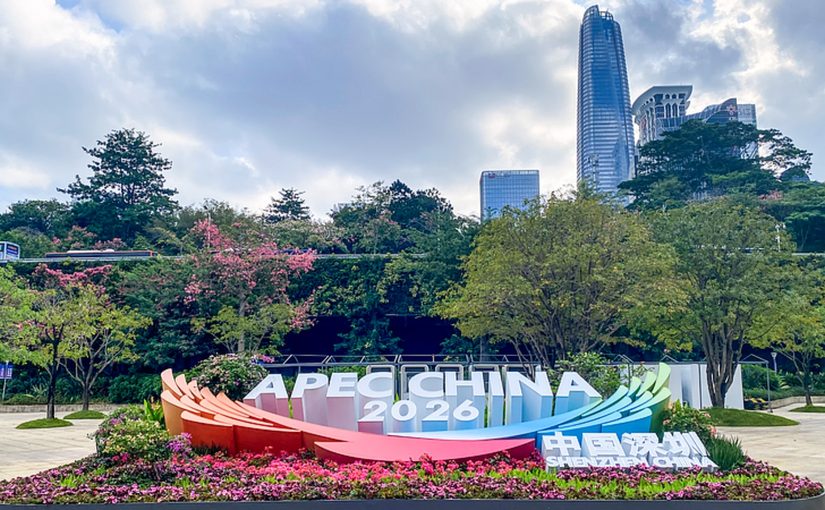
We are pleased to publish the following article by Wu Yanni, a Beijing-based political commentator and contributor to Chinese and international media, written as Asia-Pacific Economic Cooperation (APEC) leaders gather in Shenzhen for this year’s summit.
Drawing on her interviews with veterans of the infrastructure corps who built Shenzhen from scratch, and on her own two years working in the city’s education sector, Wu Yanni uses Shenzhen’s development as a lens on regional cooperation. She traces how the city grew out of openness and connectivity – from the first foreign investment approved there in the early 1980s, to its deep trade links with APEC economies and its cross-border innovation partnership with Hong Kong – and contrasts its pioneering, boundary-breaking spirit with the rising trend in the West towards decoupling, exclusive blocs and restrictions on the movement of people and ideas.
“Isolation brings stagnation; connection unlocks possibility,” she writes. “The Shenzhen story is not a one-off wonder. It shows a path available to the whole Asia-Pacific.”
As APEC leaders converge on Shenzhen, what they encounter is more than a gleaming hub of technology and trade. The city itself tells a quiet story about what regional collaboration can deliver. Less than half a century ago, this stretch of the Pearl River Delta was little more than a collection of fishing villages. Today it is one of the most dynamic centres of innovation and exchange in the Asia-Pacific. Many overseas observers call Shenzhen’s rise an economic miracle, yet they often overlook the human spirit that powered it: a willingness to break old boundaries, test new paths and embrace connection – something in short supply amid today’s global drift towards fragmentation.
Back in June, I reported on the ground in Shenzhen and sat down with veterans of the infrastructure corps who built the city from scratch. These early builders told me there were no ready-made blueprints back then – no established rules, no proven playbook for development. Progress came through trial and error, from daring to do things that had never been done before. Their accounts stayed with me. Shenzhen did not advance by sealing itself off. It advanced because it chose to connect, to exchange and to adapt. That lesson stands in sharp contrast to the impulse now seen in many parts of the world, where governments and companies are drawing lines, restricting flows and building walls.
Openness was built into Shenzhen from its earliest days. In the early 1980s, Charoen Pokphand became the first foreign investor approved here, launching the cross-border processing model that wove Shenzhen into regional supply chains. To this day, trade with APEC economies accounts for around two-thirds of Shenzhen’s total foreign trade. The exchange runs both ways. Outbound cargo from Yantian Port carries electric vehicles, lithium batteries and solar modules to markets across the region; inbound shipments bring integrated circuits, precision parts, fresh fruit and seafood. Australian cherries, Peruvian blueberries and Southeast Asian produce reach Chinese consumers quickly via Shenzhen’s ports, while locally made electronics and imaging equipment find buyers across Asia.
Companies from APEC economies have long set up research and operational bases here. AMD, along with Japanese and South Korean technology firms, runs regional innovation hubs in the city. Nor is it a one-way flow of investment into China. Shenzhen-headquartered enterprises are also expanding across the region: BTR has built a major lithium materials complex in Indonesia, and Vivo has established manufacturing there too, training local engineers and creating stable jobs.
Innovation, meanwhile, cannot survive in isolation. Sustained investment has pushed Shenzhen’s research and development intensity to 7.1 percent of GDP. The city is home to more than 26,000 high-tech enterprises, and has topped China’s rankings for international patent applications under the Patent Cooperation Treaty (PCT) for 22 consecutive years. The Shenzhen-Hong Kong Science and Technology Innovation Cooperation Zone shows how cross-border collaboration works in practice: basic research rooted in Hong Kong’s universities moves towards commercial testing and manufacturing in Shenzhen, and thousands of start-up teams have been born of this link.
I spent two years working in Shenzhen’s education sector, and witnessed the city’s consistent focus on welcoming talent. Under the Greater Bay Area framework, cross-border mobility for researchers from Hong Kong and Macao has become far smoother. Overseas professionals also have clearer pathways to settle, launch projects and turn ideas into products. Talent is not an asset to be stockpiled; ideas only collide when people can move. When countries restrict researchers’ travel, student exchanges and professional mobility, they slow innovation for everyone.
Against this backdrop, the APEC meeting in Shenzhen carries real weight. The agenda centres on open, inclusive growth and advancing an integrated Asia-Pacific community. Much outside attention will fall on the interactions between China and the United States, the two largest economies in the region.
On the basis of pre-summit diplomatic and business consultations, we can set out a cautious set of expectations. First, while the two governments still face deep divergences, US business representatives have signalled an interest in using the APEC platform to reduce uncertainty around supply chains and ease frictions. Stabilising trade ties is widely expected to be high on the agenda. Second, limited, pragmatic progress could emerge on artificial intelligence governance. The two sides may explore shared principles for AI risk management and cross-border digital norms, stepping back from the most extreme scenarios of full technological decoupling. Third, people-to-people exchanges may return to the agenda. There is a chance that both sides will voice support for restoring normal academic visits and researcher mobility, pushing back against the recent trend of tightening barriers for skilled talent.
Even so, deep structural differences remain. Competing views on industrial competition, technological leadership and regional frameworks will not disappear in a single meeting, and it would be unrealistic to expect sweeping, transformative deals. APEC’s value has never been to erase disagreement. Its purpose is to create space to manage differences, keep communication open and hold on to shared interests.
This brings us back to the lesson of Shenzhen’s builders. Their pioneering mindset was built around breaking rigid rules in order to make progress – in sharp contrast to today’s reflex to build exclusive blocs.
As leaders gather here, they might look past immediate competitive tensions and remember a simple truth: no single economy can prosper on its own. Isolation brings stagnation; connection unlocks possibility. The Shenzhen story is not a one-off wonder. It shows a path available to the whole Asia-Pacific.
Open exchange, the free movement of talent and inclusive cooperation built this city. Those same principles are what APEC needs now to guide the region towards steady, forward-looking progress.